New · FreePlay The Witnesses The in-depth puzzle battle quest through Bible history

Objects of the Bible

The dove and the olive leaf

A bird sent three times, and the smallest possible piece of evidence that the world was back.

A raven goes first and simply keeps going. Then a dove is sent and returns because there is nowhere to set her foot, and the account records the hand reaching out to take her back in. Seven days later she comes back at evening with a freshly picked olive leaf, which proves more than dry ground would: not only is there land, there are trees, and they are alive. On the third sending she does not return, and that silence is the answer.

Where it appearsGenesis 8

Scroll down to the account
The dove and the olive leaf

The movements, in the order the text gives them.

The Account of The dove and the olive leaf

  1. 01

    Genesis 8:6-7

    The raven

    It goes out and back and forth and never settles the question. The account does not explain it and does not need to.

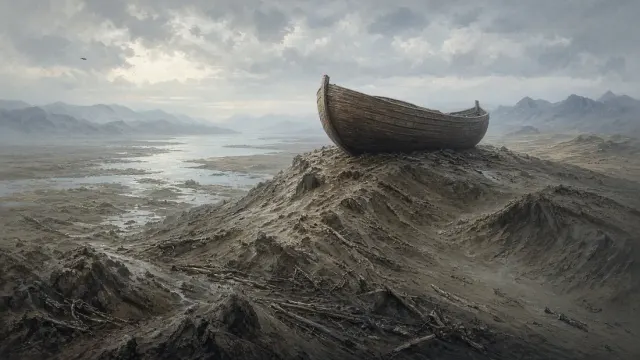
    The raven has acquired a rather worse reputation than these two verses give it. Genesis says that it went forth to and fro. It does not call the bird disobedient, accuse it of abandoning Noah, or describe what it ate. A flight report has often been made to carry a character reference it never supplied.

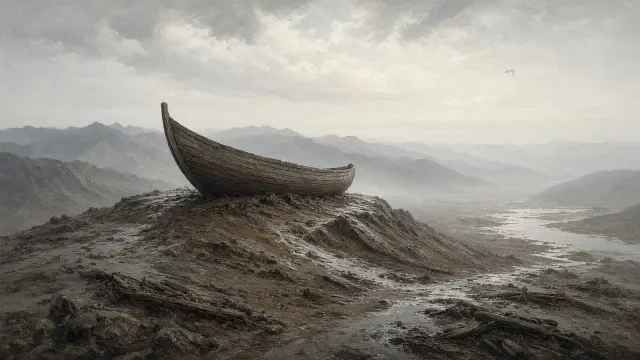
    The window matters just as much as the bird. Noah opens something he made, an ordinary feature of the extraordinary refuge. The chapter has already said that the ark rests on the mountains and that mountain tops have appeared. Yet exposed heights do not establish that the surrounding earth is habitable. The bird can reach beyond the opening; Noah cannot inspect the country from his compartment. The scene concerns the limits of what can yet be known.

    The forty days belong here, after the notice of visible mountain tops, not to the initial forty days of rain. Genesis has slowed the movement from catastrophe to recovery into dates, intervals, and observations. The raven's repeated movement belongs to that waiting. The earth does not become ready for its inhabitants simply because the weather has stopped being disastrous.

    Verse by verse

    1. 8:6

      The preceding verse reports visible mountain tops. The forty days here should not be confused with the forty days of rainfall in Genesis 7:12.

    2. 8:7

      Went forth to and fro describes repeated movement. The verse does not report a single, final departure.

    3. 8:7

      Genesis supplies no diet, motive, or moral verdict for the raven.
    Genesis 8:6-7

    King James Version · 2 verses

    8:6And it came to pass at the end of forty days, that Noah opened the window of the ark which he had made:

    8:7And he sent forth a raven, which went forth to and fro, until the waters were dried up from off the earth.

    Genesis 8:6-7: The raven
  2. 02

    Genesis 8:8-9

    No rest for her foot

    The dove returns because the world is still water. A hand comes out and takes her in, and the waiting resets.

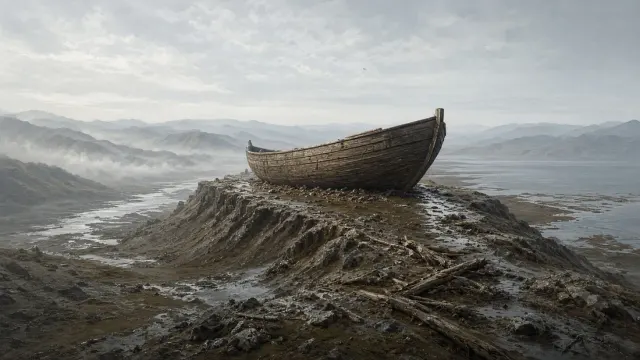
    The scale suddenly becomes the sole of a foot. After mountains, depths, and an earth under water, Genesis attends to a place small enough for a dove to stand. The great question of whether the world is habitable is tested at that size. The answer is not yet.

    Noah's response receives three actions: he puts out his hand, takes the bird, and brings it into the ark. The sentence could have stopped at she returned. Instead, it records the hand at the window. Care appears as something done, not as a speech about Noah's tenderness. The same man responsible for the enormous vessel now attends to one small creature that still needs it.

    The return is also information. The dove was sent to see whether the water had receded; its inability to find rest answers that question without a word. It has not failed by coming back. Its return establishes that the conditions outside are not yet suitable. The ark remains a necessary refuge, even after it has ceased to be a moving one. A grounded vessel can still be the only available home.

    Verse by verse

    1. 8:8

      The purpose of sending the dove is explicit: to see whether the waters had receded from the ground.

    2. 8:9

      The text describes the bird's inability to find a resting place, not its unwillingness to leave Noah.

    3. 8:9

      The hand, taking, and bringing inside are stated actions. The passage supplies no speech or interior monologue for Noah.

    Genesis 8:8-9

    King James Version · 2 verses

    8:8Also he sent forth a dove from him, to see if the waters were abated from off the face of the ground;

    8:9But the dove found no rest for the sole of her foot, and she returned unto him into the ark, for the waters were on the face of the whole earth: then he put forth his hand, and took her, and pulled her in unto him into the ark.

    Genesis 8:8-9: No rest for her foot
  3. 03

    Genesis 8:10-12

    The leaf, and then nothing

    One leaf says the trees survived. A week later her absence says the rest.

    A leaf is enough. Genesis does not give the dove a branch large enough to decorate a monument, and it does not specify a white bird. It gives one freshly plucked olive leaf, carried back in the evening. The important words follow: so Noah knew. This small object changes what can be established about the earth outside.

    The sequence is beautifully economical. On the first flight the bird returns without anything; on the second it returns with evidence; on the third it does not return. The missing bird then says more about the changing conditions than another leaf would have said. Yet Noah still waits seven days between the latter flights. The passage measures recovery by intervals, not by the urgency of the occupants.

    The leaf is evidence that the waters have abated, not a detailed botanical account of how vegetation survived or recovered. Genesis does not settle those questions here. Nor does it make the bird the author of the covenant that follows. It lets a living creature bring a small piece of the living world back to the ark. After so much water, the decisive evidence can be held in a beak.

    Verse by verse

    1. 8:10

      Other seven days marks another interval of waiting; the flights are not presented as three attempts on the same day.

    2. 8:11

      The Hebrew aleh means leaf. The text does not say olive branch or specify the color of the dove.

    3. 8:11

      Pluckt off represents the description of the leaf as freshly plucked, rather than a general statement about floating debris.

    4. 8:12

      The dove does not return after the final sending. The command for the human household to leave comes later, in Genesis 8:15-16.

    Genesis 8:10-12

    King James Version · 3 verses

    8:10And he stayed yet other seven days; and again he sent forth the dove out of the ark;

    8:11And the dove came in to him in the evening; and, lo, in her mouth was an olive leaf pluckt off: so Noah knew that the waters were abated from off the earth.

    8:12And he stayed yet other seven days; and sent forth the dove; which returned not again unto him any more.

    Genesis 8:10-12: The leaf, and then nothing

Why it matters

This is how Scripture prefers to give evidence, small and checkable rather than overwhelming. The dove earns its place as an image of peace not because it is gentle but because of what it brought back, and the pattern of sending, waiting and sending again is the closest thing Genesis has to a description of patience.

1 song

The music

Every song in the catalogue whose passage falls inside these chapters.

  1. Genesis 6-8

    Waters Over the Earth

Nearby

All the objects

Report an error on this page