

The big picture
Judges 6 introduces Gideon by showing how thoroughly Midian has reduced Israel. People hide in caves, crops disappear, livestock is stripped away, and Gideon threshes wheat where it can be concealed. When Israel cries out, the first answer is not a soldier but a prophet who recalls the exodus and names disobedience. Gideon’s call follows with questions, fear, a sign, and the promise “Surely I will be with thee.” His first assigned act is not against Midian but against Baal’s altar in his own household. He obeys at night because he is afraid, and the city wakes to a religious confrontation. Only then do enemy armies gather. The Spirit comes upon Gideon before the fleece signs, which confirm an already spoken promise rather than create a new command.
Central truth
Judges 6 shows the LORD confronting both Midian's oppression and Israel's Baal worship, while Gideon's fear, questions, altar-breaking, and fleece signs reveal a hesitant deliverer being repeatedly reassured.

The study notes have a page of their own
The movement by movement analysis, the words to trace, the verse by verse notes and where readers differ are written for someone studying alone. They are on the Deep Personal Reflections page for this chapter. This page is the lesson.
A chapter-specific teaching brief
These anchors come from this chapter itself. They help a teacher use the Level 1 overview, the Level 2 study, and the Scripture text as one lesson.
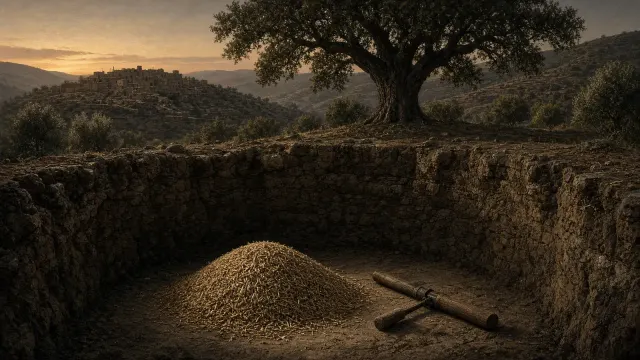
Open with the chapter’s first image
Judges 6:1: “And the children of Israel did evil in the sight of the LORD: and the LORD delivered them into the hand of Midian seven years.”
Slow down at the turning point
Judges 6:21: “Then the angel of the LORD put forth the end of the staff that was in his hand, and touched the flesh and the unleavened cakes; and there rose up fire out…”
Keep this word trail visible
LORD, Israel, Gideon, Midianites, altar, hand
What to explain, in order
Teach the passage in this order. Each step names the verses it rests on, so every point can be shown in the text before it is applied.
Judges 6:1-6
Seven years of locusts
Start with the scale of Midian's oppression. Israel hides in "dens which are in the mountains, and caves", and every harvest the raiders come "as grasshoppers for multitude", camels without number, leaving "no sustenance for Israel". Explain that these are nomadic raiders who strip the land each season. Teach this first so the class understands why Gideon is hiding his wheat: this is starvation, not inconvenience. End on 6:6, "the children of Israel cried unto the LORD".
Judges 6:7-10
A prophet before a deliverer
Point out the surprise: Israel cries, and the LORD sends an unnamed prophet. He recites the exodus, the deliverance from all oppressors, the land, and the command not to fear the Amorite gods, then says "but ye have not obeyed my voice." Explain that the LORD answers their cry first with the truth. Teach this step before Gideon so the class sees the order: the cause named, then the rescue given. It also makes clear that the real enemy in this chapter is Baal before it is Midian.
Judges 6:11-24
The call in the winepress
Read the call slowly. The angel sits under the oak at Ophrah; Gideon threshes in a winepress, a pit where no one would expect grain, to hide it. Then the greeting, the complaint, the commission and the excuse. Explain that "the angel of the LORD" here speaks as the LORD himself (6:14, 6:16); readers in different traditions explain this differently, so state what the text says. Read the sign of fire from the rock, Gideon's fear, and the LORD's answer "Peace be unto thee; fear not: thou shalt not die." Explain Jehovah-shalom: the LORD is peace.
Judges 6:25-32
Start at home
That same night comes the hardest command. Gideon must pull down his father's Baal altar and Asherah pole and sacrifice his father's bullock on a new altar to the LORD. He obeys, but by night, "because he feared his father's household". Do not shame his fear; he still obeyed. Then the town demands his death and Joash defends him with mockery of Baal. Explain the name Jerubbaal. Teach this step at the centre because the deliverer's first battle is against the idol in his own family.
Judges 6:33-35
The Spirit and the trumpet
Now Midian gathers in the valley of Jezreel. Read 6:34: "the Spirit of the LORD came upon Gideon, and he blew a trumpet". Explain that the Hebrew pictures the Spirit clothing Gideon like a garment. The man who hid in the winepress now summons his clan, his tribe and the northern tribes. Teach this before the fleece so the class sees that the Spirit's empowering comes before the request for signs, not because of it.
Judges 6:36-40
The fleece
Read the two tests as they are written. Gideon twice says "as thou hast said", which shows he knows what God promised. The first test is reasonable to him; the second reverses it, because dew on wool might be natural. He knows he is pressing his request: "Let not thine anger be hot against me". God answers both. Teach this last and teach it carefully: the text shows God's patience with a frightened servant, not a method to copy. Point ahead to chapter 7, where God offers another sign without being asked.
Where learners get stuck
The misreadings this passage tends to produce, and how to answer each from the text.
"We should put out a fleece to find God's will."
Gideon already had God's will in plain words (6:14, 6:16, 6:25), and he says so himself: "as thou hast said" (6:36-37). The fleece sought reassurance, not guidance, and Gideon feared he was trying God's patience (6:39). The passage describes God's kindness to a fearful man; it nowhere commands the method. Point learners to praying with Scripture and seeking counsel.
"Gideon was a mighty warrior from the start."
Gideon is hiding grain in a winepress (6:11), argues with the angel (6:13), calls himself the least in his house (6:15), and pulls down the altar at night out of fear (6:27). The greeting in 6:12 declares what the LORD's presence will make of him. The text emphasises "Surely I will be with thee" (6:16), not Gideon's hidden strengths.
"Gideon's complaint in 6:13 was sinful unbelief."
Gideon voices a real question: if the LORD is with us, why is this happening. The LORD does not rebuke him; he "looked upon him" and sent him (6:14). The prophet in 6:10 has already answered the question: Israel did not obey. Honest questions can be brought to God, and this text shows him answering with a commission rather than a scolding.
"The angel was just a messenger, not God himself."
In 6:14 and 6:16 the text says "the LORD" spoke to Gideon, and Gideon fears he will die because he has seen the angel of the LORD face to face (6:22-23). Jewish and Christian traditions explain the angel of the LORD differently. Report what the chapter says plainly and leave the wider identification open rather than resolving it in class.
Learning objectives
- Explain why Gideon is threshing wheat in a winepress.
- Identify the rebuke delivered before Gideon is commissioned.
- Trace Gideon's questions and the LORD's repeated assurances.
- Describe why tearing down Baal's altar precedes battle with Midian.
- Explain the origin of Gideon's name Jerubbaal in the passage.
- Distinguish the fleece signs from a general method for making decisions.
Teacher preparation
- Map Midianite movement into Israel and note why raiding at harvest creates famine conditions without permanent occupation.
- Read 6:7–10 carefully. The unnamed prophet explains Israel's distress before Gideon receives his commission.
- Prepare to explain winepress threshing as concealment, since normal threshing needed open air for winnowing.
- Mark the sequence altar, offering, Baal altar, Spirit, army, fleece so the signs are not detached from the commission already given.
- Do not teach the fleece as a Christian decision-making technique. Gideon already has a direct command and still asks for reassurance.
Evidence and interpretation checks
Explicit
Judges 6:11 says Gideon threshes by the winepress to hide from Midian, while 6:12 records the striking greeting, 'The LORD is with thee, thou mighty man of valour.'
Scripture-supported
Verses 8–10 explicitly connect oppression to Israel's refusal to obey the LORD's voice, and verses 25–32 make the destruction of Baal's altar Gideon's first commanded act.
Strong inference
Gideon's night action in 6:27 is explicitly linked to fear of his father's household and the men of the city. His obedience is real, but the passage refuses to paint it as fearless theater.
Possible or traditional reading
Some readers make the wet and dry fleece a standing model for seeking guidance. The passage presents it as reassurance requested after explicit revelation, not as a rule for ordinary choices.
Limit
The chapter does not tell whether Gideon's questions arise from unbelief, trauma, caution, or some mixture beyond the specific fear named in verse 27. Do not diagnose what the text leaves unstated.
Discussion with answer guidance
1. What answer does the prophet give before Gideon ever appears?
What a good answer contains
Israel cries out, and the first thing the LORD sends is a prophet, not a deliverer. The prophet recites the LORD's acts, "I brought you up from Egypt, and brought you forth out of the house of bondage" (6:8), the deliverance and the gift of the land (6:9), and then the command "fear not the gods of the Amorites" and the verdict "but ye have not obeyed my voice" (6:10). A good answer sees that the LORD names the cause of the trouble before he removes it. A weak answer skips the prophet and hurries to Gideon.
Show teacher guidance
Use 6:8–10. The LORD rescued Israel from Egypt and gave the land, but Israel did not obey his voice.
2. Why is the angel's greeting to Gideon so arresting in 6:12?
What a good answer contains
The angel says "The LORD is with thee, thou mighty man of valour" (6:12) to a man threshing wheat in a winepress "to hide it from the Midianites" (6:11). Gideon answers with complaint, "if the LORD be with us, why then is all this befallen us?" (6:13), and then insists "I am the least in my father's house" (6:15). A good answer lets the gap stand: the greeting describes what the LORD will make of him, not what he looks like yet. A weak answer decides Gideon was secretly brave all along.
Show teacher guidance
Set 'mighty man of valour' beside Gideon's hidden threshing in verse 11 and his protest in verses 13–15. Let the tension stand.
3. What promise answers Gideon's claim that his family and place are too small?
What a good answer contains
"Surely I will be with thee, and thou shalt smite the Midianites as one man" (6:16). The LORD does not argue with Gideon's estimate of his clan; he changes the subject from Gideon's size to his own presence. Verse 14 has already said "Go in this thy might" and "have not I sent thee?". A good answer centres on "I will be with thee". A weak answer makes the lesson that Gideon had hidden potential, which the text does not say.
Show teacher guidance
Use 6:16. The decisive assurance is 'Surely I will be with thee,' not a revised estimate of Gideon's social importance.
4. Why must Gideon tear down his father's Baal altar before assembling troops?
What a good answer contains
Because the problem began with worship. The prophet named "the gods of the Amorites" (6:10), and the LORD's first command is to "throw down the altar of Baal that thy father hath, and cut down the grove that is by it" (6:25) and build "an altar unto the LORD thy God" in its place (6:26). A good answer sees that the deliverer must deal with idolatry at home, in his own father's house, before he faces Midian. A weak answer treats the altar as a test of courage only.
Show teacher guidance
Use 6:25–26. The conflict begins with worship inside Israel before it moves to Midian outside Israel.
5. How does Joash answer the men who want Gideon killed?
What a good answer contains
The men demand Gideon's death, and Joash answers "Will ye plead for Baal? will ye save him?" and "if he be a god, let him plead for himself, because one hath cast down his altar" (6:31). That day Gideon is called Jerubbaal, "Let Baal plead against him" (6:32). A good answer sees the irony: a god who needs defending is no god, and the father who owned the altar now mocks it. A weak answer misses that Joash was the altar's owner in 6:25.
Show teacher guidance
Use 6:31. He challenges Baal to plead for himself, which leads to the name Jerubbaal in verse 32.
6. What is unusual about using the fleece as a model for guidance?
What a good answer contains
By the time of the fleece the LORD has already spoken plainly: "have not I sent thee?" (6:14), "Surely I will be with thee" (6:16), and the command of 6:25. Gideon himself says "as thou hast said" twice (6:36-37). The fleece asks for confirmation of a word already given, and Gideon fears the LORD's anger for asking a second time (6:39). A good answer notes that God graciously answers but that the text never commands this method. A weak answer turns the fleece into a technique for decisions.
Show teacher guidance
Point out that 6:14, 6:16, and 6:25 already contain direct commands and promises. The fleece confirms what has already been spoken.
Responsible application
Heart and habits
Ask what the chapter treats as the first battlefield: Midian's camp or Israel's altar. Use the order of verses 25–32 and 33–35.
Relationships and community
Discuss how Joash's response changes the public conflict around Gideon. Focus on his argument that Baal should defend himself if Baal is truly a god.
The fleece in its place
Build a timeline of everything Gideon already knows before verses 36–40. The fleece looks very different once the earlier commands and promises stay on the board.
Session plans
Two timings of the same lesson. The shorter keeps the reading, the central discussion and one response; the longer gives the confusions and the application their own time.
45 minutes
Raiders like locusts
Read 6:1-10. Take question one and write the prophet's three points: what I did, what I said, what you did.
The call
Read 6:11-24. Take questions two and three, then confusion two on whether Gideon was brave from the start.
The altar at home
Read 6:25-32. Take questions four and five. Ask what it cost Gideon to do this in his father's house.
The fleece
Read 6:33-40. Take question six and confusion one. Keep the focus on what God had already said.
Close
Read the key verse together, hand out the sheet, and pray using 6:16.
90 minutes
Opening
Ask the group to describe a time they felt too small for a task. Keep the answers brief.
Under Midian
Read 6:1-10. Take question one. Ask why the LORD sends a prophet before a deliverer.
The winepress
Read 6:11-16. Take questions two and three. Work through confusions two and three.
Fire from the rock
Read 6:17-24. Discuss confusion four and explain Jehovah-shalom.
Throw down the altar
Read 6:25-32. Take questions four and five. Ask what idols might sit in our own households, without requiring anyone to answer aloud.
The Spirit clothes him
Read 6:33-35. Ask what changed in Gideon and who changed it.
The fleece
Read 6:36-40 and take question six and confusion one. Read ahead to 7:9-11.
Response and handout
Choose one application. Read the key verse together, point to the take-home line and pray.
Adapting the lesson
Children
Bring a small bag of wheat and a bowl to show Gideon hiding his grain. Act out the angel saying the LORD is with you. Use blocks to build an altar to Baal and knock it down, then build one to God. For the fleece, use a piece of wool and a cup of water. Tell the children God was kind to Gideon when he was afraid, and that God has already told us he is with us.
Youth
Start with the winepress and ask why someone would hide grain there. Let them talk about times they felt the least in their family or school. Spend time on 6:25-27: Gideon obeyed even though afraid, and by night. Ask what it would cost them to stand against something everyone around them accepts. Debunk the fleece as a decision method.
Adults
Adults can give time to the prophet's role in 6:7-10, the identity of the angel, and the fleece as reassurance rather than guidance. Discuss the cost of confronting idolatry in one's own family, with care for those whose families are divided by faith. Keep chapter 8 in view without reading it back into every verse here.
One to one
Read 6:11-16 together and ask which line the person most needs: the greeting, the question, the commission, or "Surely I will be with thee". Stay with that line. If they are anxious about a decision and want a sign, gently show what God had already said to Gideon and look together for what he has already said to them.
Song and video learning lab
A song or video may interpret, compress, or dramatize the text. Its value becomes clearer when its choices are compared with Scripture.
- Before the media: the exact passage and its central movement.
- During the media: the words, people, events, and emotions the artist emphasizes.
- After the media: what it clarifies, what it leaves out, and what belongs back in the biblical text.
Handout
One page for learners to take home. The print button prints this section alone.
Judges 6:1–40
The passage in brief
Midian raids Israel every harvest, and the people hide in caves. When Israel cries out, the LORD first sends a prophet to remind them that they have not obeyed him. Then the angel of the LORD finds Gideon hiding wheat in a winepress and calls him to save Israel. Gideon protests that he is the least, but the LORD promises to be with him. Gideon tears down his father's altar to Baal by night. The Spirit comes on him, and he asks God for signs with a fleece.
A verse to keep
And the LORD said unto him, Surely I will be with thee, and thou shalt smite the Midianites as one man.
Judges 6:16 · King James Version
Questions to take home
What did the prophet remind Israel of in 6:8-10?
What did the LORD promise Gideon in 6:16 when Gideon said he was the least?
Why did Gideon pull down the altar by night, according to 6:27?
This week
Write 6:16 on a card and read it each morning this week before you start the hardest task of your day.
Music and video connected to the passage
Related media appears when its Scripture reference overlaps this study. Music and video can illuminate a theme while the biblical text remains the foundation.
 Mighty Man in the WinepressJudges 6:1-40Listen to related music →
 Three Hundred LampsJudges 6-8Listen to related music →
 God Only Needed Three HundredJudges 6-8Listen to related music →
 Judges, In Their Own EyesJudges 1:1-21:25Listen to related music →God Only Needed Three HundredJudges 6–8Watch a related video →