New · FreePlay The Witnesses The in-depth puzzle battle quest through Bible history

Objects of the Bible

The flaming sword

A guard set at a gate, turning every way, keeping a road rather than closing it.

At the east of the garden two things are placed: cherubim, and a sword of flame that turns every way. The verb the account uses is not to block but to keep, the same word used earlier for what the man was supposed to do with the garden itself. It is the first weapon in the Bible, and it is defensive. Nothing is said about it ever being used, and nothing is said about it being taken away.

Where it appearsGenesis 3

Scroll down to the account
The flaming sword

The movements, in the order the text gives them.

The Account of The flaming sword

  1. 01

    Genesis 3:23

    Sent out

    The exile is stated first in plain terms. The man goes back to the ground he was taken from.

    The destination is the material of his own making. The man is sent to till the ground from whence he was taken, and the closing words reach back to the dust of Genesis 2:7. His departure is not simply movement from one address to another. He must now work the earth that will eventually receive him again.

    Work itself is not the new punishment. The garden already needed tending in 2:15. What changes in chapter 3 is the ground's resistance, the sweat, and the certainty of returning to dust. That distinction keeps the verse from turning agriculture into a curse in itself. The man was made for activity before he was sentenced to toil.

    The opening therefore carries the reason from the preceding verse: access to the tree of life must be prevented. The sword has not appeared yet, but its purpose is already established. It will enforce a separation that God has ordered, not pursue a fugitive on a private errand. The man leaves the garden alive and clothed, as 3:21 has just specified. Care has not canceled judgment. Judgment has not erased every provision.

    Verse by verse

    1. 3:23

      From whence he was taken recalls Genesis 2:7 and the return to the ground announced in 3:19.

    2. 3:23

      Therefore connects the removal to the danger named in 3:22, eating from the tree of life and living forever.
    Genesis 3:23

    King James Version · 1 verse

    3:23Therefore the LORD God sent him forth from the garden of Eden, to till the ground from whence he was taken.

    Genesis 3:23: Sent out
  2. 02

    Genesis 3:24

    Placed at the east

    The guard faces the way people left by. It is the direction of departure that is watched.

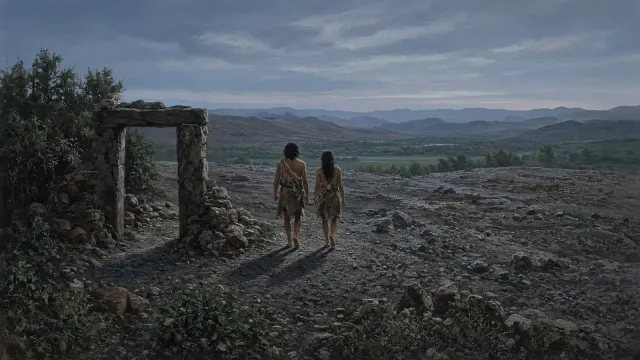
    A human is displaced; the guardians are placed. The two actions stand side by side, making the east of the garden the visible boundary between former residence and present exclusion. The Book of Genesis does not describe a stone gateway, a wall, or the number of cherubim. The location and the assignment are what matter.

    East will recur when Cain leaves the LORD's presence and settles east of Eden in Genesis 4:16. That echo gives direction a significance within these departures, but it does not turn a compass point into a universal symbol of evil. The garden itself had been planted eastward in 2:8. The pattern concerns movement and separation, not a defective part of the horizon.

    The cherubim also resist the harmless appearance often given them in decoration. Here their first recorded task is to secure an approach that humanity cannot use. Later, golden cherubim stand over the mercy seat, where God promises to meet with Moses in Exodus 25:18-22. They belong to the language of divine presence and its guarded boundaries. Genesis gives them a post, not a portrait.

    Verse by verse

    1. 3:24

      Cherubim is already plural in Hebrew. Genesis specifies neither their number nor their physical features here.

    2. 3:24

      At the east identifies the guarded approach. A constructed gate is not mentioned in the verse.

    3. 3:24

      The verb drove out is stronger than a casual departure; the removal is imposed, not presented as the man choosing to relocate.

    Genesis 3:24

    King James Version · 1 verse

    3:24So he drove out the man; and he placed at the east of the garden of Eden Cherubims, and a flaming sword which turned every way, to keep the way of the tree of life.

    Genesis 3:24: Placed at the east
  3. 03

    Genesis 3:24

    Turning every way

    A blade that turns in all directions cannot be walked around. The account gives it no wielder and no end.

    The sword moves; the boundary does not. Turned every way describes an active guard, not a blade planted in the soil for decoration. The Hebrew form presents continual turning, and the verse never identifies a hand holding it. Adding an armed angel with a particular posture supplies a picture that Genesis itself has not drawn.

    Its task is equally exact: to keep the way of the tree of life. No wound is described, no duel occurs, and no human challenger is named. The weapon's presence is sufficient to establish that the road is not available. Guarding the way does not mean welcoming travelers along it. In this setting, the guarded road is the blocked approach.

    There is also no report that the sword burns the tree. The object under protection remains life, while the excluded people face mortality. Later Scripture speaks openly of renewed access: Hebrews 10:19-20 names a new and living way into the holy place, and Revelation 22:14 names the right to the tree. Neither passage supplies the sword's biography. Both make the contrast intelligible. Access must be opened, not seized.

    Verse by verse

    1. 3:24

      The Hebrew phrase describes the flame of the sword turning itself; the King James expresses the motion as turned every way.

    2. 3:24

      Keep translates shamar, also used for the man keeping the garden in Genesis 2:15.

    3. 3:24

      The passage gives neither a date for the guard's removal nor instructions for overcoming it.

    Genesis 3:24

    King James Version · 1 verse

    3:24So he drove out the man; and he placed at the east of the garden of Eden Cherubims, and a flaming sword which turned every way, to keep the way of the tree of life.

    Genesis 3:24: Turning every way

Why it matters

This is the image that makes exile bearable in Genesis. The way to the tree of life is kept, not destroyed, which means the gate is a held position rather than a verdict. Every later curtain, veil and guarded threshold in Scripture is standing in the same place, and the tearing of one of them at the end of the gospels is written as an answer to it.

2 songs

The music

Every song in the catalogue whose passage falls inside these chapters.

  1. Genesis 3:1-5:32

    Blood in the Ground

  2. Genesis 3

    East of Eden

Nearby

All the objects

Report an error on this page