New · FreePlay The Witnesses The in-depth puzzle battle quest through Bible history

People of the Bible

Achan

Took a cloak, some silver and a wedge of gold, and thirty-six men died at a town nobody was worried about.

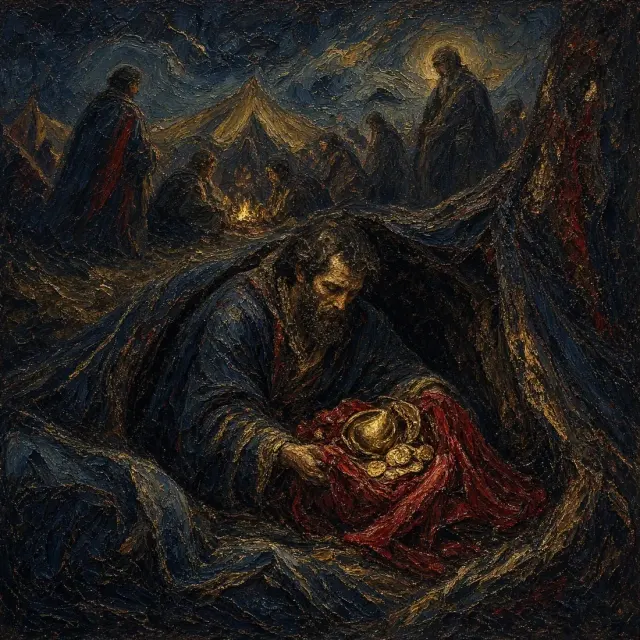
Jericho falls and everything in it is devoted, which means nothing is to be taken. Achan takes a Babylonian cloak, two hundred shekels of silver and a bar of gold, and buries them under his tent. Nobody knows. The next target is Ai, a place small enough that the scouts recommend sending only two or three thousand men, and Israel is routed and thirty-six men are killed. Joshua tears his clothes and lies on his face until evening, and is told to get up, because Israel has sinned.

Where he appearsJoshua 7

Scroll down to the account
Achan

The movements, in the order the text gives them.

The Account of Achan

  1. 01

    Joshua 7:1-5

    The small town that was not small

    The scouts say do not trouble the whole army, they are few. Thirty-six men are killed and the survivors run, and the heart of the people turns to water.

    The Book of Joshua identifies the culprit before the soldiers leave camp. This is not a mystery about who took the goods. The first sentence names Achan, sets him inside Judah's family line, and then names the consequence for the children of Israel. One man's taking is framed inside a people's breach.

    The reconnaissance report measures the visible problem: Ai is small, so a small force should do. It does not measure what the opening verse has already disclosed. About three thousand go up; about thirty-six are killed; the survivors run downhill. The terrible reversal is not only military. Rahab described Canaanite hearts melting in 2:11. Now Israel's hearts melt and become water. The confidence brought back from Jericho has changed sides, and the buried goods are still in an Israelite tent.

    Verse by verse

    1. 7:1

      Accursed thing refers to what has been placed under the ban, not an object carrying a magical curse.

    2. 7:1

      The genealogy places Achan within Judah rather than among the outsiders. His own action has consequences for the wider community.

    3. 7:3

      The scouts judge the town by its small population; the chapter's stated explanation of defeat is the covenant breach.

    4. 7:5

      The KJV says about thirty and six, retaining the approximation rather than giving an exact casualty count.

    Joshua 7:1-5

    King James Version · 5 verses

    7:1But the children of Israel committed a trespass in the accursed thing: for Achan, the son of Carmi, the son of Zabdi, the son of Zerah, of the tribe of Judah, took of the accursed thing: and the anger of the LORD was kindled against the children of Israel.

    7:2And Joshua sent men from Jericho to Ai, which is beside Beth-aven, on the east side of Beth-el, and spake unto them, saying, Go up and view the country. And the men went up and viewed Ai.

    7:3And they returned to Joshua, and said unto him, Let not all the people go up; but let about two or three thousand men go up and smite Ai; and make not all the people to labour thither; for they are but few.

    7:4So there went up thither of the people about three thousand men: and they fled before the men of Ai.

    7:5And the men of Ai smote of them about thirty and six men: for they chased them from before the gate even unto Shebarim, and smote them in the going down: wherefore the hearts of the people melted, and became as water.

    Joshua 7:1-5: The small town that was not small
  2. 02

    Joshua 7:6-15

    Get up, why are you lying on your face

    Joshua asks why they were ever brought over the Jordan. The answer is that something devoted is in the camp, and that they cannot stand until it is out.

    Joshua is on his face asking what has gone wrong with the crossing of the Jordan. The answer relocates the problem. Not the crossing, not the size of Ai, not a failed promise: Israel hath sinned. The speech piles up the verbs, taken, stolen, dissembled, put among their own stuff. What Achan treated as an acquisition is described as a breach of covenant.

    Get thee up is therefore more than an impatient dismissal of prayer. Joshua must act on information he did not have. The repeated inability to stand before enemies is joined to the order to rise and remove what is within the camp. The investigation moves inward, from people to tribe to family to household to man. The LORD's withdrawal is conditional in the speech, not an announcement that Israel has been abandoned without remedy. But it is not solved by another military estimate.

    Verse by verse

    1. 7:11

      Dissembled means concealed the truth or acted deceitfully. The charge includes concealment as well as taking.

    2. 7:12

      Jericho's ban has reached Israel through the taking of its prohibited goods, just as Joshua warned in 6:18.

    3. 7:14

      The passage describes selection through successive family groups but does not specify the physical mechanism used.

    4. 7:15

      Folly here is grave covenantal wrongdoing, not a harmless mistake or a lapse of intelligence.

    Joshua 7:6-15: Get up, why are you lying on your face

    Joshua 7:6-15

    King James Version · 10 verses

    7:6And Joshua rent his clothes, and fell to the earth upon his face before the ark of the LORD until the eventide, he and the elders of Israel, and put dust upon their heads.

    7:7And Joshua said, Alas, O Lord GOD, wherefore hast thou at all brought this people over Jordan, to deliver us into the hand of the Amorites, to destroy us? would to God we had been content, and dwelt on the other side Jordan!

    7:8O Lord, what shall I say, when Israel turneth their backs before their enemies!

    7:9For the Canaanites and all the inhabitants of the land shall hear of it, and shall environ us round, and cut off our name from the earth: and what wilt thou do unto thy great name?

    7:10And the LORD said unto Joshua, Get thee up; wherefore liest thou thus upon thy face?

    7:11Israel hath sinned, and they have also transgressed my covenant which I commanded them: for they have even taken of the accursed thing, and have also stolen, and dissembled also, and they have put it even among their own stuff.

    7:12Therefore the children of Israel could not stand before their enemies, but turned their backs before their enemies, because they were accursed: neither will I be with you any more, except ye destroy the accursed from among you.

    7:13Up, sanctify the people, and say, Sanctify yourselves against to morrow: for thus saith the LORD God of Israel, There is an accursed thing in the midst of thee, O Israel: thou canst not stand before thine enemies, until ye take away the accursed thing from among you.

    7:14In the morning therefore ye shall be brought according to your tribes: and it shall be, that the tribe which the LORD taketh shall come according to the families thereof; and the family which the LORD shall take shall come by households; and the household which the LORD shall take shall come man by man.

    7:15And it shall be, that he that is taken with the accursed thing shall be burnt with fire, he and all that he hath: because he hath transgressed the covenant of the LORD, and because he hath wrought folly in Israel.


  3. 03

    Joshua 7:16-21

    Tribe by tribe, family by family

    The lot narrows from Judah down to one man. Asked to give glory to God and confess, he does, and names the cloak, the silver and the gold, and where they are buried.

    The narrowing public search ends in an intensely particular confession. A garment, two hundred shekels of silver, fifty shekels' weight of gold. Then the sequence: I saw, I coveted, I took. Achan supplies the desire himself; there is no need to invent hunger, family pressure, or a private theory that the rules should not apply to him. He wanted the objects he saw.

    Hide it not from me is answered by the location of the hiding place. Even the position of the silver is specified. In the next two verses the messengers run, recover the objects, and lay them before the LORD, turning concealed property into public evidence. My son does not reduce the seriousness of Joshua's demand. It makes the address personal while requiring truth. Achan has stopped hiding his act in words; the things themselves must also come out of the ground.

    Verse by verse

    1. 7:19

      Give glory to God accompanies a demand for truthful acknowledgment. John 9:24 uses related language in an interrogation, though the circumstances and accusation are different.

    2. 7:21

      Babylonish renders of Shinar. The Hebrew identifies the garment's region, without describing its color or exact pattern.

    3. 7:21

      The sequence of seeing, desiring, and taking recalls Genesis 3:6. The parallel concerns the movement toward taking what was forbidden.

    4. 7:21

      The confession is specific, but the text does not disclose Achan's eternal destiny or define the full character of his repentance.

    Joshua 7:16-21

    King James Version · 6 verses

    7:16So Joshua rose up early in the morning, and brought Israel by their tribes; and the tribe of Judah was taken:

    7:17And he brought the family of Judah; and he took the family of the Zarhites: and he brought the family of the Zarhites man by man; and Zabdi was taken:

    7:18And he brought his household man by man; and Achan, the son of Carmi, the son of Zabdi, the son of Zerah, of the tribe of Judah, was taken.

    7:19And Joshua said unto Achan, My son, give, I pray thee, glory to the LORD God of Israel, and make confession unto him; and tell me now what thou hast done; hide it not from me.

    7:20And Achan answered Joshua, and said, Indeed I have sinned against the LORD God of Israel, and thus and thus have I done:

    7:21When I saw among the spoils a goodly Babylonish garment, and two hundred shekels of silver, and a wedge of gold of fifty shekels weight, then I coveted them, and took them; and, behold, they are hid in the earth in the midst of my tent, and the silver under it.

    Joshua 7:16-21: Tribe by tribe, family by family
  4. 04

    Joshua 7:24-26

    The valley of Achor

    Everything he has goes with him to the valley. The place is named trouble, and a heap of stones is raised. Hosea later calls that same valley a door of hope.

    The inventory has changed. First came the things Achan took; now come his sons, daughters, animals, tent, and everything he has. The movement from him to them in the execution is present in the Hebrew as well as the KJV. The passage does not supply the children's ages, nor does it say they helped hide the goods. Those missing explanations should not be manufactured to make the scene easier.

    Trouble becomes a place-name. Joshua's words turn Achan's action back upon him, and the heap of stones makes the consequence visible where the stolen property had once been hidden. The LORD's anger turns away, but the chapter does not conclude with applause. It leaves a valley and a heap. Joshua 22:20 later recalls the central fact in the dispute over another altar: that man perished not alone in his iniquity.

    Verse by verse

    1. 7:24

      Sons and daughters are explicitly included in those brought to the valley. Their participation in the theft is not stated.

    2. 7:25

      The pronouns shift from him to them. Deuteronomy 24:16 forbids executing children for their fathers' sins; Joshua does not explain the relationship between that law and every person included here.

    3. 7:25

      The Hebrew root akar, trouble, links Joshua's words with Achor. First Chronicles 2:7 calls the man Achar, the troubler of Israel.

    4. 7:26

      Unto this day locates the stone heap within the remembered landscape of the account, without supplying a date for its composition.

    Joshua 7:24-26

    King James Version · 3 verses

    7:24And Joshua, and all Israel with him, took Achan the son of Zerah, and the silver, and the garment, and the wedge of gold, and his sons, and his daughters, and his oxen, and his asses, and his sheep, and his tent, and all that he had: and they brought them unto the valley of Achor.

    7:25And Joshua said, Why hast thou troubled us? the LORD shall trouble thee this day. And all Israel stoned him with stones, and burned them with fire, after they had stoned them with stones.

    7:26And they raised over him a great heap of stones unto this day. So the LORD turned from the fierceness of his anger. Wherefore the name of that place was called, The valley of Achor, unto this day.

    Joshua 7:24-26: The valley of Achor

Why it matters

Achan is the counterweight to Rahab, placed five chapters after her. She is an outsider who is brought inside and lives; he is an insider who hides plunder and does not. The account is uncomfortable and the account does not soften it, including the whole household going to the valley with him. What it is arguing is that the nation is one body, and that a thing hidden under one tent is not a private matter.

1 song

The music

Every song in the catalogue whose passage falls inside these chapters.

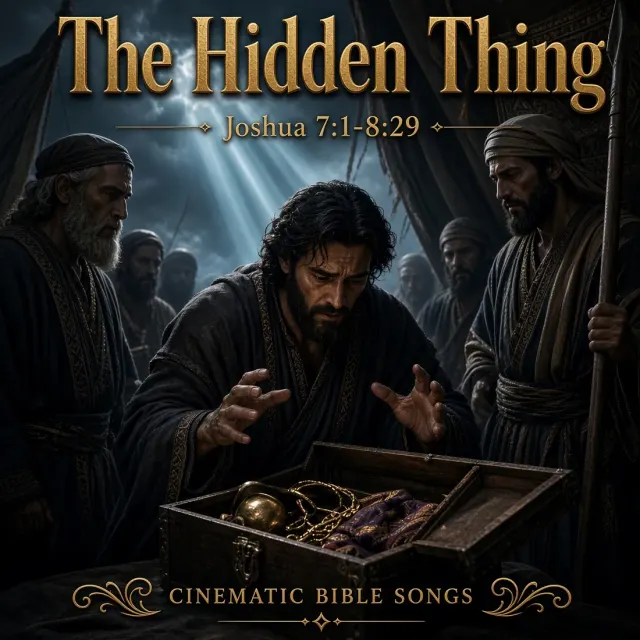
  1. Joshua 7:1-8:29

    The Hidden Thing

Nearby

All the people

Report an error on this page