New · FreePlay The Witnesses The in-depth puzzle battle quest through Bible history

People of the Bible

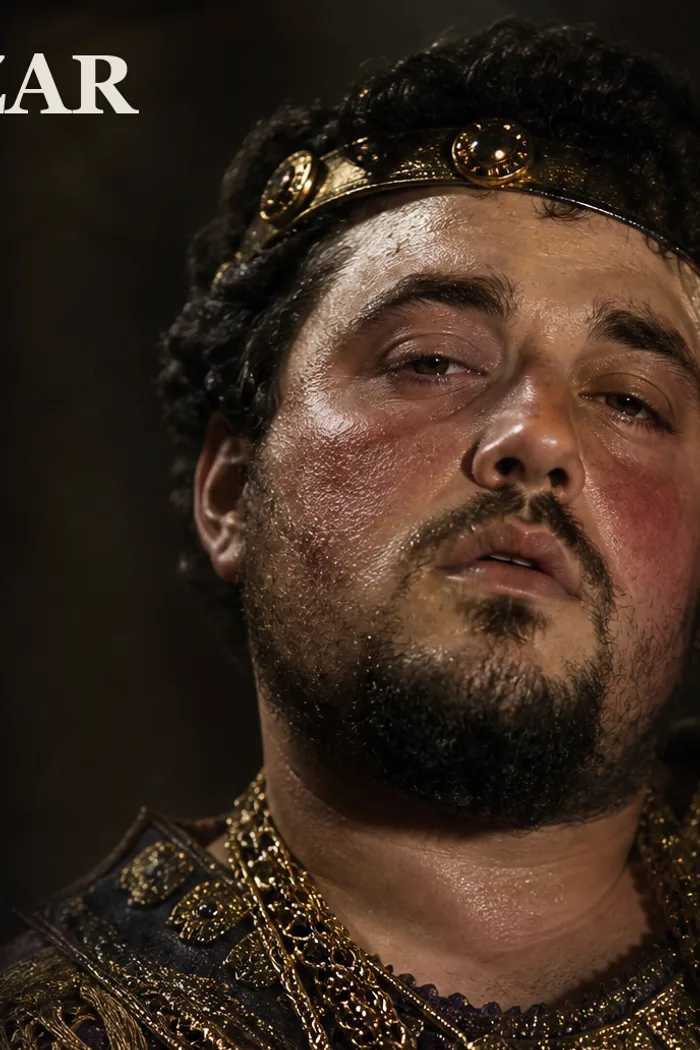
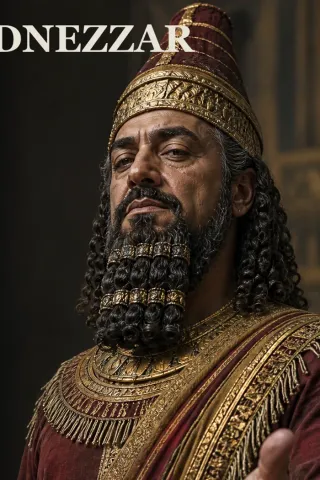
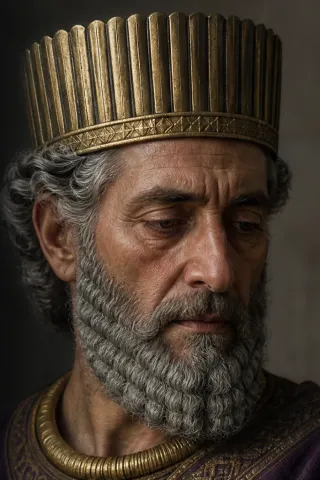
Belshazzar

Threw a feast with the vessels taken out of the temple, and was dead before morning.

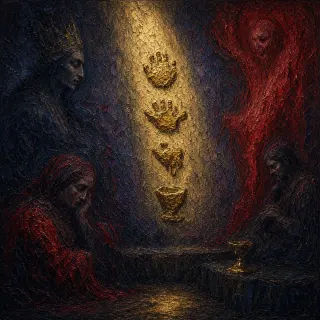
Belshazzar holds a feast for a thousand of his lords while the Medes and Persians are outside the walls. He sends for the gold and silver vessels his father had taken from the house in Jerusalem, and the whole company drinks from them and praises the gods of gold and silver, brass, iron, wood and stone. In the same hour fingers appear and write on the plaster of the wall opposite the lampstand, and his knees knock together. The wise men cannot read it, and the queen remembers a man.

Where he appearsDaniel 5

Scroll down to the account
Belshazzar

The movements, in the order the text gives them.

The Account of Belshazzar

  1. 01

    Daniel 5:1-4

    The vessels out of the temple

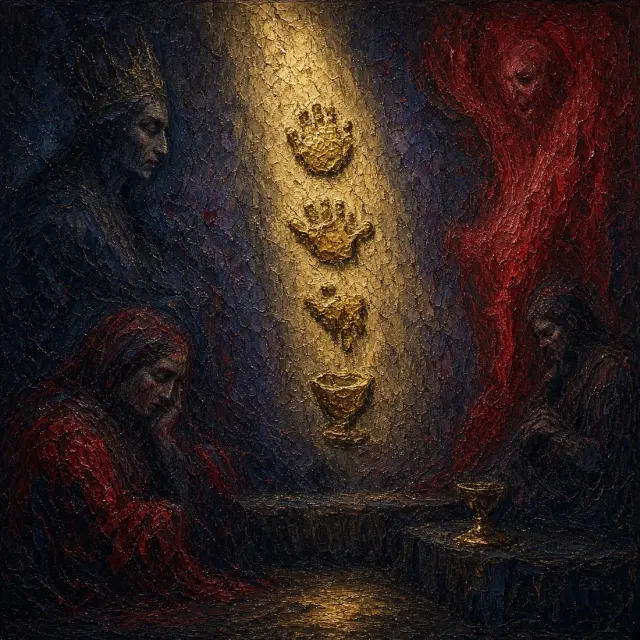
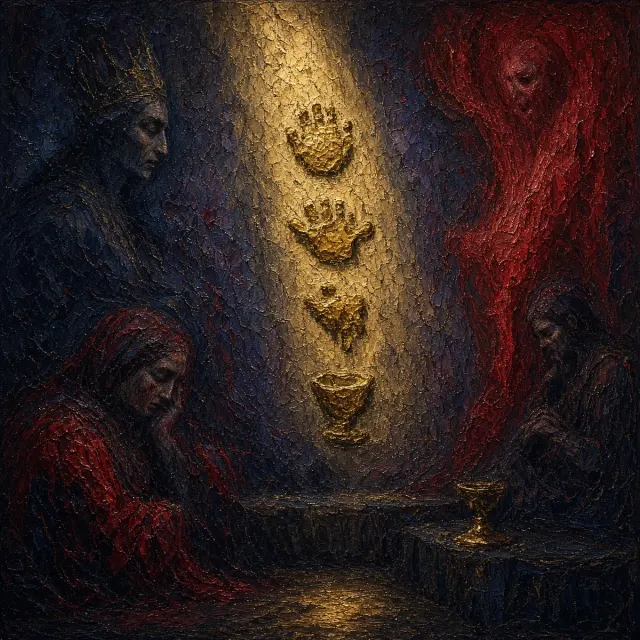
    A thousand lords, the wives and the concubines, and the gold vessels brought out deliberately. They drink and praise gods of gold, silver, brass, iron, wood and stone.

    The vessels are not ordinary palace silver. Their origin is repeated in consecutive verses: the temple at Jerusalem, the house of God at Jerusalem. The Book of Daniel keeps identifying their owner while Belshazzar behaves as though capture has transferred every right of use. What Babylon can carry away, he treats as Babylon's to redefine.

    This is a public act, not a private lapse over a cup of wine. The thousand lords, the royal household, and the repeated drinking place the desecration inside a court celebration. The account does not require an invented speech mocking Jerusalem. The chosen objects and the praise offered over them already say enough. Vessels belonging to the worship of God are made to serve the praise of manufactured gods.

    The list of materials has its own cold precision: gold, silver, brass, iron, wood, stone. Some are more expensive than others; none is alive. The feast displays wealth splendidly and distinguishes nothing beyond it. Belshazzar can recognize the value of a sacred vessel while refusing the claim its sacredness makes. The precious metal has survived its journey. Its proper use has been overturned.

    Verse by verse

    1. 5:1

      Before the thousand makes the king's drinking a public display within the feast. It does not identify the festival or occasion.

    2. 5:2

      Daniel calls Nebuchadnezzar his father. A dynastic or ancestral sense is a common interpretation; the precise family relationship is not established here.

    3. 5:4

      The six materials describe the gods being praised. The passage does not say that every vessel used at the feast came from Jerusalem.

    Daniel 5:1-4

    King James Version · 4 verses

    5:1Belshazzar the king made a great feast to a thousand of his lords, and drank wine before the thousand.

    5:2Belshazzar, whiles he tasted the wine, commanded to bring the golden and silver vessels which his father Nebuchadnezzar had taken out of the temple which was in Jerusalem; that the king, and his princes, his wives, and his concubines, might drink therein.

    5:3Then they brought the golden vessels that were taken out of the temple of the house of God which was at Jerusalem; and the king, and his princes, his wives, and his concubines, drank in them.

    5:4They drank wine, and praised the gods of gold, and of silver, of brass, of iron, of wood, and of stone.

    Daniel 5:1-4: The vessels out of the temple
  2. 02

    Daniel 5:5-9

    Fingers on the plaster

    A hand writes opposite the candlestick on the wall of the king’s palace, and he sees the part of the hand that wrote. His countenance changes, his thoughts trouble him, and his knees smite one against another.

    A thousand guests are not enough to make the king feel secure once a hand begins to write. The change is registered in his face, his thoughts, his hips, his knees. The Book of Daniel does not need to announce that the feast has lost its confidence. The host's body announces it.

    The writing stands opposite the candlestick, on the plaster of his own palace wall. The revelation is not hidden in some distant sanctuary. It occupies the room he controls, where his assembled experts cannot make it intelligible. Belshazzar offers what royal power normally has available: a distinguished robe, a gold chain, and high office. The offer is substantial. It is also helpless against a message that refuses to become manageable through payment.

    His wise men cannot read the inscription or explain it, and the repeated change of countenance closes the scene where it began. More rank and more experts have not supplied more understanding. The lords who formed the audience for the king's display now share his astonishment. The same public setting that magnified his grandeur makes his inability impossible to conceal.

    Verse by verse

    1. 5:5

      The text mentions fingers and the visible part of a hand, not a complete figure. It does not identify this candlestick as the temple lampstand.

    2. 5:7

      Third ruler is the stated reward. The verse does not itself explain the administrative arrangement behind that rank.

    3. 5:8-9

      The reason the specialists cannot read the writing is not supplied. Explanations involving unusual letter arrangements remain proposals, not details given in the passage.

    Daniel 5:5-9

    King James Version · 5 verses

    5:5In the same hour came forth fingers of a man’s hand, and wrote over against the candlestick upon the plaister of the wall of the king’s palace: and the king saw the part of the hand that wrote.

    5:6Then the king’s countenance was changed, and his thoughts troubled him, so that the joints of his loins were loosed, and his knees smote one against another.

    5:7The king cried aloud to bring in the astrologers, the Chaldeans, and the soothsayers. And the king spake, and said to the wise men of Babylon, Whosoever shall read this writing, and shew me the interpretation thereof, shall be clothed with scarlet, and have a chain of gold about his neck, and shall be the third ruler in the kingdom.

    5:8Then came in all the king’s wise men: but they could not read the writing, nor make known to the king the interpretation thereof.

    5:9Then was king Belshazzar greatly troubled, and his countenance was changed in him, and his lords were astonied.

    Daniel 5:5-9: Fingers on the plaster
  3. 03

    Daniel 5:13-23

    You knew all this

    Daniel refuses the gifts and then recounts the humbling of Nebuchadnezzar at length before laying the charge: you have lifted yourself up against the Lord of heaven, and the God in whose hand your breath is you have not glorified.

    Belshazzar introduces Daniel as a captive. Daniel answers as a witness against the king. The opening refusal of the gifts makes the terms plain: the interpretation will be given, but it will not be purchased. A robe and a chain cannot turn judgment into a favorable report.

    Before reading the wall, Daniel reads the reign of Nebuchadnezzar. The earlier king possessed terrible freedom over life, death, promotion, and disgrace, yet that freedom was given, not inherent. His removal demonstrated the difference. Belshazzar's offense is then stated with devastating precision: though thou knewest all this. The problem is not that no warning reached him. The history of the throne itself had already supplied one.

    The charge ends by reducing the distance between blasphemy and dependence to a single breath. The gods praised at the feast cannot see, hear, or know; the God left unhonored holds the king's breath. Belshazzar has treated sacred vessels as objects subject to his command while treating himself as independent of their owner. Daniel reverses that arrangement. Even the breath required to issue the command was never the king's unrestricted possession. The writing is extraordinary. His accountability is not new.

    Verse by verse

    1. 5:13

      Jewry is the KJV's term here for Judah, the land from which Daniel was taken. The reference identifies his exile, not a recent arrival at court.

    2. 5:17

      Daniel refuses payment as a condition of speaking. Verse 29 later records Belshazzar ordering the rewards bestowed anyway.

    3. 5:22-23

      Knowledge of Nebuchadnezzar's humiliation is explicitly attributed to Belshazzar. The condemnation rests on the stated facts, not a reconstructed private psychology.

    Daniel 5:13-23: You knew all this

    Daniel 5:13-23

    King James Version · 11 verses

    5:13Then was Daniel brought in before the king. And the king spake and said unto Daniel, Art thou that Daniel, which art of the children of the captivity of Judah, whom the king my father brought out of Jewry?

    5:14I have even heard of thee, that the spirit of the gods is in thee, and that light and understanding and excellent wisdom is found in thee.

    5:15And now the wise men, the astrologers, have been brought in before me, that they should read this writing, and make known unto me the interpretation thereof: but they could not shew the interpretation of the thing:

    5:16And I have heard of thee, that thou canst make interpretations, and dissolve doubts: now if thou canst read the writing, and make known to me the interpretation thereof, thou shalt be clothed with scarlet, and have a chain of gold about thy neck, and shalt be the third ruler in the kingdom.

    5:17Then Daniel answered and said before the king, Let thy gifts be to thyself, and give thy rewards to another; yet I will read the writing unto the king, and make known to him the interpretation.

    5:18O thou king, the most high God gave Nebuchadnezzar thy father a kingdom, and majesty, and glory, and honour:

    5:19And for the majesty that he gave him, all people, nations, and languages, trembled and feared before him: whom he would he slew; and whom he would he kept alive; and whom he would he set up; and whom he would he put down.

    5:20But when his heart was lifted up, and his mind hardened in pride, he was deposed from his kingly throne, and they took his glory from him:

    5:21And he was driven from the sons of men; and his heart was made like the beasts, and his dwelling was with the wild asses: they fed him with grass like oxen, and his body was wet with the dew of heaven; till he knew that the most high God ruled in the kingdom of men, and that he appointeth over it whomsoever he will.

    5:22And thou his son, O Belshazzar, hast not humbled thine heart, though thou knewest all this;

    5:23But hast lifted up thyself against the Lord of heaven; and they have brought the vessels of his house before thee, and thou, and thy lords, thy wives, and thy concubines, have drunk wine in them; and thou hast praised the gods of silver, and gold, of brass, iron, wood, and stone, which see not, nor hear, nor know: and the God in whose hand thy breath is, and whose are all thy ways, hast thou not glorified:


  4. 04

    Daniel 5:24-31

    Numbered, weighed, divided

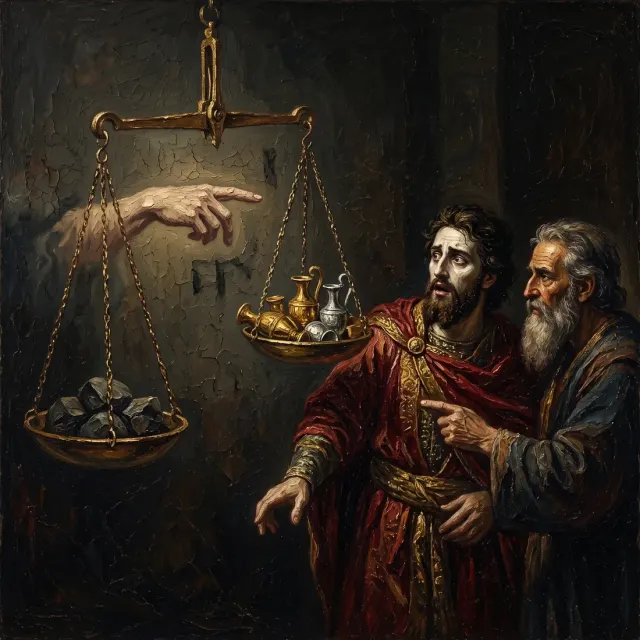
    Mene, mene, tekel, upharsin. He is clothed with scarlet and a chain of gold and proclaimed third ruler, and in that night he is slain and Darius takes the kingdom.

    The inscription sounds like an account being closed. Numbered. Weighed. Divided. Belshazzar has been arranging the value of things around him; now his kingdom and his own adequacy are assessed. Found wanting does not mean that he wanted more possessions. It means the weighing has exposed a deficiency in the man being weighed.

    Daniel's explanation leaves the king no interpretation to negotiate. The kingdom is numbered and finished, the king is deficient, and the realm is given away. These are not flattering predictions with enough room to mean anything. Each clause names a loss of authority. Even the final word reaches toward the identity of those receiving it, through the sound of Peres and Persia.

    Belshazzar nevertheless orders the honors delivered. The Book of Daniel records the robe, the chain, and the proclamation without telling why he keeps his promise. Then it gives his death in one short sentence. A promotion within the kingdom and the ending of its ruler stand next to each other with no cushioning between them. The court can still announce a new rank. It cannot guarantee that the world in which the rank matters will last the night.

    Verse by verse

    1. 5:26-27

      Mene is explained through numbering; Tekel through weighing. Wanting means deficient in the balance, not desirous.

    2. 5:29

      The king orders the promised honors despite Daniel's earlier refusal to sell the interpretation. The account does not state his motive.

    3. 5:30-31

      Belshazzar is killed that night, and Darius the Median receives the kingdom. The passage gives neither the killer's name nor a description of the city's capture.

    Daniel 5:24-31

    King James Version · 8 verses

    5:24Then was the part of the hand sent from him; and this writing was written.

    5:25And this is the writing that was written, MENE, MENE, TEKEL, UPHARSIN.

    5:26This is the interpretation of the thing: MENE; God hath numbered thy kingdom, and finished it.

    5:27TEKEL; Thou art weighed in the balances, and art found wanting.

    5:28PERES; Thy kingdom is divided, and given to the Medes and Persians.

    5:29Then commanded Belshazzar, and they clothed Daniel with scarlet, and put a chain of gold about his neck, and made a proclamation concerning him, that he should be the third ruler in the kingdom.

    5:30In that night was Belshazzar the king of the Chaldeans slain.

    5:31And Darius the Median took the kingdom, being about threescore and two years old.

Why it matters

The charge against him is not ignorance but refusal to learn from what he already knew. Daniel spends most of his reply on Nebuchadnezzar, the pride, the sentence, the grass, the restoration, and then says you knew all this and have not humbled your heart. Four words are weighed, counted, divided, and the same night he is slain. It is the shortest distance in Scripture between a banquet and an ending.

2 songs

The music

Every song in the catalogue whose passage falls inside these chapters.

  1. Daniel 5:1-31

    Mene, Mene, Tekel, Upharsin

  2. Daniel 5

    Weighed in the Balances

Nearby

All the people

Report an error on this page