
New · FreePlay The Witnesses The in-depth puzzle battle quest through Bible history

People of the Bible

Mary of Bethany

Is found at his feet all three times she appears, and the third time she breaks a year’s wages over them.

Every scene she is in puts her in the same posture. In Luke she sits at his feet and hears his word while the house is busy, which was the position of a student and not the position of a woman in that room. In John, when her brother has died, she falls at his feet and says the same sentence Martha said, and the response to hers is not an argument but tears. Nothing is recorded of her outside those three occasions.

Where she appearsLuke 10 · John 11 to 12 · Matthew 26

Scroll down to the account
Mary of Bethany

The movements, in the order the text gives them.

The Account of Mary of Bethany

  1. 01

    Luke 10:39-42

    Sat at Jesus’ feet, and heard his word

    She takes the posture of a disciple in a house where she was expected in the kitchen. She is told she has chosen the good part, and it shall not be taken away.

    Mary's defense is not one of the speeches recorded in this room. Jesus supplies it. Luke gives her position and her attention, sat at Jesus' feet, and heard his word, but records no reply from her when Martha asks for help. The person being discussed does not have to win the argument herself. The teacher declares what her place is worth.

    That place is not an empty interval between useful activities. She is listening to teaching, and Jesus calls it a choice. The word chosen prevents Mary from becoming merely a specimen of a quiet personality. Luke describes something she does, not a temperament that excuses her from everything else. Sitting still and doing nothing are not interchangeable descriptions.

    The final words also answer the precise threat in the room. Martha has asked Jesus to send Mary into the serving; Jesus says that her good part will not be taken away. He is not announcing that hospitality is worthless or that sisters should never help one another. He refuses to treat Mary's learning as disposable. The guest whose needs have become the subject of debate has identified something he intends to give. Mary is allowed to receive it.

    Verse by verse

    1. 10:39

      Luke expressly says that Mary hears Jesus' word. Her sitting is attached to learning, not described as idleness.

    2. 10:39

      The village is unnamed in Luke 10:38; John 11:1 associates the sisters Mary and Martha with Bethany.

    3. 10:40

      Martha addresses Jesus, not Mary, asking him to require her sister's assistance.

    4. 10:42

      Chosen describes Mary's action. The verse is not a classification of all people into permanently active or contemplative personalities.
    Luke 10:39-42

    King James Version · 4 verses

    10:39And she had a sister called Mary, which also sat at Jesus’ feet, and heard his word.

    10:40But Martha was cumbered about much serving, and came to him, and said, Lord, dost thou not care that my sister hath left me to serve alone? bid her therefore that she help me.

    10:41And Jesus answered and said unto her, Martha, Martha, thou art careful and troubled about many things:

    10:42But one thing is needful: and Mary hath chosen that good part, which shall not be taken away from her.

    Luke 10:39-42: Sat at Jesus’ feet, and heard his word
  2. 02

    John 11:28-33

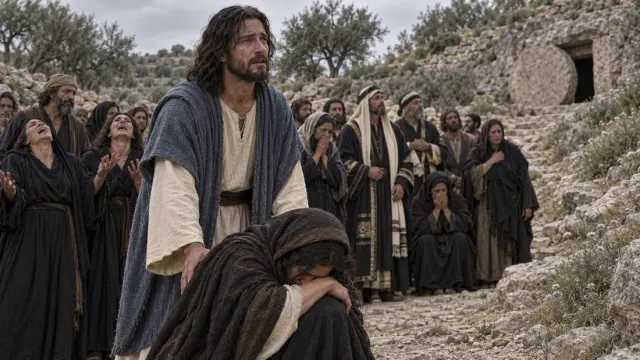
    She fell down at his feet

    She comes only when called, weeps, and says what her sister said. He groans in the spirit and is troubled, and the shortest verse in the Bible follows.

    The comforters follow the wrong explanation to the right person. Martha's message is private, but Mary's departure is visible. Those sitting with her suppose she is going to the grave and follow her out. Instead they accompany her to Jesus, who has not yet entered the village. The Gospel of John carefully distinguishes what they think she is doing from where she actually goes.

    Mary falls at his feet and speaks the same sentence Martha spoke in verse 21. Their common loss has found common words. The response, however, is not a repetition of the earlier conversation. Martha's encounter includes the declaration about resurrection and life; Mary's brings the weeping of the assembled mourners directly into view, and Jesus is himself deeply moved and troubled. John does not require identical exchanges to describe the same love.

    The feet are familiar, but the occasion is not. In Luke 10 Mary sat there to hear; here she falls there with her brother dead. Her words still affirm what Jesus' presence could have prevented, even as her tears express what has happened. Jesus does not remain an untouched lecturer outside that grief. Before he commands the grave, the chapter records his own tears.

    Verse by verse

    1. 11:28

      Martha privately conveys the summons. The passage does not record the earlier words in which Jesus gave it.

    2. 11:30-31

      The mourners expect a visit to the grave, but Mary goes to Jesus outside the village. Their explanation is reported as their assumption.

    3. 11:32

      Mary's opening repeats Martha's words from 11:21. John does not use the repetition to rank the sisters' grief.

    4. 11:33

      The cause and object of the indignation often associated with embrimaomai are debated. The verse states Jesus' strong reaction without naming someone he rebukes.

    John 11:28-33

    King James Version · 6 verses

    11:28And when she had so said, she went her way, and called Mary her sister secretly, saying, The Master is come, and calleth for thee.

    11:29As soon as she heard that, she arose quickly, and came unto him.

    11:30Now Jesus was not yet come into the town, but was in that place where Martha met him.

    11:31The Jews then which were with her in the house, and comforted her, when they saw Mary, that she rose up hastily and went out, followed her, saying, She goeth unto the grave to weep there.

    11:32Then when Mary was come where Jesus was, and saw him, she fell down at his feet, saying unto him, Lord, if thou hadst been here, my brother had not died.

    11:33When Jesus therefore saw her weeping, and the Jews also weeping which came with her, he groaned in the spirit, and was troubled,

    John 11:28-33: She fell down at his feet
  3. 03

    John 12:3

    The house was filled with the odour

    She anoints his feet and wipes them with her hair. The smell is what the room notices, and John records it as if the fragrance were the point.

    The room receives the fragrance before anyone finishes calculating its price. John gives a physical consequence that reaches beyond the person being anointed: the house was filled. The costly substance has left its container and become part of the air everyone shares. Mary's act cannot be reduced to a number quietly entered beside a name.

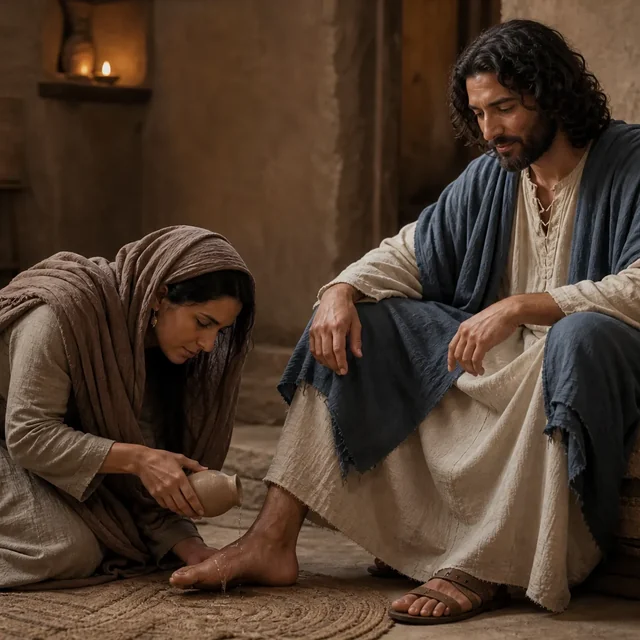
    Her position is again at Jesus' feet, but her action has changed. In Luke 10 she hears; in John 11 she weeps; here she anoints and wipes with her hair. Those repeated feet connect learning, bereavement, and this costly attention without turning the three occasions into the same scene. Her hands are active now. A portrait of Mary as someone who only sits would have considerable difficulty with this verse.

    The context supplies both a valuation and an interpretation. Judas names three hundred pence in verse 5; Jesus relates the ointment to his burial in verse 7. John does not say that Mary has explained the whole course of the coming death and resurrection. The significance is supplied by Jesus, not by an invented account of her thoughts. Yet the act is unmistakably hers. Before its meaning is argued over, the fragrance has already filled the house.

    Verse by verse

    1. 12:3

      A litra is an ancient Roman pound, not automatically the same weight as a modern English pound.

    2. 12:3

      John 12:5 values the ointment at three hundred denarii; Matthew 20:2 supplies a one-denarius daily wage as a comparison, not a universal salary scale.

    3. 12:3

      John describes anointing the feet and wiping them with hair. He does not say in this verse that Mary broke the container.

    4. 12:3

      The repeated position at Jesus' feet links Luke 10:39, John 11:32, and this passage; it does not mean these are her only mentions in Scripture.

    John 12:3

    King James Version · 1 verse

    12:3Then took Mary a pound of ointment of spikenard, very costly, and anointed the feet of Jesus, and wiped his feet with her hair: and the house was filled with the odour of the ointment.

    John 12:3: The house was filled with the odour
  4. 04

    Matthew 26:6-13

    Told for a memorial of her

    The disciples call it waste and are answered with burial. The promise that follows is unique in the gospels and it is made about a woman nobody else defends.

    Waste is the disciples' verdict. A good work is Jesus' verdict. The disagreement concerns the same expensive ointment and the same action; it cannot be settled simply by counting its value. Jesus identifies a moment that will not remain available, the anointing of his body before burial. A continuing duty to the poor does not erase that particular opportunity.

    Matthew leaves the woman unnamed. Her identification with Mary of Bethany comes from reading this account alongside John 12, not from a name hidden in Matthew's wording. The details should remain visible: Matthew describes ointment poured on Jesus' head, while John describes Mary's attention to his feet. The identification does not require either Gospel to surrender what it actually says.

    The promise of remembrance then overturns the complaint with remarkable precision. What the disciples would have preferred converted into money will be spoken of wherever the gospel is preached. The material has been poured out, but the deed will not disappear. Jesus connects its remembrance to his burial and to the proclamation reaching the whole world, far beyond this house in Bethany. Matthew preserves no speech from the woman and supplies no name in this scene. He does preserve the promise that what she has done will be remembered.

    Verse by verse

    1. 26:6-7

      Matthew names Simon the leper as the host but does not name the woman. The association with Mary of Bethany depends on comparison with John 12.

    2. 26:7

      Matthew specifies the head; John 12:3 specifies the feet. Both details should be retained when the accounts are compared.

    3. 26:11

      Deuteronomy 15:11 joins the continuing presence of poverty to a command to give generously, not permission to withhold help.

    4. 26:12

      Jesus gives the act a burial significance. Matthew does not specify how fully the woman understood the events ahead.

    5. 26:13

      The promised memorial concerns what the woman has done, carried within the worldwide proclamation of the gospel.

    Matthew 26:6-13

    King James Version · 8 verses

    26:6Now when Jesus was in Bethany, in the house of Simon the leper,

    26:7There came unto him a woman having an alabaster box of very precious ointment, and poured it on his head, as he sat at meat.

    26:8But when his disciples saw it, they had indignation, saying, To what purpose is this waste?

    26:9For this ointment might have been sold for much, and given to the poor.

    26:10When Jesus understood it, he said unto them, Why trouble ye the woman? for she hath wrought a good work upon me.

    26:11For ye have the poor always with you; but me ye have not always.

    26:12For in that she hath poured this ointment on my body, she did it for my burial.

    26:13Verily I say unto you, Wheresoever this gospel shall be preached in the whole world, there shall also this, that this woman hath done, be told for a memorial of her.

    Matthew 26:6-13: Told for a memorial of her

Why it matters

The anointing is the one thing the gospels promise will be remembered. She breaks an alabaster box of spikenard, very costly, and the house fills with it. Judas prices it at three hundred pence, which is most of a year’s work, and calls it waste. The defence given for her is that she has done it against the day of his burying, and the promise attached is that wherever this gospel is preached, what she did will be told for a memorial of her.

12 songs

The music

Every song in the catalogue whose passage falls inside these chapters.

  1. Luke 10:38-42

    The Better Part

    Play here
    Open song pageRead lyrics
  2. Luke 10:25-37

    Who Is My Neighbor?

    Play here
    Open song pageRead lyrics
  3. Luke 10:25-37

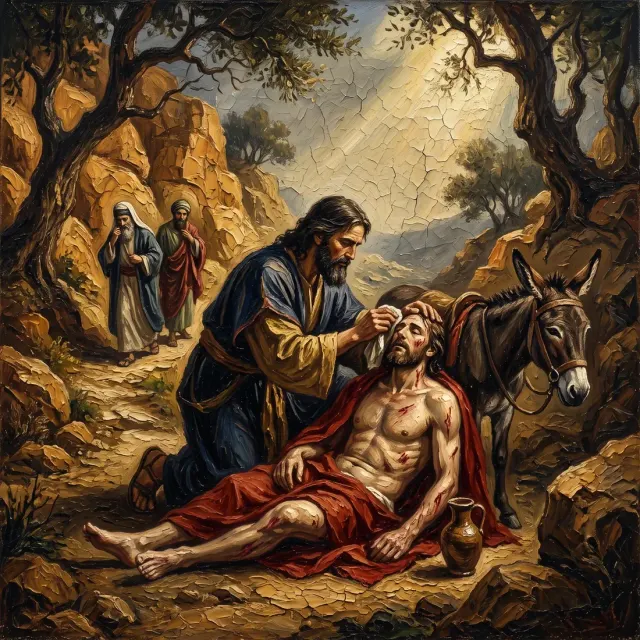
    Who Was Neighbor?

  4. John 11:1-46

    Lazarus, Come Forth

  5. John 11:45-57

    One Man Should Die

    Play here
    Open song pageRead lyrics
  6. John 12:20-36

    Except a Corn of Wheat Fall

    Play here
    Open song pageRead lyrics
  7. John 12:1-11

    Six Days Before Passover

    Play here
    Open song pageRead lyrics
  8. Matthew 26:47-75; Mark 14:43-72; Luke 22:47-62; John 18:1-27

    Before the Cock Crow

  9. Matthew 26:36-56

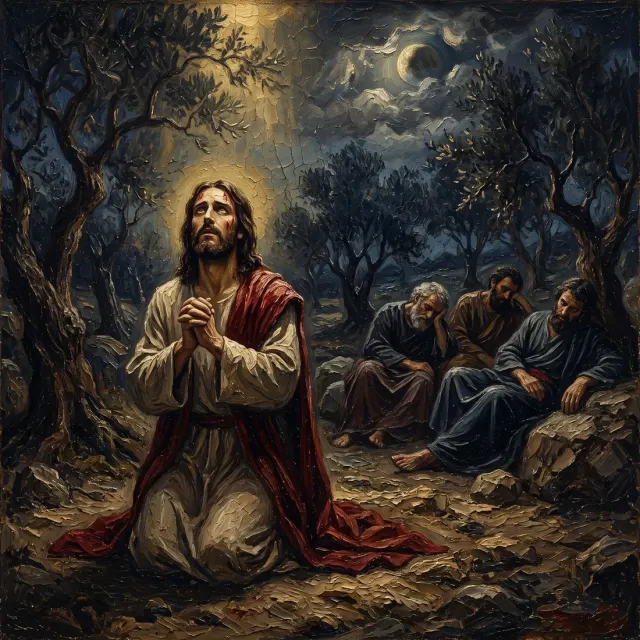
    The Cup in the Garden

    Play here
    Open song pageRead lyrics
  10. Matthew 26:1-16; Mark 14:1-11; John 12:1-8

    The Fragrance and the Silver

  11. Matthew 26:17-35; Mark 14:12-31; Luke 22:7-38; John 13-17

    This Do in Remembrance

  12. Matthew 26:36-46; Mark 14:32-42; Luke 22:39-46

    Thy Will Be Done

Nearby

All the people

Report an error on this page