New · FreePlay The Witnesses The in-depth puzzle battle quest through Bible history

Places of the Bible

Haran

The waypoint that twice became a home, and twice had to be left again.

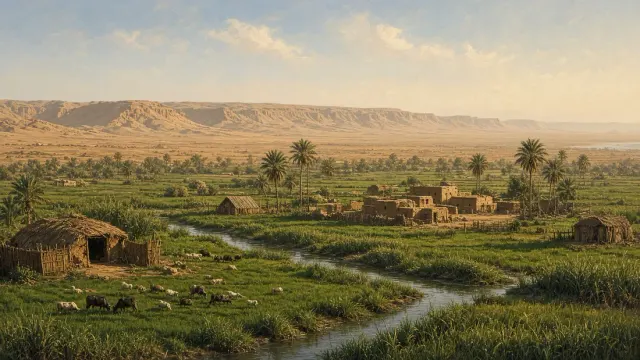
Haran is where Terah’s journey stops. The family sets out for Canaan and settles here instead, and Terah dies in it, so the first thing the place does is absorb a migration. Then Abram is called out of it at seventy-five, and Genesis 12 begins with an instruction that is mostly a list of things to leave: thy country, and thy kindred, and thy father’s house.

Where it appearsGenesis 11 to 12 · Genesis 29 to 30

Scroll down to the account

The movements, in the order the text gives them.

The Account of Haran

  1. 01

    Genesis 11:31-32

    They came unto Haran, and dwelt there

    A journey to Canaan becomes a residence somewhere else. The text records the settling without comment and then records a death.

    The most consequential words here are and dwelt there. A stopping place becomes a settled life. The Book of Genesis gives Haran no description of streets or walls; its importance is measured by what happens to the household inside it. For Terah, the place becomes permanent. For Abram, it becomes another place that must be left.

    The stated destination remains Canaan, so arrival in Haran is not the fulfillment of the sentence's opening intention. Yet the text does not blame the town or announce that settling there was an act of rebellion. It records the stop and the father's death. Any explanation of why the family stayed must be distinguished from what these two verses actually provide.

    Haran also becomes a point of continuing family connection. When Jacob reaches its shepherds in chapter 29, they know Laban and identify Rachel approaching with the sheep. The place Abram leaves does not disappear from the family's life. It holds both an ending and a surviving branch of kinship. The route away from it is not the erasure of everyone who remained.

    Verse by verse

    1. 11:31

      Dwelt indicates residence rather than a stated overnight stop. The passage does not give the length of that residence.

    2. 11:32

      Terah dies in Haran at 205. The notice closes his life without saying that Abram's intended destination has changed.

    Genesis 11:31-32

    King James Version · 2 verses

    11:31And Terah took Abram his son, and Lot the son of Haran his son’s son, and Sarai his daughter in law, his son Abram’s wife; and they went forth with them from Ur of the Chaldees, to go into the land of Canaan; and they came unto Haran, and dwelt there.

    11:32And the days of Terah were two hundred and five years: and Terah died in Haran.

    Genesis 11:31-32: They came unto Haran, and dwelt there
  2. 02

    Genesis 12:1-5

    Get thee out of thy country

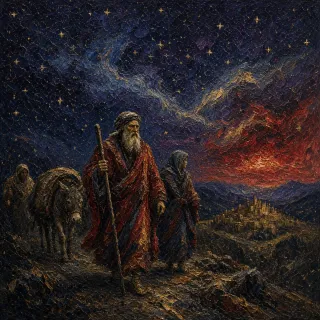
    The call is three departures deep and one destination wide: a land that I will show thee. Abram was seventy and five years old when he departed out of Haran.

    The command narrows before the promise widens. Country, kindred, father's house: each phrase moves closer to the center of Abram's existing life. Then the promise opens outward, from one man to a great nation and finally to all families of the earth. Separation is not the final purpose. A blessing extending beyond the separated household is.

    The age and inventory keep the departure from becoming a picture of youthful restlessness. Abram is seventy-five. Possessions have accumulated, and people belong to the household gathered in Haran. Leaving requires moving an established life, not slipping away from one that has not begun. The Book of Genesis names Sarai, whose childlessness makes the promised nation a claim that present circumstances cannot supply.

    The KJV's had said also matters. Acts 7:2 places God's appearance before the residence in Haran, while this passage records the departure from it. The call spans more than one stage of travel. Hebrews 11:8 reads the going as obedience by faith, not as proof that Abram possessed a complete itinerary. The final line is deliberately firm: into the land of Canaan they came. The household has reached the land. Possession and descendants remain promises.

    Verse by verse

    1. 12:1

      Country, kindred, and father's house name overlapping circles of belonging. The command addresses Abram directly, not every traveler indiscriminately.

    2. 12:3

      All families extends the stated purpose beyond Abram's own descendants. Galatians 3:8 explicitly reads the promised blessing of the nations as advance proclamation of the gospel.

    3. 12:5

      Souls here means people. The phrase describes the household acquired in Haran; it does not by itself specify that every person was a religious convert.

    Genesis 12:1-5

    King James Version · 5 verses

    12:1Now the LORD had said unto Abram, Get thee out of thy country, and from thy kindred, and from thy father’s house, unto a land that I will shew thee:

    12:2And I will make of thee a great nation, and I will bless thee, and make thy name great; and thou shalt be a blessing:

    12:3And I will bless them that bless thee, and curse him that curseth thee: and in thee shall all families of the earth be blessed.

    12:4So Abram departed, as the LORD had spoken unto him; and Lot went with him: and Abram was seventy and five years old when he departed out of Haran.

    12:5And Abram took Sarai his wife, and Lot his brother’s son, and all their substance that they had gathered, and the souls that they had gotten in Haran; and they went forth to go into the land of Canaan; and into the land of Canaan they came.

    Genesis 12:1-5: Get thee out of thy country
  3. 03

    Genesis 29:1-14

    The stone upon the well’s mouth

    Jacob arrives, moves a stone no one else was waiting to move, and meets Rachel at the well before he has spoken to anyone else in the town.

    Jacob has barely arrived before he is advising the local shepherds how to spend their afternoon. They answer with the procedure at the well: the flocks gather before the stone is moved. The exchange gives the scene its wonderfully practical texture. Water is available, but access is arranged collectively, and the newcomer has not yet learned the arrangement.

    Then Rachel arrives and Jacob moves the stone himself. The text emphasizes the action without announcing a miracle or explaining his strength. It also refuses to make the meeting merely a glance at an attractive woman. Laban his mother's brother occurs three times in verse 10. Rachel, the sheep, and the flock are all identified through the family connection Jacob has traveled to find.

    The well recalls chapter 24, but the details are not identical. There Rebekah draws water for the servant's camels; here her son waters the flock belonging to Rachel's father. Service changes hands while the meeting still opens a route into the family. Jacob's tears are stated, not supplied by interpretation, and Laban's welcome is physical: running, embracing, kissing. Bone and flesh names real kinship. At this point in the account, the welcome is a welcome, not a license to invent Laban's private calculations.

    Verse by verse

    1. 29:5

      Son of Nahor uses a broader ancestral relationship. Genesis 24:15 and 24:29 identify Laban as Rebekah's brother, with Bethuel as their father and Nahor as their grandfather.

    2. 29:8

      The shepherds describe a shared watering procedure. The text does not specify the stone's weight or the number of people needed to move it.

    3. 29:12

      Brother here means kinsman; Jacob immediately identifies himself more precisely as Rebekah's son.

    Genesis 29:1-14

    King James Version · 14 verses

    29:1Then Jacob went on his journey, and came into the land of the people of the east.

    29:2And he looked, and behold a well in the field, and, lo, there were three flocks of sheep lying by it; for out of that well they watered the flocks: and a great stone was upon the well’s mouth.

    29:3And thither were all the flocks gathered: and they rolled the stone from the well’s mouth, and watered the sheep, and put the stone again upon the well’s mouth in his place.

    29:4And Jacob said unto them, My brethren, whence be ye? And they said, Of Haran are we.

    29:5And he said unto them, Know ye Laban the son of Nahor? And they said, We know him.

    29:6And he said unto them, Is he well? And they said, He is well: and, behold, Rachel his daughter cometh with the sheep.

    29:7And he said, Lo, it is yet high day, neither is it time that the cattle should be gathered together: water ye the sheep, and go and feed them.

    29:8And they said, We cannot, until all the flocks be gathered together, and till they roll the stone from the well’s mouth; then we water the sheep.

    29:9And while he yet spake with them, Rachel came with her father’s sheep: for she kept them.

    29:10And it came to pass, when Jacob saw Rachel the daughter of Laban his mother’s brother, and the sheep of Laban his mother’s brother, that Jacob went near, and rolled the stone from the well’s mouth, and watered the flock of Laban his mother’s brother.

    29:11And Jacob kissed Rachel, and lifted up his voice, and wept.

    29:12And Jacob told Rachel that he was her father’s brother, and that he was Rebekah’s son: and she ran and told her father.

    29:13And it came to pass, when Laban heard the tidings of Jacob his sister’s son, that he ran to meet him, and embraced him, and kissed him, and brought him to his house. And he told Laban all these things.

    29:14And Laban said to him, Surely thou art my bone and my flesh. And he abode with him the space of a month.

  4. 04

    Genesis 29:25-30

    Behold, it was Leah

    The deceiver is deceived in the dark by a father with two daughters. Another seven years of service are agreed in the morning.

    Behold, it was Leah is brutally short. The Book of Genesis does not provide a technical explanation of how the substitution escaped detection through the night. It puts the discovery in the morning and lets Jacob's accusation name the action: beguiled. Speculation about veils, drink, or exchanged signals should not be mistaken for details supplied here.

    Laban answers the charge of deception with a lecture on local custom. The younger must not precede the firstborn. For Jacob, who obtained his elder brother's blessing by presenting himself as the firstborn, the wording has an unmistakable edge. The correspondence does not make Laban honest or turn Leah into a punishment disguised as a person. It places Jacob on the receiving side of a substitution, while the women bear consequences that cannot be reduced to his education.

    The payment terms are often misread. Jacob completes Leah's wedding week, receives Rachel, and then serves the additional seven years. He does not wait fourteen years before marrying Rachel. Laban secures further labor while the household begins with an explicit inequality: Jacob loves Rachel more than Leah. That is not an incidental romantic preference tucked into the ending. It defines the imbalance under which both sisters enter married life.

    Verse by verse

    1. 29:26

      The Hebrew word translated firstborn is the feminine form bekhirah. It gives Laban's reply a pointed connection with the birth-order conflict in Jacob's own family.

    2. 29:27-28

      Her week is the wedding week that Jacob completes before receiving Rachel. The additional seven years are service owed afterward.

    3. 29:30

      The comparison of Jacob's love is explicit. Leah's own involvement or consent in the substitution is not described in these verses.

    Genesis 29:25-30

    King James Version · 6 verses

    29:25And it came to pass, that in the morning, behold, it was Leah: and he said to Laban, What is this thou hast done unto me? did not I serve with thee for Rachel? wherefore then hast thou beguiled me?

    29:26And Laban said, It must not be so done in our country, to give the younger before the firstborn.

    29:27Fulfil her week, and we will give thee this also for the service which thou shalt serve with me yet seven other years.

    29:28And Jacob did so, and fulfilled her week: and he gave him Rachel his daughter to wife also.

    29:29And Laban gave to Rachel his daughter Bilhah his handmaid to be her maid.

    29:30And he went in also unto Rachel, and he loved also Rachel more than Leah, and served with him yet seven other years.

    Genesis 29:25-30: Behold, it was Leah
  5. 05

    Genesis 31:1-21

    Return unto the land of thy fathers

    He leaves as his grandfather did, and takes twenty years of livestock with him. Haran hands the family back a generation larger.

    Rachel and Leah finally speak together, and their agreement is about their father. He has treated them as strangers, sold them, and consumed the money associated with them. Those are their accusations, not a modern explanation imposed on silent women. The sisters whose marriages began in rivalry now give a shared answer about leaving the household that arranged them.

    The command to return comes before Jacob's family conference. His account of altered wages and the dream explains the departure to his wives, but God's instruction in verse 3 is already direct. I will be with thee renews the promise of Bethel; the God named in verse 13 is not confined to the place where Jacob first raised a pillar. Haran has held years of service, marriages, children, and increasing livestock, but it has not replaced the promised return.

    The leaving is not made spotless to match the command. Rachel steals her father's images. Jacob conceals the departure. The Book of Genesis places those facts beside obedience without pretending they are the same thing. Laban's sons call Jacob's wealth a theft from their father; Jacob attributes it to God's protection against changed wages; Rachel actually removes objects belonging to Laban. Different claims and different actions must stay distinct. A household can be leaving under a divine command and still carry unresolved trouble in its baggage.

    Verse by verse

    1. 31:3

      I will be with thee repeats the assurance of Genesis 28:15. The return is presented as a divine instruction, not merely a response to Laban's changed expression.

    2. 31:14-16

      Rachel and Leah themselves describe their treatment in financial and family terms. Their speech should not be replaced with an invented account of private motives.

    3. 31:19

      Images translates teraphim, household religious objects. The passage does not explain Rachel's purpose in taking them or establish an automatic legal right of inheritance through possession of them.

    4. 31:21

      The river is the Euphrates on the route from Mesopotamia toward Gilead. Hosea 12:12 later recalls Jacob's service for a wife in Syria.

    Genesis 31:1-21: Return unto the land of thy fathers

    Genesis 31:1-21

    King James Version · 21 verses

    31:1And he heard the words of Laban’s sons, saying, Jacob hath taken away all that was our father’s; and of that which was our father’s hath he gotten all this glory.

    31:2And Jacob beheld the countenance of Laban, and, behold, it was not toward him as before.

    31:3And the LORD said unto Jacob, Return unto the land of thy fathers, and to thy kindred; and I will be with thee.

    31:4And Jacob sent and called Rachel and Leah to the field unto his flock,

    31:5And said unto them, I see your father’s countenance, that it is not toward me as before; but the God of my father hath been with me.

    31:6And ye know that with all my power I have served your father.

    31:7And your father hath deceived me, and changed my wages ten times; but God suffered him not to hurt me.

    31:8If he said thus, The speckled shall be thy wages; then all the cattle bare speckled: and if he said thus, The ringstraked shall be thy hire; then bare all the cattle ringstraked.

    31:9Thus God hath taken away the cattle of your father, and given them to me.

    31:10And it came to pass at the time that the cattle conceived, that I lifted up mine eyes, and saw in a dream, and, behold, the rams which leaped upon the cattle were ringstraked, speckled, and grisled.

    31:11And the angel of God spake unto me in a dream, saying, Jacob: And I said, Here am I.

    31:12And he said, Lift up now thine eyes, and see, all the rams which leap upon the cattle are ringstraked, speckled, and grisled: for I have seen all that Laban doeth unto thee.

    31:13I am the God of Beth-el, where thou anointedst the pillar, and where thou vowedst a vow unto me: now arise, get thee out from this land, and return unto the land of thy kindred.

    31:14And Rachel and Leah answered and said unto him, Is there yet any portion or inheritance for us in our father’s house?

    31:15Are we not counted of him strangers? for he hath sold us, and hath quite devoured also our money.

    31:16For all the riches which God hath taken from our father, that is ours, and our children’s: now then, whatsoever God hath said unto thee, do.

    31:17Then Jacob rose up, and set his sons and his wives upon camels;

    31:18And he carried away all his cattle, and all his goods which he had gotten, the cattle of his getting, which he had gotten in Padan-aram, for to go to Isaac his father in the land of Canaan.

    31:19And Laban went to shear his sheep: and Rachel had stolen the images that were her father’s.

    31:20And Jacob stole away unawares to Laban the Syrian, in that he told him not that he fled.

    31:21So he fled with all that he had; and he rose up, and passed over the river, and set his face toward the mount Gilead.

Why it matters

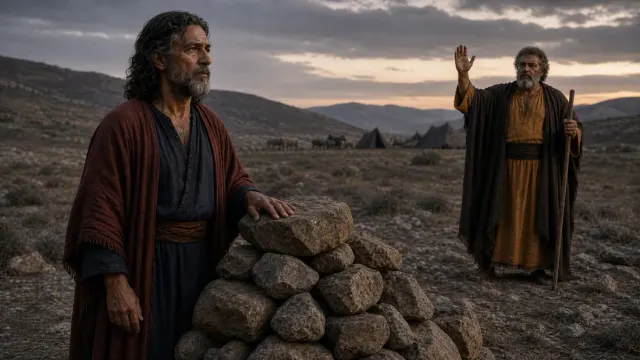
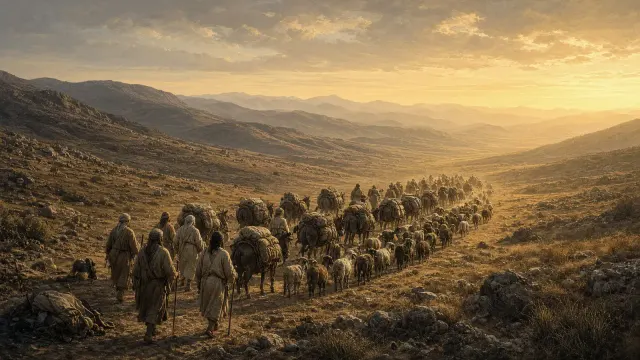
Two generations later the family comes back. Rebekah is fetched from here for Isaac, and Jacob is sent here to escape his brother and to find a wife, and he stays twenty years. Everything that shapes Israel happens in Haran rather than in Canaan: four wives, eleven of the twelve sons, the flocks, the wages changed ten times, and the long argument with Laban that ends in a heap of stones and a border neither man will cross. The promise runs through a foreign town on the way to the land.

3 songs

The music

Every song in the catalogue whose passage falls inside these chapters.

  1. Genesis 11:27-14:24

    Go Forth from Your Country

  2. Genesis 12:1-9

    Go From Your Country

  3. Genesis 29:1-31:55

    Twenty Years in Haran

Nearby

All the places

Report an error on this page