New · FreePlay The Witnesses The in-depth puzzle battle quest through Bible history

Places of the Bible

Megiddo

A pass that armies cannot avoid, which is why it collects battles and eventually a name for the last one.

The town sits at the mouth of a narrow pass through the Carmel ridge, and the road from Egypt to Mesopotamia has to come through it. That single fact explains the whole biblical record of the place. Whoever holds Megiddo controls the traffic of the ancient world, and the account keeps returning to it not for what it is but for what has to pass through it.

Where it appearsJudges 5 · 2 Kings 23

Scroll down to the account

The movements, in the order the text gives them.

The Account of Megiddo

  1. 01

    Judges 5:19-21

    By the waters of Megiddo

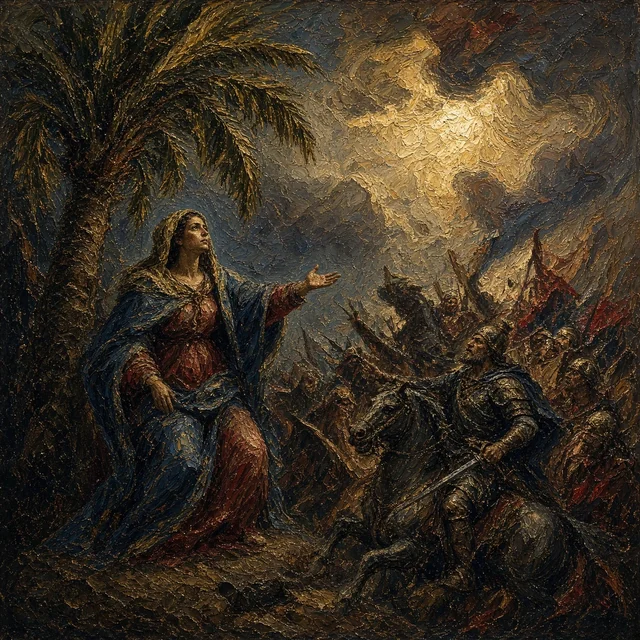
    The song names the place and the river together. They took no gain of money, and the river of Kishon swept them away.

    The kings arrive in a line of repeated fighting verbs, and the account of their profit fits into four words: no gain of money. That small financial notice becomes sharper near the song's end, where Sisera's mother and her attendants explain the delayed return by imagining the division of spoil. The women at the window are counting what the battlefield has already denied.

    Then the scale of the fighting suddenly widens. Kings have fought; now the stars fight, and the Kishon sweeps the enemy away. The river is not decorative scenery attached to the battle. It is one of the forces by which strength is overturned. Earlier in the song, the heavens drop water; here the waters of Megiddo and the repeated name Kishon give the victory a physical setting.

    The language is poetry, not a diagram of celestial mechanics. It presents heaven and earth engaged against Sisera without inviting a calculation of which star struck which chariot. Nor should the poetry be flattened into an account in which the LORD's action disappears. The military power described in chapter 4 included nine hundred iron chariots. The song gives that power no final boast. It gives the river the last movement.

    Verse by verse

    1. 5:19

      Taanach and the waters of Megiddo locate the fighting; the verse does not say that the battle took place inside Megiddo's city walls.

    2. 5:20

      The stars fighting belong to the song's description of heaven opposing Sisera. The verse supplies no astronomical mechanism or endorsement of divination by the stars.

    3. 5:21

      Judges 4:15-16 describes the defeat and pursuit, while this song emphasizes the river's action. A detailed reconstruction of chariots sinking in particular depths of mud goes beyond either passage.
    Judges 5:19-21

    King James Version · 3 verses

    5:19The kings came and fought, then fought the kings of Canaan in Taanach by the waters of Megiddo; they took no gain of money.

    5:20They fought from heaven; the stars in their courses fought against Sisera.

    5:21The river of Kishon swept them away, that ancient river, the river Kishon. O my soul, thou hast trodden down strength.

    Judges 5:19-21: By the waters of Megiddo
  2. 02

    2 Kings 9:27

    He fled to Megiddo, and died there

    Ahaziah is caught in Jehu’s purge on the road and gets as far as this town before the wound finishes him.

    Also is the dangerous word. Jehu has just killed Joram, but his command extends the violence to the king of Judah. Ahaziah is not an unrelated traveller caught at the wrong junction. The preceding chapter ties him to Ahab's house and records his participation in Joram's war, followed by his visit to the wounded king. The northern royal crisis has reached a southern crown.

    The verse distinguishes being struck from dying. The attack occurs on the ascent to Gur near Ibleam; Megiddo is where the flight ends in death. Those are not interchangeable points on the map, and collapsing them into a battle fought at Megiddo removes what the sentence carefully preserves. Here the city is an endpoint, not the named place of the wound.

    The following verse returns Ahaziah to Jerusalem in a chariot for burial. The vehicle that belonged to his royal movement now carries his body. A king of Judah dies away from his own capital, in the collapse of the house to which he attached himself. The place-name holds that consequence with extraordinary economy. He reached Megiddo. It did not become an escape.

    Verse by verse

    1. 9:27

      This is Ahaziah king of Judah, not the earlier Ahaziah king of Israel in 2 Kings 1. The title in the verse prevents the two kings from being confused.

    2. 9:27

      The verse places the attack near Ibleam and the death at Megiddo. It does not describe a separate pitched battle at Megiddo.

    3. 9:27

      Second Chronicles 22:9 gives a different sequence involving capture in Samaria and being brought to Jehu. The extra stages needed to merge that account with this route are not supplied by either text.

    2 Kings 9:27

    King James Version · 1 verse

    9:27But when Ahaziah the king of Judah saw this, he fled by the way of the garden house. And Jehu followed after him, and said, Smite him also in the chariot. And they did so at the going up to Gur, which is by Ibleam. And he fled to Megiddo, and died there.

    2 Kings 9:27: He fled to Megiddo, and died there
  3. 03

    2 Chronicles 35:20-22

    He hearkened not unto the words of Necho

    The warning is explicit and comes from an enemy. Josiah disguises himself and goes into the valley anyway.

    After all this is a hard opening. The chapter has just described Josiah's carefully ordered Passover, then turns from the prepared temple to an expedition he was warned not to join. His earlier faithfulness is not erased, but neither is it allowed to make the next decision automatically right.

    The warning comes through an unexpected mouth. Necho claims that God has sent him and tells Josiah to stand aside. Such a claim, left by itself, could be read simply as a king invoking divine authority. Verse 22 goes further: the Book of 2 Chronicles identifies these as words from the mouth of God. That distinction is crucial. The passage's judgment is not merely that Josiah ignored Egyptian diplomatic language. He failed to heed a warning the book itself affirms.

    The disguise adds a grim echo. Ahab had also entered battle disguised after rejecting a warning, and an arrow had reached him. The resemblance does not make Josiah another Ahab in every respect. It makes the present action impossible to excuse by his earlier record. The same chapter can honor his Passover and condemn his refusal to listen. At Megiddo, his altered appearance does not alter the word he has refused.

    Verse by verse

    1. 35:20

      After all this connects the new scene to the preceding reforms; it does not specify that the campaign immediately followed the Passover without intervening years.

    2. 35:21-22

      Necho first makes the claim that God sent him, and verse 22 then independently identifies his words as coming from God. The second statement must not be reduced to the first man's unverified assertion.

    3. 35:22

      The passage states that Josiah disguised himself to fight, but does not disclose his full strategic reasoning. The archers and the king's wound appear in the following verse.

    2 Chronicles 35:20-22

    King James Version · 3 verses

    35:20After all this, when Josiah had prepared the temple, Necho king of Egypt came up to fight against Carchemish by Euphrates: and Josiah went out against him.

    35:21But he sent ambassadors to him, saying, What have I to do with thee, thou king of Judah? I come not against thee this day, but against the house wherewith I have war: for God commanded me to make haste: forbear thee from meddling with God, who is with me, that he destroy thee not.

    35:22Nevertheless Josiah would not turn his face from him, but disguised himself, that he might fight with him, and hearkened not unto the words of Necho from the mouth of God, and came to fight in the valley of Megiddo.

    2 Chronicles 35:20-22: He hearkened not unto the words of Necho
  4. 04

    2 Kings 23:29-30

    The archers shot at king Josiah

    His servants carry him dead in a chariot from Megiddo to Jerusalem, and the last good reign of Judah ends at a crossroads.

    The chapter has called Josiah unequalled in turning to the LORD, and then it records him coming home dead. Neither statement cancels the other. The preceding verses have already distinguished the king's remarkable reform from the judgment still hanging over Judah because of Manasseh's provocations. This is not a tidy account in which national consequences disappear as soon as one king acts faithfully.

    The Book of 2 Kings gives the death at Megiddo and the body carried to Jerusalem. The Book of 2 Chronicles supplies a longer account, with an arrow wound, transfer to another chariot, arrival in Jerusalem, and then death. The difference should remain visible rather than being concealed inside a smooth composite. Kings is especially abrupt: the man goes out as king; his servants bring him back dead.

    The people's appointment of Jehoahaz follows in the same verse as the burial. Mourning and succession must occupy the same national moment. Yet the next verses allow this new reign only three months before Necho removes him. The dead king reaches his own tomb; the kingdom does not recover its freedom of action merely by filling his throne. Megiddo marks a loss that the coronation cannot repair.

    Verse by verse

    1. 23:29

      The archers are named in 2 Chronicles 35:23, not in these two verses of Kings. Necho is credited with killing Josiah here without the weapon being specified.

    2. 23:30

      Kings says the servants carried Josiah dead from Megiddo; Chronicles 35:24 describes bringing him to Jerusalem and then says he died. Neither wording should be silently replaced by the other.

    3. 23:30

      Zechariah 12:11 names great mourning in the valley of Megiddon. Its frequent association with Josiah's mourning is an interpretation; Zechariah does not name Josiah in that verse.

    2 Kings 23:29-30

    King James Version · 2 verses

    23:29In his days Pharaoh-nechoh king of Egypt went up against the king of Assyria to the river Euphrates: and king Josiah went against him; and he slew him at Megiddo, when he had seen him.

    23:30And his servants carried him in a chariot dead from Megiddo, and brought him to Jerusalem, and buried him in his own sepulchre. And the people of the land took Jehoahaz the son of Josiah, and anointed him, and made him king in his father’s stead.

    2 Kings 23:29-30: The archers shot at king Josiah

Why it matters

Deborah’s song places the fight there: the kings came and fought, then fought the kings of Canaan in Taanach by the waters of Megiddo, and adds that the river of Kishon swept them away. Ahaziah dies there fleeing from Jehu. And Josiah, the best king since David, goes out against Pharaoh Necho who is only passing through, is told plainly that the quarrel is not with him, and is shot by archers at Megiddo. The reforming reign ends on a road somebody else was using.

3 songs

The music

Every song in the catalogue whose passage falls inside these chapters.

  1. Judges 4-5

    Rise, Deborah

  2. 2 Kings 21:1-23:30

    The Book Found in the House

  3. 2 Kings 22-23

    The Book Was Found

Nearby

All the places

Report an error on this page