Places of the Bible

Ramah

Samuel’s home town, where the elders came to ask for a king and got a warning instead.

It is where Samuel lives and where he returns between circuits. He judges Israel on a route, Bethel and Gilgal and Mizpeh year by year, and his return was to Ramah, for there was his house, and there he judged Israel, and there he built an altar unto the LORD. The town is the fixed point of a travelling job, and it is also where his sons are made judges and where they take bribes.

Where it appears1 Samuel 7 · 1 Samuel 8 · 1 Samuel 25 · Jeremiah 31

Scroll down to the account

The movements, in the order the text gives them.

The Account of Ramah

  1. 01

    1 Samuel 7:15-17

    His return was to Ramah

    The circuit is named town by town and the home is named last. He builds an altar where he lives rather than where he works.

    The judge's circuit ends at home, but the judging does not. Ramah is where Samuel lives, where he continues to hear Israel's affairs, and where he builds an altar. The three repeated statements about what happens there put household, public responsibility, and worship in the same small space. Home is not the place where his calling disappears.

    After the thunder, battle, and memorial stone earlier in the chapter, these verses deliberately become ordinary. From year to year. A nation needs more than a memorable day of deliverance; the account also records the repeated work of judging in named places. The passage gives authority an itinerary rather than a palace.

    All the days of his life is important, too. Samuel's service is not presented as a temporary arrangement that becomes worthless once a king appears. His later promise to keep praying and teaching in 1 Samuel 12:23 fits this opening description. Ramah remains the home of a man whose work is larger than a change in government.

    Verse by verse

    1. 7:15

      The lifetime description includes Samuel's continuing ministry after the establishment of Saul's kingship.

    2. 7:16

      In circuit describes a recurring round of visits; the passage does not specify a travel time between the towns.

    3. 7:17

      The altar belongs to the period before Solomon's Jerusalem temple. The verse does not identify Ramah as the location of the ark.

    1 Samuel 7:15-17

    King James Version · 3 verses

    7:15And Samuel judged Israel all the days of his life.

    7:16And he went from year to year in circuit to Beth-el, and Gilgal, and Mizpeh, and judged Israel in all those places.

    7:17And his return was to Ramah; for there was his house; and there he judged Israel; and there he built an altar unto the LORD.

    1 Samuel 7:15-17: His return was to Ramah
  2. 02

    1 Samuel 8:1-5

    Make us a king to judge us

    The elders come with a real grievance about his sons and a request that is not about his sons at all.

    The elders bring Samuel a complaint that the passage has already confirmed. His sons take bribes and bend judgment. Their accusation is not dismissed as an excuse invented by people who simply dislike an old prophet. The failure in Beersheba is real, and the sons' appointment came from Samuel himself.

    That makes the request at Ramah more complicated than a contest between a good arrangement and an obviously needless replacement. The elders identify two problems, Samuel's age and his sons' conduct, then propose a king like all the nations. The final phrase reaches beyond repairing dishonest courts. They want the recognizable arrangement their neighbors have.

    The wording keeps Samuel distinct from his sons even while exposing the failure of succession: they walked not in his ways. An office has passed into the family; the father's manner of exercising it has not. The delegation comes to the very place where Samuel still judges, asking the faithful judge to provide a different kind of judge. The institutional problem stands in his own household.

    Verse by verse

    1. 8:1

      Samuel's age is not numbered here. The passage supplies old age, not a date of birth or a retirement age.

    2. 8:3

      Lucre means gain; taking bribes and perverting judgment specify the corrupt means of pursuing it.

    3. 8:5

      Deuteronomy 17:14 also anticipates the language of a king like neighboring nations, while placing Israel's king under divine requirements.

    1 Samuel 8:1-5

    King James Version · 5 verses

    8:1And it came to pass, when Samuel was old, that he made his sons judges over Israel.

    8:2Now the name of his firstborn was Joel; and the name of his second, Abiah: they were judges in Beer-sheba.

    8:3And his sons walked not in his ways, but turned aside after lucre, and took bribes, and perverted judgment.

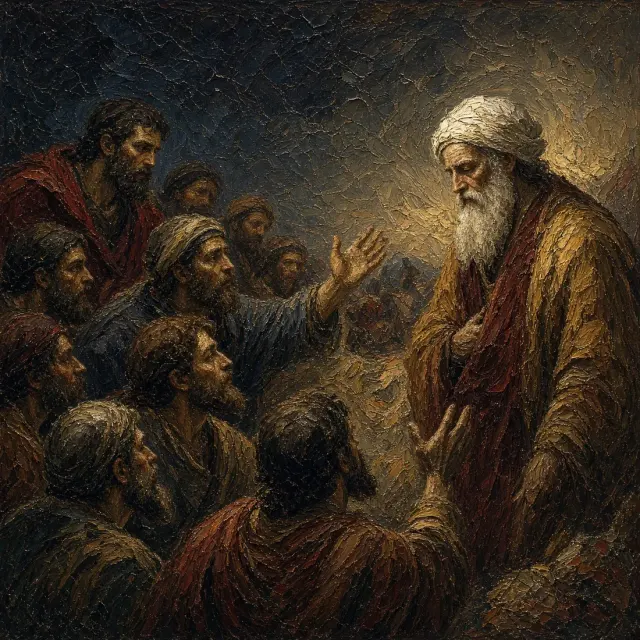
    8:4Then all the elders of Israel gathered themselves together, and came to Samuel unto Ramah,

    8:5And said unto him, Behold, thou art old, and thy sons walk not in thy ways: now make us a king to judge us like all the nations.

    1 Samuel 8:1-5: Make us a king to judge us
  3. 03

    1 Samuel 8:11-18

    This will be the manner of the king

    The warning is a list of verbs, all of them take, and it ends with a sentence about crying out in that day and not being heard.

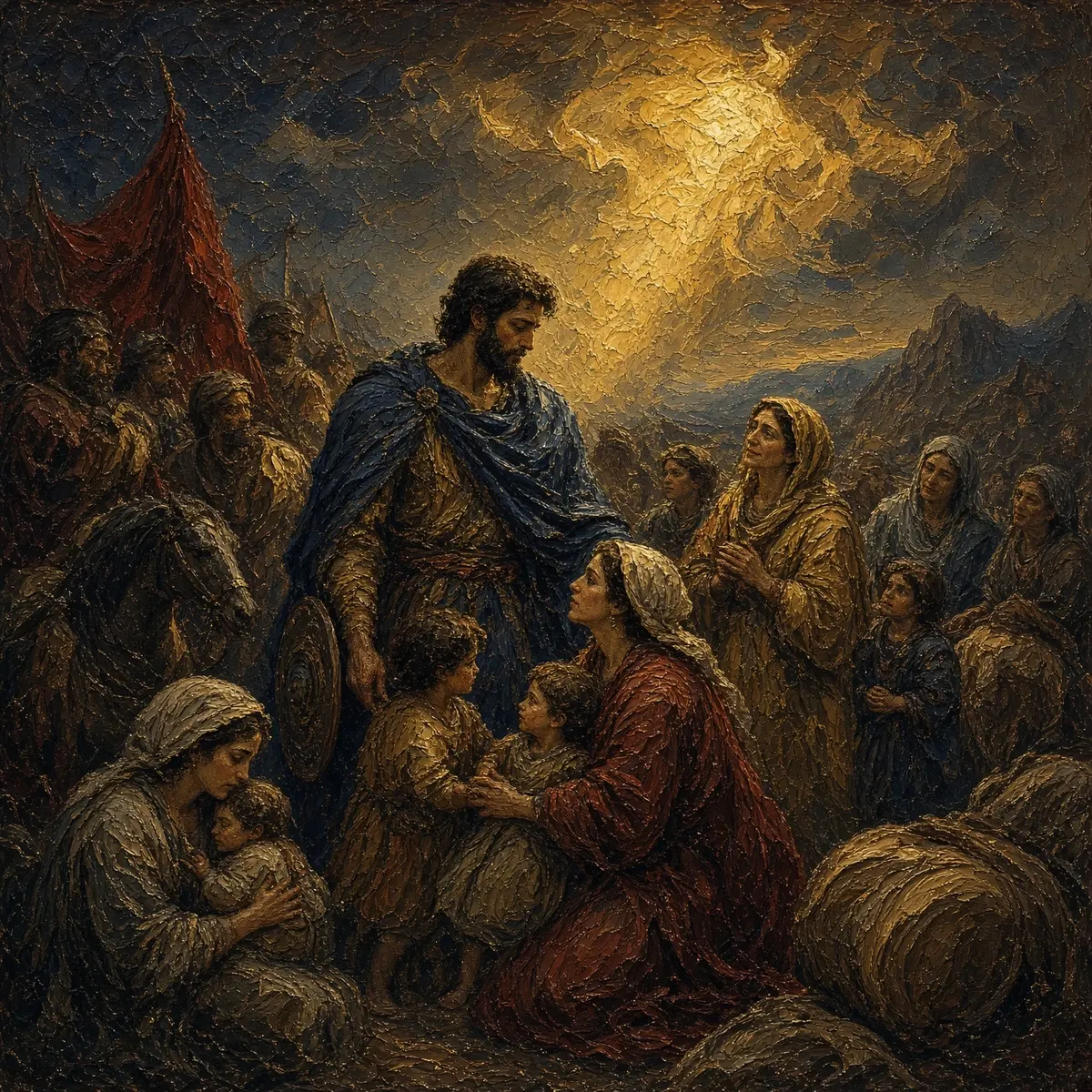
    He will take is the speech's repeated verb, and Samuel gives it very little rest. Sons, daughters, fields, harvest, servants, livestock: the warning moves through the household until almost nothing stands outside the king's reach. The people have asked what a king can do for them. Samuel describes what the king will require from them.

    The repeated his matters as much as the repeated take. His chariots, his ground, his harvest, his work. Military organization and courtly provision are paid for in the labor and property of actual families. Even the best fields are not protected by being the best; their quality makes them desirable.

    Then the list changes scale. It no longer concerns only particular children or a tenth of particular produce. The people themselves become his servants. The final cry is directed against the king they chose, and the warning includes God's refusal to answer that cry in that day. This is not a vague complaint that government can be expensive. Every item in the account already has an owner.

    Verse by verse

    1. 8:11

      Manner describes the royal practices being warned about; the speech is not presented as approval of every taking it lists.

    2. 8:12

      To ear his ground means to plow it. Ear is an old English agricultural verb here.

    3. 8:17-18

      The tenth is specified for produce and sheep; the warning then broadens to the people themselves being servants.

    1 Samuel 8:11-18

    King James Version · 8 verses

    8:11And he said, This will be the manner of the king that shall reign over you: He will take your sons, and appoint them for himself, for his chariots, and to be his horsemen; and some shall run before his chariots.

    8:12And he will appoint him captains over thousands, and captains over fifties; and will set them to ear his ground, and to reap his harvest, and to make his instruments of war, and instruments of his chariots.

    8:13And he will take your daughters to be confectionaries, and to be cooks, and to be bakers.

    8:14And he will take your fields, and your vineyards, and your oliveyards, even the best of them, and give them to his servants.

    8:15And he will take the tenth of your seed, and of your vineyards, and give to his officers, and to his servants.

    8:16And he will take your menservants, and your maidservants, and your goodliest young men, and your asses, and put them to his work.

    8:17He will take the tenth of your sheep: and ye shall be his servants.

    8:18And ye shall cry out in that day because of your king which ye shall have chosen you; and the LORD will not hear you in that day.

    1 Samuel 8:11-18: This will be the manner of the king
  4. 04

    1 Samuel 8:19-22

    Nevertheless the people refused

    They repeat the request unchanged after hearing the cost. Samuel is told to hearken unto their voice, which is the hardest instruction he gets.

    Nevertheless means the warning was not missed. The people have heard the inventory of royal demands and answer by repeating the request. Their second statement adds the picture that governs their expectation: a king going out before them and fighting their battles. Samuel has described a ruler who takes their sons; they describe a ruler who protects their homes. Both statements occupy the same conversation.

    The small word also is revealing. Their request is not only for security or judgment in the abstract. They want to possess what the surrounding nations possess. The comparison survives every item in Samuel's warning.

    Samuel then repeats their words before the LORD. He neither invents a compromise nor treats their insistence as the end of his responsibility. God's instruction to grant the request does not retract the earlier account of its cost. The chapter ends with the men returning to their cities, not with a king installed in Ramah. A decision has been permitted. The warning remains in the record.

    Verse by verse

    1. 8:20

      Going out before the people describes visible leadership in battle, the function emphasized in their repeated request.

    2. 8:21-22

      Rehearsed means recounted or repeated. The instruction to listen to the people repeats 8:7 and does not erase its judgment on their demand.

    1 Samuel 8:19-22

    King James Version · 4 verses

    8:19Nevertheless the people refused to obey the voice of Samuel; and they said, Nay; but we will have a king over us;

    8:20That we also may be like all the nations; and that our king may judge us, and go out before us, and fight our battles.

    8:21And Samuel heard all the words of the people, and he rehearsed them in the ears of the LORD.

    8:22And the LORD said to Samuel, Hearken unto their voice, and make them a king. And Samuel said unto the men of Israel, Go ye every man unto his city.

  5. 05

    Jeremiah 31:15-17

    A voice was heard in Ramah

    Centuries later the town names a grief, Rachel weeping for her children, and the passage that follows refuses to end there.

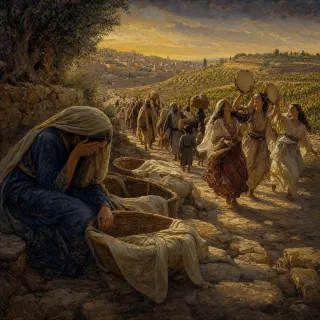
    Ramah is heard before it is described. A voice, lamentation, bitter weeping: the place enters through a mother's grief rather than through its buildings or defenses. Rachel stands as the ancestral mother of descendants who are absent. The repeated for her children keeps the lament from dissolving into a general statement about national misfortune. The loss has names and relationships, even when the verse does not list them.

    The reply does not argue that her children never mattered enough to justify the tears. It names the direction from which they will return: the land of the enemy, then their own border. Comfort is given the shape of a journey home. In this passage, the promise concerns return from displacement; it should not be silently converted into a different claim about the event.

    Matthew 2:17-18 carries Rachel's lament into Bethlehem's bereavement under Herod. That later use gives the older words another terrible setting without cancelling Jeremiah's setting of exile and promised return. The grief is not decorative. Neither is the promised homecoming.

    Verse by verse

    1. 31:15

      Rahel is the KJV spelling here of Rachel, mother of Joseph and Benjamin. Identifying Samuel's Ramah with this Ramah remains a geographical question, not a conclusion secured by the shared name.

    2. 31:16-17

      The promised return is explicitly from the enemy's land to the children's own border. Matthew's later quotation does not remove that original setting.

    Jeremiah 31:15-17

    King James Version · 3 verses

    31:15Thus saith the LORD; A voice was heard in Ramah, lamentation, and bitter weeping; Rahel weeping for her children refused to be comforted for her children, because they were not.

    31:16Thus saith the LORD; Refrain thy voice from weeping, and thine eyes from tears: for thy work shall be rewarded, saith the LORD; and they shall come again from the land of the enemy.

    31:17And there is hope in thine end, saith the LORD, that thy children shall come again to their own border.

    Jeremiah 31:15-17: A voice was heard in Ramah

Why it matters

That failure is what brings the delegation. All the elders of Israel gather themselves together and come to Samuel unto Ramah, and the request is careful and reasonable and devastating: make us a king to judge us like all the nations. The answer is a speech about what a king will do, stated as a list of takings, he will take your sons, your daughters, your fields, your servants, the tenth of your seed, and ye shall be his servants. They listen and say nevertheless. Samuel dies here and all Israel gathers to bury him.

4 songs

The music

Every song in the catalogue whose passage falls inside these chapters.

  1. 1 Samuel 7:2-8:22

    Hitherto Hath the LORD Helped Us

  2. 1 Samuel 8-10

    Give Us a King

  3. 1 Samuel 25:1-27:12

    Blessed Be Thy Advice

  4. Jeremiah 30:1-31:40

    A New Covenant

Nearby

All the places

Report an error on this page