
Places of the Bible

Rome

He wanted to go for years, and the way he finally arrived was at government expense, under guard.

There is a church in Rome before any apostle reaches it. Paul writes his longest and most careful letter to a congregation he has never met, and says plainly that he has been prevented from coming many times. When he does arrive it is as a prisoner on appeal, after a shipwreck, and the brethren come out to meet him as far as Appii forum and The three taverns, which is about forty miles down the road.

Where it appearsActs 28 · Romans 1 · Romans 8 · 2 Timothy 4

Scroll down to the account

The movements, in the order the text gives them.

The Account of Rome

  1. 01

    Romans 1:9-13

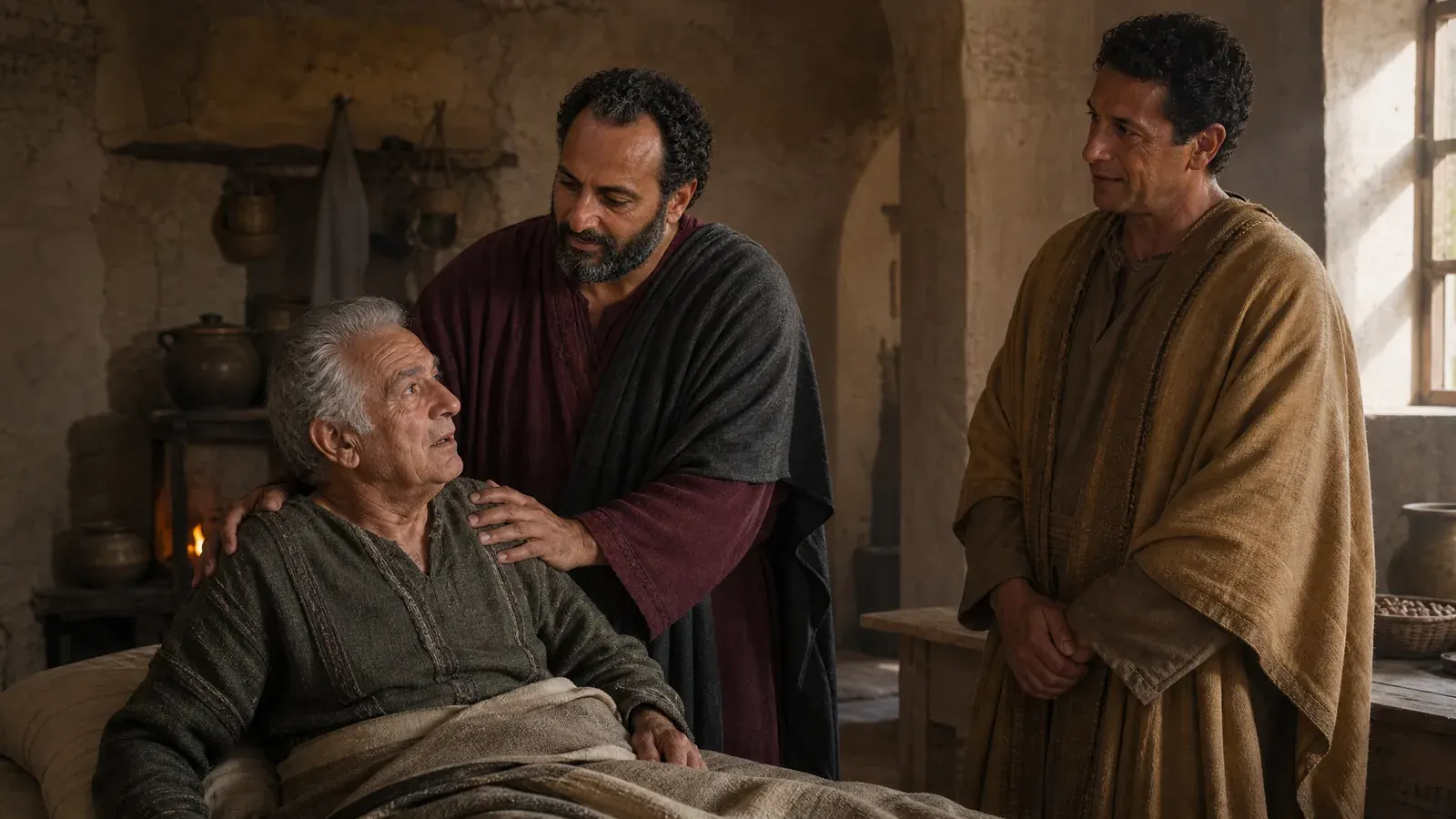
    Oftentimes I purposed to come unto you, but was let hitherto

    The letter opens by admitting a plan that has failed repeatedly, which is an unusual way to introduce yourself to strangers.

    Paul follows a promise to give with an admission that he expects to receive. That is, he adds, and the visit becomes an occasion for mutual encouragement. The apostle is not approaching Rome as a full vessel arriving among empty ones. Their faith will do something for him too.

    That small clarification matters because this is a congregation he has not founded by a visit. Its faith is already spoken of throughout the world in verse 8. His repeated prayers and frustrated plans establish a relationship before a personal arrival, but they do not make him the source of everything already happening there. Rome has believers before Rome has Paul.

    The wished-for prosperous journey is equally easy to misread. The request is for a way through, under God's will, not for a guarantee of agreeable transport. The Book of Acts eventually supplies the arrival after imprisonment, a storm, and shipwreck. The destination is reached; the itinerary has been another matter. In this paragraph the desire is strong, the plans are real, and the apostle still does not command the road.

    Verse by verse

    1. 1:10

      A prosperous journey here means a successful journey. The wording does not promise wealth, luxury, or freedom from danger along the route.

    2. 1:12

      Paul includes himself among those who will receive encouragement. The mutuality is explicit, not a courtesy inferred from his tone.

    3. 1:13

      Was let means was hindered in this older English usage, not was permitted. The verse does not identify a single cause for every delay.

    Romans 1:9-13

    King James Version · 5 verses

    1:9For God is my witness, whom I serve with my spirit in the gospel of his Son, that without ceasing I make mention of you always in my prayers;

    1:10Making request, if by any means now at length I might have a prosperous journey by the will of God to come unto you.

    1:11For I long to see you, that I may impart unto you some spiritual gift, to the end ye may be established;

    1:12That is, that I may be comforted together with you by the mutual faith both of you and me.

    1:13Now I would not have you ignorant, brethren, that oftentimes I purposed to come unto you, (but was let hitherto,) that I might have some fruit among you also, even as among other Gentiles.

    Romans 1:9-13: Oftentimes I purposed to come unto you, but was let hitherto
  2. 02

    Acts 28:15

    He thanked God, and took courage

    A delegation walks forty miles to meet a prisoner. The account records the effect on him rather than the size of the crowd.

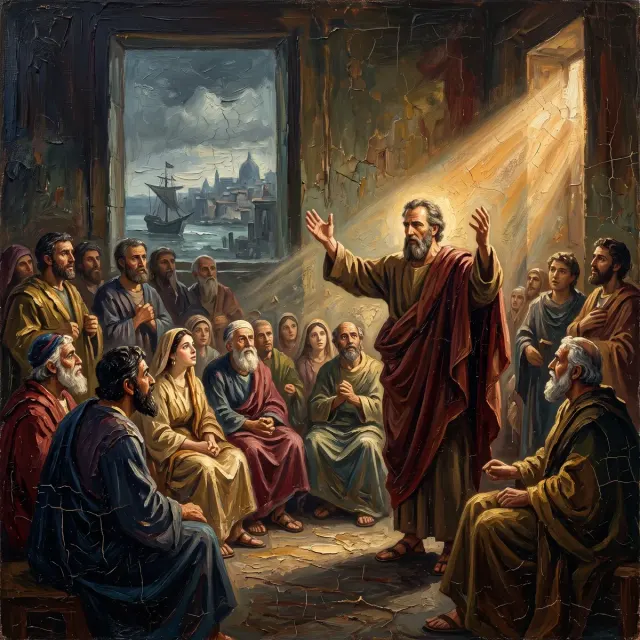
    The sight that gives Paul courage is a group of people, not the skyline of Rome. The sentence is exact: whom when Paul saw. After all the distance covered, the welcome matters enough for the Book of Acts to record both his thanksgiving and his renewed courage.

    These believers have not waited for the prisoner to reach their doorstep. They come out to meet him, and two named places locate their effort along the approach. Their presence does not release him from custody or settle his appeal. It changes the arrival without changing his legal circumstances. The man entering under guard is also being received as a brother.

    Romans 1:12 gives this encounter a particularly human resonance. Paul had hoped for encouragement through the Romans' faith as well as for opportunities to strengthen them. Here the encouragement reaches him before the city does. The passage needs no invented speech of welcome and no claim that he had lost all hope. It records the visible effect of people who came to meet him. The welcome has already done work.

    Verse by verse

    1. 28:15

      Appii forum and The three taverns are place names, not a statement that the group visited three drinking establishments. The verse names two meeting locations.

    2. 28:15

      Paul's thanksgiving and courage are stated responses. The text does not describe the precise words spoken by those who met him.

    Acts 28:15

    King James Version · 1 verse

    28:15And from thence, when the brethren heard of us, they came to meet us as far as Appii forum, and The three taverns: whom when Paul saw, he thanked God, and took courage.

    Acts 28:15: He thanked God, and took courage
  3. 03

    Acts 28:30-31

    No man forbidding him

    The book ends on an adverb rather than a verdict, and the last thing it reports is that nobody was stopping him.

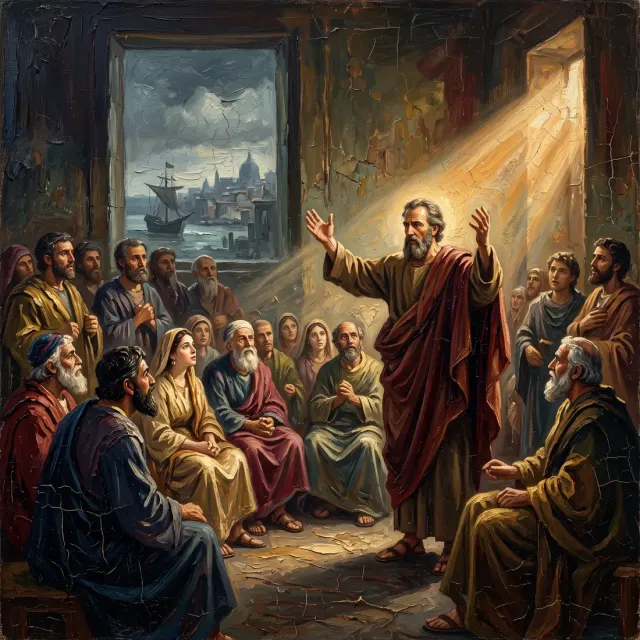
    The Book of Acts ends with an open door, not a courtroom verdict. Paul receives those who come, and teaching continues. The two years are counted, but the outcome of the appeal is not supplied in the final sentence. The book refuses to make a legal disposition its last concern.

    There is a deliberate contrast between the visitor's access and the host's restriction. Earlier in this chapter Paul has named his chain. The rented accommodation has not turned him into a free traveler, and his own hired house is not an announcement that he has bought property in Rome. He can receive people where he cannot simply choose to leave.

    The kingdom of God also brings the ending back to the beginning. Acts 1:3 describes the risen Jesus speaking about that kingdom; Acts 28:31 closes with Paul proclaiming it. The geographical reach has changed enormously, but the subject has not been exchanged for a message about Paul's achievements. His circumstances remain restricted. The final emphasis falls on speech that is not being stopped.

    Verse by verse

    1. 28:30

      The two-year residence is stated without an accompanying verdict. Release or execution should not be inserted into these verses as though the book reports it here.

    2. 28:31

      Confidence translates parrhesia, bold or open speech. The absence of interference with this teaching is not a claim that all Christians everywhere enjoyed legal immunity.

    Acts 28:30-31

    King James Version · 2 verses

    28:30And Paul dwelt two whole years in his own hired house, and received all that came in unto him,

    28:31Preaching the kingdom of God, and teaching those things which concern the Lord Jesus Christ, with all confidence, no man forbidding him.

    Acts 28:30-31: No man forbidding him
  4. 04

    Romans 8:38-39

    Nor things present, nor things to come

    The list of what cannot separate is written to people living in the capital of the power that would eventually try.

    Death comes first in the list, and the sentence does not say it will be prevented. It says death cannot accomplish a separation. That distinction keeps this immense declaration from becoming a promise Paul has not made.

    The preceding verses have already named persecution, hunger, exposure, danger, and the sword. They even quote Psalm 44's language about sheep for slaughter. Paul has not forgotten suffering between one paragraph and the next. His certainty is stated in its presence. The repeated nor keeps denying one possible separating power after another, across life and death, time and space, the visible scale of things and the powers beyond ordinary sight.

    The final phrase gathers the whole argument into Christ Jesus. This is not an abstract claim that affection somehow survives everything. Earlier in the chapter God's love has been located in the giving of the Son, and Christ's death, resurrection, and intercession have been named. I am persuaded rests on those acts, not on a favorable forecast. The list is vast because the claim is precise: no created power can make that love fail.

    Verse by verse

    1. 8:38

      Principalities and powers name categories of authority or power. Their exact classification is debated; the verse does not provide a roster of identifiable beings.

    2. 8:39

      The love named here is God's love in Christ Jesus. The claim concerns the inability of the listed powers to sever that bond, not the absence of hardship.

    Romans 8:38-39

    King James Version · 2 verses

    8:38For I am persuaded, that neither death, nor life, nor angels, nor principalities, nor powers, nor things present, nor things to come,

    8:39Nor height, nor depth, nor any other creature, shall be able to separate us from the love of God, which is in Christ Jesus our Lord.

    Romans 8:38-39: Nor things present, nor things to come
  5. 05

    2 Timothy 4:9-18

    At my first answer no man stood with me

    The last letter asks for a cloak, some books, and a visit before winter, and forgives everyone who left.

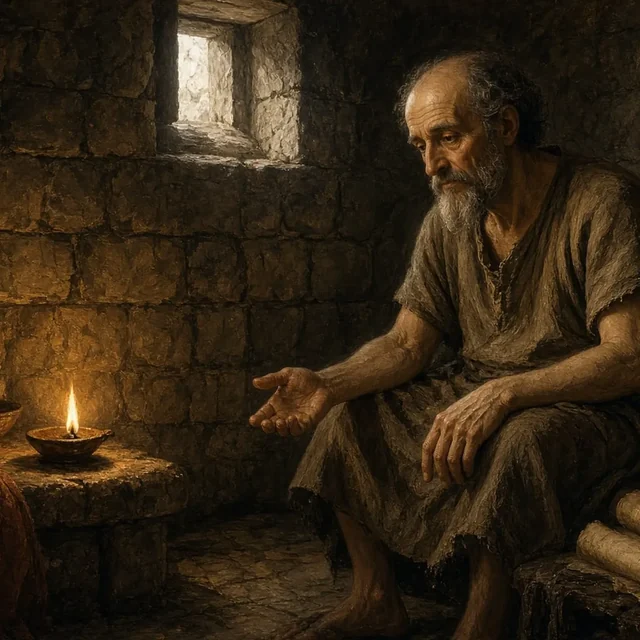
    The cloak belongs in the same passage as the heavenly kingdom. Paul needs Timothy, asks for books, singles out the parchments, and later says to come before winter. The confidence at the paragraph's end does not dissolve these ordinary needs. A man expecting a crown still needs his coat.

    The absent colleagues require careful reading. Demas has forsaken him, and a reason is given. Crescens and Titus have gone elsewhere without the same accusation, while Tychicus has been sent by Paul himself. Turning every departure into betrayal would be forceful writing at the cost of falsehood. Mark, meanwhile, is profitable for the ministry. The man whose earlier departure helped occasion the separation in Acts 15:37-39 is now specifically requested. The text gives the changed assessment without supplying a reunion scene.

    At the first defense, human support failed; the Lord stood with him. The strengthening had a stated purpose: the proclamation was to be fully heard. Paul asks that the desertion not be charged against those who abandoned him, even while naming Alexander's opposition bluntly. Then deliverance opens onto the heavenly kingdom. Read beside the approaching departure in verses 6-8, that assurance cannot simply mean that Paul expects never to die. The end he trusts is larger than acquittal. The letter leaves the need for companionship intact, and the request for the cloak remains on the page.

    Verse by verse

    1. 4:10-12

      Demas alone in this list is explicitly said to have forsaken Paul for love of the present world. Tychicus's absence is an assignment, not a desertion.

    2. 4:11

      Acts 15:37-39 records the earlier dispute concerning Mark. This request supplies evidence of renewed usefulness without explaining every stage of the reconciliation.

    3. 4:13

      Cloke is the King James spelling of cloak. The request is followed in verse 21 by the urgency of arriving before winter.

    4. 4:16

      First answer refers to a legal defense. It does not by itself identify this event with Paul's first Roman imprisonment; Rome is explicitly named in 2 Timothy 1:17.

    5. 4:17-18

      The lion's mouth is language of mortal danger, also found in Psalm 22:21. The verse does not establish that Paul survived an actual encounter with arena lions.

    2 Timothy 4:9-18

    King James Version · 10 verses

    4:9Do thy diligence to come shortly unto me:

    4:10For Demas hath forsaken me, having loved this present world, and is departed unto Thessalonica; Crescens to Galatia, Titus unto Dalmatia.

    4:11Only Luke is with me. Take Mark, and bring him with thee: for he is profitable to me for the ministry.

    4:12And Tychicus have I sent to Ephesus.

    4:13The cloke that I left at Troas with Carpus, when thou comest, bring with thee, and the books, but especially the parchments.

    4:14Alexander the coppersmith did me much evil: the Lord reward him according to his works:

    4:15Of whom be thou ware also; for he hath greatly withstood our words.

    4:16At my first answer no man stood with me, but all men forsook me: I pray God that it may not be laid to their charge.

    4:17Notwithstanding the Lord stood with me, and strengthened me; that by me the preaching might be fully known, and that all the Gentiles might hear: and I was delivered out of the mouth of the lion.

    4:18And the Lord shall deliver me from every evil work, and will preserve me unto his heavenly kingdom: to whom be glory for ever and ever. Amen.

    2 Timothy 4:9-18: At my first answer no man stood with me

Why it matters

Acts ends without a verdict, which is either an accident of publication or the most deliberate ending in the New Testament. Paul spends two whole years in his own hired house, receiving all that came in unto him, preaching with all confidence, no man forbidding him. The last two words in the Greek are the point. Later, in a second letter to Timothy, the tone has changed: a cloke left at Troas, a request to come before winter, and at my first answer no man stood with me. The same city holds both.

3 songs

The music

Every song in the catalogue whose passage falls inside these chapters.

  1. Acts 28:11-31

    Preaching the Kingdom with All Confidence

  2. Romans 1:1-3:31

    All Have Sinned

  3. Romans 8:1-39

    No Condemnation

Nearby

All the places

Report an error on this page