The big picture
An invading alliance approaches Judah, the southern kingdom of God's people. Jehoshaphat, its king, fears the threat and gathers the people to seek God. Moab and Ammon, neighbouring peoples, are among the attackers. Families stand with their children at the temple, the house of worship in Jerusalem, the royal city. God answers through a Levite, a member of the tribe assigned to sacred service. Judah will go out, but it will not win by fighting.
In this chapter
- Fear Leads the King to Seek Help 2 Chronicles 20:1-4
Reports reach Jehoshaphat that a vast force is coming from beyond the sea and has reached En-gedi, a settlement in his land.
- The Gathered Families Stand in Need 2 Chronicles 20:5-13
Jehoshaphat prays before the gathered families.
- God Promises Rescue Without Their Fighting 2 Chronicles 20:14-19
Jahaziel, a Levite in the crowd, receives God's spirit.
- Singers Lead as the Invaders Turn on Themselves 2 Chronicles 20:20-23
Judah leaves early, and Jehoshaphat urges trust in God and his prophets.
- Spoils and Praise Follow the Rescue 2 Chronicles 20:24-30
Judah reaches the lookout and sees dead bodies everywhere, with no one escaped.
- A Faithful Reign Still Has Serious Failures 2 Chronicles 20:31-37
Jehoshaphat rules twenty-five years and generally follows his father Asa's right path.
Central truth
Judah admits its helplessness and trusts God's promise, then finds the invading alliance destroyed without having to fight the battle itself.
Scripture beside the summary
2 Chronicles · King James Version · 372 Chronicles 20:1-4
Fear Leads the King to Seek Help
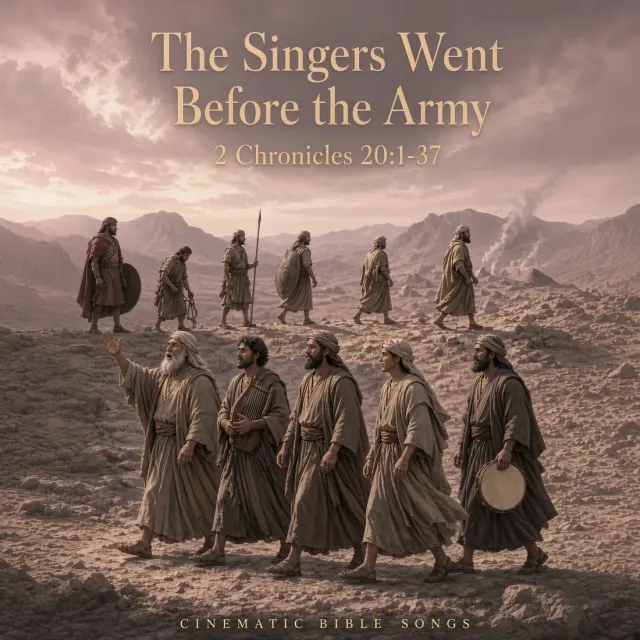
Reports reach Jehoshaphat that a vast force is coming from beyond the sea and has reached En-gedi, a settlement in his land. He is afraid. Rather than hiding that fear or making a quick alliance, he sets himself to seek God. He orders a fast, a time without food joined to seeking help, across Judah. People come from all the towns to ask God for aid. The first response gathers the kingdom around its need. The threat is real, and fear becomes a reason for prayer rather than a claim of self-sufficiency.
In everyday life
The airport duty chief receives news of a major failure affecting incoming flights. She admits the scale of the problem and calls every relevant team together before acting. Pretending calm is not enough; help must be sought openly. Her fear sharpens the need for a shared response. Jehoshaphat gathers Judah specifically to fast and seek God.
Notice
2 Chronicles 20:3 The king's fear is named before his decision to seek God. The account does not require him to feel unafraid before he turns toward the source of help.
2 Chronicles 20:1-4
King James Version1It came to pass after this also, that the children of Moab, and the children of Ammon, and with them other beside the Ammonites, came against Jehoshaphat to battle.
2Then there came some that told Jehoshaphat, saying, There cometh a great multitude against thee from beyond the sea on this side Syria; and, behold, they be in Hazazon-tamar, which is En-gedi.
3And Jehoshaphat feared, and set himself to seek the LORD, and proclaimed a fast throughout all Judah.
4And Judah gathered themselves together, to ask help of the LORD: even out of all the cities of Judah they came to seek the LORD.
2 Chronicles 20:5-13
The Gathered Families Stand in Need
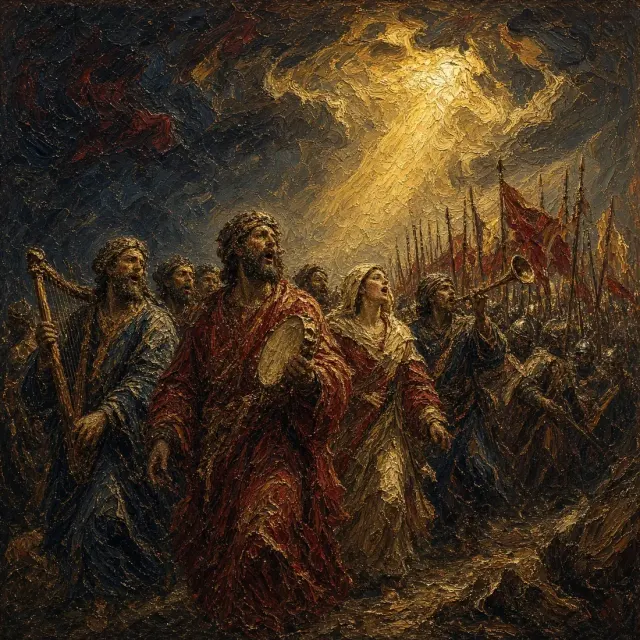
Jehoshaphat prays before the gathered families. God rules all kingdoms and gave this land to Abraham's descendants, Israel's people. Abraham was their ancestor and God's friend. They built the house as a place to cry for help in disaster. Now peoples once spared by Israel seek to drive them from God's gift. The king asks God to judge them. Judah lacks strength against the force and does not know what to do, so its eyes turn to God. Men, women and children stand together. The prayer exposes need instead of covering it with royal confidence.
In everyday life
The single parent spreads overdue bills on a community adviser's desk with her children beside her. She stops pretending to have a hidden plan and says she cannot solve the crisis alone. The request becomes clear when the lack is named. Every family member lives under the same threat. Judah's king appeals to God's rule and promise of land.
Notice
2 Chronicles 20:12 Jehoshaphat openly admits both lack of strength and lack of a plan. The confession gives the whole gathering a truthful place from which to seek God.
2 Chronicles 20:5-13
King James Version5And Jehoshaphat stood in the congregation of Judah and Jerusalem, in the house of the LORD, before the new court,
6And said, O LORD God of our fathers, art not thou God in heaven? and rulest not thou over all the kingdoms of the heathen? and in thine hand is there not power and might, so that none is able to withstand thee?
7Art not thou our God, who didst drive out the inhabitants of this land before thy people Israel, and gavest it to the seed of Abraham thy friend for ever?
8And they dwelt therein, and have built thee a sanctuary therein for thy name, saying,
9If, when evil cometh upon us, as the sword, judgment, or pestilence, or famine, we stand before this house, and in thy presence, (for thy name is in this house,) and cry unto thee in our affliction, then thou wilt hear and help.
10And now, behold, the children of Ammon and Moab and mount Seir, whom thou wouldest not let Israel invade, when they came out of the land of Egypt, but they turned from them, and destroyed them not;
11Behold, I say, how they reward us, to come to cast us out of thy possession, which thou hast given us to inherit.
12O our God, wilt thou not judge them? for we have no might against this great company that cometh against us; neither know we what to do: but our eyes are upon thee.
13And all Judah stood before the LORD, with their little ones, their wives, and their children.
2 Chronicles 20:14-19
God Promises Rescue Without Their Fighting
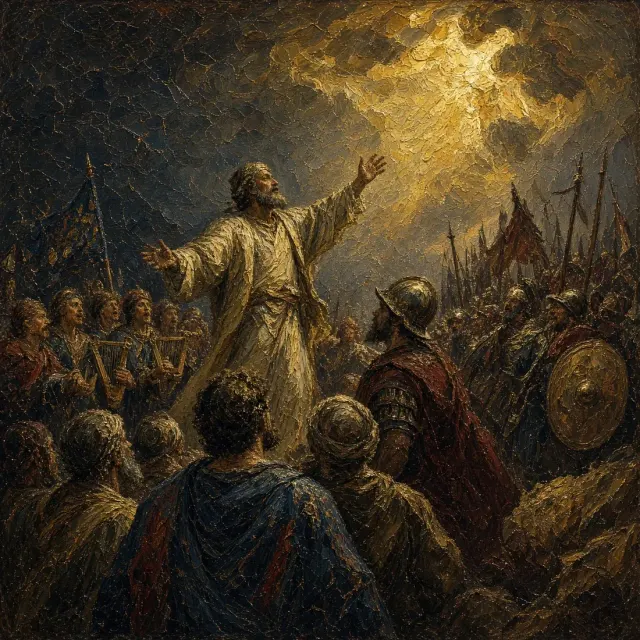
Jahaziel, a Levite in the crowd, receives God's spirit. He tells the king and people not to fear the multitude because the battle belongs to God. They must go out the next day to a named route where the enemy will approach. They will not need to fight; they are to take their places and see God's rescue. Jehoshaphat and the people bow in worship. Other Levites rise to praise loudly. The promise does not tell Judah to ignore the danger at home. It tells them how to face it in trust.
In everyday life
The flood rescue officer tells a trapped family to reach the marked upper landing and wait for the crew. They still have a real step to take, but they are not being asked to cross the current themselves. The instructions distinguish their part from the rescue team's work. God promises Judah a battle won without its fighting.
Notice
2 Chronicles 20:17 The promise of rescue still includes an instruction to go out and stand. Judah's trust has an assigned action, even though defeating the enemy will not be its work.
2 Chronicles 20:14-19
King James Version14Then upon Jahaziel the son of Zechariah, the son of Benaiah, the son of Jeiel, the son of Mattaniah, a Levite of the sons of Asaph, came the Spirit of the LORD in the midst of the congregation;
15And he said, Hearken ye, all Judah, and ye inhabitants of Jerusalem, and thou king Jehoshaphat, Thus saith the LORD unto you, Be not afraid nor dismayed by reason of this great multitude; for the battle is not yours, but God’s.
16To morrow go ye down against them: behold, they come up by the cliff of Ziz; and ye shall find them at the end of the brook, before the wilderness of Jeruel.
17Ye shall not need to fight in this battle: set yourselves, stand ye still, and see the salvation of the LORD with you, O Judah and Jerusalem: fear not, nor be dismayed; to morrow go out against them: for the LORD will be with you.
18And Jehoshaphat bowed his head with his face to the ground: and all Judah and the inhabitants of Jerusalem fell before the LORD, worshipping the LORD.
19And the Levites, of the children of the Kohathites, and of the children of the Korhites, stood up to praise the LORD God of Israel with a loud voice on high.
2 Chronicles 20:20-23
Singers Lead as the Invaders Turn on Themselves
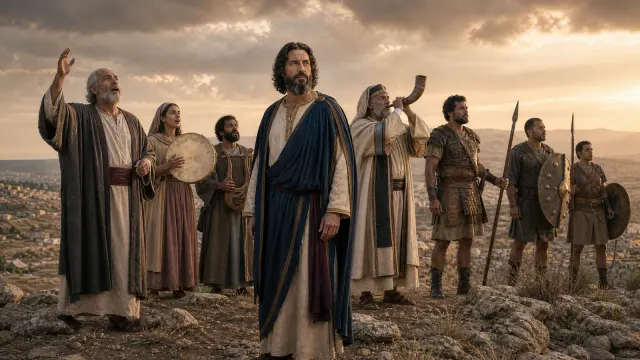
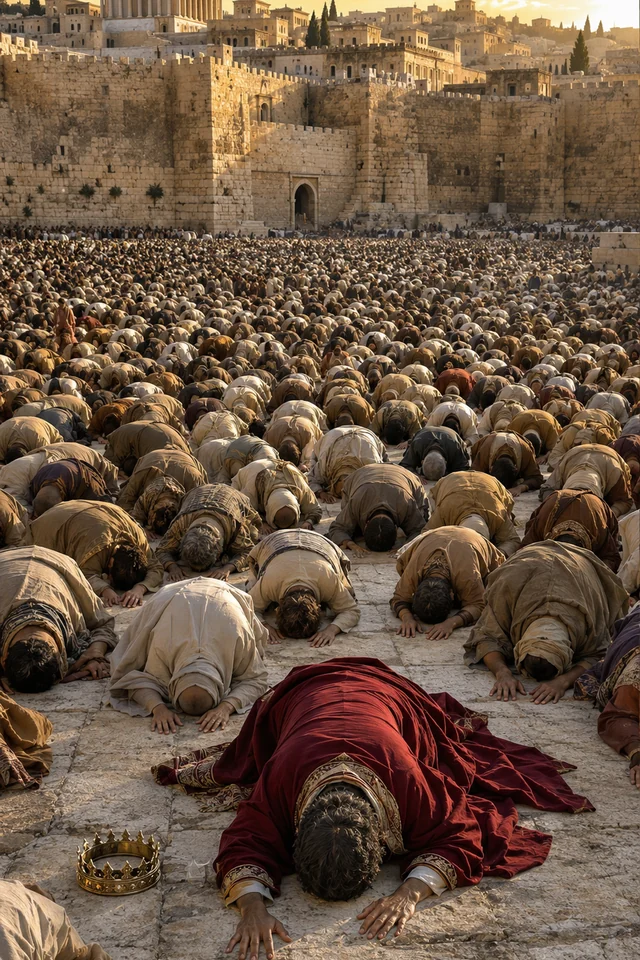
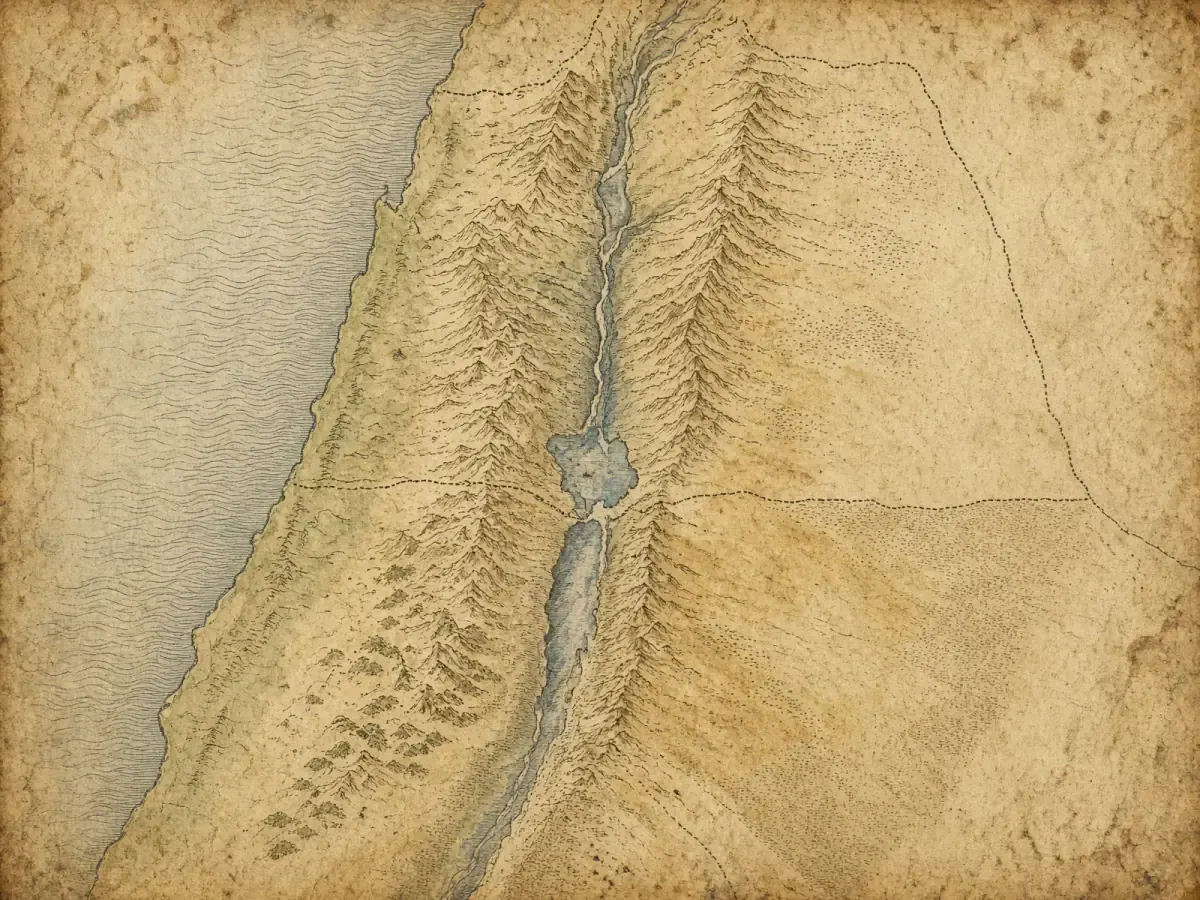
Judah leaves early, and Jehoshaphat urges trust in God and his prophets. After consulting the people, he puts singers before the army to praise God's holy splendour and lasting mercy. As they begin, God sets ambushes against the invaders. Moab and Ammon attack the people from mount Seir, their allies, and destroy them. They then turn on one another. The force that threatened Judah breaks apart through its own violence. The praise comes before Judah has seen the outcome, resting on the promise already received.
In everyday life
The evacuation marshal hears frightened residents begin a familiar song while waiting for news from outside. The singing does not deny the danger; it helps them hold to the instructions they have been given. Their attention stays together while events remain out of sight. Judah's singers praise God before he causes the invading force to destroy itself.
Notice
2 Chronicles 20:22 The singing begins before Judah sees the enemy's defeat. Praise here answers a promise already heard rather than following a victory the people have watched themselves win.
2 Chronicles 20:20-23
King James Version20And they rose early in the morning, and went forth into the wilderness of Tekoa: and as they went forth, Jehoshaphat stood and said, Hear me, O Judah, and ye inhabitants of Jerusalem; Believe in the LORD your God, so shall ye be established; believe his prophets, so shall ye prosper.
21And when he had consulted with the people, he appointed singers unto the LORD, and that should praise the beauty of holiness, as they went out before the army, and to say, Praise the LORD; for his mercy endureth for ever.
22And when they began to sing and to praise, the LORD set ambushments against the children of Ammon, Moab, and mount Seir, which were come against Judah; and they were smitten.
23For the children of Ammon and Moab stood up against the inhabitants of mount Seir, utterly to slay and destroy them: and when they had made an end of the inhabitants of Seir, every one helped to destroy another.
2 Chronicles 20:24-30
Spoils and Praise Follow the Rescue
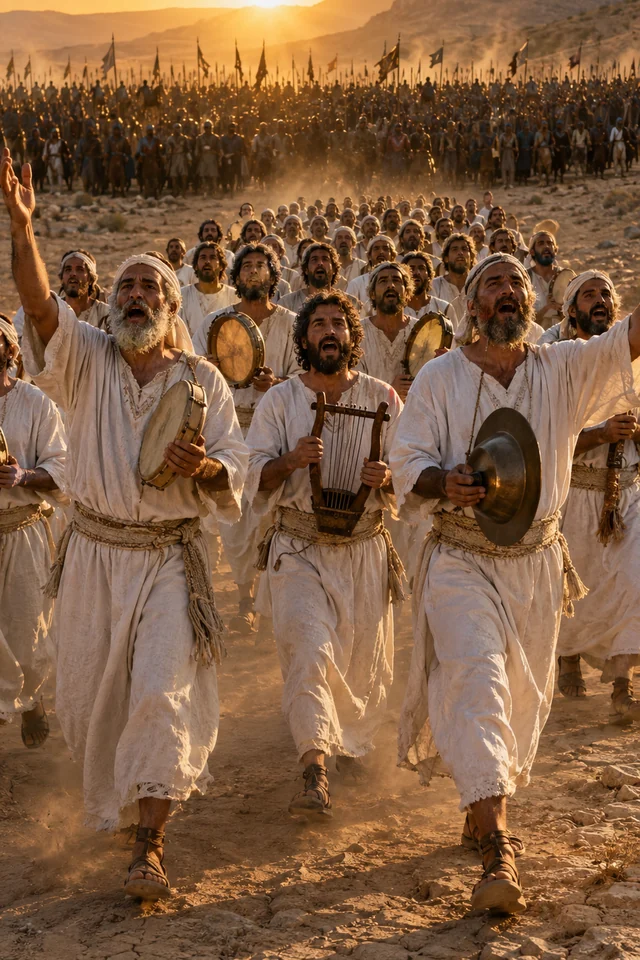
Judah reaches the lookout and sees dead bodies everywhere, with no one escaped. The people collect so much wealth and goods that it takes three days. On the fourth they gather in the valley of Berachah, a place named for blessing God there. They return to Jerusalem with music and joy because God has made them rejoice over their enemies. Nearby kingdoms hear that God fought for Israel and fear him. Jehoshaphat's realm has rest. The rescue brings peace and wealth, but the account does not hide the many dead left on the ground.
In everyday life
The aid coordinator returns to a town after a threat has passed and hears bells ringing in the square. Residents are thankful to be alive, while teams still record losses outside the celebration. Relief and the weight of death remain close together. Safety does not make every part of the event light. Judah gathers spoils from a divinely defeated army.
Notice
2 Chronicles 20:29 The neighbouring kingdoms respond to news that God fought for Israel. The later peace is linked to that report, not only to the goods Judah brings home.
2 Chronicles 20:24-30
King James Version24And when Judah came toward the watch tower in the wilderness, they looked unto the multitude, and, behold, they were dead bodies fallen to the earth, and none escaped.
25And when Jehoshaphat and his people came to take away the spoil of them, they found among them in abundance both riches with the dead bodies, and precious jewels, which they stripped off for themselves, more than they could carry away: and they were three days in gathering of the spoil, it was so much.
26And on the fourth day they assembled themselves in the valley of Berachah; for there they blessed the LORD: therefore the name of the same place was called, The valley of Berachah, unto this day.
27Then they returned, every man of Judah and Jerusalem, and Jehoshaphat in the forefront of them, to go again to Jerusalem with joy; for the LORD had made them to rejoice over their enemies.
28And they came to Jerusalem with psalteries and harps and trumpets unto the house of the LORD.
29And the fear of God was on all the kingdoms of those countries, when they had heard that the LORD fought against the enemies of Israel.
30So the realm of Jehoshaphat was quiet: for his God gave him rest round about.
2 Chronicles 20:31-37
A Faithful Reign Still Has Serious Failures
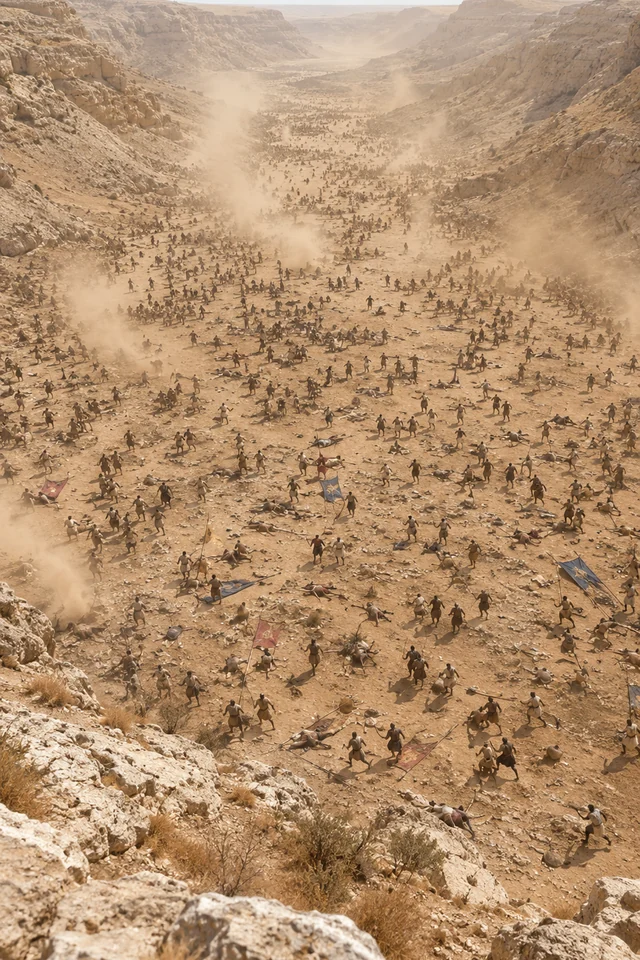
Jehoshaphat rules twenty-five years and generally follows his father Asa's right path. Yet worship sites remain because the people have not fully directed their hearts toward God. Later he joins Ahaziah, Israel's wicked king, to build trading ships at Ezion-geber, a port. Eliezer, a prophet, announces that God has broken the work because of the alliance. The ships are wrecked before they can sail to Tarshish, their destination. The final assessment includes both good and failure. Earlier rescue has not made every later partnership sound.
In everyday life
The charity trustee reviews a year that includes both strong service and a failed deal with an unreliable partner. She refuses to let the good work excuse the contract that ignored a known warning. A mixed record needs a clear account of each choice. Past success cannot approve a new alliance. Jehoshaphat's ships are broken under God's announced judgement.
Notice
2 Chronicles 20:37 The prophet ties the lost ships to the chosen partnership. Their failure is not presented as random bad luck after an otherwise unquestioned business decision.
2 Chronicles 20:31-37
King James Version31And Jehoshaphat reigned over Judah: he was thirty and five years old when he began to reign, and he reigned twenty and five years in Jerusalem. And his mother’s name was Azubah the daughter of Shilhi.
32And he walked in the way of Asa his father, and departed not from it, doing that which was right in the sight of the LORD.
33Howbeit the high places were not taken away: for as yet the people had not prepared their hearts unto the God of their fathers.
34Now the rest of the acts of Jehoshaphat, first and last, behold, they are written in the book of Jehu the son of Hanani, who is mentioned in the book of the kings of Israel.
35And after this did Jehoshaphat king of Judah join himself with Ahaziah king of Israel, who did very wickedly:
36And he joined himself with him to make ships to go to Tarshish: and they made the ships in Ezion-geber.
37Then Eliezer the son of Dodavah of Mareshah prophesied against Jehoshaphat, saying, Because thou hast joined thyself with Ahaziah, the LORD hath broken thy works. And the ships were broken, that they were not able to go to Tarshish.
Details worth noticing
The opening image
2 Chronicles 20:1 begins with “It came to pass after this also, that the children of Moab, and the children of Ammon, and with them other beside the Ammonites, came against Jehoshaphat…”
Where the chapter turns
2 Chronicles 20:14 forms a natural hinge: “Then upon Jahaziel the son of Zechariah, the son of Benaiah, the son of Jeiel, the son of Mattaniah, a Levite of the sons of Asaph, came the Spirit of the…”
The final note
2 Chronicles 20:37 leaves the reader with “Then Eliezer the son of Dodavah of Mareshah prophesied against Jehoshaphat, saying, Because thou hast joined thyself with Ahaziah, the LORD hath broken thy…”
A word trail through the chapter
The words LORD, Jehoshaphat, Judah, Jerusalem, children, inhabitants help reveal the chapter’s repeated concerns.
KJV words made clear
- behold
- look, or pay close attention
- unto
- to
- thee
- you
- thou
- you
- thy
- your
Music and video connected to the passage
Related media appears when its Scripture reference overlaps this study. Music and video can illuminate a theme while the biblical text remains the foundation.