


Jonah 1:3
He paid the fare thereof
The detail about paying is the one that stings. Running costs money, and the account records that he found a ship already going.
Verse by verse
- 1:3
The Hebrew repeats yarad, go down, for the movement to Joppa and into the ship; the downward wording continues in 1:5.
- 1:3
The fare is an actual payment for the voyage; neither its amount nor the claim that Jonah bought the entire vessel is stated.
- 1:3
Tarshish is commonly associated with a distant Mediterranean destination, but its precise identification is disputed.
- 1:3
Jonah 4:2 later supplies his own explanation for the flight: he knew God's gracious and merciful character.


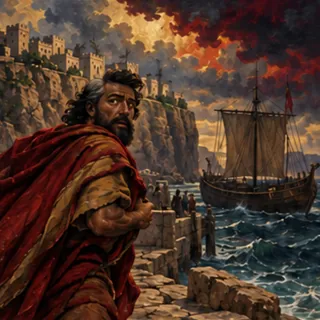








The ship is available, the destination is suitable, and Jonah has the money. Every practical arrangement works. The direction is still disobedience. The Book of Jonah gives the purchase unusual attention because this is not a prophet carried unwillingly away from his task. He pays to go.
Tarshish appears three times in a single verse, while from the presence of the LORD appears twice. Destination and purpose are being hammered together. Jonah has been told to rise and go to Nineveh; he does rise, but uses the motion to leave. Then the repeated direction is downward: down to Joppa, down into the ship, and, in the following verses, farther down into its interior. The geography records a real journey while its verbal pattern makes the flight unmistakable.
The exact identification of Tarshish remains disputed, but the force of the passage does not depend on drawing a confidently modern map. The chosen destination is not the commanded one. Nor does the language require the assumption that Jonah has forgotten who made the sea. In 1:9 he explicitly identifies the LORD as its maker. He is trying to escape a commission from the God whose territory includes the route of escape. The fare purchases passage, not release.