

The big picture
The letter reaches its closing charge with death in view. Paul, the imprisoned messenger addressing Timothy, expects his service to end soon. Timothy is the younger worker who must continue preaching. Jesus Christ, their Lord, will judge both living and dead when he appears. That future gives weight to the work. Alongside these solemn words come urgent needs: a visit, a cloak, and books. Friends have left, others send greetings, and Paul remembers a hearing where no human supporter stood beside him.
In this chapter
- Keep Teaching When Hearers Resist 2 Timothy 4:1-5
Paul gives Timothy his charge before God and Jesus, the coming judge.
- Service Nears Its Final End 2 Timothy 4:6-8
Approaching death becomes, for Paul, an offering poured out.
- Bring Companions Books and a Cloak 2 Timothy 4:9-15
Paul urges Timothy to come soon.
- The Lord Stays When Others Leave 2 Timothy 4:16-18
At his first hearing, Paul had no one beside him.
- Greetings Before Winter Comes 2 Timothy 4:19-22
Greetings go to Prisca and Aquila, two fellow believers, and the household of Onesiphorus, a friend who helped him.
Central truth
Facing death and desertion, Paul urges Timothy to keep preaching and asks for help while trusting the Lord to preserve him.
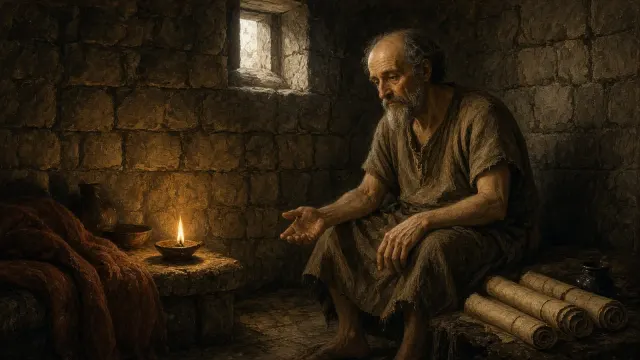

Scripture beside the summary
2 Timothy · King James Version · 222 Timothy 4:1-5
Keep Teaching When Hearers Resist
Paul gives Timothy his charge before God and Jesus, the coming judge. He must proclaim the message whether the time feels welcome or not. Correction, rebuke, and encouragement all need patience and teaching. Paul warns that listeners will reject sound instruction. They will collect teachers who tell them what their desires want to hear and turn instead to invented accounts. Timothy must remain clear-headed, endure hardship, and carry out his work fully. His task is to announce good news faithfully, not to shape it around each audience's wishes.
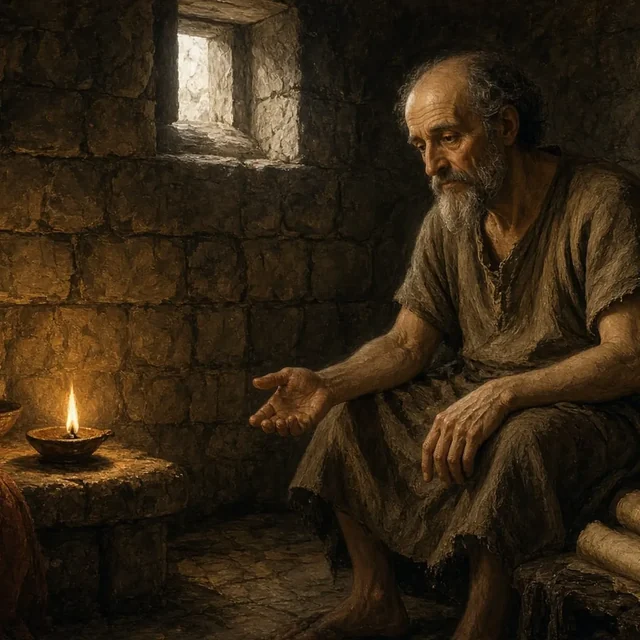
In everyday life
A ski patroller posts an avalanche warning across the trail entrance while impatient skiers gather behind him. They prefer a reassuring answer and point toward guides willing to take them uphill. He keeps the barrier in place and explains the danger with patience. Paul guards truthful teaching, not a slope closed for unsafe snow.
Notice
2 Timothy 4:3 The listeners gather teachers to suit their own desires. The failure is not limited to dishonest speakers; the audience helps create a demand for pleasing claims.
2 Timothy 4:1-5
King James Version1I charge thee therefore before God, and the Lord Jesus Christ, who shall judge the quick and the dead at his appearing and his kingdom;
2Preach the word; be instant in season, out of season; reprove, rebuke, exhort with all longsuffering and doctrine.
3For the time will come when they will not endure sound doctrine; but after their own lusts shall they heap to themselves teachers, having itching ears;
4And they shall turn away their ears from the truth, and shall be turned unto fables.
5But watch thou in all things, endure afflictions, do the work of an evangelist, make full proof of thy ministry.
2 Timothy 4:6-8
Service Nears Its Final End
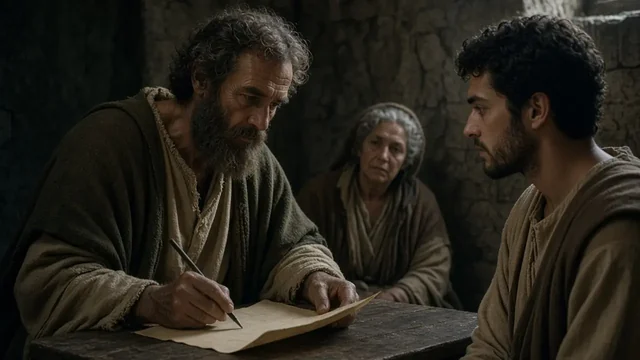
Approaching death becomes, for Paul, an offering poured out. He has fought his fight, finished his race, and remained faithful. These images look back on a completed course of service, not on an escape from hardship. He looks ahead to a crown of righteousness from the Lord, the fair judge. The reward is not reserved for him alone. It belongs also to those who long for Jesus to appear. Paul's confidence joins the end of his own work with a hope shared by many other believers.
In everyday life
An old sailor rests in bed at home with his sea chest open beside him. He asks his daughter to return a borrowed tool and closes the log from his last voyage. He speaks of work finished while his family faces the coming loss. Paul expects a reward from the risen Lord after death.
Notice
2 Timothy 4:8 Paul immediately shares the promised reward with others who welcome the Lord's appearing. His confidence is personal. Yet he does not claim a private hope no one else can have.
2 Timothy 4:6-8
King James Version6For I am now ready to be offered, and the time of my departure is at hand.
7I have fought a good fight, I have finished my course, I have kept the faith:
8Henceforth there is laid up for me a crown of righteousness, which the Lord, the righteous judge, shall give me at that day: and not to me only, but unto all them also that love his appearing.
2 Timothy 4:9-15
Bring Companions Books and a Cloak
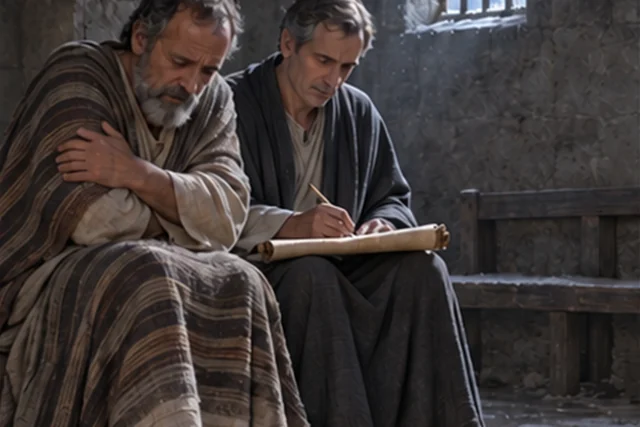
Paul urges Timothy to come soon. Demas, a former companion, chose this life and left for Thessalonica, a city. Fellow workers Crescens and Titus went to Galatia and Dalmatia, two regions. Luke, another companion, remains. Mark, a useful fellow worker, should come too. Paul sent Tychicus, his messenger, to Ephesus, a city. His cloak and books remain in Troas, another city, with Carpus, their keeper. Timothy should bring them, especially the parchments. Alexander, a metalworker, harmed Paul and strongly opposed their message. Timothy must beware of him; Paul leaves repayment to the Lord.

In everyday life
The offshore engineer radios the supply crew with a short list: a warm coat, repair manuals, and a trusted mechanic. Several colleagues have rotated away, and the remaining pair cannot cover every fault. Large responsibilities sit beside ordinary needs for warmth and company. Paul makes these requests while expecting death in the service of Jesus.
Notice
2 Timothy 4:13 The request for a cloak and reading materials sits among solemn charges. Paul's hope for the future does not remove present needs for warmth and useful possessions.
2 Timothy 4:9-15
King James Version9Do thy diligence to come shortly unto me:
10For Demas hath forsaken me, having loved this present world, and is departed unto Thessalonica; Crescens to Galatia, Titus unto Dalmatia.
11Only Luke is with me. Take Mark, and bring him with thee: for he is profitable to me for the ministry.
12And Tychicus have I sent to Ephesus.
13The cloke that I left at Troas with Carpus, when thou comest, bring with thee, and the books, but especially the parchments.
14Alexander the coppersmith did me much evil: the Lord reward him according to his works:
15Of whom be thou ware also; for he hath greatly withstood our words.
2 Timothy 4:16-18
The Lord Stays When Others Leave
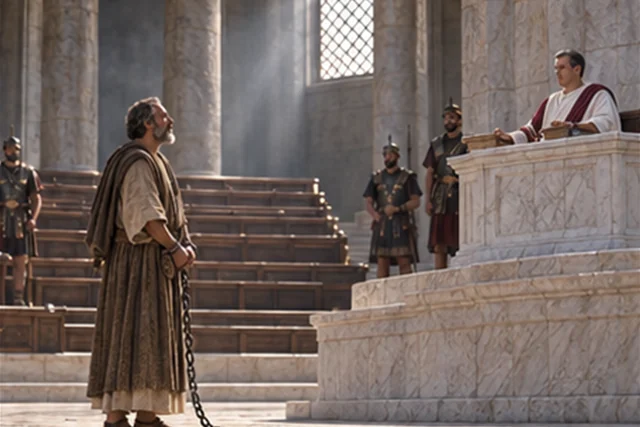
At his first hearing, Paul had no one beside him. Everyone left, but he asks that their failure not be counted against them. The Lord stood with him and gave him strength. That support allowed the message to be heard fully among the Gentiles, people outside the Jewish people. Paul describes his rescue as escape from a lion's mouth, a picture of deadly danger. He trusts the Lord to save him from evil and keep him for the heavenly kingdom. Since death is near, this hope cannot mean endless safety from dying.
In everyday life
A smallholder stands beside her dry well as an inspector arrives to assess a disputed water claim. Neighbours who promised support stay away. Her adviser unfolds the survey and helps her explain the loss despite her shaking hands. Paul credits the Lord with strength and preservation through death, not help to defend a water supply.
Notice
2 Timothy 4:18 Paul has already said his death is near. His trust in rescue therefore reaches to God's kingdom, rather than promising that no one can end his earthly life.
2 Timothy 4:16-18
King James Version16At my first answer no man stood with me, but all men forsook me: I pray God that it may not be laid to their charge.
17Notwithstanding the Lord stood with me, and strengthened me; that by me the preaching might be fully known, and that all the Gentiles might hear: and I was delivered out of the mouth of the lion.
18And the Lord shall deliver me from every evil work, and will preserve me unto his heavenly kingdom: to whom be glory for ever and ever. Amen.
2 Timothy 4:19-22
Greetings Before Winter Comes
Greetings go to Prisca and Aquila, two fellow believers, and the household of Onesiphorus, a friend who helped him. Erastus, another companion, stayed in Corinth, a city. Trophimus, a fellow worker, was left sick at Miletum, another town. Paul urges Timothy to arrive before winter. Eubulus, Pudens, Linus, and Claudia, believers with Paul, send greetings, as do the others. Their names place personal ties around his loneliness and urgent requests. He closes by asking for the Lord's presence with Timothy and grace for those receiving the letter.

In everyday life
The departing student checks a bus timetable as her grandmother lists relatives who send their love. One uncle is ill in another town, and a cousin has stayed behind to help. She asks the student to return before winter makes travel harder. Ordinary names carry affection across the distance. Paul adds prayer for the Lord's presence and grace.
Notice
2 Timothy 4:20 Trophimus remains sick despite belonging to this circle of faithful workers. Paul reports the illness without blaming him or suggesting that faith makes sickness impossible.
2 Timothy 4:19-22
King James Version19Salute Prisca and Aquila, and the household of Onesiphorus.
20Erastus abode at Corinth: but Trophimus have I left at Miletum sick.
21Do thy diligence to come before winter. Eubulus greeteth thee, and Pudens, and Linus, and Claudia, and all the brethren.
22The Lord Jesus Christ be with thy spirit. Grace be with you. Amen.
Details worth noticing
The opening image
2 Timothy 4:1 begins with “I charge thee therefore before God, and the Lord Jesus Christ, who shall judge the quick and the dead at his appearing and his kingdom;”
Where the chapter turns
2 Timothy 4:5 forms a natural hinge: “But watch thou in all things, endure afflictions, do the work of an evangelist, make full proof of thy ministry.”
The final note
2 Timothy 4:22 leaves the reader with “The Lord Jesus Christ be with thy spirit. Grace be with you. Amen.”
A word trail through the chapter
The words Lord, Amen, appearing, charge, Christ, diligence help reveal the chapter’s repeated concerns.
KJV words made clear
- quick
- Living people, contrasted here with those who have died.
- evangelist
- A person whose work is to proclaim the good news about Jesus.
- parchments
- Sheets made from prepared animal skin and used for writing.
- cloke
- An outer garment used to cover the body and keep warm.
Music and video connected to the passage
No exact media match is cataloged for this passage yet. New material can be connected when it becomes available.