
The big picture
Two priests have died, and their deaths stand behind these instructions. God tells Moses, Israel's leader, how Aaron, the chief priest and his brother, must enter the innermost part of the worship tent. Israel, the people whose sins and uncleanness affect the sanctuary, needs a yearly act of cleansing. A veil normally bars this inner space. Aaron cannot approach it whenever he chooses, even though he leads the priestly service.
In this chapter
- Aaron Must Enter on God's Terms Leviticus 16:1-5
God warns Aaron through Moses not to enter the inner holy place whenever he wishes.
- Two Goats Receive Different Roles Leviticus 16:6-10
Aaron first provides atonement for himself and his household with the bull.
- Blood Cleanses the Inner Sanctuary Leviticus 16:11-19
Aaron kills his bull and carries incense over burning coals behind the veil.
- Confessed Sins Are Sent Away Leviticus 16:20-22
After cleansing the holy place, tent, and altar, Aaron brings forward the living goat.
- Those Who Serve Must Wash Leviticus 16:23-28
Aaron leaves the linen garments in the tent, washes, and puts on his other clothes.
- All the People Keep the Day Leviticus 16:29-34
The tenth day of the seventh month is set aside each year.
Central truth
God appoints a yearly day when the chief priest cleanses the sanctuary and the people's sins are confessed and carried away.


Scripture beside the summary
Leviticus · King James Version · 34Leviticus 16:1-5
Aaron Must Enter on God's Terms
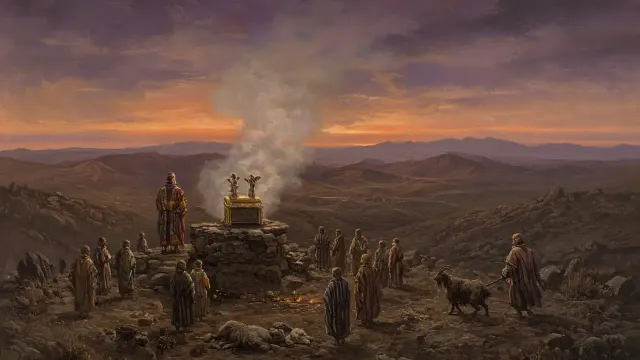
God warns Aaron through Moses not to enter the inner holy place whenever he wishes. God appears in the cloud above the ark's cover, and careless approach would mean death. Aaron must bring a bull for a sin offering and a ram for a burnt offering. He washes and puts on the prescribed linen garments. Israel brings a pair of goats to deal with sin. A ram will be burned whole for the people too. Access begins with limits, preparation, and offerings.
In everyday life
A tunnel maintenance leader waits for the authorised shutdown before entering the sealed service passage. She puts on the required gear and brings the listed equipment, despite knowing the tunnel well. Familiarity does not give permission to enter at any time. Aaron approaches God's presence rather than a closed transport system.
Notice
Leviticus 16:2 The warning applies to Aaron himself. Being chief priest does not remove the boundary around the place where God says he will appear.
Leviticus 16:1-5
King James Version1And the LORD spake unto Moses after the death of the two sons of Aaron, when they offered before the LORD, and died;
2And the LORD said unto Moses, Speak unto Aaron thy brother, that he come not at all times into the holy place within the vail before the mercy seat, which is upon the ark; that he die not: for I will appear in the cloud upon the mercy seat.
3Thus shall Aaron come into the holy place: with a young bullock for a sin offering, and a ram for a burnt offering.
4He shall put on the holy linen coat, and he shall have the linen breeches upon his flesh, and shall be girded with a linen girdle, and with the linen mitre shall he be attired: these are holy garments; therefore shall he wash his flesh in water, and so put them on.
5And he shall take of the congregation of the children of Israel two kids of the goats for a sin offering, and one ram for a burnt offering.
Leviticus 16:6-10
Two Goats Receive Different Roles
Aaron first provides atonement for himself and his household with the bull. He then presents the people's two goats at the tent entrance and casts lots to assign their roles. One is offered to the Lord as a sin offering. The other stays alive to be sent into the wilderness as the scapegoat. Both belong to the day's dealing with sin, but they do not meet the same end. The choice is made through lots rather than Aaron's personal preference.

In everyday life
An auction steward draws sealed tickets to assign two donated items to their promised uses. One goes into the sale, while the other is delivered directly to a family. The method prevents her choosing favourites. The two goats serve a rite of atonement, not the distribution of donated goods.
Notice
Leviticus 16:10 The second goat remains alive before being sent away. Its part in the day's cleansing is distinct from the goat killed as a sin offering.
Leviticus 16:6-10
King James Version6And Aaron shall offer his bullock of the sin offering, which is for himself, and make an atonement for himself, and for his house.
7And he shall take the two goats, and present them before the LORD at the door of the tabernacle of the congregation.
8And Aaron shall cast lots upon the two goats; one lot for the LORD, and the other lot for the scapegoat.
9And Aaron shall bring the goat upon which the LORD’s lot fell, and offer him for a sin offering.
10But the goat, on which the lot fell to be the scapegoat, shall be presented alive before the LORD, to make an atonement with him, and to let him go for a scapegoat into the wilderness.
Leviticus 16:11-19
Blood Cleanses the Inner Sanctuary
Aaron kills his bull and carries incense over burning coals behind the veil. Its cloud covers the ark's lid so he can approach without dying. He sprinkles the bull's blood there, then does the same with the goat's blood for the people. No one else stays in the tent during this work. He also cleanses the altar with blood. The sanctuary needs cleansing because it stands among a people whose sins and uncleanness affect their worship before God.

In everyday life
A water-plant specialist enters the closed treatment chamber while the rest of the crew waits outside. She follows the required sequence to restore the system the whole town depends on. One worker acts for many who cannot join her there. Aaron uses sacrificial blood to cleanse a sanctuary before God.
Notice
Leviticus 16:16 The sanctuary remains among an unclean people. Its cleansing addresses the effects of their sins where God dwells, not a flaw in the building materials.
Leviticus 16:11-19
King James Version11And Aaron shall bring the bullock of the sin offering, which is for himself, and shall make an atonement for himself, and for his house, and shall kill the bullock of the sin offering which is for himself:
12And he shall take a censer full of burning coals of fire from off the altar before the LORD, and his hands full of sweet incense beaten small, and bring it within the vail:
13And he shall put the incense upon the fire before the LORD, that the cloud of the incense may cover the mercy seat that is upon the testimony, that he die not:
14And he shall take of the blood of the bullock, and sprinkle it with his finger upon the mercy seat eastward; and before the mercy seat shall he sprinkle of the blood with his finger seven times.
15Then shall he kill the goat of the sin offering, that is for the people, and bring his blood within the vail, and do with that blood as he did with the blood of the bullock, and sprinkle it upon the mercy seat, and before the mercy seat:
16And he shall make an atonement for the holy place, because of the uncleanness of the children of Israel, and because of their transgressions in all their sins: and so shall he do for the tabernacle of the congregation, that remaineth among them in the midst of their uncleanness.
17And there shall be no man in the tabernacle of the congregation when he goeth in to make an atonement in the holy place, until he come out, and have made an atonement for himself, and for his household, and for all the congregation of Israel.
18And he shall go out unto the altar that is before the LORD, and make an atonement for it; and shall take of the blood of the bullock, and of the blood of the goat, and put it upon the horns of the altar round about.
19And he shall sprinkle of the blood upon it with his finger seven times, and cleanse it, and hallow it from the uncleanness of the children of Israel.
Leviticus 16:20-22
Confessed Sins Are Sent Away
After cleansing the holy place, tent, and altar, Aaron brings forward the living goat. He places both hands on its head and confesses all the people's wrongs and rebellions. The sins are put upon this goat. A chosen man leads it away to a place where nobody lives. The man releases it there. The act gives a visible form to removal: the confessed sins are carried away from the community rather than left unnamed within the camp.

In everyday life
A debt counsellor places the final cleared accounts in a sealed archive box and carries it from the family's kitchen. The family watches the papers that once covered every meal leave the room. A visible removal marks a burden dealt with. The goat bears confessed sins, which cannot be reduced to paperwork.
Notice
Leviticus 16:21 Both hands are placed on the living goat while the sins are confessed. The action joins spoken admission with the visible sending away of the burden.
Leviticus 16:20-22
King James Version20And when he hath made an end of reconciling the holy place, and the tabernacle of the congregation, and the altar, he shall bring the live goat:
21And Aaron shall lay both his hands upon the head of the live goat, and confess over him all the iniquities of the children of Israel, and all their transgressions in all their sins, putting them upon the head of the goat, and shall send him away by the hand of a fit man into the wilderness:
22And the goat shall bear upon him all their iniquities unto a land not inhabited: and he shall let go the goat in the wilderness.
Leviticus 16:23-28
Those Who Serve Must Wash
Aaron leaves the linen garments in the tent, washes, and puts on his other clothes. He then offers burnt offerings for himself and the people, and burns the sin offerings' fat. The man who released the goat must wash himself and his clothes before re-entering the camp. The remains of both slaughtered animals are burned beyond the camp. Their blood has served its use inside the holy place. Their handler must also wash before returning. Finishing the central rite does not remove the rules for those who handle its remains.

In everyday life
A hazardous-waste worker removes his outer gear and washes before rejoining the crew's meal area. The driver who carried the sealed waste follows the same return procedure. Completing the main job does not end the need for careful re-entry. Sacred handling here concerns ritual cleanness, not chemical exposure.
Notice
Leviticus 16:26 Even the man who leads away the living goat must wash before returning. A supporting role in the rite still carries its own requirements.
Leviticus 16:23-28
King James Version23And Aaron shall come into the tabernacle of the congregation, and shall put off the linen garments, which he put on when he went into the holy place, and shall leave them there:
24And he shall wash his flesh with water in the holy place, and put on his garments, and come forth, and offer his burnt offering, and the burnt offering of the people, and make an atonement for himself, and for the people.
25And the fat of the sin offering shall he burn upon the altar.
26And he that let go the goat for the scapegoat shall wash his clothes, and bathe his flesh in water, and afterward come into the camp.
27And the bullock for the sin offering, and the goat for the sin offering, whose blood was brought in to make atonement in the holy place, shall one carry forth without the camp; and they shall burn in the fire their skins, and their flesh, and their dung.
28And he that burneth them shall wash his clothes, and bathe his flesh in water, and afterward he shall come into the camp.
Leviticus 16:29-34
All the People Keep the Day
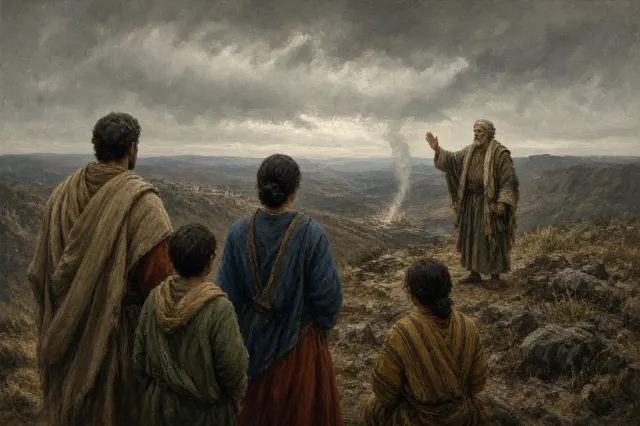
The tenth day of the seventh month is set aside each year. The people must humble themselves and do no work, including foreigners living among them. On this day the priest makes atonement to cleanse them from their sins before God. Future chief priests must carry out the same service in the linen garments. Sanctuary, altar, priests, and people are all included. Moses' received command becomes a continuing annual observance, not a ceremony limited to Aaron's first year.
In everyday life
A bereavement-group leader closes the meeting room for the annual day of remembrance and asks every regular activity to pause. Members and visiting families share the same solemn time. The date returns even when different volunteers lead it. Israel's appointed day includes atonement for sin, not remembrance of loss alone.
Notice
Leviticus 16:29 The resident foreigner shares the rest day with native members of Israel. The pause reaches everyone living within the community, not only its oldest families.
Leviticus 16:29-34
King James Version29And this shall be a statute for ever unto you: that in the seventh month, on the tenth day of the month, ye shall afflict your souls, and do no work at all, whether it be one of your own country, or a stranger that sojourneth among you:
30For on that day shall the priest make an atonement for you, to cleanse you, that ye may be clean from all your sins before the LORD.
31It shall be a sabbath of rest unto you, and ye shall afflict your souls, by a statute for ever.
32And the priest, whom he shall anoint, and whom he shall consecrate to minister in the priest’s office in his father’s stead, shall make the atonement, and shall put on the linen clothes, even the holy garments:
33And he shall make an atonement for the holy sanctuary, and he shall make an atonement for the tabernacle of the congregation, and for the altar, and he shall make an atonement for the priests, and for all the people of the congregation.
34And this shall be an everlasting statute unto you, to make an atonement for the children of Israel for all their sins once a year. And he did as the LORD commanded Moses.
Details worth noticing
The opening image
Leviticus 16:1 begins with “And the LORD spake unto Moses after the death of the two sons of Aaron, when they offered before the LORD, and died;”
Where the chapter turns
Leviticus 16:17 forms a natural hinge: “And there shall be no man in the tabernacle of the congregation when he goeth in to make an atonement in the holy place, until he come out, and have made…”
The final note
Leviticus 16:34 leaves the reader with “And this shall be an everlasting statute unto you, to make an atonement for the children of Israel for all their sins once a year. And he did as the LORD…”
A word trail through the chapter
The words atonement, offering, holy, goat, LORD, Aaron help reveal the chapter’s repeated concerns.
KJV words made clear
- afflict your souls
- Humble yourselves before God, traditionally understood to include fasting.
- scapegoat
- The living goat sent away bearing the confessed sins of the people.
Music and video connected to the passage
Related media appears when its Scripture reference overlaps this study. Music and video can illuminate a theme while the biblical text remains the foundation.