
The big picture
Jerusalem, the city of God's people, hears a promise of change. Zechariah, God's prophet, brings the message. Old people and children will again fill its streets. The builders are urged to continue as the land moves from insecurity towards fruitful life. God's resolve to do good comes with clear duties of truthful speech and fair judgement. Days once kept as fasts will become feasts, and people from many nations will seek the Lord because they hear that he is with his people.
In this chapter
- God Returns and the Streets Fill with Life Zechariah 8:1-8
God declares fierce care for Zion, Jerusalem's holy mountain, and says he has returned to dwell in the city.
- The Builders Can Work Towards a Fruitful Future Zechariah 8:9-13
God encourages those hearing the prophets during the rebuilding of his temple.
- Promised Good Calls for Truthful Conduct Zechariah 8:14-17
God recalls that he resolved to punish when the forefathers provoked his anger and did not turn from that judgement.
- Mourning Days Become Glad Feasts Zechariah 8:18-19
God answers the concern about fasting with a promise of transformation.
- Nations Seek the Lord with His People Zechariah 8:20-23
People from one city will go to another and invite its residents to seek the Lord and pray.
Central truth
God’s return brings safe streets, fruitful work, and shared worship, while the restored people are called to practise the truth and peace that fit his presence.


Scripture beside the summary
Zechariah · King James Version · 23Zechariah 8:1-8
God Returns and the Streets Fill with Life
God declares fierce care for Zion, Jerusalem's holy mountain, and says he has returned to dwell in the city. It will be called truthful, and his mountain holy. Old men and women will sit in the streets with walking sticks, while boys and girls play nearby. What seems astonishing to the people left is not beyond God's power. He will rescue his people from east and west and bring them to live in Jerusalem. They will belong to him, and he will be their God in truth and right conduct. The promise gives safety the visible shape of ordinary shared life.

In everyday life
A street-access designer watches an older woman rest on a bench while children play where traffic once made everyone hurry indoors. The place now allows slow steps and play to exist together. She checks that the route remains open for both. Zechariah promises a city's renewal through God's dwelling there, not safety produced by street design alone.
Notice
Zechariah 8:4 Great age is pictured with a walking stick in a public street. The promise includes people living long and feeling safe outside, not merely surviving behind doors.
Zechariah 8:1-8
King James Version1Again the word of the LORD of hosts came to me, saying,
2Thus saith the LORD of hosts; I was jealous for Zion with great jealousy, and I was jealous for her with great fury.
3Thus saith the LORD; I am returned unto Zion, and will dwell in the midst of Jerusalem: and Jerusalem shall be called a city of truth; and the mountain of the LORD of hosts the holy mountain.
4Thus saith the LORD of hosts; There shall yet old men and old women dwell in the streets of Jerusalem, and every man with his staff in his hand for very age.
5And the streets of the city shall be full of boys and girls playing in the streets thereof.
6Thus saith the LORD of hosts; If it be marvellous in the eyes of the remnant of this people in these days, should it also be marvellous in mine eyes? saith the LORD of hosts.
7Thus saith the LORD of hosts; Behold, I will save my people from the east country, and from the west country;
8And I will bring them, and they shall dwell in the midst of Jerusalem: and they shall be my people, and I will be their God, in truth and in righteousness.
Zechariah 8:9-13
The Builders Can Work Towards a Fruitful Future
God encourages those hearing the prophets during the rebuilding of his temple. Earlier there had been no payment for people or working animals, and no safety in travel. Neighbours had been set against one another. God now promises a different course for those left. Seeds will prosper, vines and land will yield, and the sky will give dew. Judah and Israel, the names of his people, had been spoken of as a curse among nations. He will save them and make them a blessing. The builders are therefore told to be strong rather than let the earlier hardship decide the future.

In everyday life
A building labourer accepts the next day's work after months when payment and safe travel were uncertain. The newly supplied site and agreed wages give his hands a task again. He still remembers the earlier shortage without treating it as permanent. Zechariah promises God changing the people's standing and the land's fruitfulness, not security contained in a work agreement.
Notice
Zechariah 8:12 The promise includes dew as well as planted seed. Human work and conditions people cannot produce for themselves belong together in the picture of renewed fruitfulness.
Zechariah 8:9-13
King James Version9Thus saith the LORD of hosts; Let your hands be strong, ye that hear in these days these words by the mouth of the prophets, which were in the day that the foundation of the house of the LORD of hosts was laid, that the temple might be built.
10For before these days there was no hire for man, nor any hire for beast; neither was there any peace to him that went out or came in because of the affliction: for I set all men every one against his neighbour.
11But now I will not be unto the residue of this people as in the former days, saith the LORD of hosts.
12For the seed shall be prosperous; the vine shall give her fruit, and the ground shall give her increase, and the heavens shall give their dew; and I will cause the remnant of this people to possess all these things.
13And it shall come to pass, that as ye were a curse among the heathen, O house of Judah, and house of Israel; so will I save you, and ye shall be a blessing: fear not, but let your hands be strong.
Zechariah 8:14-17
Promised Good Calls for Truthful Conduct
God recalls that he resolved to punish when the forefathers provoked his anger and did not turn from that judgement. Now he has resolved to do good to Jerusalem and Judah, its surrounding people. They need not fear. He then names what they must do: speak truth to neighbours and give decisions that serve truth and peace at the gates, where disputes are heard. They must not plan harm against one another or delight in false oaths. God hates those practices. His settled intention to bless does not make deception acceptable within the life he is restoring.

In everyday life
A mediation trainer asks two neighbours to put accurate dates and costs on the table before signing a peace agreement. Friendly language cannot repair a dispute while one account is knowingly false. She keeps truth within the work of peace. Zechariah ties these duties to God's promise for his people, not the success of a mediation technique.
Notice
Zechariah 8:17 God names both hidden schemes and false oaths as things he hates. The promised good does not leave room for dishonesty merely because it remains unseen.
Zechariah 8:14-17
King James Version14For thus saith the LORD of hosts; As I thought to punish you, when your fathers provoked me to wrath, saith the LORD of hosts, and I repented not:
15So again have I thought in these days to do well unto Jerusalem and to the house of Judah: fear ye not.
16These are the things that ye shall do; Speak ye every man the truth to his neighbour; execute the judgment of truth and peace in your gates:
17And let none of you imagine evil in your hearts against his neighbour; and love no false oath: for all these are things that I hate, saith the LORD.
Zechariah 8:18-19
Mourning Days Become Glad Feasts
God answers the concern about fasting with a promise of transformation. The fasts kept in the fourth, fifth, seventh, and tenth months will become times of joy and glad celebration for Judah. The days are not merely erased from the calendar. Their meaning changes as God changes the people's condition. The promise ends by calling them to love truth and peace. Glad worship therefore belongs with the conduct already named, not with a return to carefree deceit. Their shared memory of grief will become an occasion for rejoicing in a restored relationship with God.

In everyday life
A remembrance organiser prepares a shared meal after separated families return. The date was once marked only by a silent vigil. The date remains, but the gathering now includes welcome alongside memory. She keeps the change tied to what has happened. Zechariah promises God turning several fasts into feasts, not an organiser deciding that grief has lasted long enough.
Notice
Zechariah 8:19 The four fasting months remain named as their character changes. The promise transforms times associated with loss rather than requiring the people to forget they existed.
Zechariah 8:18-19
King James Version18And the word of the LORD of hosts came unto me, saying,
19Thus saith the LORD of hosts; The fast of the fourth month, and the fast of the fifth, and the fast of the seventh, and the fast of the tenth, shall be to the house of Judah joy and gladness, and cheerful feasts; therefore love the truth and peace.
Zechariah 8:20-23
Nations Seek the Lord with His People
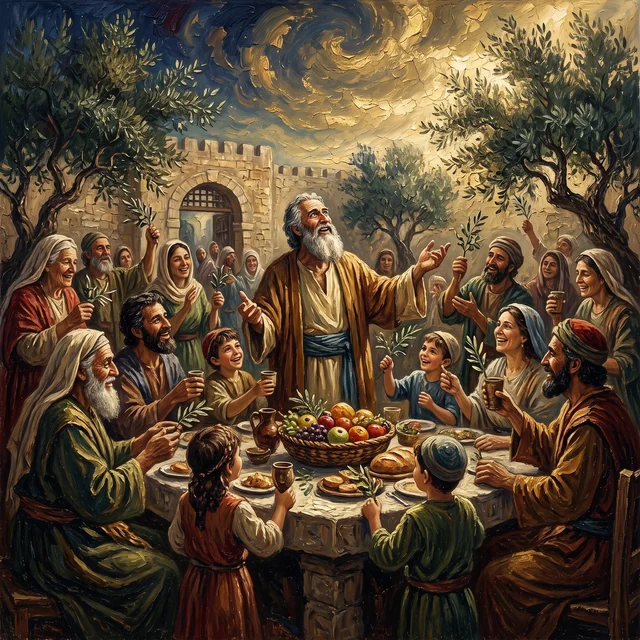
People from one city will go to another and invite its residents to seek the Lord and pray. They also commit themselves to going, rather than sending others ahead alone. Many peoples and strong nations will come to Jerusalem. Ten men from different languages will take hold of a Jewish man's garment. They want to come with him because they hear God is with his people. The image makes attraction to God's presence concrete. The restored community is no longer known only by defeat or disgrace; others want to share its approach to the Lord.
In everyday life
A multilingual tour guide pauses when visitors ask to accompany a local family to a place important in its life. They want to learn from the people who belong there, not only see the building from outside. The family agrees to walk with them. Zechariah promises nations seeking the living God, not cultural interest satisfied by a guided visit.
Notice
Zechariah 8:23 The request to go together is based on hearing that God is present. The attraction is not wealth or military strength, but the relationship the people have with him.
Zechariah 8:20-23
King James Version20Thus saith the LORD of hosts; It shall yet come to pass, that there shall come people, and the inhabitants of many cities:
21And the inhabitants of one city shall go to another, saying, Let us go speedily to pray before the LORD, and to seek the LORD of hosts: I will go also.
22Yea, many people and strong nations shall come to seek the LORD of hosts in Jerusalem, and to pray before the LORD.
23Thus saith the LORD of hosts; In those days it shall come to pass, that ten men shall take hold out of all languages of the nations, even shall take hold of the skirt of him that is a Jew, saying, We will go with you: for we have heard that God is with you.
Details worth noticing
The opening image
Zechariah 8:1 begins with “Again the word of the LORD of hosts came to me, saying,”
Where the chapter turns
Zechariah 8:11 forms a natural hinge: “But now I will not be unto the residue of this people as in the former days, saith the LORD of hosts.”
The final note
Zechariah 8:23 leaves the reader with “Thus saith the LORD of hosts; In those days it shall come to pass, that ten men shall take hold out of all languages of the nations, even shall take hold…”
A word trail through the chapter
The words LORD, hosts, people, days, Jerusalem, house help reveal the chapter’s repeated concerns.
KJV words made clear
- residue
- Those remaining from the people after earlier losses.
- hire
- Payment for work, here lacking for both people and working animals.
Music and video connected to the passage
Related media appears when its Scripture reference overlaps this study. Music and video can illuminate a theme while the biblical text remains the foundation.