The big picture
Attempts at healing uncover more corruption rather than recovery. Falsehood, theft, raiding, royal approval, intoxication, and political violence accumulate around the image of an oven whose heat continues even when the baker sleeps. The same heated order that entertains rulers eventually consumes judges and kings. Hosea then turns from the court to a kitchen, calling Ephraim a cake not turned, damaged by uneven exposure while remaining unaware of its condition. Gray hairs continue the same diagnosis of decline without recognition. Foreign policy receives equally unflattering imagery: Ephraim is a silly dove moving between Egypt and Assyria, only to meet a net. The closing verses distinguish loud distress from genuine return. Crying, assembling, traveling, and turning can all occur without turning to the Most High, leaving the nation like a bow that cannot shoot straight.
In this chapter
- The Oven Explains the Heat Beneath the Celebration Hosea 7:1-7
The attempt to heal Israel uncovers what is already there: falsehood inside, raiding outside, and deeds surrounding the people while remaining fully before the Lord.
- Half-Cooked Confidence and an Unnoticed Decline Hosea 7:8-10
Hosea reaches for a kitchen image to puncture national self-confidence: Ephraim is "a cake not turned." One side receives heat while the other does not, and leaving the cake in that condition will not improve it.
- The Diplomatic Dove Flies Into a Net Hosea 7:11-12
The dove is not peaceful in this comparison.
- Distress Can Be Loud Without Becoming Return Hosea 7:13-16
The closing section distinguishes noise from return.

Scripture beside the summary
Hosea · King James Version · 16Hosea 7:1-7
The Oven Explains the Heat Beneath the Celebration
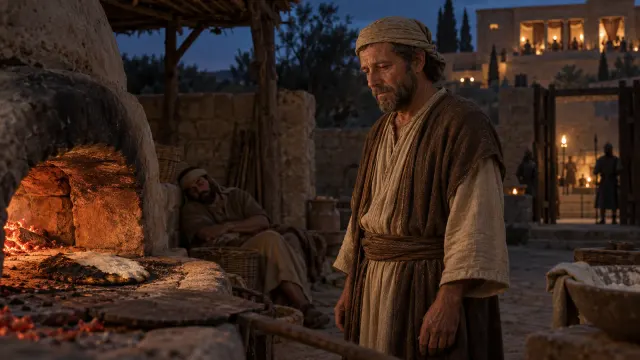
The attempt to heal Israel uncovers what is already there: falsehood inside, raiding outside, and deeds surrounding the people while remaining fully before the Lord. Their failure is partly a failure of memory. They do not consider that the wickedness they normalize is still remembered. Hosea then lets an oven explain the court. Heat is prepared, maintained, and allowed to build beneath apparent pauses. Wine, royal celebration, scorn, plotting, and desire occupy the same overheated atmosphere. The sleeping baker does not mean the fire has gone out; by morning it is blazing. The metaphor should not be forced into a chart where every baker, loaf, and waiting period becomes a named conspirator. Its result is explicit enough. Judges are consumed, kings fall, and nobody calls upon the Lord. The court can be delighted by wickedness while the same temperature that entertains it is quietly preparing to burn through the leadership itself.

Deep dive
Healing is met by disclosure rather than recovery. The thief inside and the raiding band outside leave no neat boundary between private and public disorder. The people fail to consider that their deeds remain before the Lord, even while those deeds surround them. Forgetting divine remembrance has become part of their self-deception.
The oven image then stretches across several verses. Desire, celebration, intoxication, and plotting share a heat that can be maintained even while outward activity pauses. The sleeping baker does not mean that the fire has ceased to matter; it blazes again in the morning. Precise assignments of every baker, oven, and period of waiting to named conspirators are uncertain. The stated result is enough: judges are devoured, kings fall, and none calls upon the Lord. The royal company can celebrate wickedness while the same heated order consumes its own leadership. Courtly approval offers very little fire protection.
Words to trace: oven, wickedness, baker, king, princes, adulterers
Verse-by-verse path
- Hosea 7:1
Samaria is named for the first time, the capital Omri built on a hill he bought from Shemer (1 Kings 16:24). “Healed” is rafa, the verb Assyria could not supply in 5:13 and the people claimed in 6:1. Every attempt to treat the patient lays bare a new infection.
- Hosea 7:2
“Consider not in their hearts” is literally they do not say to their heart. “Beset them about” is the verb for an army surrounding a city. Their own deeds have laid siege to them, and the besieging lines are in full view of God.
- Hosea 7:3
The court is entertained by crime: the king is “made glad”, amused, by wickedness and flattered by lies. A small change of letters would give “they anoint kings” for “they make the king glad”, and some scholars read it that way, fitting the king-making of verse 7.
- Hosea 7:4
The oven is a tannur, a clay cylinder fired from inside, with dough slapped on its hot inner wall. The baker could stop stoking while the dough rose overnight and the embers kept their heat. “Adulterers” here hints at people burning with appetite for something that is not theirs.
- Hosea 7:5
“The day of our king” is a royal festival, perhaps a coronation or accession day. “Bottles of wine” is literally the heat of wine, chamat, the heat that runs through the oven lines. “Scorners” are the letsim of Proverbs, the mockers. The king has joined their table.
- Hosea 7:6
The standard Hebrew text reads “their baker sleepeth”; by changing one letter many translators read “their anger sleepeth”, smouldering all night to flame at dawn. Either way the plot is kept warm in the dark and bursts out in the morning.
- Hosea 7:7
Of the last six kings of Israel, four were assassinated: Zechariah by Shallum, Shallum by Menahem, Pekahiah by Pekah, and Pekah by Hoshea (2 Kings 15:10–30). The verse’s “all their kings are fallen” is a plain summary of those years.
Hosea 7:1-7
King James Version1When I would have healed Israel, then the iniquity of Ephraim was discovered, and the wickedness of Samaria: for they commit falsehood; and the thief cometh in, and the troop of robbers spoileth without.
2And they consider not in their hearts that I remember all their wickedness: now their own doings have beset them about; they are before my face.
3They make the king glad with their wickedness, and the princes with their lies.
4They are all adulterers, as an oven heated by the baker, who ceaseth from raising after he hath kneaded the dough, until it be leavened.
5In the day of our king the princes have made him sick with bottles of wine; he stretched out his hand with scorners.
6For they have made ready their heart like an oven, whiles they lie in wait: their baker sleepeth all the night; in the morning it burneth as a flaming fire.
7They are all hot as an oven, and have devoured their judges; all their kings are fallen: there is none among them that calleth unto me.
Hosea 7:8-10
Half-Cooked Confidence and an Unnoticed Decline
Hosea reaches for a kitchen image to puncture national self-confidence: Ephraim is "a cake not turned." One side receives heat while the other does not, and leaving the cake in that condition will not improve it. The image catches incompleteness, poor judgment, and damage without needing a battlefield. Mixing among surrounding peoples has not produced balance. The next image is even more domestic and uncomfortable. Strangers have consumed Ephraim's strength, gray hairs have appeared, and twice the text insists that "he knoweth it not." Decline is happening alongside a refusal or inability to recognize decline. Pride, meanwhile, testifies openly. The combination makes ignorance more than an information problem, because visible signs are already present while return still does not occur. The Book of Hosea can be funny without becoming light. The unturned cake earns a smile only long enough to make the diagnosis harder to ignore.

Deep dive
A cake that has not been turned is an unusually domestic image for a nation's condition. One side receives heat while the other does not; the result is not improved by leaving the arrangement alone. The metaphor exposes incompleteness and damage within a people who have mixed themselves among surrounding nations. Hosea does not need a grand military image to puncture their confidence. The kitchen is adequate.
The gray hairs continue the account of deterioration that remains unacknowledged. Twice the verse insists that Ephraim does not know. This is more pointed than simply saying that foreign powers have weakened the nation: the loss is occurring alongside a failure to perceive it. Pride testifies openly while the people still do not return or seek the Lord. The combination turns ignorance into a moral problem, because the signs are already present and the failure to respond continues. The chapter's humor is diagnostic, not relief from the seriousness of the decline.
Words to trace: Ephraim, knoweth, cake, devoured, face, gray
Verse-by-verse path
- Hosea 7:8
“Mixed himself” is balal, the verb for mixing oil into flour for the grain offering (Leviticus 2:4–5): Ephraim is kneaded into the nations. A cake, ugah, was a flat loaf baked on hot stones, like the one Elijah found at his head (1 Kings 19:6); left unturned, it is burnt below and raw above.
- Hosea 7:9
The verb for gray hairs “here and there” is zaraq, to sprinkle or scatter, as dust is thrown or flour is dusted. The strangers who eat his strength include Assyria’s tribute collectors: Hoshea himself became Shalmaneser’s servant and paid him presents (2 Kings 17:3).
- Hosea 7:10
The first half repeats 5:5 word for word. “For all this” sounds like Isaiah’s refrain in the same decades, “For all this his anger is not turned away” (Isaiah 9:12, 17, 21), turned round: for all this, they do not turn.
Hosea 7:8-10
King James Version8Ephraim, he hath mixed himself among the people; Ephraim is a cake not turned.
9Strangers have devoured his strength, and he knoweth it not: yea, gray hairs are here and there upon him, yet he knoweth not.
10And the pride of Israel testifieth to his face: and they do not return to the LORD their God, nor seek him for all this.
Hosea 7:11-12
The Diplomatic Dove Flies Into a Net
The dove is not peaceful in this comparison. Hosea calls it "silly" and "without heart," making lack of understanding the point of the image. Ephraim calls to Egypt and goes to Assyria, moving between great powers as though a change of destination were the same thing as a change of dependence. The motion is energetic, but the underlying search remains unchanged. Then the Lord's net crosses the flight path. The bird that seems free to choose its direction is brought down, and diplomatic mobility is exposed as far less secure than it appeared. The reference to chastening "as their congregation hath heard" matters because judgment is not introduced as an entirely unannounced trap. Warning has already belonged to the relationship. Hosea reduces complicated foreign policy to a memorable picture: a bird without understanding, two attractive directions, and a net that reveals how little control the repeated flights have actually purchased.

Deep dive
The dove does not signify peaceful innocence here. The qualifying words are "silly" and "without heart," describing a failure of understanding. Calling to Egypt and going to Assyria look like alternative strategies, but Hosea treats the repeated movement as evidence of the same unresolved problem. Changing the destination has not changed the nature of the search.
The Lord's net then answers the apparent freedom of flight. The chosen route does not place the people outside his reach, and being brought down reverses the self-directed motion of the bird. The reference to what the congregation has heard makes the announced chastening something other than an entirely unannounced surprise. Earlier warning belongs to the situation. The image is economical: diplomatic activity supplies the flight, lack of discernment supplies the danger, and the net exposes how little security the movement has actually achieved.
Words to trace: Assyria, call, chastise, congregation, dove, Egypt
Verse-by-verse path
- Hosea 7:11
“Silly” is potah, simple, easily enticed, from patah, the very verb used in 2:14 for God alluring Israel into the wilderness. Ephraim is easy to entice, but by others. Hoshea sent to So, king of Egypt, while paying tribute to Assyria (2 Kings 17:4), flying both ways at once.
- Hosea 7:12
The net is the fowler’s reshet, the same net Israel’s leaders spread on Tabor in 5:1: the trappers are trapped. The last clause is difficult Hebrew; a small change gives “according to the report of their wickedness”, but the King James “as their congregation hath heard” also fits.
Hosea 7:11-12
King James Version11Ephraim also is like a silly dove without heart: they call to Egypt, they go to Assyria.
12When they shall go, I will spread my net upon them; I will bring them down as the fowls of the heaven; I will chastise them, as their congregation hath heard.
Hosea 7:13-16
Distress Can Be Loud Without Becoming Return
The closing section distinguishes noise from return. Israel flees from the Lord even after redemption, speaks lies, howls upon beds, assembles for corn and wine, and uses strengthened arms against the giver of that strength. The pain and hunger are not dismissed as unreal. The accusation concerns where the distress is directed and what it seeks to recover. The people cry, but not "with their heart." They turn, but not "to the most High." Hosea therefore gathers a chapter full of movement into the image of a deceitful bow, an instrument that can look ready while sending the shot somewhere other than the intended mark. Egypt, previously treated as a possible source of help, becomes the place of derision. Princes fall, speech becomes part of the ruin, and all the activity leaves the central absence untouched. The missing movement is not physical. It is the return every other movement has been avoiding.

Deep dive
The contrast between redemption and lies makes the people's speech part of the breach. Crying on beds is distinguished from crying with the heart, while gathering for grain and wine reveals the focus of the distress. The complaint is not that hunger and pain are unreal. It is that the desired recovery of benefits has not become a restored relation with their giver.
Arms that the Lord strengthened are used in schemes against him. The final description of a return that is not to the Most High makes the chapter's repeated movements intelligible: turning, assembling, calling, and traveling are not sufficient descriptions of repentance. The "deceitful bow" pictures an instrument whose apparent readiness cannot guarantee a true shot. Princes fall, and Egypt becomes a place of derision rather than the solution sought earlier. The people have expended effort and speech throughout the chapter, but its missing movement remains the simplest to name.
Words to trace: arms, assemble, beds, bound, corn, cried
Verse-by-verse path
- Hosea 7:13
“Woe” is oy, “destruction” is shod, two short cries. “Redeemed” is padah, to buy out of slavery, the verb Deuteronomy 7:8 uses for the rescue from Egypt. The God who paid for them is the one they have fled.
- Hosea 7:14
Wailing on beds may describe mourning rites for a dying fertility god. For “assemble themselves” the old Greek read “gash themselves”, one letter different, recalling Baal’s prophets cutting themselves on Carmel (1 Kings 18:28). Either way, the cry is for corn and wine.
- Hosea 7:15
“Bound” is better trained or disciplined, as in Psalm 18:34, “He teacheth my hands to war.” 2 Kings 14:25–27 credits the LORD with Jeroboam II’s victories. The arms God strengthened in war are now raised in schemes against him.
- Hosea 7:16
“Not to the most High” is obscure Hebrew, perhaps “not upward” or “to no-god”. Psalm 78:57, a psalm about Ephraim’s failure, uses the same picture: “they were turned aside like a deceitful bow.” A slack bow sends the arrow anywhere but the target.
Hosea 7:13-16
King James Version13Woe unto them! for they have fled from me: destruction unto them! because they have transgressed against me: though I have redeemed them, yet they have spoken lies against me.
14And they have not cried unto me with their heart, when they howled upon their beds: they assemble themselves for corn and wine, and they rebel against me.
15Though I have bound and strengthened their arms, yet do they imagine mischief against me.
16They return, but not to the most High: they are like a deceitful bow: their princes shall fall by the sword for the rage of their tongue: this shall be their derision in the land of Egypt.
Questions to keep in mind while reading
- Identify the historical crisis, covenant failure, warning, and promised hope.
- Distinguish the prophet’s immediate audience from later biblical connections.
- Do not turn present-day headlines into confident fulfillment claims without textual evidence.
Text first
Where readers differ
The chapter summary begins with what the passage says and how its parts fit together. It does not assume one denomination has already settled every question. Where a conclusion depends on a tradition, literary theory, or historical reconstruction, that dependence is named openly.
The KJV text is presented first. Interpretive conclusions are labeled, and differences are introduced only when they help a reader understand why serious communities do not always reach the same answer.
Comparative interpretive notes for this chapter are in preparation. Until reviewed notes are ready, this page separates the KJV text from summary and application without claiming that serious readers agree on every question.
Questions beneath the surface
- What account of God, human freedom, responsibility, and the good life emerges from Hosea 7?
- Which tension does the chapter refuse to resolve quickly?
- What changes when the chapter is read as part of the whole canon rather than as an isolated moral lesson?
- Where might a sincere reader confuse a familiar tradition with something the text states directly?
Questions for serious personal contemplation
These open-ended questions make room for tension, honest response, prayer, and conclusions that remain accountable to the chapter.
Observe without rushing
What part of Hosea 7 makes you stop, feel unsettled, or feel surprised, and why?
Which detail in the passage would be easiest to overlook? How does that detail change your understanding?
Where do you see tension between what happens and this focus: Hosea 7 develops its own movement around Ephraim, heart, oven, princes, wickedness?
What important question does the passage leave open instead of resolving quickly?
Examine your inner life honestly
Which person, response, fear, or desire in the passage feels most like your own life right now?
What assumption about God, other people, or yourself does this text challenge?
Which part would you rather soften, avoid, or explain away too quickly? What might that reaction reveal?
If this Scripture could ask you one direct question, what do you think it would ask?
Respond with wisdom and courage
What do you need to remember, confess, grieve, thank God for, or trust after reading this passage?
How might another faithful person read this situation differently without ignoring the text?
What obedient response would be costly, uncomfortable, or slow, yet still faithful to Scripture?
What question will you carry into prayer this week, and which verses will you keep in front of you?
Music and video connected to the passage
Related media appears when its Scripture reference overlaps this study. Music and video can illuminate a theme while the biblical text remains the foundation.