New · FreePlay The Witnesses The in-depth puzzle battle quest through Bible history

Places of the Bible

Mount Carmel

A contest with rules both sides agreed to, and one of them had four hundred and fifty men.

It is the third year of a drought Elijah announced and then disappeared for, and Ahab greets him as the troubler of Israel. The proposal is made to the whole people first, and it is a question rather than a sermon: how long halt ye between two opinions. The text says the people answered him not a word, which is the most honest line in the chapter. Then the terms are set out and they are scrupulously fair.

Where it appears1 Kings 18

Scroll down to the account
Mount Carmel

The movements, in the order the text gives them.

The Account of Mount Carmel

  1. 01

    1 Kings 18:17-21

    The people answered him not a word

    The question is about halting between two opinions, and the silence that follows it is recorded rather than filled.

    Ahab has identified the national emergency as a man. Elijah identifies it as disobedience. The distinction matters: the king calls the prophet Israel's troubler, but the reply sends that charge straight back to the royal household and its abandonment of the LORD's commandments. The drought is not presented as a private quarrel between two difficult men. The issue is the authority Israel has rejected.

    Then the chapter puts two very different tables side by side. Jezebel maintains prophets at her table; earlier, Obadiah has kept the LORD's prophets alive with bread and water in caves. Royal provision is plentiful for one group while the other survives in hiding. Elijah's demand brings the publicly supported religion into public examination.

    Yet his decisive address is to the people, not merely to Ahab. Halt here means limp, not simply stop. The picture is of a people unable to walk a straight course between competing loyalties. Their first contribution to the gathering is silence. Later they will approve the proposed test, and later still they will name the LORD twice. At this point they cannot bring themselves to say either name in reply. The silence belongs in the account as much as the fire.

    Verse by verse

    1. 18:17-18

      The charge of troubling Israel is disputed within the passage: Ahab directs it at Elijah, and Elijah explicitly redirects it to the king and his father's house.

    2. 18:19

      The prophets of the groves are associated with Asherah. Four hundred are summoned alongside the four hundred and fifty prophets of Baal, but verse 22 identifies the competing prophets as Baal's four hundred and fifty.

    3. 18:21

      The chapter gives the people's silence, not the individual motives behind it. Fear, embarrassment, and calculation should not be supplied as though the verse named them.

    1 Kings 18:17-21

    King James Version · 5 verses

    18:17And it came to pass, when Ahab saw Elijah, that Ahab said unto him, Art thou he that troubleth Israel?

    18:18And he answered, I have not troubled Israel; but thou, and thy father’s house, in that ye have forsaken the commandments of the LORD, and thou hast followed Baalim.

    18:19Now therefore send, and gather to me all Israel unto mount Carmel, and the prophets of Baal four hundred and fifty, and the prophets of the groves four hundred, which eat at Jezebel’s table.

    18:20So Ahab sent unto all the children of Israel, and gathered the prophets together unto mount Carmel.

    18:21And Elijah came unto all the people, and said, How long halt ye between two opinions? if the LORD be God, follow him: but if Baal, then follow him. And the people answered him not a word.

    1 Kings 18:17-21: The people answered him not a word
  2. 02

    1 Kings 18:22-29

    Cry aloud, for he is a god

    They are given every advantage and all day. The mockery is specific, and the account notes there was no voice, nor any that answered.

    Elijah gives the larger delegation first choice of the animal and first use of the day. Their numbers earn them precedence, not an exemption from the rules. Put no fire under appears on both sides of the proposal. Nobody is being asked to admire anyone's skill with kindling.

    The people's approval is carefully limited: they accept the terms of the test. It is well spoken is not yet the confession of verse 39. Meanwhile, the hours accumulate and the answer does not. At noon Elijah supplies the missing god with an assortment of human inconveniences: conversation, absence, travel, sleep. An astonishingly full schedule for someone who has not appeared. The chapter explicitly calls this mockery; it is not a polite exchange of religious preferences.

    But the bleeding keeps the scene from becoming mere comedy. The prophets cut themselves according to their custom, and the account records actual blood, not just noisy enthusiasm. More effort produces more injury without producing a reply. The final sentence closes three doors: no voice, no answer, no attention. The contrast is not between two impressive performances with one slightly better than the other. On one side, the whole afternoon has passed without an answer.

    Verse by verse

    1. 18:22

      Elijah's claim to stand alone in this contest does not mean no other prophets of the LORD are alive. Verses 4 and 13 have already named the hundred whom Obadiah hid.

    2. 18:23-25

      Both offerings must be prepared without an added fire. Baal's prophets choose their bullock first and begin first, so the terms do not disadvantage them in those respects.

    3. 18:27

      The proposed explanations for Baal's silence are Elijah's taunts, not the Book of 1 Kings affirming that Baal is actually sleeping or travelling.

    4. 18:29

      The verb prophesied describes the activity of Baal's prophets here; it does not certify their speech as revelation from the LORD.

    1 Kings 18:22-29

    King James Version · 8 verses

    18:22Then said Elijah unto the people, I, even I only, remain a prophet of the LORD; but Baal’s prophets are four hundred and fifty men.

    18:23Let them therefore give us two bullocks; and let them choose one bullock for themselves, and cut it in pieces, and lay it on wood, and put no fire under: and I will dress the other bullock, and lay it on wood, and put no fire under:

    18:24And call ye on the name of your gods, and I will call on the name of the LORD: and the God that answereth by fire, let him be God. And all the people answered and said, It is well spoken.

    18:25And Elijah said unto the prophets of Baal, Choose you one bullock for yourselves, and dress it first; for ye are many; and call on the name of your gods, but put no fire under.

    18:26And they took the bullock which was given them, and they dressed it, and called on the name of Baal from morning even until noon, saying, O Baal, hear us. But there was no voice, nor any that answered. And they leaped upon the altar which was made.

    18:27And it came to pass at noon, that Elijah mocked them, and said, Cry aloud: for he is a god; either he is talking, or he is pursuing, or he is in a journey, or peradventure he sleepeth, and must be awaked.

    18:28And they cried aloud, and cut themselves after their manner with knives and lancets, till the blood gushed out upon them.

    18:29And it came to pass, when midday was past, and they prophesied until the time of the offering of the evening sacrifice, that there was neither voice, nor any to answer, nor any that regarded.


  3. 03

    1 Kings 18:30-35

    He repaired the altar of the LORD that was broken down

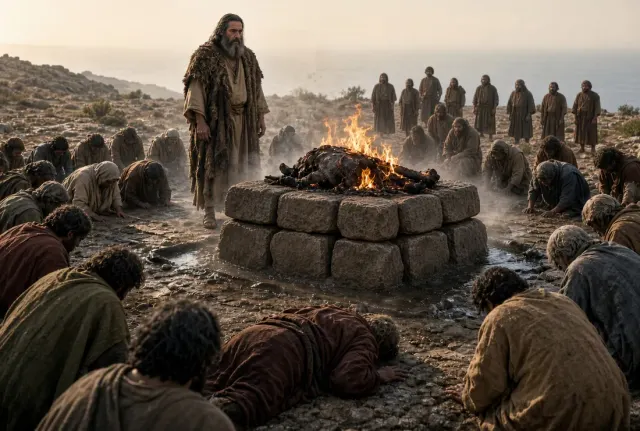
    Twelve stones for twelve tribes, a trench, and four barrels of water poured three times, until the water ran round about.

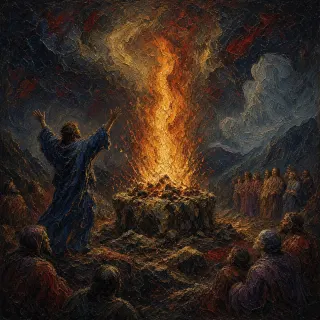
    Before Elijah asks for fire, he repairs something. The broken altar matters because this is a return to the LORD, not the introduction of a newly discovered deity. Come near allows the people to see the work at close range. The public answer is preceded by public preparation.

    Then twelve stones make a claim no royal boundary can reduce. The chapter explains the number by Jacob's sons and repeats the name God gave Jacob: Israel. Elijah is not building an altar for an isolated religious party. The name in his prayer and the stones under the sacrifice belong to the whole covenant people. The count is theology made visible without a speech.

    The water receives nearly as much attention as the bullock. Four vessels, filled and poured three times, soak the offering and wood until the trench fills. The passage specifies the repetition but does not explain where the water came from; a spring, the sea, and a supply carried up the mountain are not details available to the commentary. What is available is the emphatic wetness. Elijah has not made an ordinary fire easier to start. By the end of the preparation, even the ground around the altar is holding water.

    Verse by verse

    1. 18:30

      The altar is described as broken down, but this verse does not identify who broke it or when. The repair should not be expanded into an undocumented account of its destruction.

    2. 18:31

      The explanation of the twelve stones is supplied by the passage itself: the tribes descended from Jacob, whom God named Israel. No additional numerical code is required.

    3. 18:33-35

      The KJV's barrels translates a word for jars or pitchers, not a modern standardized barrel measure. Neither the exact capacity of each vessel nor the water's source is stated.

    1 Kings 18:30-35

    King James Version · 6 verses

    18:30And Elijah said unto all the people, Come near unto me. And all the people came near unto him. And he repaired the altar of the LORD that was broken down.

    18:31And Elijah took twelve stones, according to the number of the tribes of the sons of Jacob, unto whom the word of the LORD came, saying, Israel shall be thy name:

    18:32And with the stones he built an altar in the name of the LORD: and he made a trench about the altar, as great as would contain two measures of seed.

    18:33And he put the wood in order, and cut the bullock in pieces, and laid him on the wood, and said, Fill four barrels with water, and pour it on the burnt sacrifice, and on the wood.

    18:34And he said, Do it the second time. And they did it the second time. And he said, Do it the third time. And they did it the third time.

    18:35And the water ran round about the altar; and he filled the trench also with water.

    1 Kings 18:30-35: He repaired the altar of the LORD that was broken down
  4. 04

    1 Kings 18:36-39

    Let it be known this day

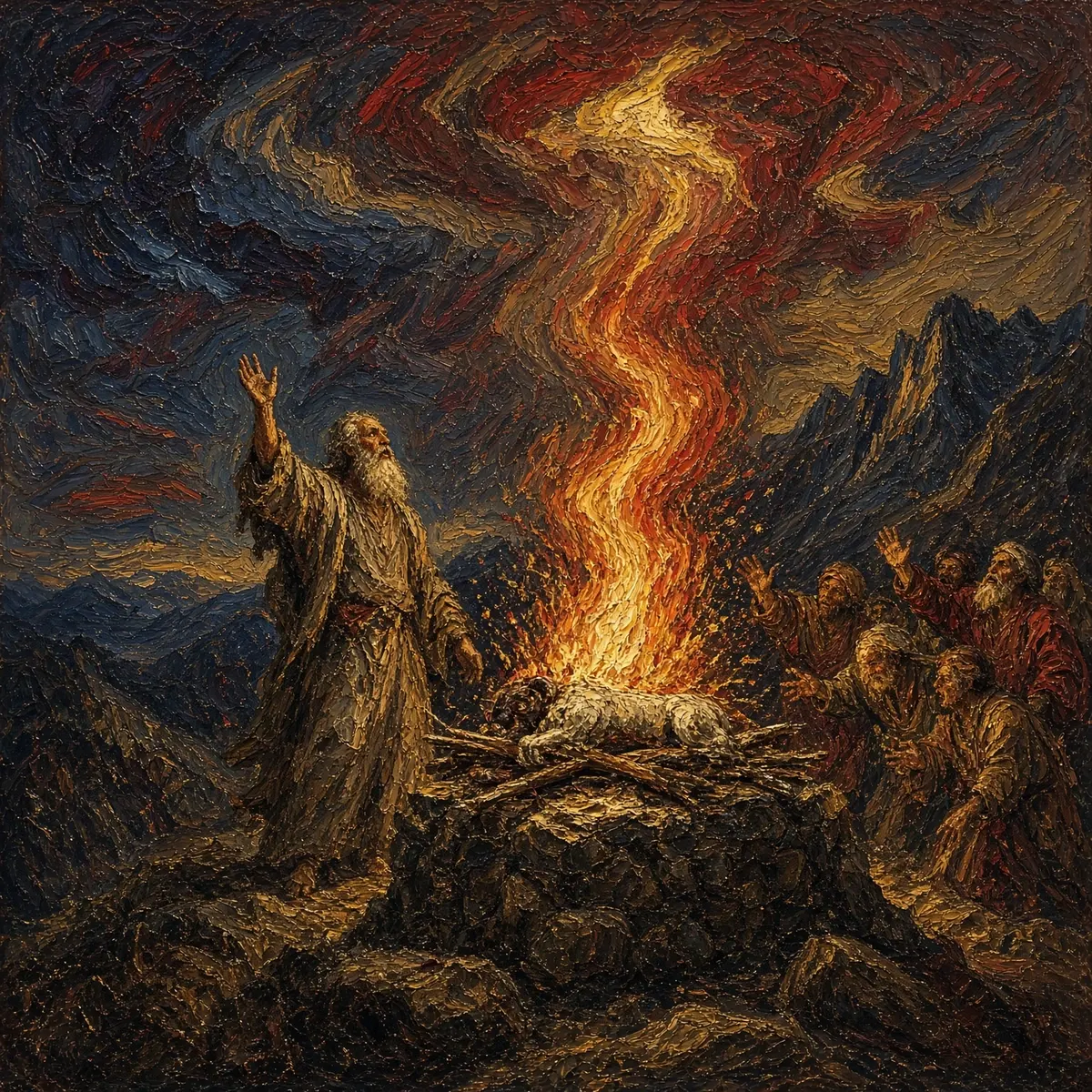
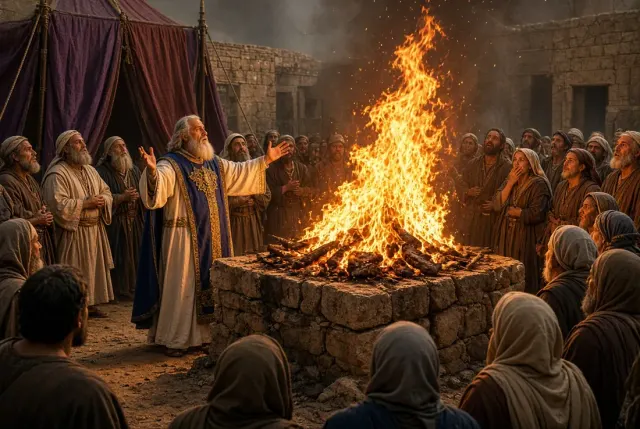
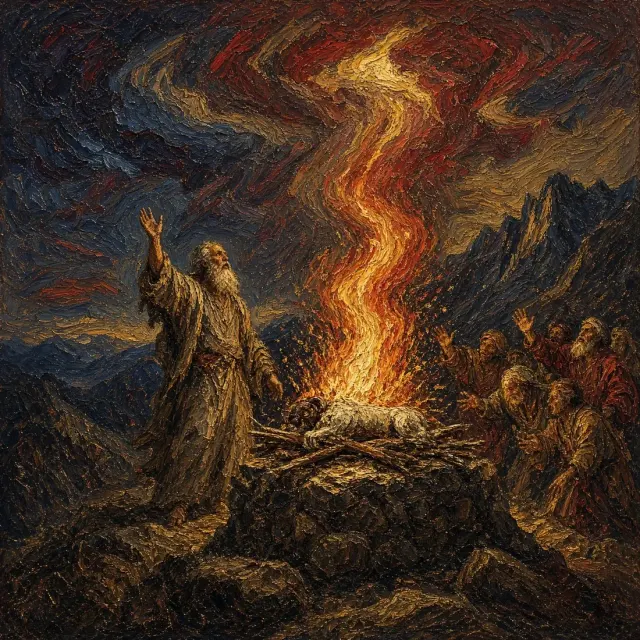
    The prayer is short and its stated purpose is that the people would know their hearts had been turned back. The fire licks up even the water.

    Elijah's prayer contains its own explanation of the spectacle. Let it be known governs three claims: the LORD is God in Israel, Elijah is his servant, and the actions have been done at God's word. The prophet is not asking the crowd to mistake a remarkable man for the source of the power. Even his vindication is phrased as service.

    The next request reaches beyond the altar to the people. Knowing who God is and having their heart turned back belong together. That is why the response cannot be reduced to successful ignition. The fire consumes the offering and wood, but the sentence keeps going through stones, dust, and the water in the trench. The account is emphatic about what ordinary expectations would leave behind.

    The people's response then answers the silence of verse 21. They had offered no word when challenged to choose; now the same confession comes twice. The LORD, he is the God. The repeated sentence is not padding. It gives public speech to the recognition Elijah's prayer requested. The chapter has moved from a damaged altar to a restored declaration, and it identifies the source of both the fire and the return.

    Verse by verse

    1. 18:36

      The prayer names Abraham, Isaac, and Israel, using Jacob's God-given name just as the explanation of the twelve stones did in verse 31.

    2. 18:37

      The confession in verse 39 answers this prayer, but it does not establish that every Israelite remains faithful afterward. The threats and resistance of chapter 19 still belong to the account.

    3. 18:39

      The following verse records the capture and killing of Baal's prophets at the brook Kishon. The public confession must not be presented as though it were the chapter's only immediate consequence.

    1 Kings 18:36-39

    King James Version · 4 verses

    18:36And it came to pass at the time of the offering of the evening sacrifice, that Elijah the prophet came near, and said, LORD God of Abraham, Isaac, and of Israel, let it be known this day that thou art God in Israel, and that I am thy servant, and that I have done all these things at thy word.

    18:37Hear me, O LORD, hear me, that this people may know that thou art the LORD God, and that thou hast turned their heart back again.

    18:38Then the fire of the LORD fell, and consumed the burnt sacrifice, and the wood, and the stones, and the dust, and licked up the water that was in the trench.

    18:39And when all the people saw it, they fell on their faces: and they said, The LORD, he is the God; the LORD, he is the God.

    1 Kings 18:36-39: Let it be known this day
  5. 05

    1 Kings 18:41-46

    There is a sound of abundance of rain

    He hears the rain before there is a cloud, sends a servant seven times, and outruns Ahab’s chariot to the entrance of Jezreel.

    Ahab goes up to eat; Elijah goes up to bend low. The repeated movement places the two men beside each other while giving them very different postures. The prophet whose prayer at the altar was spoken before the people now has his face between his knees on the summit. The announcement of abundant rain precedes the visible cloud.

    Nothing is the servant's honest first report, not a diagnosis of his faith. The repeated journeys belong to the description of the waiting. At the seventh, the cloud is only the size of a man's hand, yet the message to Ahab is already practical: get moving before the road becomes impassable. The scale changes rapidly from that small shape over the sea to a blackened sky and great rain.

    The hand returns in the closing verse, this time the hand of the LORD upon Elijah. The first hand measures the cloud; the second names the power enabling the prophet. The text does not provide his running speed or turn the journey into a contest with the chariot. It gives the gathered-up clothing, the run, and the entrance to Jezreel. The drought announced in chapter 17 has ended with water falling and the prophet still in motion.

    Verse by verse

    1. 18:41

      The promise of rain appears in 18:1 before the gathering on Carmel. The ending answers that prior divine announcement, not merely a prediction invented when a cloud becomes visible.

    2. 18:43-44

      Verse 44 identifies the successful observation as the seventh. The passage does not attach a universal prayer formula to the number of the servant's journeys.

    3. 18:46

      Girding the loins means gathering up the garment for movement. Running before Ahab is stated, but the verse does not explain the action as a permanent endorsement of the king's rule.

    1 Kings 18:41-46

    King James Version · 6 verses

    18:41And Elijah said unto Ahab, Get thee up, eat and drink; for there is a sound of abundance of rain.

    18:42So Ahab went up to eat and to drink. And Elijah went up to the top of Carmel; and he cast himself down upon the earth, and put his face between his knees,

    18:43And said to his servant, Go up now, look toward the sea. And he went up, and looked, and said, There is nothing. And he said, Go again seven times.

    18:44And it came to pass at the seventh time, that he said, Behold, there ariseth a little cloud out of the sea, like a man’s hand. And he said, Go up, say unto Ahab, Prepare thy chariot, and get thee down, that the rain stop thee not.

    18:45And it came to pass in the mean while, that the heaven was black with clouds and wind, and there was a great rain. And Ahab rode, and went to Jezreel.

    18:46And the hand of the LORD was on Elijah; and he girded up his loins, and ran before Ahab to the entrance of Jezreel.

    1 Kings 18:41-46: There is a sound of abundance of rain

Why it matters

Two bullocks, two altars, no fire put under either, and the God that answereth by fire, let him be God. The prophets of Baal go first and are given all morning and into the afternoon, and Elijah mocks them with suggestions: cry aloud, for he is a god, either he is talking or he is pursuing, or he is in a journey, or peradventure he sleepeth. Then Elijah repairs a broken altar with twelve stones, soaks it three times, and prays thirty-two words. The fire falls, and afterwards he runs ahead of a chariot to Jezreel and then, hearing one threat, runs for his life.

3 songs

The music

Every song in the catalogue whose passage falls inside these chapters.

  1. 1 Kings 18

    Answer by Fire

  2. 1 Kings 18

    Fire Fell on Carmel

    Play hereOpen song pageRead lyrics
  3. 1 Kings 18:1-46

    The LORD, He Is God

The videos

The videos

Every release whose passage falls inside these chapters, playing here.

Nearby

All the places

Report an error on this page