The big picture
A prison letter could have made Paul's chains the center of everything, but the Book of Philippians measures the chapter by what those chains fail to stop. Fellowship has endured into imprisonment, love is asked to grow sharper in judgment, and confinement has carried the gospel into places freedom might not have reached in the same way. Even rival preachers cannot control the meaning of their own activity once Christ is being proclaimed. Paul's uncertainty about life or death is genuine, yet neither outcome is allowed to become simple defeat. His personal desire to be with Christ stands beside the congregation's continuing need of him. By the end, the question has moved from Paul's fate to the Philippians' steadiness together, whether he returns to see it or only hears of it from afar.
In this chapter
- Fellowship That Has Stayed Beside a Prisoner Philippians 1:1-8
Paul begins with an unusually wide embrace: all the saints, with bishops and deacons named inside the congregation rather than above it as though the real work belonged only to officeholders.
- Love Is Asked to Become More Discerning Philippians 1:9-11
The prayer does not let love escape the hard work of seeing clearly.
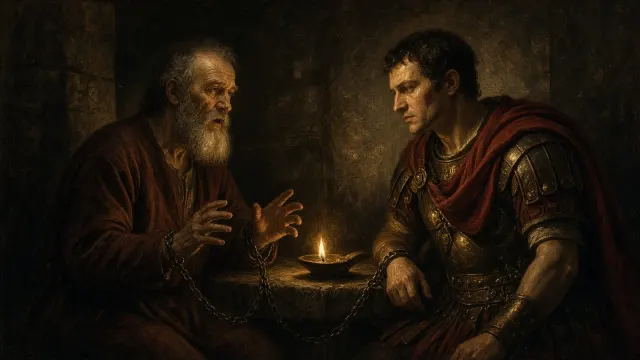
- The Chains Have Not Consulted the Gospel Philippians 1:12-18
The chains behave badly as chains.
- Life, Death, and the People Who Still Need Him Philippians 1:19-26
Paul's use of “salvation” does not collapse into a confident forecast that the prison door will open.
- A Common Front, Not a Performance for Paul's Visits Philippians 1:27-30
Paul's concern is what the congregation is when he is not in the room.

Scripture beside the summary
Philippians · King James Version · 30Philippians 1:1-8
Fellowship That Has Stayed Beside a Prisoner
Paul begins with an unusually wide embrace: all the saints, with bishops and deacons named inside the congregation rather than above it as though the real work belonged only to officeholders. That repeated “all” gives the opening of the Book of Philippians more weight once later disagreements appear. His affection is not reserved for an easy circle. The fellowship he remembers is koinonia, participation that has lasted “from the first day until now” and has followed him into bonds. Material support will give that partnership further substance later in the letter. Even the confidence that God will complete his good work belongs inside this shared life and reaches toward “the day of Jesus Christ,” not toward the guaranteed success of any preferred undertaking. Paul can be confident in God's continuing work and still admit how painfully he longs for people from whom prison has separated him.
Deep dive
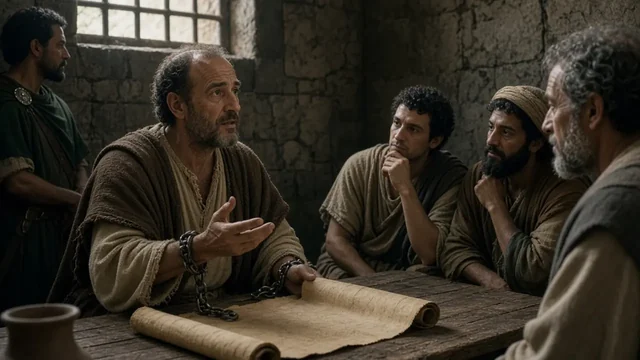
Paul names himself and Timotheus as servants before mentioning anyone's office. The greeting reaches all the saints, with the bishops and deacons included, rather than treating the congregation as an audience watching its officials conduct the real business. The repeated "all" matters in a letter that will soon address divided interests and name two people who need reconciliation. His affection is deliberately wider than a favored circle.
The Greek word koinonia, translated "fellowship," means sharing or participation. Here it has done more than arrange pleasant company. The Philippians have participated in the gospel's advance and remained associated with Paul in his bonds. The gifts described in chapter 4 will put material substance behind that partnership. God's "good work" belongs within this shared life of grace, not a promise that every undertaking will reach its preferred outcome. Its horizon is "the day of Jesus Christ." Paul's confidence rests on the God who began the work, while his language of longing makes clear that confidence has not made the separation painless.
Words to trace: Christ, Jesus, gospel, grace, Always, begun
Verse-by-verse path
- Philippians 1:1
Paul does not call himself an apostle here, as he does not in the Thessalonian letters or Philemon; with this church he had no authority to defend. “Servants” is douloi, slaves, a title shared with Timothy, who was with him when the church began (Acts 16). It is the only letter of Paul to name overseers and deacons in its address.
- Philippians 1:2
Philippi was a Roman colony, refounded for veterans after the battle fought outside its walls in 42 BC, where Antony and Octavian defeated Brutus and Cassius. In a city built on a victory that ushered in the Roman peace, a greeting of peace “from God our Father” had its own edge.
- Philippians 1:3
The Greek can also mean “for all your remembrance of me”, thanking God for the way the Philippians kept Paul in mind, which their gifts had shown. “My God” is personal, and it returns at the end of the letter: “my God shall supply all your need” (4:19).
- Philippians 1:4
“With joy” is the first sounding of the letter’s keynote: joy and rejoicing appear some sixteen times in four chapters. The Greek also doubles the word “all”, in every prayer, for you all, a habit the letter keeps up.
- Philippians 1:5
“Fellowship” is koinonia, which in commercial Greek meant a business partnership. “From the first day” reaches back to Lydia, the seller of purple at Philippi, who after her baptism pressed Paul and his companions to stay in her house (Acts 16:15).
- Philippians 1:6
“Begun” and “perform” are enarchomai and epiteleo, a pair Greek used for starting and completing a religious rite. Paul pairs the same two verbs in Galatians 3:3: “having begun in the Spirit, are ye now made perfect by the flesh?” Here God does both halves.
- Philippians 1:7
“Think” is phroneo, the letter’s signature verb, used about ten times for a settled way of thinking. “Defence and confirmation” are legal words, apologia, a speech in court, and bebaiosis, a guarantee. The Greek of “I have you in my heart” also allows “you have me in your heart”.
- Philippians 1:8
“God is my record” is an oath, calling God as witness. “Long after” is epipotheo, to yearn for. The bowels, splanchna, were the heart, lungs and liver, taken as the seat of feeling, and Paul says his yearning is Christ’s own: he loves them with the affection of Jesus.
Philippians 1:1-8
King James Version1Paul and Timotheus, the servants of Jesus Christ, to all the saints in Christ Jesus which are at Philippi, with the bishops and deacons:
2Grace be unto you, and peace, from God our Father, and from the Lord Jesus Christ.
3I thank my God upon every remembrance of you,
4Always in every prayer of mine for you all making request with joy,
5For your fellowship in the gospel from the first day until now;
6Being confident of this very thing, that he which hath begun a good work in you will perform it until the day of Jesus Christ:
7Even as it is meet for me to think this of you all, because I have you in my heart; inasmuch as both in my bonds, and in the defence and confirmation of the gospel, ye all are partakers of my grace.
8For God is my record, how greatly I long after you all in the bowels of Jesus Christ.
Philippians 1:9-11
Love Is Asked to Become More Discerning
The prayer does not let love escape the hard work of seeing clearly. In the Book of Philippians, abundance is asked to grow together with “knowledge and in all judgment,” because strong affection by itself does not distinguish the excellent from whatever is loudest, newest, or most immediately attractive. Paul gives the movement an order: love deepens, perception sharpens, integrity follows, and the result is fruit of righteousness. The horizon remains the day of Christ, which keeps excellence from being reduced to short-term approval. Yet the fruit is “by Jesus Christ,” so the passage does not turn discernment into a display of self-made moral achievement. Grace and judgment are not rivals here. Paul can begin with what God has done, take the Philippians' actual choices seriously, and still end with glory and praise belonging to God. Mature love, in this prayer, is not less thoughtful because it is more abundant.
Deep dive
The prayer does not ask love to become less thoughtful as it becomes more abundant. Knowledge and judgment belong inside its growth. A community can be energetic, affectionate, and still unable to distinguish what matters from what merely attracts attention. Paul therefore joins the amount of their love to the quality of its perception. To "approve things that are excellent" is not simply to have strong feelings about everything at once.
The movement of the prayer is carefully ordered: abounding love, discernment, integrity, and the fruit of righteousness. The repeated horizon of the day of Christ prevents the excellent from being reduced to whatever wins immediate approval. Yet the fruit is "by Jesus Christ," not a display of independent moral achievement. Paul begins with gratitude for what God has done and ends the prayer with God's glory. Between those points, he takes the Philippians' actual judgment and conduct seriously. Grace does not make their discernment unnecessary; it is the setting in which he asks for that discernment to mature.
Words to trace: Christ, abound, approve, excellent, filled, fruits
Verse-by-verse path
- Philippians 1:9
“Judgment” is aisthesis, perception or moral discernment, found only here in the New Testament and the root of the English aesthetic. “Knowledge” is epignosis, the fuller knowing of Ephesians 1:17. Love is asked to grow in both at once.
- Philippians 1:10
“Approve things that are excellent” can equally mean test the things that differ: the same Greek phrase covers both. “Sincere” is eilikrines, traditionally explained as judged by sunlight, like cloth held up to the sun to check for flaws, though the etymology is uncertain. “Without offence” can mean not stumbling or not tripping others.
- Philippians 1:11
“Fruits” is singular in the Greek, fruit of righteousness, one harvest. “Being filled” is perfect in tense, already filled and remaining so. The phrase “fruit of righteousness” comes from the Greek Old Testament (Proverbs 11:30; Amos 6:12).
Philippians 1:9-11
King James Version9And this I pray, that your love may abound yet more and more in knowledge and in all judgment;
10That ye may approve things that are excellent; that ye may be sincere and without offence till the day of Christ;
11Being filled with the fruits of righteousness, which are by Jesus Christ, unto the glory and praise of God.
Philippians 1:12-18
The Chains Have Not Consulted the Gospel
The chains behave badly as chains. They are supposed to restrict Paul, yet in the Book of Philippians they become part of the reason Christ is discussed through the governing headquarters or guard and beyond. The precise setting behind the KJV's “palace” is uncertain, and the letter never names the city of imprisonment, but its point is clear enough: confinement has made the reason for Paul's bonds more widely known and has made other believers bolder. Then the chapter complicates the good news with ugly motives. Some preachers genuinely wish him well; others hope their preaching will add pain to an already imprisoned man. Paul does not rename envy as healthy competition. He simply refuses to let their motive dictate the value of Christ being proclaimed. That is a narrower claim than saying every religious message is equally acceptable. The rivals intend injury, but they cannot force Paul to make their hostility the limit of his joy.

Deep dive
Paul answers concern about his circumstances by reporting what those circumstances have done for the gospel. The expected obstacle has become a means of making Christ known. The KJV's "palace" represents a term associated with a governor's headquarters or its guard; interpreters differ over the precise setting. The sentence establishes the spread of knowledge about Paul's bonds in Christ, not the conversion of an emperor. The letter itself does not name the city of imprisonment.
The more uncomfortable development comes from fellow preachers. Some speak from goodwill, while others hope to make an imprisoned man suffer more. Their envy is not dressed up as healthy competition. Nevertheless, Paul's test here is whether Christ is being proclaimed, not whether the speaker has treated Paul generously. That distinction should not be expanded into approval of every religious message: he describes rival motives behind preaching Christ, not contradictory gospels as equally true. His opponents can intend personal injury and still fail to control the meaning of their activity. The prison limits Paul's movement; neither the prison nor the competition gets to set the limits of his joy.
Words to trace: Christ, bonds, brethren, gospel, preach, rejoice
Verse-by-verse path
- Philippians 1:12
“I would ye should understand” is a standard letter formula, “I want you to know”. “Furtherance” is prokope, progress, a word some explain as cutting a way forward, as pioneers clear a road for an army. It comes back in verse 25 for the Philippians’ own progress.
- Philippians 1:13
“Palace” is praitorion, which could mean the Praetorian Guard, the emperor’s troops in Rome, or a governor’s headquarters, as at Caesarea (Acts 23:35). Prisoners were chained to soldiers in shifts, so one guard after another heard why this man was held. “In Christ” means the chains are known to be for Christ, not for a crime.
- Philippians 1:14
“Waxing confident” is peitho in the perfect, persuaded and remaining so. “Bold” is tolmao, to dare. Many early copies lengthen “the word” to “the word of God”. The logic is surprising: seeing a leader in chains made others braver, not more careful.
- Philippians 1:15
Envy and strife, phthonos and eris, stand side by side in Romans 1:29 in the list of what fills a mind given up to itself; here Paul finds them among preachers of Christ. “Good will” is eudokia, the word used in Ephesians 1:5 for God’s own good pleasure.
- Philippians 1:16
In the oldest manuscripts this verse and the next are reversed: those preaching from love come first, those from contention second. The King James follows later copies. “Contention” is eritheia, selfish ambition, a word Aristotle used for canvassing for office through hired partisans.
- Philippians 1:17
“I am set” is keimai, to lie in place, used of a soldier posted at his station or of a stone laid where it belongs; Luke 2:34 uses it of the child Jesus, “set for the fall and rising again of many”. “Defence” repeats the apologia of verse 7.
- Philippians 1:18
“What then?” is a colloquial shrug in Greek, “So what?”. “Pretence” is prophasis, a pretext, a plausible front for another motive. The final clause looks ahead: “and will rejoice” is future, turning the reader toward what Paul expects next.
Philippians 1:12-18
King James Version12But I would ye should understand, brethren, that the things which happened unto me have fallen out rather unto the furtherance of the gospel;
13So that my bonds in Christ are manifest in all the palace, and in all other places;
14And many of the brethren in the Lord, waxing confident by my bonds, are much more bold to speak the word without fear.
15Some indeed preach Christ even of envy and strife; and some also of good will:
16The one preach Christ of contention, not sincerely, supposing to add affliction to my bonds:
17But the other of love, knowing that I am set for the defence of the gospel.
18What then? notwithstanding, every way, whether in pretence, or in truth, Christ is preached; and I therein do rejoice, yea, and will rejoice.
Philippians 1:19-26
Life, Death, and the People Who Still Need Him
Paul's use of “salvation” does not collapse into a confident forecast that the prison door will open. The Book of Philippians immediately leaves both life and death on the table, making the deeper expectation that Christ will be magnified in his body either way. Prayer and the supply of the Spirit belong to that confidence, not to a claim that uncertainty has vanished. “To live is Christ, and to die is gain” therefore opens a tension between two goods. Departure means being with Christ, which Paul calls far better; continued life means fruitful labor and furtherance for people who still need him. He does not treat embodied life as an unfortunate waiting room, and he does not pretend his personal desire and the congregation's need point in the same direction. His confidence that he will remain turns toward their joy, but only after possible death has been faced without being converted into mere dramatic scenery.
Deep dive
The word "salvation" in verse 19 cannot be flattened into a prediction of immediate release, because Paul immediately considers both life and death. His expectation is that Christ will be magnified in his body in either outcome. Prayer and the Spirit's supply belong to that confidence. He does not describe himself as a man who has made uncertainty disappear; he describes what would make either outcome something other than defeat.
The pull toward departure is explicitly a desire "to be with Christ." It is not disgust with embodied life, since remaining in the flesh means fruitful labor and the Philippians' furtherance. The tension is therefore between two goods, not meaningful death and meaningless survival. Paul's personal desire and the congregation's need do not point in the same direction, and he allows both to appear. His confidence that he will remain turns the discussion toward their joy and a hoped-for reunion. The paragraph moves from his possible death to their growth without pretending that the first subject was merely a dramatic introduction.
Words to trace: Christ, abide, flesh, Jesus, know, live
Verse-by-verse path
- Philippians 1:19
“This shall turn to my salvation” is word for word the Greek of Job 13:16, spoken by a man sure he would be vindicated. “Supply” is epichoregia, from the choregos, the wealthy citizen of Athens who paid for a chorus in the theatre: a generous provision, not a ration.
- Philippians 1:20
“Earnest expectation” is apokaradokia, watching with the head stretched forward, craning the neck to see; Romans 8:19 uses it of the whole creation. “Magnified” is megaluno, to make great. Paul’s own body is what stands on trial, and in it, alive or dead, Christ is to appear large.
- Philippians 1:21
The Greek has no main verbs: “for to me the living, Christ, and the dying, gain.” “Gain” is kerdos, profit, the word Paul uses again in 3:7, “what things were gain to me, those I counted loss for Christ”. Death alone keeps the word on the profit side of the ledger.
- Philippians 1:22
The Greek grammar of this verse comes apart, as though the sentence is pulled two ways at once. “Wot” is 1611 English for know. The verb, gnorizo, usually means to make known, so Paul may be saying not that he does not know which to choose but that he will not declare it.
- Philippians 1:23
“In a strait” is synechomai, to be hemmed in, pressed from both sides, as the crowd pressed Jesus in Luke 8:45. “Depart” is analuo, to loose, used of striking a tent or casting off a ship’s moorings. “Far better” piles up three comparatives, literally much more better.
- Philippians 1:24
“Abide in the flesh” uses flesh in its plain sense, bodily life, not the power of sin it names in Galatians 5. “For you” is the whole reason. Paul sets what is needful for others above what he calls far better for himself.
- Philippians 1:25
“Abide and continue” is a wordplay, meno and parameno: remain, and remain alongside. “Furtherance” is the prokope of verse 12 again: the gospel’s progress in Rome, the Philippians’ progress in faith. Whether Paul did return is not recorded, though 1 Timothy 1:3 places him later in Macedonia.
- Philippians 1:26
“Rejoicing” is kauchema, ground for boasting, the word of Galatians 6:4. “By my coming” uses parousia, the word for an official visit, which the New Testament also uses for the coming of the Lord (1 Thessalonians 4:15). The boast is to be “in Jesus Christ”, with Paul as its occasion.
Philippians 1:19-26
King James Version19For I know that this shall turn to my salvation through your prayer, and the supply of the Spirit of Jesus Christ,
20According to my earnest expectation and my hope, that in nothing I shall be ashamed, but that with all boldness, as always, so now also Christ shall be magnified in my body, whether it be by life, or by death.
21For to me to live is Christ, and to die is gain.
22But if I live in the flesh, this is the fruit of my labour: yet what I shall choose I wot not.
23For I am in a strait betwixt two, having a desire to depart, and to be with Christ; which is far better:
24Nevertheless to abide in the flesh is more needful for you.
25And having this confidence, I know that I shall abide and continue with you all for your furtherance and joy of faith;
26That your rejoicing may be more abundant in Jesus Christ for me by my coming to you again.
Philippians 1:27-30
A Common Front, Not a Performance for Paul's Visits
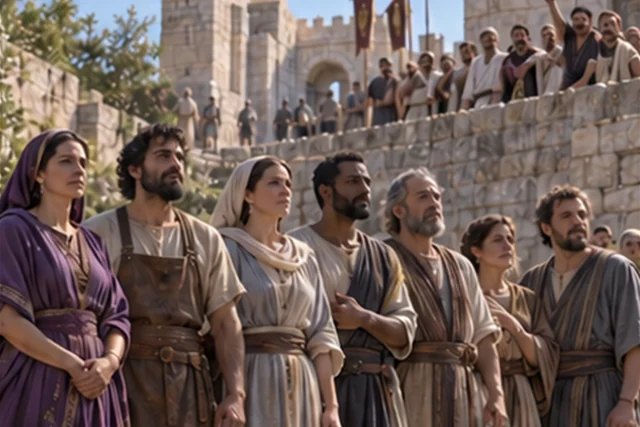
Paul's concern is what the congregation is when he is not in the room. The KJV's “conversation” reaches beyond speech to their manner of life, and the Book of Philippians makes that distinction crucial: whether Paul comes or remains absent, he wants to hear of one spirit, one mind, and people striving together rather than a temporary display produced by his presence. Opposition does not replace that concern for unity. The Philippians are to stand without being terrified by adversaries, with their steadiness interpreted differently by those opposing them and by those whose salvation is from God. The difficult line comes next, where believing in Christ and suffering “for his sake” are placed together as what has been given. The qualification matters. The passage does not call every hardship Christ's suffering or declare pain enjoyable. It locates their present conflict beside the conflict they already saw in Paul and now hear continues through his imprisonment.
Deep dive
The KJV's "conversation" concerns the manner of life, not merely the words exchanged in conversation. Paul wants news of a community standing together, with one spirit and one mind, rather than a report that everyone behaved well while he was in the room. His presence cannot be the mechanism holding their life together. This prepares the next chapter's attention to rivalry, empty ambition, and the interests of others.
Opposition appears alongside unity rather than replacing it. Paul describes their steadiness as a sign whose meaning differs for adversaries and believers, with salvation traced to God. He then places believing and suffering for Christ within the same language of what has been given. This is not a declaration that suffering is enjoyable or that every hardship has the same cause. The qualification "for his sake" matters. The Philippians are sharing the conflict they saw in Paul and now hear about through his imprisonment. Their circumstances are not evidence that they have somehow wandered outside the life described by the gospel.
Words to trace: Christ, gospel, hear, absent, adversaries, affairs
Verse-by-verse path
- Philippians 1:27
“Let your conversation be” is politeuomai, to live as a citizen. In Philippi, a colony whose people prized their Roman citizenship (Acts 16:21), the word was pointed, and it returns in 3:20, “our conversation is in heaven”. “Striving together” is synathleo, to compete as teammates in the games.
- Philippians 1:28
“Terrified” is ptyro, used of a horse that shies in fright, found only here in the New Testament. “Evident token” is endeixis, proof, a word for evidence in a legal case. The same steadiness is read as a sign pointing in two opposite directions.
- Philippians 1:29
“It is given” is echaristhe, from charis: graciously granted, given as a favour. The Greek begins “to you it was granted, on behalf of Christ” and then breaks off to insert “not only to believe on him” before resuming with the second gift, suffering, which the sentence had been heading for all along.
- Philippians 1:30
“Conflict” is agon, a contest in the games, the root of agony. They had seen it in person: at Philippi Paul and Silas were stripped, beaten with rods and fastened in the stocks (Acts 16:22–24). Now they hear of it from his prison.
Philippians 1:27-30
King James Version27Only let your conversation be as it becometh the gospel of Christ: that whether I come and see you, or else be absent, I may hear of your affairs, that ye stand fast in one spirit, with one mind striving together for the faith of the gospel;
28And in nothing terrified by your adversaries: which is to them an evident token of perdition, but to you of salvation, and that of God.
29For unto you it is given in the behalf of Christ, not only to believe on him, but also to suffer for his sake;
30Having the same conflict which ye saw in me, and now hear to be in me.
Questions to keep in mind while reading
- Identify the audience, problem, argument, command, and pastoral purpose.
- Follow connecting words so that one sentence remains inside the author’s reasoning.
- Distinguish a universal theological claim from an instruction shaped by a particular situation.
Text first
Where readers differ
The chapter summary begins with what the passage says and how its parts fit together. It does not assume one denomination has already settled every question. Where a conclusion depends on a tradition, literary theory, or historical reconstruction, that dependence is named openly.
The KJV text is presented first. Interpretive conclusions are labeled, and differences are introduced only when they help a reader understand why serious communities do not always reach the same answer.
Comparative interpretive notes for this chapter are in preparation. Until reviewed notes are ready, this page separates the KJV text from summary and application without claiming that serious readers agree on every question.
Questions beneath the surface
- What account of God, human freedom, responsibility, and the good life emerges from Philippians 1?
- Which tension does the chapter refuse to resolve quickly?
- What changes when the chapter is read as part of the whole canon rather than as an isolated moral lesson?
- Where might a sincere reader confuse a familiar tradition with something the text states directly?
Questions for serious personal contemplation
These open-ended questions make room for tension, honest response, prayer, and conclusions that remain accountable to the chapter.
Observe without rushing
What part of Philippians 1 makes you stop, feel unsettled, or feel surprised, and why?
Which detail in the passage would be easiest to overlook? How does that detail change your understanding?
Where do you see tension between what happens and this focus: Paul writing under guard while the Gospel advances through imprisonment and believers receive courage?
What important question does the passage leave open instead of resolving quickly?
Examine your inner life honestly
Which person, response, fear, or desire in the passage feels most like your own life right now?
What assumption about God, other people, or yourself does this text challenge?
Which part would you rather soften, avoid, or explain away too quickly? What might that reaction reveal?
If this Scripture could ask you one direct question, what do you think it would ask?
Respond with wisdom and courage
What do you need to remember, confess, grieve, thank God for, or trust after reading this passage?
How might another faithful person read this situation differently without ignoring the text?
What obedient response would be costly, uncomfortable, or slow, yet still faithful to Scripture?
What question will you carry into prayer this week, and which verses will you keep in front of you?
Music and video connected to the passage
Related media appears when its Scripture reference overlaps this study. Music and video can illuminate a theme while the biblical text remains the foundation.