The big picture
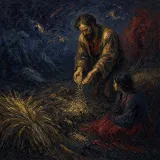
The Book of Ruth moves from famine and bereavement into the working life of a harvest field. Ruth goes to glean, a provision already built into Israel’s law for vulnerable people, and her “hap” brings her to land belonging to Boaz, a relative of Elimelech. Boaz’s response turns generosity into a set of concrete protections: Ruth may remain with his women workers, drink freely, eat at his table, gather without rebuke, and work under an explicit order that the young men not touch her. He also has extra grain dropped deliberately for her. Ruth returns to Naomi with abundance and with food saved from the meal. When she names Boaz, Naomi sees more than a successful day. She recognizes covenant kindness and identifies him as one of their redeemers. Hope is returning, but the chapter lets it ripen through both barley and wheat harvests rather than forcing a quick resolution.
In this chapter
- Ruth Works Behind the Reapers in Boaz’s Field Ruth 2:1-7
Ruth enters the field because Israel’s harvest law has already made room for people with little power.
- Boaz Joins Generosity to Concrete Safety Ruth 2:8-16
Boaz does not leave kindness floating at the level of good intentions.
- Naomi Recognizes Covenant Kindness in the Harvest Ruth 2:17-23
Ruth’s first day in Boaz’s field ends with enough barley to surprise Naomi, and the detail that she also brings home food saved from the meal shows how consistently Naomi remains in her thoughts.

Scripture beside the summary
Ruth · King James Version · 23Ruth 2:1-7
Ruth Works Behind the Reapers in Boaz’s Field
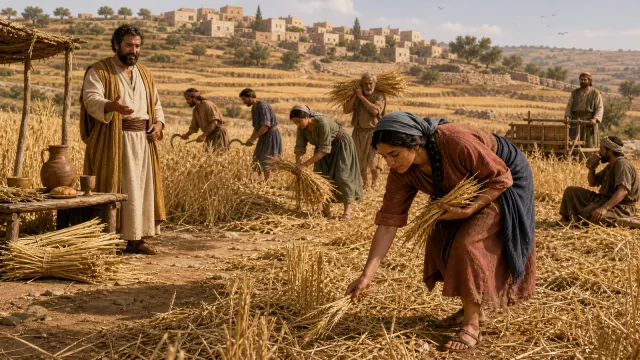
Ruth enters the field because Israel’s harvest law has already made room for people with little power. Gleaning is not private charity invented by a generous landowner. It is a legal provision for the poor, stranger, widow, and fatherless, though Ruth’s request for permission shows that a right on paper does not erase social vulnerability. Then comes the Book of Ruth’s wonderfully modest providence: “her hap was to light on” a field belonging to Boaz, of Elimelech’s family. From Ruth’s angle, she has simply arrived somewhere to work. From the wider account, the ordinary choice of a field is already carrying family significance she does not yet know. The overseer identifies her first as the Moabite woman who returned with Naomi, then notes her steady labor. Her diligence is real, but the provision does not depend on proving exceptional worth. The field was supposed to leave space for need before Ruth ever entered it.
Deep dive
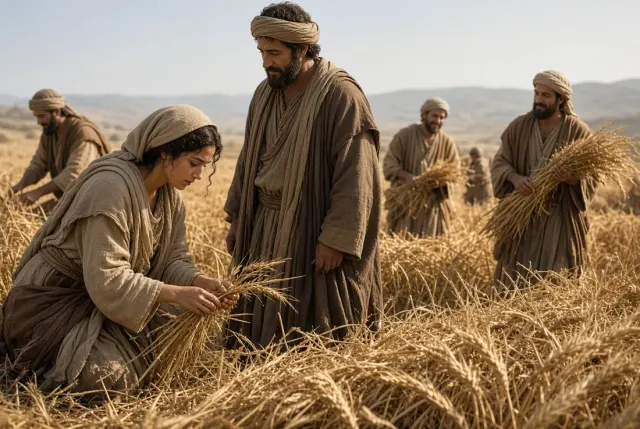
Gleaning rests on Israel’s law that landowners leave portions of harvest for the poor, stranger, widow, and fatherless. Ruth still asks permission because legal provision does not erase social vulnerability. The phrase that she happened to come to Boaz’s field describes the event from her limited perspective while the larger account invites readers to see providence through ordinary decisions.
The overseer identifies Ruth by ethnicity and relationship before describing her labor. She is visible as a foreign widow and as Naomi’s companion. Her diligence matters, but the book does not teach that vulnerable people deserve food only when they prove exceptional productivity. The field is already governed by a command to leave space for those in need.
Words to trace: reapers, Boaz, field, Naomi, damsel, Elimelech
Verse-by-verse path
- Ruth 2:1
The reader learns of Boaz before Ruth does. “Kinsman” here is moda, an acquaintance or known relative, not yet the legal term go’el that Naomi will use in verse 20. “A mighty man of wealth” is gibbor chayil, a phrase that can mean a warrior, a man of property or a man of worth; Ruth will be called an eshet chayil, “a virtuous woman”, in 3:11.
- Ruth 2:2
Ruth takes the initiative and Naomi answers in two words. “Ears of corn” means heads of grain; “corn” in 1611 English was any cereal, here barley. “Find grace” is chen, favour, and the word will return three times in this chapter as Ruth and Boaz speak.
- Ruth 2:3
“Her hap was to light on” translates a doubled Hebrew phrase, literally “her chance chanced upon”, miqreh, luck or happening. The Book of Ruth puts it in the language of pure accident, with a straight face, and then names the field’s owner in the same breath.
- Ruth 2:4
Master and workers exchange blessings in the LORD’s name, a greeting that shows the tone of the field before anything happens in it. “Behold” marks his arrival as a surprise and as good timing: he comes out from the town on the very day she chose his field.
- Ruth 2:5
“Whose damsel is this?” asks to whom she belongs, a father, husband or household, the ordinary way of placing a young woman. Boaz notices her among the gleaners at once.
- Ruth 2:6
The overseer answers with her origin twice, “Moabitish” and “out of the country of Moab”, which is how the town sees her. He does not give her name; he may not know it.
- Ruth 2:7
The Hebrew of the last clause is difficult: literally “this her sitting in the house a little”. It may mean she rested only briefly in the field shelter, or that she has hardly stopped since morning. Gleaning “among the sheaves” was more than the law required, which only left the edges and the dropped ears (Leviticus 19:9).
Ruth 2:1-7
King James Version1And Naomi had a kinsman of her husband’s, a mighty man of wealth, of the family of Elimelech; and his name was Boaz.
2And Ruth the Moabitess said unto Naomi, Let me now go to the field, and glean ears of corn after him in whose sight I shall find grace. And she said unto her, Go, my daughter.
3And she went, and came, and gleaned in the field after the reapers: and her hap was to light on a part of the field belonging unto Boaz, who was of the kindred of Elimelech.
4And, behold, Boaz came from Beth-lehem, and said unto the reapers, The LORD be with you. And they answered him, The LORD bless thee.
5Then said Boaz unto his servant that was set over the reapers, Whose damsel is this?
6And the servant that was set over the reapers answered and said, It is the Moabitish damsel that came back with Naomi out of the country of Moab:
7And she said, I pray you, let me glean and gather after the reapers among the sheaves: so she came, and hath continued even from the morning until now, that she tarried a little in the house.
Ruth 2:8-16
Boaz Joins Generosity to Concrete Safety
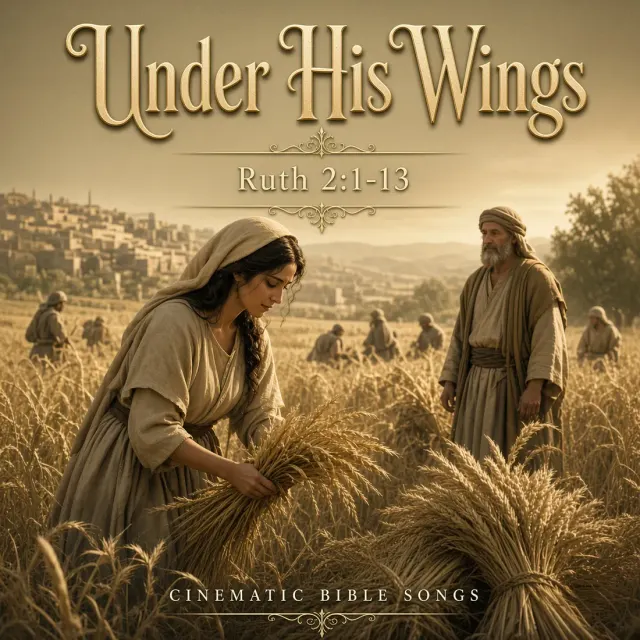
Boaz does not leave kindness floating at the level of good intentions. He turns it into rules, food, water, belonging, and safety. Ruth is told to stay close to his women workers. She may drink from water others have drawn. The young men are explicitly charged not to touch her, and later they are told not to reproach her as she gathers. That detail matters because a field can be economically open and still socially dangerous. Boaz has heard what Ruth did for Naomi and speaks of her taking refuge under the LORD’s wings, but his blessing does not become an excuse to wait for invisible help. He himself participates in that refuge. At the meal he feeds her until she is satisfied, then quietly arranges for extra grain to be dropped where she can gather it. The gift preserves Ruth’s agency and protects her from public humiliation. In the Book of Ruth, generosity has structure.
Deep dive
Boaz’s kindness is practical. He provides belonging among the women workers, water drawn by others, food at his table, freedom to gather, and a clear protection order. His command not to touch or reproach Ruth recognizes that a field can be economically open while still socially dangerous. Responsible generosity includes safety, dignity, and enforceable boundaries.
Boaz has heard what Ruth did for Naomi and describes her as taking refuge under the LORD’s wings. His blessing does not replace human action; Boaz becomes one means through which that refuge is experienced. He also protects Ruth from shame by telling the workers to leave grain without rebuke. Giving can honor a person’s agency rather than requiring public humiliation.
Words to trace: Boaz, glean, LORD, young, eyes, field
Verse-by-verse path
- Ruth 2:8
“Hearest thou not” is a gentle way of saying “listen”. “My daughter” sets Boaz as an older man speaking to a young woman. “Abide here fast by my maidens” uses davaq again, the verb of Ruth clinging to Naomi (1:14), now applied to staying with his women workers.
- Ruth 2:9
“Touch” can mean molest or strike, and the charge suggests the danger was real for a lone foreign woman in a field. Drawing water was usually work for women and foreigners (Deuteronomy 29:11); here the young Israelite men draw it and the Moabite widow drinks.
- Ruth 2:10
Falling on the face and bowing to the ground is the full gesture of a suppliant. Her question contains a Hebrew pun: “take knowledge of me”, lehakkireni, and “stranger”, nokhriyyah, come from the same root, to recognise and to be foreign.
- Ruth 2:11
Boaz describes her journey in words that echo God’s call to Abraham in Genesis 12:1: leaving father, mother and “the land of thy nativity” for a land not known before. He has heard the whole account, fully, from the town’s talk.
- Ruth 2:12
“Recompense” is shalem, to repay in full; “a full reward” is maskoreth, wages. “Under whose wings” pictures a bird sheltering its young, as in Psalm 91:4. In 3:9 Ruth will ask Boaz to spread his own “skirt”, the same Hebrew word, kanaph, wing, over her.
- Ruth 2:13
“Spoken friendly” is literally “spoken to the heart”, the tender phrase of Judges 19:3. She calls herself shiphchah, a maidservant, and adds that she is not even equal to one of his. In 3:9 she will choose a different word, amah, one of higher standing, a handmaid who can be married.
- Ruth 2:14
“Vinegar” is chomets, soured wine used as a dip for bread, a labourer’s relish. Parched corn is roasted grain, eaten from the hand. Boaz serves her himself, and she eats until she is “sufficed, and left”, enough for Naomi too, as verse 18 shows.
- Ruth 2:15
“Among the sheaves” is now permitted outright by the owner, the very request she had made in verse 7. “Reproach her not” means do not shame her; she is to gather in the heart of the crop without being chased off.
- Ruth 2:16
“Of purpose” is a rare Hebrew verb, shol tashollu, to pull out, draw from the bundle. The reapers are to pull stalks from their gathered handfuls and let them fall, so that what Ruth picks up still counts as gleaning, not alms.
Ruth 2:8-16
King James Version8Then said Boaz unto Ruth, Hearest thou not, my daughter? Go not to glean in another field, neither go from hence, but abide here fast by my maidens:
9Let thine eyes be on the field that they do reap, and go thou after them: have I not charged the young men that they shall not touch thee? and when thou art athirst, go unto the vessels, and drink of that which the young men have drawn.
10Then she fell on her face, and bowed herself to the ground, and said unto him, Why have I found grace in thine eyes, that thou shouldest take knowledge of me, seeing I am a stranger?
11And Boaz answered and said unto her, It hath fully been shewed me, all that thou hast done unto thy mother in law since the death of thine husband: and how thou hast left thy father and thy mother, and the land of thy nativity, and art come unto a people which thou knewest not heretofore.
12The LORD recompense thy work, and a full reward be given thee of the LORD God of Israel, under whose wings thou art come to trust.
13Then she said, Let me find favour in thy sight, my lord; for that thou hast comforted me, and for that thou hast spoken friendly unto thine handmaid, though I be not like unto one of thine handmaidens.
14And Boaz said unto her, At mealtime come thou hither, and eat of the bread, and dip thy morsel in the vinegar. And she sat beside the reapers: and he reached her parched corn, and she did eat, and was sufficed, and left.
15And when she was risen up to glean, Boaz commanded his young men, saying, Let her glean even among the sheaves, and reproach her not:
16And let fall also some of the handfuls of purpose for her, and leave them, that she may glean them, and rebuke her not.
Ruth 2:17-23
Naomi Recognizes Covenant Kindness in the Harvest
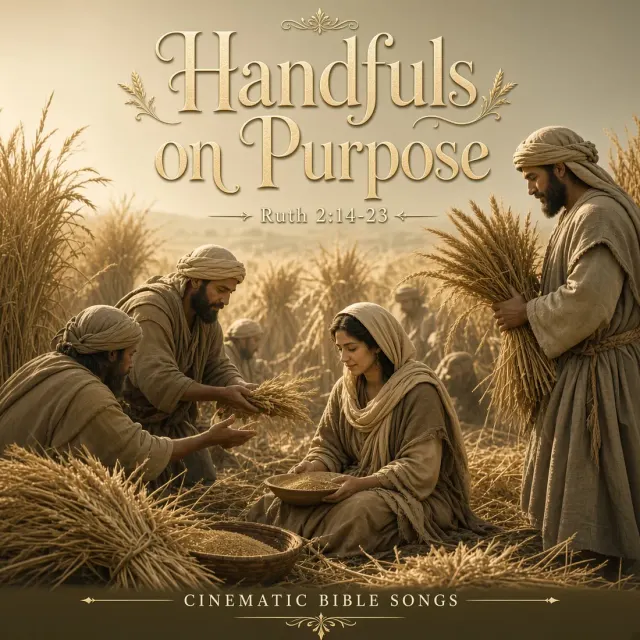
Ruth’s first day in Boaz’s field ends with enough barley to surprise Naomi, and the detail that she also brings home food saved from the meal shows how consistently Naomi remains in her thoughts. Naomi immediately asks where such abundance came from. The name “Boaz” changes the meaning of the day. What looked like a productive field now becomes connected to Elimelech’s family and to the responsibilities of a redeemer. Naomi blesses the LORD’s kindness to the living and the dead, language that fits the Book of Ruth’s pattern of divine faithfulness arriving through human generosity. Redemption here is not reduced to romance. It concerns family land, the preservation of a household, and the protection of vulnerable relatives. Naomi is just as attentive to Ruth’s safety as to the grain, urging her to remain with Boaz’s maidens. Hope has returned, but the women keep living and working through barley harvest and wheat harvest before anything else is attempted.
Deep dive
Ruth’s day produces more than a handful of grain, and the saved portion from her meal shows that she remembered Naomi while eating. Naomi’s questions reveal surprise at such abundance. Her blessing can grammatically point to the LORD’s kindness expressed through Boaz, fitting the book’s pattern in which divine faithfulness and human generosity work together.
Naomi’s knowledge adds a legal and family dimension: Boaz is among their redeemers. Redemption here concerns the protection of family land, name, and vulnerable relatives, not a private romantic feeling alone. Naomi also emphasizes safety among Boaz’s workers. Hope is returning, but the women continue through both barley and wheat harvests before the next step is taken.
Words to trace: gleaned, mother, daughter, harvest, Naomi, barley
Verse-by-verse path
- Ruth 2:17
An ephah was a dry measure of perhaps twenty to thirty litres, several days’ worth of grain for two women from one day’s gleaning. She beats it out herself with a stick before carrying it home, which reduced the load to the kernels.
- Ruth 2:18
“She brought forth” is the leftover food from the meal, kept back for Naomi. The Hebrew subject of “saw” can be read either way: Naomi saw the grain, or Ruth made her see it. Either way the evidence comes home first and the explanation follows.
- Ruth 2:19
Naomi asks two questions in one breath and blesses the unknown benefactor before she knows who he is. Ruth holds the name to the last word of the verse, and in Hebrew “Boaz” does end the sentence.
- Ruth 2:20
The “his” of “his kindness” can refer to the LORD or to Boaz; the Hebrew allows both. “Near of kin” and “next kinsmen” are two different words: qarov, close, and go’alenu, “one of our redeemers”, the relative bound by law to buy back land or a person for the family (Leviticus 25:25).
- Ruth 2:21
Ruth reports the order slightly differently: Boaz told her to stay with his maidens (verse 8), and she repeats it as his “young men”, a masculine form that may be general. “Until they have ended all my harvest” means some weeks of secure work.
- Ruth 2:22
“That they meet thee not” uses paga, which can mean to fall upon or harm. Naomi confirms what Boaz meant: in another man’s field a lone Moabite gleaner would have no protection.
- Ruth 2:23
Wheat followed barley by about seven weeks, the span from Passover to Pentecost. Through all that time the chapter reports nothing further between Ruth and Boaz. “Dwelt with her mother in law” closes on the household of two widows still unchanged, which is the problem chapter 3 takes up.
Ruth 2:17-23
King James Version17So she gleaned in the field until even, and beat out that she had gleaned: and it was about an ephah of barley.
18And she took it up, and went into the city: and her mother in law saw what she had gleaned: and she brought forth, and gave to her that she had reserved after she was sufficed.
19And her mother in law said unto her, Where hast thou gleaned to day? and where wroughtest thou? blessed be he that did take knowledge of thee. And she shewed her mother in law with whom she had wrought, and said, The man’s name with whom I wrought to day is Boaz.
20And Naomi said unto her daughter in law, Blessed be he of the LORD, who hath not left off his kindness to the living and to the dead. And Naomi said unto her, The man is near of kin unto us, one of our next kinsmen.
21And Ruth the Moabitess said, He said unto me also, Thou shalt keep fast by my young men, until they have ended all my harvest.
22And Naomi said unto Ruth her daughter in law, It is good, my daughter, that thou go out with his maidens, that they meet thee not in any other field.
23So she kept fast by the maidens of Boaz to glean unto the end of barley harvest and of wheat harvest; and dwelt with her mother in law.
Questions to keep in mind while reading
- Track who acts, who speaks, who is affected, and what changes.
- Notice repeated promises, failures, rescues, and consequences.
- Do not assume the account approves every action that is reported.
Text first
Where readers differ
The chapter summary begins with what the passage says and how its parts fit together. It does not assume one denomination has already settled every question. Where a conclusion depends on a tradition, literary theory, or historical reconstruction, that dependence is named openly.
The KJV text is presented first. Interpretive conclusions are labeled, and differences are introduced only when they help a reader understand why serious communities do not always reach the same answer.
Comparative interpretive notes for this chapter are in preparation. Until reviewed notes are ready, this page separates the KJV text from summary and application without claiming that serious readers agree on every question.
Questions beneath the surface
- What account of God, human freedom, responsibility, and the good life emerges from Ruth 2?
- Which tension does the chapter refuse to resolve quickly?
- What changes when the chapter is read as part of the whole canon rather than as an isolated moral lesson?
- Where might a sincere reader confuse a familiar tradition with something the text states directly?
Questions for serious personal contemplation
These open-ended questions make room for tension, honest response, prayer, and conclusions that remain accountable to the chapter.
Observe without rushing
What part of Ruth 2 makes you stop, feel unsettled, or feel surprised, and why?
Which detail in the passage would be easiest to overlook? How does that detail change your understanding?
Where do you see tension between what happens and this focus: Ruth gleaning behind the reapers as Boaz notices her and orders protection and generosity?
What important question does the passage leave open instead of resolving quickly?
Examine your inner life honestly
Which person, response, fear, or desire in the passage feels most like your own life right now?
What assumption about God, other people, or yourself does this text challenge?
Which part would you rather soften, avoid, or explain away too quickly? What might that reaction reveal?
If this Scripture could ask you one direct question, what do you think it would ask?
Respond with wisdom and courage
What do you need to remember, confess, grieve, thank God for, or trust after reading this passage?
How might another faithful person read this situation differently without ignoring the text?
What obedient response would be costly, uncomfortable, or slow, yet still faithful to Scripture?
What question will you carry into prayer this week, and which verses will you keep in front of you?
Music and video connected to the passage
Related media appears when its Scripture reference overlaps this study. Music and video can illuminate a theme while the biblical text remains the foundation.