The big picture
The Book of Ruth opens with a household steadily emptied by famine, migration, and death. Bethlehem has no bread, so Elimelech’s family goes to Moab, where Naomi eventually loses her husband and both sons. When she hears that the LORD has given bread again in Judah, she begins the return and urges Ruth and Orpah to seek new futures rather than bind themselves to her losses. Orpah leaves after Naomi’s repeated request, while Ruth chooses a loyalty that reaches beyond companionship to people, God, death, and burial. Bethlehem receives the two women at barley harvest, but Naomi can still describe herself as empty while Ruth stands beside her. The chapter closes without correcting Naomi’s grief. Instead, the Book of Ruth quietly places grief, loyal presence, returning bread, and the beginning of harvest in the same frame.
In this chapter
- Famine and Death Empty Naomi’s Household Ruth 1:1-5
The Book of Ruth opens in the days of the judges, but instead of beginning with national conflict it follows one household driven by hunger.
- Ruth Chooses Naomi’s People and God Ruth 1:6-18
Naomi’s road back to Judah becomes a test of what love is free to choose.
- Naomi Names Bitterness as Harvest Begins Ruth 1:19-22
Bethlehem recognizes Naomi, but Naomi no longer recognizes herself in the name by which the town remembers her.
Scripture beside the summary
Ruth · King James Version · 22Ruth 1:1-5
Famine and Death Empty Naomi’s Household
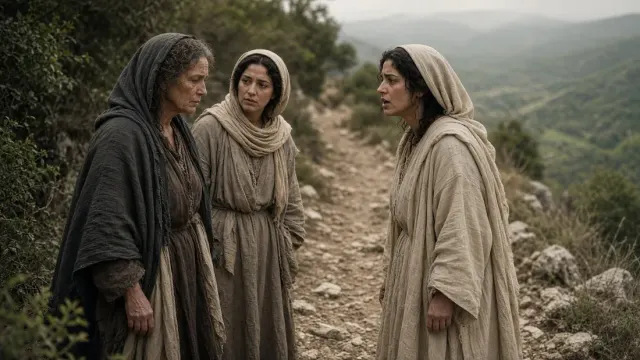
The Book of Ruth opens in the days of the judges, but instead of beginning with national conflict it follows one household driven by hunger. Bethlehem means “house of bread,” yet famine pushes Elimelech, Naomi, Mahlon, and Chilion across the border into Moab. The Book of Ruth states that movement without calling it Elimelech’s sin, a restraint that matters because the losses that follow are severe enough without adding a verdict the passage does not give. Elimelech dies first. The sons marry Ruth and Orpah, and after about ten years both sons die as well. Verse 5 reduces the household to an aching fact: Naomi is left without husband and sons. Ruth and Orpah are widows too, so the bereavement is shared even while the Book of Ruth follows Naomi’s emptiness most closely. Before any harvest, return, or redemption appears, loss is allowed to stand on its own.
Deep dive
The account begins in the days of the judges but shifts attention from public conflict to one vulnerable household. Bethlehem means house of bread, yet famine forces departure from that place. The move to Moab may carry social and covenant tension, but the Book of Ruth does not directly label the relocation as Elimelech’s sin. The stated facts are hunger, migration, marriage, and repeated bereavement.
Verse 5 describes Naomi as left without her two sons and husband. Ruth and Orpah are also widows, so loss is shared even though the narrative follows Naomi’s perspective. A faithful lesson should not treat grief as punishment without textual warrant. The chapter will show providence through return, companionship, and harvest, but it first allows the emptiness to be named honestly.
Words to trace: name, sons, Moab, Beth, Chilion, country
Verse-by-verse path
- Ruth 1:1
“Sojourn” is the Hebrew gur, to live somewhere as a resident foreigner without the rights of a native. The family flees to Moab, the nation descended from Lot (Genesis 19:37), whose people Deuteronomy 23:3 had barred from the congregation of the LORD.
- Ruth 1:2
Elimelech means “my God is king”, a pointed name in the days when, as Judges 21:25 puts it, there was no king in Israel. Ephrathites marks them as an old Bethlehem clan; Ephrath is the ancient name of the town in Genesis 35:19 and Micah 5:2.
- Ruth 1:3
Elimelech is now identified as “Naomi’s husband”, not she as his wife. From this verse on the Book of Ruth follows her. “She was left” is the verb of remainders and survivors, and it will be used of her again two verses later.
- Ruth 1:4
The phrase for taking wives here is not the usual one for marrying, and it is the idiom Ezra 10:44 uses of foreign marriages. Ten years pass with no children mentioned, a silence the reader feels before any grief is spoken.
- Ruth 1:5
Naomi’s name drops out and she becomes “the woman”. The word for her sons is yeladim, children, a word for boys; the same word returns at the book’s end when Naomi takes Obed, “the child”, into her bosom (4:16).
Ruth 1:1-5
King James Version1Now it came to pass in the days when the judges ruled, that there was a famine in the land. And a certain man of Beth-lehem-judah went to sojourn in the country of Moab, he, and his wife, and his two sons.
2And the name of the man was Elimelech, and the name of his wife Naomi, and the name of his two sons Mahlon and Chilion, Ephrathites of Beth-lehem-judah. And they came into the country of Moab, and continued there.
3And Elimelech Naomi’s husband died; and she was left, and her two sons.
4And they took them wives of the women of Moab; the name of the one was Orpah, and the name of the other Ruth: and they dwelled there about ten years.
5And Mahlon and Chilion died also both of them; and the woman was left of her two sons and her husband.
Ruth 1:6-18
Ruth Chooses Naomi’s People and God
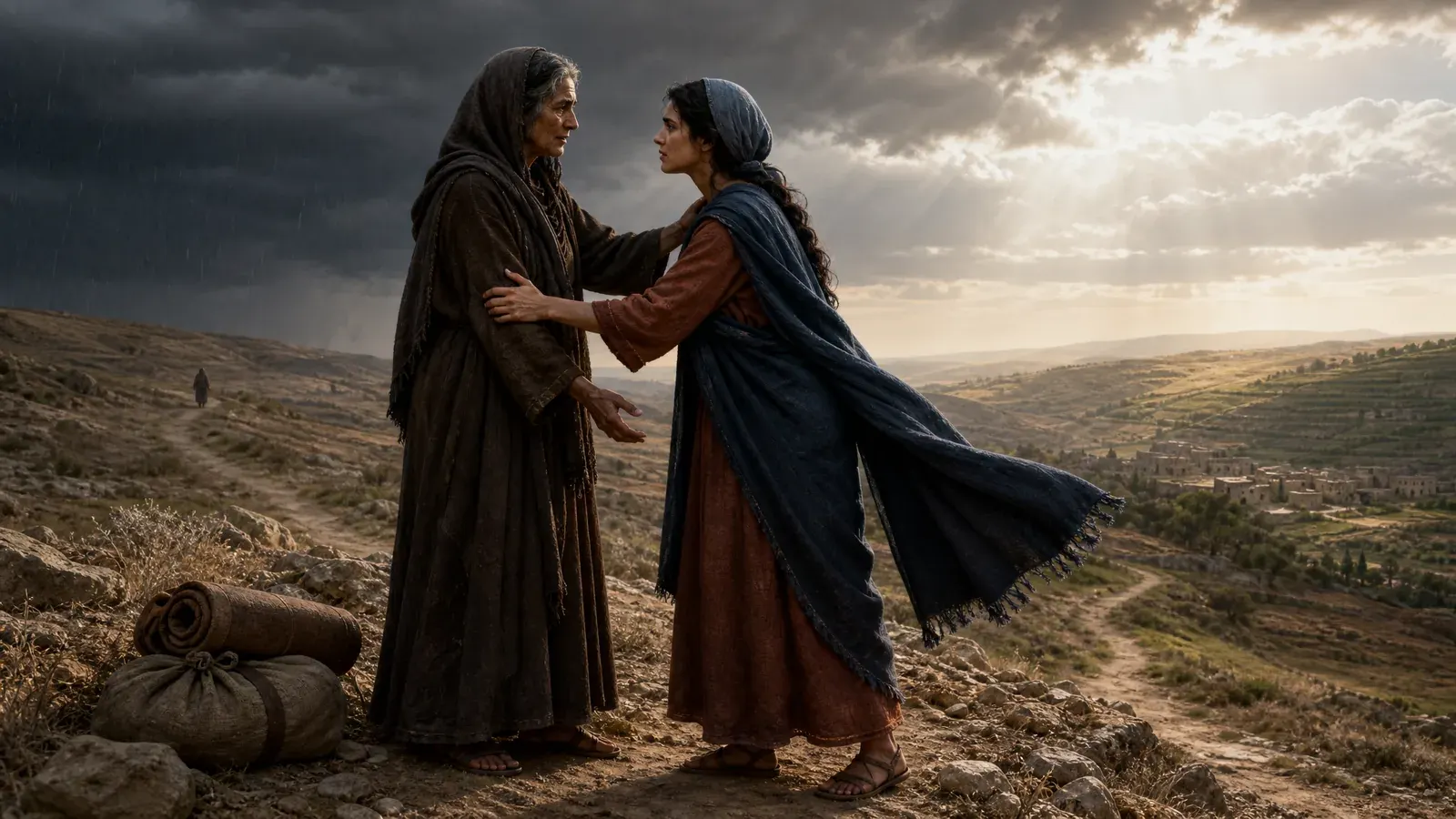
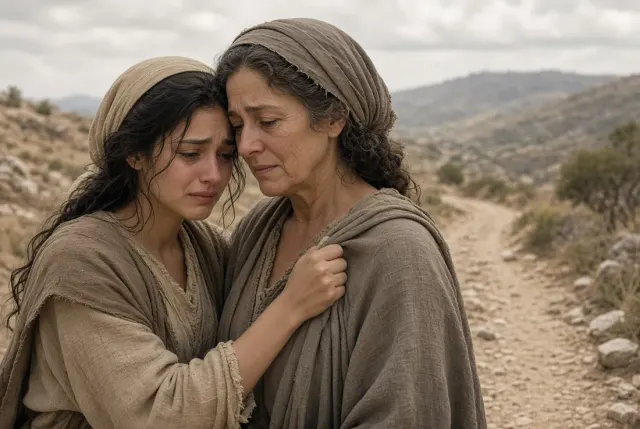
Naomi’s road back to Judah becomes a test of what love is free to choose. She has heard that the LORD has visited his people with bread, but she does not use that hope to demand that Ruth and Orpah follow her. She repeatedly releases them, thinking about their future homes and knowing she has no sons to offer. Orpah finally does what Naomi asks and leaves in tears; the Book of Ruth gives no condemnation of her. Ruth’s choice therefore lands with greater force because it is not presented as the minimum duty of a daughter-in-law. She “clave unto her,” and her words widen from travel to lodging, people, God, death, and burial. “Thy people shall be my people, and thy God my God” is not casual affection. It is a comprehensive allegiance made by one widow to another when neither woman can see what Bethlehem will hold. Naomi stops arguing because Ruth is steadfastly minded.
Deep dive
Naomi’s repeated urging arises from concern about the women’s future and her conviction that she has no sons to offer them. Orpah’s departure follows Naomi’s request and is not condemned. Ruth’s different choice is therefore voluntary loyalty, not the minimum duty every bereaved daughter-in-law must perform. The narrative honors Ruth’s costly commitment without turning Orpah into a villain.
Ruth’s speech moves from geography to household, people, God, death, and burial. Her allegiance is comprehensive, and Naomi stops arguing when she sees Ruth is steadfastly minded. These words are often used at weddings, but their immediate setting is covenant loyalty between widowed women facing an uncertain return. They must never be used to pressure someone to remain in an abusive or unsafe relationship.
Words to trace: daughters, return, LORD, people, husband, country
Verse-by-verse path
- Ruth 1:6
“Visited” is paqad, the word Joseph uses on his deathbed: “God will surely visit you” (Genesis 50:24). The verb “return”, shuv, appears here for the first time in the chapter; it will appear about a dozen times before the chapter ends.
- Ruth 1:7
The three women set off together, so Naomi’s speech to them in the next verses is made on the road, after the decision to travel has already been taken. They are not debating at a doorway; they are walking.
- Ruth 1:8
“Mother’s house” is unusual; a widow normally went back to her father’s house, as Tamar does in Genesis 38:11. “Deal kindly” translates chesed, loyal love that goes beyond obligation, the word on which the whole book turns.
- Ruth 1:9
“Rest” is menuchah, the settled security of a home and a husband. Naomi will later seek this same rest for Ruth herself (3:1), and the plan she makes then will lead to Boaz.
- Ruth 1:10
“Return with thee” is a strange phrase for two Moabite women who have never seen Judah. They speak as though Naomi’s homeland were already theirs.
- Ruth 1:11
Naomi is thinking of the levirate custom, set out in Deuteronomy 25:5–10, in which a brother of the dead husband would marry the widow and raise up a son to carry the dead man’s name. She has no sons left to offer, and she knows it.
- Ruth 1:12
Naomi stacks up three impossibilities: if she had hope, if she had a husband that very night, if she bore sons. Each one is less likely than the last. The argument runs itself into the ground on purpose.
- Ruth 1:13
“It grieveth me much” is literally “it is very bitter to me”, the root mar that will give her the name Mara in verse 20. The Hebrew can also be read “my lot is more bitter than yours”. “The hand of the LORD” is the phrase used of plagues sent on the Philistines in 1 Samuel 5:9.
- Ruth 1:14
The difference between the two daughters in law is a difference of verbs. Orpah kisses, the gesture of leave-taking. Ruth clings, davaq, the verb Genesis 2:24 uses of a man cleaving to his wife.
- Ruth 1:15
The god of Moab was Chemosh (Numbers 21:29). For Naomi, going back to one’s people and going back to one’s gods are the same act, and Ruth’s answer will accept the connection and turn it the other way.
- Ruth 1:16
“Intreat me not” means stop pressing me. The oath is built in pairs, go and go, lodge and lodge, people and people, God and God, and “lodgest” is a traveller’s word for staying the night. Ruth commits to the journey as well as to the destination.
- Ruth 1:17
“The LORD do so to me, and more also” is a solemn self-curse, a formula used by Eli and by kings (1 Samuel 3:17). Ruth swears by the covenant name, the LORD, not by a vague deity. A Moabite woman invokes Israel’s God by name.
- Ruth 1:18
“Stedfastly minded” renders a verb meaning to strengthen oneself, to make oneself firm. Naomi falls silent. She does not address Ruth again in this chapter, and when she speaks in Bethlehem she does not mention her.
Ruth 1:6-18
King James Version6Then she arose with her daughters in law, that she might return from the country of Moab: for she had heard in the country of Moab how that the LORD had visited his people in giving them bread.
7Wherefore she went forth out of the place where she was, and her two daughters in law with her; and they went on the way to return unto the land of Judah.
8And Naomi said unto her two daughters in law, Go, return each to her mother’s house: the LORD deal kindly with you, as ye have dealt with the dead, and with me.
9The LORD grant you that ye may find rest, each of you in the house of her husband. Then she kissed them; and they lifted up their voice, and wept.
10And they said unto her, Surely we will return with thee unto thy people.
11And Naomi said, Turn again, my daughters: why will ye go with me? are there yet any more sons in my womb, that they may be your husbands?
12Turn again, my daughters, go your way; for I am too old to have an husband. If I should say, I have hope, if I should have an husband also to night, and should also bear sons;
13Would ye tarry for them till they were grown? would ye stay for them from having husbands? nay, my daughters; for it grieveth me much for your sakes that the hand of the LORD is gone out against me.
14And they lifted up their voice, and wept again: and Orpah kissed her mother in law; but Ruth clave unto her.
15And she said, Behold, thy sister in law is gone back unto her people, and unto her gods: return thou after thy sister in law.
16And Ruth said, Intreat me not to leave thee, or to return from following after thee: for whither thou goest, I will go; and where thou lodgest, I will lodge: thy people shall be my people, and thy God my God:
17Where thou diest, will I die, and there will I be buried: the LORD do so to me, and more also, if ought but death part thee and me.
18When she saw that she was stedfastly minded to go with her, then she left speaking unto her.
Ruth 1:19-22
Naomi Names Bitterness as Harvest Begins
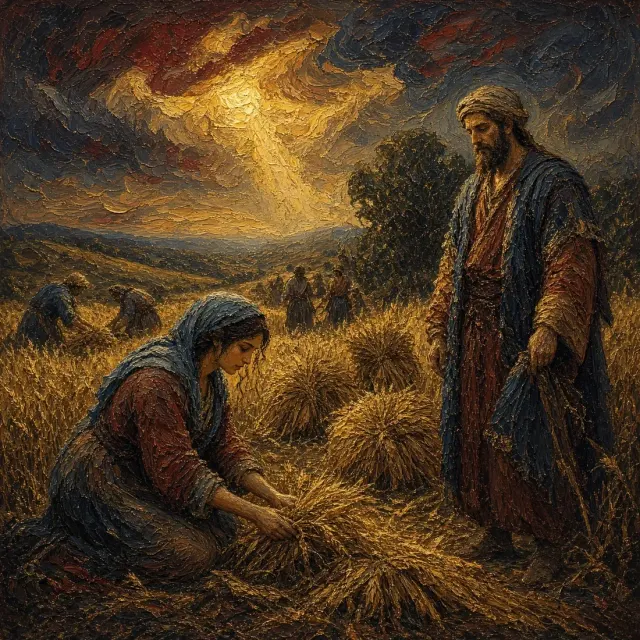
Bethlehem recognizes Naomi, but Naomi no longer recognizes herself in the name by which the town remembers her. She asks to be called Mara and interprets her losses through the sovereignty of the Almighty: she went out full and has returned empty. The Book of Ruth records that lament without rebuking her or rushing to explain it away. Yet the scene contains a tension Naomi cannot yet name. Ruth is standing beside her. The loyal daughter-in-law who crossed from Moab has not made the grief unreal, but she means Naomi is not literally without every human bond. Pain has narrowed the frame. Then the final sentence quietly widens it again: the women arrive “in the beginning of barley harvest.” Bread has returned to Bethlehem, Ruth has refused to abandon Naomi, and the season of gleaning is opening. Hope enters the chapter as timing and presence, not as an argument against grief.
Deep dive
Naomi speaks from grief and interprets her condition through God’s sovereignty. The Book of Ruth records her lament without rebuking it. Readers should also notice the tension in her words: she says she returned empty while Ruth is standing beside her. Trauma can narrow perception without making pain dishonest, and loyal presence may be real before a grieving person can recognize it.
The final harvest notice is quiet narrative hope, not a denial of suffering. Bread has returned to Bethlehem, Ruth has refused to abandon Naomi, and a season of gleaning is about to open. Providence in Ruth usually appears through ordinary timing and faithful action rather than spectacle. The chapter closes with grief still spoken aloud and provision only beginning.
Words to trace: Naomi, Beth, call, lehem, Almighty, LORD
Verse-by-verse path
- Ruth 1:19
“All the city was moved” uses the verb for an uproar, the one used when the camp rang with shouting at the ark’s arrival (1 Samuel 4:5). The question “Is this Naomi?” is put with feminine verbs in Hebrew: it is the women of the town who ask.
- Ruth 1:20
Naomi means pleasant; Mara means bitter, the name also given to the undrinkable waters in Exodus 15:23. “The Almighty” is Shaddai, the name God gives himself to Abraham (Genesis 17:1), and the name Job uses most often in his complaint.
- Ruth 1:21
She went out in a famine, yet calls it going out “full”: fullness to her meant a husband and two sons, not bread. “Testified against me” is courtroom language, the verb for a witness answering in a case. Naomi pictures God as a witness against her.
- Ruth 1:22
Ruth is called “the Moabitess”, a label that follows her through the book (2:2, 2:21, 4:5, 4:10). Barley was the first grain harvest of the year, in spring around Passover, with wheat following a few weeks later (2:23).
Ruth 1:19-22
King James Version19So they two went until they came to Beth-lehem. And it came to pass, when they were come to Beth-lehem, that all the city was moved about them, and they said, Is this Naomi?
20And she said unto them, Call me not Naomi, call me Mara: for the Almighty hath dealt very bitterly with me.
21I went out full, and the LORD hath brought me home again empty: why then call ye me Naomi, seeing the LORD hath testified against me, and the Almighty hath afflicted me?
22So Naomi returned, and Ruth the Moabitess, her daughter in law, with her, which returned out of the country of Moab: and they came to Beth-lehem in the beginning of barley harvest.
Questions to keep in mind while reading
- Track who acts, who speaks, who is affected, and what changes.
- Notice repeated promises, failures, rescues, and consequences.
- Do not assume the account approves every action that is reported.
Text first
Where readers differ
The chapter summary begins with what the passage says and how its parts fit together. It does not assume one denomination has already settled every question. Where a conclusion depends on a tradition, literary theory, or historical reconstruction, that dependence is named openly.
The KJV text is presented first. Interpretive conclusions are labeled, and differences are introduced only when they help a reader understand why serious communities do not always reach the same answer.
Comparative interpretive notes for this chapter are in preparation. Until reviewed notes are ready, this page separates the KJV text from summary and application without claiming that serious readers agree on every question.
Questions beneath the surface
- What account of God, human freedom, responsibility, and the good life emerges from Ruth 1?
- Which tension does the chapter refuse to resolve quickly?
- What changes when the chapter is read as part of the whole canon rather than as an isolated moral lesson?
- Where might a sincere reader confuse a familiar tradition with something the text states directly?
Questions for serious personal contemplation
These open-ended questions make room for tension, honest response, prayer, and conclusions that remain accountable to the chapter.
Observe without rushing
What part of Ruth 1 makes you stop, feel unsettled, or feel surprised, and why?
Which detail in the passage would be easiest to overlook? How does that detail change your understanding?
Where do you see tension between what happens and this focus: Naomi’s household leaving Bethlehem for Moab during famine; Ruth holding to Naomi on the road while Orpah departs in the distance; Naomi and Ruth entering Bethlehem at the beginning of barley harvest?
What important question does the passage leave open instead of resolving quickly?
Examine your inner life honestly
Which person, response, fear, or desire in the passage feels most like your own life right now?
What assumption about God, other people, or yourself does this text challenge?
Which part would you rather soften, avoid, or explain away too quickly? What might that reaction reveal?
If this Scripture could ask you one direct question, what do you think it would ask?
Respond with wisdom and courage
What do you need to remember, confess, grieve, thank God for, or trust after reading this passage?
How might another faithful person read this situation differently without ignoring the text?
What obedient response would be costly, uncomfortable, or slow, yet still faithful to Scripture?
What question will you carry into prayer this week, and which verses will you keep in front of you?
Music and video connected to the passage
Related media appears when its Scripture reference overlaps this study. Music and video can illuminate a theme while the biblical text remains the foundation.