The big picture
Worship in Corinth exposes relationships that private intention cannot hide. Paul first addresses men and women praying and prophesying, using headship, creation, hair, coverings, and custom in an argument whose details have generated genuine interpretive difficulty. He does not erase that difficulty, and neither does the chapter. The second half is much less obscure and much more severe. At the Lord's supper, social division has turned a shared meal into a scene where some have abundance and others are hungry and ashamed. Paul answers by returning to what he received about Jesus giving bread and cup on the night of betrayal. A meal that proclaims the Lord's self-giving death cannot be organized around taking one's own supper first. Self-examination therefore ends in something practical: discern the body, wait for one another, and do not let ordinary hunger turn the church's gathering into condemnation.
Central truth
Paul directs men and women who pray and prophesy to honour their relationships before God, while affirming their mutual dependence in the Lord. Paul rebukes a divided meal that humiliates poorer believers and restores the Lord's Supper as discerning participation that proclaims Christ's death until he comes.
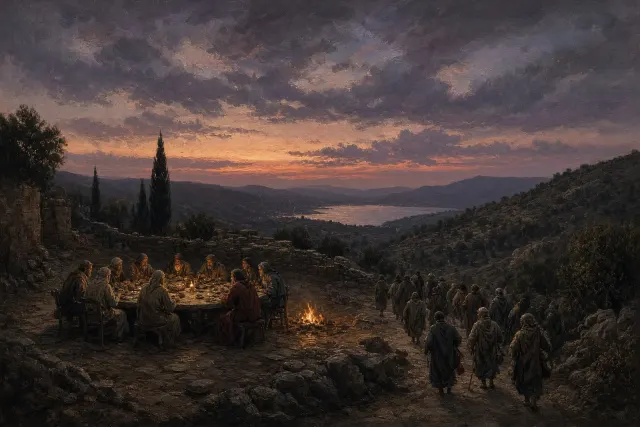

The study notes have a page of their own
The movement by movement analysis, the words to trace, the verse by verse notes and where readers differ are written for someone studying alone. They are on the Deep Personal Reflections page for this chapter. This page is the lesson.
A chapter-specific teaching brief
These anchors come from this chapter itself. They help a teacher use the Level 1 overview, the Level 2 study, and the Scripture text as one lesson.
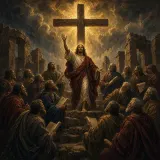
Open with the chapter’s first image
1 Corinthians 11:1: “Be ye followers of me, even as I also am of Christ.”
Slow down at the turning point
1 Corinthians 11:17: “Now in this that I declare unto you I praise you not, that ye come together not for the better, but for the worse.”
Keep this word trail visible
woman, head, Lord, drink, bread, praise
What to explain, in order
Teach the passage in this order. Each step names the verses it rests on, so every point can be shown in the text before it is applied.
1 Corinthians 11:1–16
1 Corinthians 10:31-11:2
Imitating Christ, and the praise that opens
Start by tying this paragraph to what has gone before. The rule of 10:31-33 is to do all to God's glory, giving no offence, and 11:1 is the person behind the rule: "Be ye followers of me, even as I also am of Christ." Then read 11:2. Paul praises them for keeping "the ordinances", explained as the traditions he handed on. Teach this first so the class meets the coverings question as part of a larger concern, honour and consideration in worship, and so they hear that Paul begins this section with praise, not complaint.
1 Corinthians 11:3
Three heads
Write the three relationships on the board in Paul's order. Explain that "head" in Greek can carry the sense of authority, and in some uses source or origin, and that interpreters weigh these differently here. Point out the frame: Christ and God at both ends. The relationship of Christ to God, whom the church confesses as equal in nature, shows that whatever "head" means it does not mean lesser worth. Teach this verse by itself before the coverings, because everything in 11:4-10 depends on it, and because learners often arrive with a fixed meaning they have never tested against the verse as a whole.
1 Corinthians 11:4-6
Praying and prophesying, man and woman
Read the two parallel sentences of 11:4-5 together and mark "praying or prophesying" in both. Explain "dishonoureth his head" as possibly a double sense, the physical head and the person named as head in 11:3, and say that readers differ. Then read 11:5-6, with shaving as the comparison of shame. Present the readings fairly: a cloth covering or veil, or long hair worn up rather than loose. Do not present claims about local customs, prostitutes or hairstyles as facts Paul supplies. Teach this step here so the shared activity of men and women is clear before the creation argument begins.
1 Corinthians 11:7-10
Image, glory, and the angels
Read Genesis 1:27 first, so the class knows both man and woman bear God's image, then 11:7. Paul says the man is "the image and glory of God" and the woman "the glory of the man", drawing on the order in Genesis 2:18-23, which 11:8-9 then cites. Explain that Paul's point is about glory and honour in worship, not a denial that women bear God's image. Then read 11:10 and name the difficulty of "because of the angels" plainly. Teach this step before 11:11-12 so the "Nevertheless" that follows is heard as Paul's own completion of the argument.
1 Corinthians 11:11-12
Nevertheless, in the Lord
This is the step most often skipped, so give it its own time. Read the two verses aloud twice. Point out the words "in the Lord": in Christ, neither man nor woman exists apart from the other. Then the creation logic: woman from man at the beginning, every man since born of a woman. Then the conclusion: "all things of God". Compare Galatians 3:28 for the shared standing of men and women in Christ. Teach this before the appeal to nature, because it guards everything Paul has said about order from becoming a claim of superiority.
1 Corinthians 11:13-16
Judge in yourselves
Read "Judge in yourselves" (11:13) as an invitation to the Corinthians' own sense of what is fitting. Explain "comely" as proper or fitting. Then read the appeal to nature in 11:14-15 and say that readers differ on whether nature here means the created order, the customs of their society, or both. Finish with 11:16. Say plainly that Christians today apply this passage in different ways: some keep head coverings in worship, some see the principle of honour expressed in other forms, some take the hair as the covering. Teach this last, and model on 11:16 a disagreement without contempt.
1 Corinthians 11:17–34
1 Corinthians 11:17-22
A meeting that did more harm than good
Begin with the contrast between 11:2, "I praise you", and 11:17, "I praise you not". Then set the scene: the church met in homes for a shared meal with the Lord's Supper at its centre. Explain that some ate and drank their fill while others went hungry, and that those who "have not" (11:22) were shamed. Many readers think the wealthy arrived early and ate first, but say that this is a reconstruction; the text gives the result, not the schedule. Explain "heresies" in 11:19 as factions. Teach this first so the class knows what Paul is correcting before he quotes the Lord.
1 Corinthians 11:23-26
What Paul received from the Lord
Read 11:23-26 alongside Luke 22:19-20 so the class sees that Paul hands on the same words the Gospel records. Explain "received" and "delivered" as the language of a tradition passed on faithfully. Explain "testament" as covenant, the new covenant promised in Jeremiah 31:31. Then read 11:26 and explain "shew" as proclaim. Say plainly that traditions differ on how Christ is present in the Supper, and do not settle that question here; the passage's own focus is on what the meal remembers, proclaims and awaits. Teach this second, because it shows the meaning that the Corinthian table was denying.
1 Corinthians 11:27-29
Unworthily, examine, discern
Explain "unworthily" (11:27) as eating in an unworthy manner, the manner of 11:21-22, not being an unworthy person. Then "examine himself" (11:28): test one's own conduct, followed by eating. Then "not discerning the Lord's body" (11:29). Present the readings fairly: the body of Christ given in the bread, the church as Christ's body (10:17, 12:27), or both. Explain "damnation" here as judgment, and say why: 11:32 shows that this judgment is the Lord's discipline to keep believers from condemnation. Teach this after the institution, so the warning is heard in light of what the Supper is.
1 Corinthians 11:30-32
Judgment as the Lord's discipline
Read 11:30 carefully: "many are weak and sickly among you, and many sleep." Explain "sleep" as death. Paul is interpreting events in Corinth; he does not give a rule by which every illness may be explained. Then read 11:31-32: if we judged ourselves we would not be judged, and when we are judged we are "chastened of the Lord", explained as disciplined like children, "that we should not be condemned with the world". Teach this step as the turn from warning to mercy, so that the class does not leave with dread but with the Lord's purpose.
1 Corinthians 11:33-34
Wait for one another
End where Paul ends, with practical instruction. The command "tarry one for another" (11:33) answers "every one taketh before other his own supper" (11:21) directly. Eating at home when hungry answers the drunkenness and the overeating. Point out the last line, "the rest will I set in order when I come", which shows that Paul did not settle every detail in writing. Teach this last so the lesson closes on what the church must do next Sunday, and so the deep theology of 11:23-32 is seen to serve a table where the poor are not shamed.
Where learners get stuck
The misreadings this passage tends to produce, and how to answer each from the text.
1 Corinthians 11:1–16
"This passage says women must stay silent in church."
This paragraph assumes the opposite. It describes "every woman that prayeth or prophesieth" (11:5) and regulates how she does it. Prophecy in this letter is speech to the church "to edification, and exhortation, and comfort" (14:3). The instruction about silence comes later, in 14:34-35, and how the two passages fit together is a real question that traditions answer differently. Teach each passage in its place, and do not use either one to make the other disappear.
"Head means the man is better than the woman."
Paul's list includes "the head of Christ is God" (11:3), and the church confesses Christ as equal with the Father in nature (John 1:1, Philippians 2:6). So headship in this verse cannot mean lesser worth. Paul also says, "neither is the man without the woman, neither the woman without the man, in the Lord" (11:11). Traditions differ on what headship means in practice, but none can use this verse to claim that men are of greater value before God, and Genesis 1:27 gives the image of God to both.
"This was just Corinthian culture, so it has nothing to say to us."
Paul argues from creation (11:7-9), from nature (11:14), and from the practice of "the churches of God" (11:16), not from Corinth alone. At the same time, Christians have long disagreed about how much of the outward practice is bound to its setting and how much is lasting. Teach both: Paul's reasons were meant to carry weight beyond one city, and faithful readers apply them in different ways. What every reading must keep is honour before God in worship and the mutual dependence of 11:11-12.
1 Corinthians 11:17–34
"I should not take communion unless I am sure I have no sin."
Paul's command is "let a man examine himself, and so let him eat" (11:28). Examination leads to the table, not away from it. "Unworthily" (11:27) refers to the manner of the Corinthians' eating, despising the church and shaming the poor (11:22). The Supper is for sinners who have been forgiven, who proclaim "the Lord's death" (11:26), a death for sins. Traditions differ on how one prepares for the table and who should come, but none teaches that only the sinless may eat.
"If people in a church get sick, it must be because of how they took communion."
Paul interprets a particular situation in Corinth in 11:30, as an apostle. He does not say that every illness or death in a church has this cause, and Scripture elsewhere refuses that kind of reasoning (John 9:2-3). The purpose he gives is discipline, "that we should not be condemned with the world" (11:32). Use this verse to take the Lord's table seriously, never to diagnose a sick believer or to add guilt to grief.
"This passage is only about the ritual, not about how we treat people."
The whole passage is framed by how the Corinthians treated one another: "one is hungry, and another is drunken" (11:21), "shame them that have not" (11:22), and "tarry one for another" (11:33). The words of institution are quoted in the middle of that rebuke. Discerning the Lord's body (11:29) is read by many as including the church, the one body of 10:17. The Supper's meaning and the treatment of the poor belong together in this text.
Learning objectives
- Identify the relationships expressed through 'head' in 11:3.
- Describe the conduct addressed for men and women.
- Trace Paul's appeals to creation, honour, and custom.
- Explain the balancing force of 'Nevertheless' in 11:11.
- Distinguish the text's claims from disputed covering interpretations.
- Discuss a contested practice without disparaging either sex.
- Explain why the gathering earns rebuke rather than praise.
- Identify the contrast between private suppers and the Lord's Supper.
- Trace the received words about bread, cup, and remembrance.
- Explain proclamation until Christ comes.
- Distinguish unworthy manner from a demand for personal perfection.
- Connect self-examination with waiting for one another.
Teacher preparation
- Read 1 Corinthians 10:31–11:16 and 14:26–40; keep Paul's imitation of Christ attached to concern for others.
- Mark every use of head, glory, shame, and covering; distinguish physical heads from relational uses without deciding the debate by wordplay.
- Read Genesis 1:27 and 2:18–23; prepare both shared image-bearing and the creation sequence Paul invokes.
- Prepare cloth-covering and hair-centred readings as disputed options; do not present claims about prostitutes or local hairstyles as facts supplied by Paul.
- Flag 'because of the angels' in 11:10 and 'no such custom' in 11:16; acknowledge interpretive difficulty without making either phrase disappear.
- Read 1 Corinthians 11:17–34 with 10:16–17; keep one body and a shared table beside the unequal meals.
- Distinguish the explicit hungry/drunken contrast from the plausible reconstruction that wealthier members eat before labourers arrive; exact schedules are not given.
- Explain 'testament' as covenant, 'shew' as proclaim, and 'tarry' as wait; read 'unworthily' as manner, not a demand to be sinless.
- Read 'damnation' in 11:29 alongside corrective judgment in 11:31–32; do not automatically equate every use with final condemnation.
- Use paper place settings without staging a sacrament, withholding food, or requiring confessions.
Evidence and interpretation checks
Explicit
Use 1 Corinthians 11:3–5,11–12: Paul names head relationships, addresses both men and women praying or prophesying, and states mutual dependence in the Lord. Use 1 Corinthians 11:21–22,33–34: one is hungry, another drunken, those without are shamed, and Paul commands waiting and eating at home when needed.
Scripture-supported
Read Genesis 2:21–23 beside 1 Corinthians 11:8 and Genesis 1:27 beside 11:7; distinguish Paul's glory argument from a denial that women bear God's image. Compare 1 Corinthians 11:23–25 with Luke 22:19–20: remembrance centres on Christ's given body and covenant blood; the table's meaning is not invented by the congregation.
Strong inference
Infer from 1 Corinthians 11:4–6 that this paragraph regulates how prayer and prophecy are performed; it does not itself announce the elimination of women's participation. Infer material inequality from 1 Corinthians 11:21–22's contrasting portions and shaming of those who lack; early arrival by wealthier participants is a reconstruction, not a stated timetable.
Possible or traditional reading
Present cloth-covering and hair-centred readings of 1 Corinthians 11:5–6,15, together with disagreement about culturally specific expression and continuing practice; disclose which reading a proposed application assumes. Present discerning the Lord's body in 1 Corinthians 11:29 as referring to Christ's sacramental body, the gathered body, or both; test each against 10:16–17 and 11:21–26.
Limit
State that 1 Corinthians 11:10 does not explain precisely how the angels motivate the instruction; 11:16 also leaves the referent of 'such custom' debated. Do not claim 1 Corinthians 11:30 explains every illness or death in a congregation; nor does 11:28 command the repentant examiner never to eat.
Discussion with answer guidance
1. Which three head relationships does Paul state before discussing coverings?
What a good answer contains
Paul states three, and the verse should be read whole: "the head of every man is Christ; and the head of the woman is the man; and the head of Christ is God" (11:3). A good answer lists all three and notices the order: it begins and ends with Christ, and the third relationship, Christ and God, involves no inferiority of nature. Readers differ on what "head" means here, whether authority, source or origin, or both, and the class should hear that honestly. A weak answer quotes only the middle clause, or settles the meaning of "head" by a slogan before reading the verses that follow.
Show teacher guidance
List 11:3 carefully. Distinguish the stated relationships from debated explanations of 'head'; do not use a slogan in place of the whole verse.
2. What are both the man and the woman doing when dishonour is discussed?
What a good answer contains
The same thing: praying or prophesying. "Every man praying or prophesying, having his head covered, dishonoureth his head. But every woman that prayeth or prophesieth with her head uncovered dishonoureth her head" (11:4-5). Paul regulates how they do it, not whether they may. A good answer notices that women's praying and prophesying in the assembly is assumed here, and that this must be held together with 14:34-35 when that passage is taught. A weak answer misses the shared activity entirely or claims that this paragraph silences women, which it does not.
Show teacher guidance
Use 11:4–5: praying or prophesying. Correct answers that miss their shared activity or claim this paragraph simply commands women never to speak.
3. How do the references to shaving and hair function in Paul's appeal?
What a good answer contains
They are comparisons of shame and glory meant to make the Corinthians feel what Paul feels about the practice. For a woman to pray uncovered is "all one as if she were shaven" (11:5); "if it be a shame for a woman to be shorn or shaven, let her be covered" (11:6). Then nature is called in: long hair is "a shame" to a man but "a glory to her: for her hair is given her for a covering" (11:14-15). A good answer sees that Paul is arguing from what the hearers already considered shameful or honourable. Readers differ on whether the covering is a cloth or the hair itself; keep those readings separate from the comparisons the text actually makes.
Show teacher guidance
Read 11:5–6,13–15. Identify comparisons involving shame and glory; keep disputed covering conclusions separate from the comparisons actually made.
4. What does 'Nevertheless' require the reader to add?
What a good answer contains
The other half of the argument. After 11:7-9, which speaks of the woman as "the glory of the man" and made "for the man", Paul writes: "Nevertheless neither is the man without the woman, neither the woman without the man, in the Lord. For as the woman is of the man, even so is the man also by the woman; but all things of God" (11:11-12). A good answer sees mutual dependence: woman came from man in creation, every man since comes through a woman, and all come from God. A weak answer stops reading at verse 10, or reads verses 11-12 as cancelling everything before them instead of balancing it.
Show teacher guidance
Read 11:11–12 after 11:7–9. Expect mutual dependence, man born through woman, and all things from God; do not stop the argument early.
5. How much can be said confidently about 'because of the angels'?
What a good answer contains
Very little with confidence. The text says, "For this cause ought the woman to have power on her head because of the angels" (11:10), and gives no explanation. Explain "power on her head" as a sign of authority, and say that readers differ on whose authority it signifies. Proposals about the angels include angels present at worship, angels as guardians of order, and others. A good answer names the stated reason, admits it is unexplained, and labels any proposal as a proposal. A weak answer invents details about angelic behaviour, or skips the phrase because it is difficult.
Show teacher guidance
Locate 11:10 and acknowledge the stated reason. Allow labelled proposals, but reject detailed claims about angelic behaviour not described here.
6. How should verse 16 shape a discussion that has become contentious?
What a good answer contains
It should lower the temperature and widen the view. Paul writes, "if any man seem to be contentious, we have no such custom, neither the churches of God" (11:16). Paul appeals beyond Corinth to the practice of the churches, and he refuses to let a quarrel be the last word. Readers differ on what "such custom" means: a custom of contentiousness, or a custom of praying uncovered. A good answer notes the appeal to the wider church, recalls Paul's praise in 11:2, and keeps contempt out of any discussion of practice. A weak answer turns the verse into a weapon in the same argument it was written to quiet.
Show teacher guidance
Read 11:16 with 11:2. Note Paul's appeal beyond Corinth and reject quarrelsome exceptionalism; acknowledge disagreement over what 'such custom' refers to.
7. Why does Paul say their coming together is for the worse?
What a good answer contains
Because the meeting was dividing and humiliating the church. Paul says "ye come together not for the better, but for the worse" (11:17), and gives the reasons: "there be divisions among you" (11:18); "every one taketh before other his own supper: and one is hungry, and another is drunken" (11:21); and they "shame them that have not" (11:22). A good answer names the harm done to the poorer members as the heart of the problem. A weak answer says only that the Corinthians had the ritual wrong; Paul's rebuke is about how they treated one another at the table that should have made them one.
Show teacher guidance
Use 11:17–22: division, private consumption, hunger, drunkenness, and humiliation undermine the assembly. Do not answer only that their ritual words are incorrect.
8. What difference is there between 'his own supper' and 'the Lord's supper'?
What a good answer contains
The first belongs to the eater; the second belongs to Christ. When they come together, "this is not to eat the Lord's supper" (11:20), because "every one taketh before other his own supper" (11:21). The possessive matters: a meal that belongs to the Lord is shared on his terms, and a meal where each eats his own has stopped being his. Paul's questions in 11:22, "have ye not houses to eat and to drink in? or despise ye the church of God", show that the wrong is contempt for God's people. A good answer sees ownership and fellowship at stake, not table manners. A weak answer reduces it to catering.
Show teacher guidance
Compare 11:20–22. Possessive eating conflicts with the meal's shared identity; retain Christ's ownership rather than treating this as catering etiquette alone.
9. Why recall the night of betrayal in the middle of a rebuke about eating?
What a good answer contains
Because the night of betrayal shows what the Lord's Supper means, and the Corinthians were contradicting it. Paul hands on what he received: "the Lord Jesus the same night in which he was betrayed took bread" (11:23) and said, "this is my body, which is broken for you" (11:24). Jesus gave himself while being betrayed; the Corinthians were serving themselves while the poor went hungry. A strong answer sets 11:21 beside 11:23-24 and lets the contrast speak. A weak answer treats the words of institution as a separate liturgy unrelated to the rebuke, or adds details about the Corinthian meal that the text does not give.
Show teacher guidance
Read 11:23–25 beside 11:21. Contrast the Lord's self-giving with self-serving consumption; do not invent extra details about Corinth's meal sequence.
10. What does the meal proclaim, and how far does that proclamation reach?
What a good answer contains
It proclaims "the Lord's death till he come" (11:26). Explain "shew" as proclaim or announce. The meal looks back to a death, speaks it aloud in the present, and looks forward to a return. A good answer keeps all three: remembrance ("this do in remembrance of me", 11:24-25), proclamation now, and expectation. It also notices that a meal can proclaim Christ's self-giving death only if it is shared in a way that matches it. A weak answer makes the Supper only a memorial of the past, or forgets that the church eating together is itself the announcement.
Show teacher guidance
Use 11:26: the Lord's death until he comes. Preserve remembrance, public proclamation, and future expectation rather than reducing it to nostalgia.
11. Does 'unworthily' mean only flawless people may eat?
What a good answer contains
No. "Unworthily" describes the manner of eating, not the worth of the eater. The Corinthians were eating in a way that despised the church and ignored the Lord's body. Paul's remedy is "let a man examine himself, and so let him eat of that bread, and drink of that cup" (11:28): examine, and then eat. A good answer notices "and so let him eat", which assumes the examined person comes to the table. Explain also that 11:31-32 describes the Lord's discipline "that we should not be condemned with the world". A weak answer keeps sincere and troubled believers away from the table out of fear.
Show teacher guidance
Read 11:27–32, especially 'and so let him eat' in 11:28. Explain responsible examination and corrective judgment, not a demand for moral perfection.
12. What practical correction closes the theological explanation?
What a good answer contains
Wait for one another, and eat at home if hungry. "Wherefore, my brethren, when ye come together to eat, tarry one for another. And if any man hunger, let him eat at home; that ye come not together unto condemnation" (11:33-34). Explain "tarry" as wait. A good answer sees that the theology of 11:23-32 lands in a practical change in how the meal is held, so that no one is left out or shamed. A weak answer ends with private self-examination and never changes the table, which leaves the hungry member of 11:21 still hungry.
Show teacher guidance
Read 11:33–34: wait for one another, and address hunger at home. Do not end with private introspection while leaving the hungry member excluded.
Responsible application
Heart and habits
Ask learners to examine a fictional worshipper's claim that personal preference alone settles every public practice; require attention to honour and others.
Relationships and community
Have the group rewrite a contemptuous disagreement about coverings so it can state a conviction without mocking women, men, or another congregation.
Complete the argument
Invite an interpretation of creation order that must also account for 'Nevertheless' and 'all things of God' in 11:11–12.
Proclamation made visible
Invite a sentence explaining how waiting and welcoming can accord with proclaiming the self-giving Lord, without reducing the Supper to social symbolism.
Session plans
Two timings of the same lesson. The shorter keeps the reading, the central discussion and one response; the longer gives the confusions and the application their own time.
1 Corinthians 11:1–16
45 minutes
Imitation and praise
Read 10:31-11:2. Ask whose example governs this section, and note that Paul starts with praise.
Three heads
Read 11:3. Take question one and the confusion about head and worth. Write the three relationships on the board.
Praying and prophesying
Read 11:4-6. Take questions two and three, with the confusion about women's silence.
Glory and the angels
Read Genesis 1:27, then 11:7-10. Take question five and label the angels question honestly.
Nevertheless, and no such custom
Read 11:11-16. Take questions four and six and the confusion about culture. Hand out the sheet and pray.
90 minutes
Honour in worship
Ask the group what shows honour in worship in their own setting, such as standing, kneeling or removing a hat. Then read 10:31-11:2.
Three heads
Read 11:3 and take question one. Present the meanings of "head" fairly and take the confusion about head and worth.
Men and women praying and prophesying
Read 11:4-6. Take question two and the confusion about women's silence, pointing ahead to 14:34-35 without teaching it yet.
Shame and glory
Read 11:5-6 and 11:13-15 together. Take question three. Present the cloth and hair readings side by side.
Creation in two chapters
Read Genesis 1:27 and 2:18-23, then 11:7-10. Take question five on the angels and explain "power on her head".
Nevertheless
Read 11:11-12 twice, then Galatians 3:28. Take question four. Let the group restate the two verses in their own words.
How churches apply it
Read 11:16. Take question six and the confusion about culture. Describe how different traditions practise this today, without ranking them.
Handout and prayer
Read the key verse together, point to the take-home line, and pray for men and women in the church to honour one another in worship.
1 Corinthians 11:17–34
45 minutes
For the worse
Read 11:17-22. Ask question one and list what made their gathering worse.
Whose supper
Compare "his own supper" and "the Lord's supper" in 11:20-21. Take question two and the confusion that it is only about ritual.
The night he was betrayed
Read 11:23-26 with Luke 22:19-20. Take questions three and four.
Examine, discern, eat
Read 11:27-32. Take question five and the confusions about communion and sinlessness, and about sickness.
Wait for one another
Read 11:33-34. Take question six. Hand out the sheet, read the key verse together and pray.
90 minutes
Two tables
Set out paper place settings, some full and some empty, and read 11:17-22. Do not comment yet. Ask what a visitor would conclude.
For the worse
Take question one and explain "heresies" as factions. Distinguish what the text says from the reconstruction of who arrived first.
His own and the Lord's
Take question two and the confusion that it is only about ritual. Read 10:16-17.
Received and delivered
Read 11:23-26, Luke 22:19-20 and Jeremiah 31:31-34. Take questions three and four. Explain "testament" and "shew".
Unworthily and discerning
Read 11:27-29. Take question five and the confusion about sinlessness. Present the readings of "discerning the Lord's body".
The Lord's discipline
Read 11:30-32. Take the confusion about sickness. Read John 9:2-3.
Wait for one another
Read 11:33-34. Take question six. Return to the place settings and rearrange them so that no place is empty.
Handout and prayer
Read the key verse together, point to the take-home line, and pray for those in the congregation who are hungry or overlooked.
Adapting the lesson
1 Corinthians 11:1–16
Children
Keep to the truths children can hold: God made men and women, both in his image (Genesis 1:27), and they need each other (11:11-12). Show ways we show respect, such as quiet voices in a library or standing for an anthem, and say that in church we show honour to God. Leave out the coverings debate and the angels, and never single out a child's appearance or clothing.
Youth
Youth will notice at once that this passage is disputed. Do not hide it. Lay out the readings fairly and let them test each against the verses. Give real weight to 11:11-12 and to the fact that women prayed and prophesied. Avoid any comment on the dress or hair of anyone present, and keep the discussion on honour before God, not on fashion.
Adults
Adults may come with strong convictions from their own tradition. Teach the text in order, name each disputed point honestly (head, covering, angels, nature, custom), and show where traditions land without ranking them. Hold 11:5 and 14:34-35 for the chapter 14 lesson but mention that they must be read together. Insist that any position be stated without mockery of other believers.
One to one
Ask why the person wants to study this passage; often it is a question from their own church or home. Read 11:3-16 through once, then go to the parts they ask about. Be honest about what is clear (both pray and prophesy; mutual dependence; all things of God) and what is debated. Help them understand their own church's practice charitably, even if they come to see it differently.
1 Corinthians 11:17–34
Children
Use a shared snack and talk about waiting until everyone has some before anyone eats. Read 11:33. Then read 11:23-24 simply and say that Jesus shared bread with his friends to help them remember he gave himself for them. Do not stage a communion service, and follow your church's practice about children and the Supper without commenting on other churches.
Youth
Youth notice who is left out. Let them find in 11:21-22 the hungry and the shamed, and ask where that happens among young people today. Read 11:23-26 slowly and let them see Jesus giving himself on the night of betrayal. Take the fear of "unworthily" seriously, since some will have stayed away from the table, and read 11:28 to them.
Adults
Adults can handle the history: house churches, a shared meal, social classes at one table. Distinguish what the text says from scholarly reconstructions. Present the different traditions' understanding of the Supper fairly and keep the lesson on what all of them can hear in this passage. Ask how the church's fellowship meals, giving and seating might leave some members hungry or shamed.
One to one
Ask how the person feels when the Lord's Supper is served: welcome, unsure, afraid. Listen. Then read 11:23-26 and 11:28 together, with emphasis on "and so let him eat". If they carry guilt that keeps them from the table, point them to the Lord's death for sins and to their pastor's care. Ask one practical question about whom they might wait for or welcome.
Song and video learning lab
A song or video may interpret, compress, or dramatize the text. Its value becomes clearer when its choices are compared with Scripture.
- Before the media: the exact passage and its central movement.
- During the media: the words, people, events, and emotions the artist emphasizes.
- After the media: what it clarifies, what it leaves out, and what belongs back in the biblical text.
Handout
One page for learners to take home. The print button prints this section alone.
1 Corinthians 11:1–16
The passage in brief
In 1 Corinthians 11:2-16 Paul addresses how men and women should pray and prophesy in the church's worship. He speaks of Christ as the head of every man, the man as head of the woman, and God as the head of Christ, and he gives instructions about head coverings. Christians understand and practise these instructions in different ways. The passage also says clearly that in the Lord men and women depend on each other, and that all things come from God.
A verse to keep
Nevertheless neither is the man without the woman, neither the woman without the man, in the Lord. For as the woman is of the man, even so is the man also by the woman; but all things of God.
1 Corinthians 11:11-12 · King James Version
Questions to take home
What were both the men and the women doing in 11:4-5?
What does the word "Nevertheless" add to the argument in 11:11-12?
How should Christians handle disagreement about this passage, according to 11:16?
This week
This week, thank God for one man and one woman in your church whose faith has helped you, and tell them.
1 Corinthians 11:17–34
The passage in brief
In 1 Corinthians 11:17-34 Paul rebukes the church because their shared meal was dividing them: some ate and drank too much while poorer members went hungry and were shamed. He reminds them that on the night he was betrayed the Lord Jesus gave bread and the cup as signs of his body and blood given for them. Every time the church eats this bread and drinks this cup, it proclaims the Lord's death until he comes. So believers must examine themselves and wait for one another.
A verse to keep
For as often as ye eat this bread, and drink this cup, ye do shew the Lord’s death till he come.
1 Corinthians 11:26 · King James Version
Questions to take home
What was wrong with the way the Corinthians were eating together (11:20-22)?
What did the Lord Jesus do on the night he was betrayed (11:23-25)?
What does Paul tell the church to do in 11:28 and 11:33?
This week
At your next church meal or gathering, look for someone who is alone or left out and make sure they are welcomed first.
Music and video connected to the passage
Related media appears when its Scripture reference overlaps this study. Music and video can illuminate a theme while the biblical text remains the foundation.