The big picture
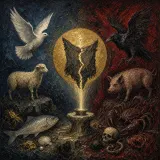
The priestly duty to distinguish now spreads across Israel’s table and household. Land animals require the chapter’s paired signs, water creatures require fins and scales, flying creatures are handled through named categories, and certain leaping insects are specifically allowed. Then the focus shifts from what may be eaten to what happens when animals die. A permitted species can still leave an unclean carcass, and carcasses affect people, garments, vessels, ovens, water, and seed in different ways. The system is detailed precisely because impurity does not spread by one crude rule. The chapter’s own explanation arrives at the end: these distinctions belong to the holiness of the LORD who brought Israel out of Egypt. The final word is covenantal identity, not a modern nutrition theory.
Central truth
Leviticus 11 trains Israel to distinguish clean from unclean creatures so that ordinary eating and contact with carcasses become part of living as a holy people brought out of Egypt.
The study notes have a page of their own
The movement by movement analysis, the words to trace, the verse by verse notes and where readers differ are written for someone studying alone. They are on the Deep Personal Reflections page for this chapter. This page is the lesson.
A chapter-specific teaching brief
These anchors come from this chapter itself. They help a teacher use the Level 1 overview, the Level 2 study, and the Scripture text as one lesson.
Open with the chapter’s first image
Leviticus 11:1: “And the LORD spake unto Moses and to Aaron, saying unto them,”
Slow down at the turning point
Leviticus 11:24: “And for these ye shall be unclean: whosoever toucheth the carcase of them shall be unclean until the even.”
Keep this word trail visible
unclean, carcase, abomination, kind, creeping, earth
What to explain, in order
Teach the passage in this order. Each step names the verses it rests on, so every point can be shown in the text before it is applied.
Leviticus 11:1-8
Land animals and the double test
Start with 10:10, the priests' duty to distinguish clean and unclean; chapter 11 is the first lesson in it. Then read the test in 11:3 and the four border cases. Explain the coney as probably the rock hyrax and note that "cheweth the cud" describes how the animals appear to eat, not modern zoology. Point to 11:8, which forbids touching their carcasses as well as eating them. Teach the test first because it shows that the chapter works by clear signs ordinary people could see at a market or in the field.
Leviticus 11:9-23
Water, air and the creeping
Move through the waters, the birds and the flying insects quickly, noticing the pattern: a rule for the waters, a list for the birds, a rule and an exception for insects. Explain "abomination" here as something to be held in disgust for food, a strong word for what Israel must not eat, not a moral judgement on the creature. God made these animals and called them good in Genesis 1. Ask the class why locusts are allowed, and point to their jumping legs. Keep this step brisk; the chapter's weight is elsewhere.
Leviticus 11:24-40
Contact and how it ends
Read 11:24-25. Then show the repeated phrase "unclean until the even" and the washing of clothes. Explain uncleanness as a state that bars a person from the sanctuary and holy food, not as guilt. It comes from ordinary life, lasts a short time, and ends by washing and waiting. Then walk through 11:32-38 and the household cases: wood washed, clay broken, springs untouched, dry seed clean. Teach it here to show that holiness reached the kitchen. Food, pots and water were all part of living near God.
Leviticus 11:41-47
Holy because God is holy
Finish with the reason. Read 11:44-45 aloud twice. This is the first time Leviticus says "ye shall be holy; for I am holy", and the ground is the exodus: the God who brought them out of Egypt now shapes their table. Then read the summary in 11:46-47. Teach this last because learners will have been asking why, and the chapter answers at the end. Explain that the answer is holiness and belonging, a distinct people marked even in what they eat, and not hygiene.
Mark 7:18-19; Acts 10:9-15
How Christians read these laws
Close by placing the chapter in the whole Bible, carefully. Mark 7:19 records that Jesus' teaching made all foods clean, and in Acts 10 Peter's vision teaches that the gospel goes to the Gentiles. Most Christians therefore do not keep these food laws, while some groups observe them as wise or as still binding, and Jewish readers continue to keep them as covenant obedience. Do not choose between these. What all can see is that Leviticus 11 taught Israel that holiness touches daily life, a point 1 Peter 1:15-16 quotes from this very chapter.
Where learners get stuck
The misreadings this passage tends to produce, and how to answer each from the text.
"God banned pork because it was unhealthy."
The chapter never gives a health reason. It gives a theological one: "ye shall be holy; for I am holy" (11:44-45), and its purpose is "To make a difference between the unclean and the clean" (11:47). Some clean animals carry disease and some unclean ones do not. Teaching hygiene as the point replaces the text's reason with one of our own.
"Unclean animals were evil or cursed."
Genesis 1 calls every creature good, and Noah took unclean animals into the ark to preserve them (Genesis 7:2). Uncleanness in Leviticus 11 is about what Israel may eat and touch, not about the worth of the animal. The camel was ridden, the donkey worked; neither was food for Israel. The distinction belongs to Israel's calling, not to the animal's nature.
"Touching something unclean was a sin."
Touching a carcass made a person unclean "until the even", and the remedy was washing and waiting (11:24-25). No sacrifice is required for that. Someone had to bury the dead animal; uncleanness was unavoidable and normal. Sin was to ignore the state and come into the sanctuary or eat holy food while unclean (7:20-21). Keep that distinction clear or the chapter will sound like a list of crimes.
"Since Christians can eat anything, this chapter has nothing to say to us."
Peter quotes its call, "Be ye holy; for I am holy", to Christians in 1 Peter 1:16. Traditions differ on whether and how the food laws apply, but they agree that the chapter shows God claiming the whole of life, down to what is on the table. It also prepares readers for Acts 10, which cannot be understood without it.
Learning objectives
- State the land-animal criteria for clean animals.
- State the water-creature criteria for clean animals.
- Recognize the listed birds and creeping creatures as categories.
- Explain how carcasses transmit uncleanness in the chapter.
- Locate the holiness rationale near the chapter's end.
- Distinguish ritual uncleanness from moral wickedness.
Teacher preparation
- Make a simple chart for land, water, birds, winged insects, and creeping creatures.
- Mark the two-feature tests for land animals and water creatures.
- Review verses 24-40 for carcass contact, vessels, water, seed, and washing rules.
- Prepare to explain that 'unclean' is a ritual category here, not a declaration that an animal is morally evil.
- Do not spend class time trying to identify every KJV bird name with modern zoological certainty.
Evidence and interpretation checks
Explicit
Leviticus 11:3 requires both a divided hoof and chewing the cud for land animals to be eaten.
Scripture-supported
Verses 44-45 ground the distinctions in the Lord's holiness and in his bringing Israel up from Egypt.
Strong inference
Because uncleanness can result from touching a carcass without any immoral intention, 'unclean' cannot simply mean personally sinful.
Possible or traditional reading
Health benefits are often proposed as the main reason for the food laws, but this chapter states holiness and distinction, not nutrition, as its rationale.
Limit
The chapter does not explain why every listed species is clean or unclean, and several KJV animal names cannot be mapped to modern species with certainty.
Discussion with answer guidance
1. What two features must a land animal have to be clean for food?
What a good answer contains
It must part the hoof, be "clovenfooted", and chew the cud: "Whatsoever parteth the hoof, and is clovenfooted, and cheweth the cud, among the beasts, that shall ye eat" (11:3). Then the chapter tests the rule against border cases: the camel, coney and hare chew the cud but do not divide the hoof (11:4-6), and the swine divides the hoof but "cheweth not the cud" (11:7). A good answer gives both features and shows that one without the other fails.
Show teacher guidance
Use verse 3, then test the camel, coney, hare, and swine examples in verses 4-8 against both features.
2. What is the corresponding two-feature rule for creatures in the waters?
What a good answer contains
Fins and scales: "whatsoever hath fins and scales in the waters, in the seas, and in the rivers, them shall ye eat" (11:9). Anything lacking either is "an abomination unto you" (11:10). A good answer notices that the rule again needs both features and that it covers seas and rivers alike. A weak answer reduces it to 'no shellfish', which is one result of the rule rather than the rule itself.
Show teacher guidance
Verses 9-12 require fins and scales. Keep the answer at the level the text gives.
3. How does the chapter handle birds differently from land animals and fish?
What a good answer contains
No test is given for birds; the chapter simply names the forbidden ones, beginning "the eagle, and the ossifrage, and the ospray" (11:13), through to the bat in 11:19. Then flying insects are forbidden in general, except those "which have legs above their feet, to leap withal upon the earth" (11:21), such as the locust and grasshopper. A good answer sees a list for birds and a rule with an exception for insects. Admit that some of the birds cannot be identified with certainty.
Show teacher guidance
It gives a list rather than a two-part physical test. Do not invent a universal bird criterion the chapter never states.
4. What happens when someone touches or carries certain carcasses?
What a good answer contains
Touching a carcass makes a person "unclean until the even" (11:24), and carrying one requires washing clothes as well (11:25, 11:28). The same applies to the carcass of a clean animal that died on its own (11:39-40). A good answer stresses that this uncleanness is temporary, ends at evening with washing, and is not a sin requiring sacrifice. A weak answer treats touching a dead animal as wrongdoing.
Show teacher guidance
Follow verses 24-28: uncleanness lasts until evening, and carrying a carcass also requires washing clothes.
5. Why are earthen vessels treated differently from springs or seed in verses 32-38?
What a good answer contains
Wooden vessels, clothing and sacks are washed and are clean at evening (11:32), but "every earthen vessel" that a dead creeping thing falls into must be broken (11:33), and ovens are broken down (11:35). Yet "a fountain or pit, wherein there is plenty of water, shall be clean" (11:36), and dry seed stays clean (11:37). A good answer notices that the porous pot cannot be cleansed while a large water source cannot be defiled.
Show teacher guidance
Have the group list the actual rulings. The point is to observe distinctions before attempting explanations the text does not supply.
6. How does the chapter explain its own purpose in verses 44-47?
What a good answer contains
Directly: "For I am the LORD your God: ye shall therefore sanctify yourselves, and ye shall be holy; for I am holy" (11:44), grounded in the exodus, "For I am the LORD that bringeth you up out of the land of Egypt" (11:45). The purpose is "To make a difference between the unclean and the clean" (11:47). A strong answer quotes these verses and says the chapter gives a theological reason, while it gives no medical one.
Show teacher guidance
Expect holiness, separation from defilement, exodus identity, and the stated task of making a difference between unclean and clean.
Responsible application
Heart and habits
Ask learners to identify how often the chapter requires attention to ordinary acts such as eating, touching, carrying, and washing. Discuss disciplined attentiveness without copying Israel's food code onto the class.
Relationships and community
Use the ritual category of uncleanness to challenge the assumption that every restricted person or object is morally condemned. Let the text teach precision in labels.
Practice distinction
Give several examples from the chapter and ask the group to classify them as clean, unclean until evening, requiring washing, or prohibited for food.
Session plans
Two timings of the same lesson. The shorter keeps the reading, the central discussion and one response; the longer gives the confusions and the application their own time.
45 minutes
Why this chapter is here
Read 10:10-11 and then 11:1-2. Ask who is being taught and who will do the teaching.
The double tests
Read 11:3-12 and take questions one and two. Make two quick sorting lists on the board, and deal with confusion one.
Birds, insects and contact
Read 11:13-25 selectively and take questions three and four. Handle confusion three from "until the even".
In the kitchen
Read 11:32-38 and take question five. Ask what a family's day would look like under these rules.
Holy for I am holy
Read 11:44-47 and take question six. Read Mark 7:18-19 and Acts 10:13-15 and give the range of Christian readings without choosing. Read the key verse and close.
90 minutes
What we eat says who we are
Ask learners about food customs in their families or churches. Read 11:1-2 with 10:10-11.
Land and water
Read 11:1-12 and take questions one and two. Sort animals by the tests, then take confusion one.
Birds and insects
Read 11:13-23 and take question three. Be honest that some bird names are uncertain.
Unclean until evening
Read 11:24-31 and 11:39-40. Take question four and confusion three, and explain the difference between uncleanness and sin.
Household rules
Read 11:32-38 and take question five.
The reason given
Read 11:41-47 and take question six and confusion two. Link 11:45 to the exodus.
Reading it after Christ
Read Mark 7:14-23, Acts 10:9-16 and 1 Peter 1:14-16. Take confusion four and set out how different traditions read the food laws today.
Handout and prayer
Read the key verse together and pray that the whole of daily life would belong to God.
Adapting the lesson
Children
Bring pictures of animals and let the children sort them using the two tests: split hooves and chewing the cud, fins and scales. Make it a game, and say God gave Israel these rules so they would remember every day that they belonged to him. Avoid calling any animal bad. End by saying that God cares about ordinary things like meals.
Youth
Ask them what their eating habits say about them: vegetarian, halal, fasting, sports diets. Then read 11:44-47 and ask what Israel's diet said about them. Let them try the tests on a list of animals. Read Acts 10 and talk about how the early church understood the change, without mocking anyone who still keeps food laws.
Adults
Adults can explore why these animals: theories of hygiene, of order in creation, of distance from pagan practice. Show which ones the text supports and which it does not. Then read Mark 7, Acts 10 and 15, Romans 14 and 1 Peter 1 and discuss how Christian traditions differ on the food laws, letting each be stated fairly.
One to one
Read 11:1-12 and 11:44-47 together. Ask what part of their daily routine they think of as having nothing to do with God. Let 11:44 open that up gently. If the person comes from a background that keeps food laws, listen first and do not argue; read Romans 14 together if the question of conscience arises.
Song and video learning lab
A song or video may interpret, compress, or dramatize the text. Its value becomes clearer when its choices are compared with Scripture.
- Before the media: the exact passage and its central movement.
- During the media: the words, people, events, and emotions the artist emphasizes.
- After the media: what it clarifies, what it leaves out, and what belongs back in the biblical text.
Handout
One page for learners to take home. The print button prints this section alone.
Leviticus 11:1–47
The passage in brief
Leviticus 11 tells Israel which animals they may eat and which they may not. Land animals must have split hooves and chew the cud; water creatures must have fins and scales. Certain birds and most insects are forbidden. Touching a dead animal made a person unclean until evening, and they washed their clothes. God gives the reason at the end: he brought Israel out of Egypt, and they are to be holy because he is holy.
A verse to keep
For I am the LORD your God: ye shall therefore sanctify yourselves, and ye shall be holy; for I am holy: neither shall ye defile yourselves with any manner of creeping thing that creepeth upon the earth.
Leviticus 11:44 · King James Version
Questions to take home
What two tests decide whether a land animal is clean in 11:3?
What reason does God give for the food laws in 11:44-45?
Where in your ordinary day could you remember that you belong to God?
This week
At one meal this week, give thanks slowly and remember that your ordinary life belongs to God.
Music and video connected to the passage
Related media appears when its Scripture reference overlaps this study. Music and video can illuminate a theme while the biblical text remains the foundation.