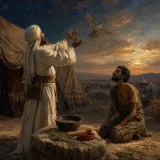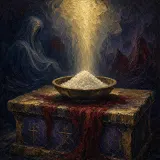
The big picture
After chapter 13’s exclusions, chapter 14 is about return. The priest first goes outside the camp to examine a person whose condition has already healed. Cleansing then unfolds through birds, washing, shaving, waiting, offerings, blood, and oil, with full restoration happening in stages rather than by one declaration. The ear, thumb, and toe reappear from priestly consecration, marking the seriousness of restored standing without turning the person into a priest. Poverty again receives a complete route, not a discounted half-ritual. The chapter then transfers the same attention to houses in Canaan. Suspicion leads to inspection, waiting, repair, and only then, if the affliction returns, demolition. A healed house can even receive atonement language, showing again that ritual cleansing is broader than forgiveness for personal wrongdoing.
Central truth
Leviticus 12 to 15 regulates temporary bodily uncleanness through time, washing, priestly examination, separation, and restoration so that impurity does not reach the tabernacle. Leviticus 14 provides ordered restoration after serious impurity, requiring examination, cleansing, sacrifice, and renewed inspection for both a healed person and an affected house.

The study notes have a page of their own
The movement by movement analysis, the words to trace, the verse by verse notes and where readers differ are written for someone studying alone. They are on the Deep Personal Reflections page for this chapter. This page is the lesson.
A chapter-specific teaching brief
These anchors come from this chapter itself. They help a teacher use the Level 1 overview, the Level 2 study, and the Scripture text as one lesson.
Open with the chapter’s first image
Leviticus 14:1: “And the LORD spake unto Moses, saying,”
Slow down at the turning point
Leviticus 14:36: “Then the priest shall command that they empty the house, before the priest go into it to see the plague, that all that is in the house be not made unclean…”
Keep this word trail visible
priest, house, offering, plague, right, hand
What to explain, in order
Teach the passage in this order. Each step names the verses it rests on, so every point can be shown in the text before it is applied.
Leviticus 12:1–15:33
Leviticus 12:1-8
Birth, blood and the way back
Begin with childbirth because it is the most ordinary and most joyful of these conditions, which helps learners see from the start that uncleanness is not sin. Read 12:2-4. Explain that the bleeding after birth is what makes the mother unclean, and that her time of purifying keeps her from the sanctuary, not from her child or her home. Mention circumcision on the eighth day in 12:3. On the different periods for a son and a daughter, say plainly that the text gives no reason and readers have offered several; do not invent one. End with the provision for the poor in 12:8, which Luke 2:24 shows Mary using.
Leviticus 13:1-46
The priest examines the skin
Explain the word first. The condition translated "leprosy" covers a range of skin diseases, and most are not what is now called leprosy, which is Hansen's disease. Then show the priest's method: look, compare, wait seven days, look again, decide. Read 13:4-6 to show the caution. Then read 13:45-46 slowly. These are the heaviest verses in the unit: torn clothes, a bare head, the cry of "Unclean, unclean", and a home outside the camp. Teach it with compassion for the person; the law protects the sanctuary, and the person bears a real cost.
Leviticus 13:47-59
Garments that carry the plague
Briefly show that the same examination applies to cloth and leather. A mould or mildew in wool, linen or skin is shown to the priest, shut up seven days, inspected, washed and either cleared or burned. The point to draw out is that the same patience is used for a garment as for a person, and that the law reaches clothing and household goods. Leave detailed discussion of houses for chapter 14, where it belongs, and mention only that it is coming.
Leviticus 15:1-18
Men's discharges
Introduce chapter 15 with care. Tell the class it covers bodily discharges of men and women, and that this is a normal part of life the law recognised. Read 15:2 and 15:13-15 for a lasting discharge, which needs seven days and an offering on the eighth. Then read 15:16-18 in summary: an ordinary emission, including within marriage, needs only washing until evening. Point out that marriage and sex are not condemned here; the couple simply wash. Keep the language plain and adult, and adjust it for younger groups.
Leviticus 15:19-33
Women's discharges and the reason for it all
Read 15:19 and 15:25-30 in summary: menstruation brings seven days of separation, and a lasting flow of blood needs seven days after healing and an offering. Then come to 15:31, the verse that explains the whole unit: uncleanness must be kept from the tabernacle "that is among them". Teach this last so the class leaves with the reason, God's dwelling among his people. Mention Mark 5:25-34, where Jesus is touched by a woman with a flow of blood for twelve years and the healing goes from him to her.
Leviticus 14:1–57
Leviticus 14:1-3
The priest goes out
Start with direction. Chapter 13 ended with a person outside the camp; chapter 14 begins with the priest going out to him. Read 14:2-3. Stress that healing has already taken place; the priest's task is to confirm it and bring the person back. Explain that the priest does not cure, and that the law assumes healing comes from God. Teach this first because it frames the whole chapter as a welcome home, and it sets the tone for the long rituals that follow.
Leviticus 14:4-9
Two birds and two shavings
Walk through the first stage: two clean birds, cedar wood, scarlet and hyssop, one bird killed over running water, the other dipped and released. Then the person washes, shaves and returns to the camp but not to the tent. Seven days later he shaves again and washes. Explain that this is a graded return. Do not over-interpret the cedar, scarlet and hyssop; note only that they appear again in the red heifer rite of Numbers 19. The released bird invites reflection, but say the text does not explain it.
Leviticus 14:10-20
The eighth day at the tent
Now the person comes to the door of the tabernacle with lambs, flour and oil. Show the trespass offering, the blood and oil on ear, thumb and toe, and the oil on the head. Then the sin offering, the burnt offering and the grain offering. Explain the link with 8:23-24, where the same marks consecrated the priests. Teach it as the climax: the person who was outside the camp is now treated with something like the dignity of ordination and declared clean at the altar.
Leviticus 14:21-32
Provision for the poor
Read 14:21-22 and the repeated "such as he is able to get". Explain that the core rites stay the same, the same lamb for the trespass offering, the same blood and oil on the same places, but the cost falls. Draw the lesson the law draws repeatedly in Leviticus: no one is shut out of restoration by poverty. Teach it as part of the main line and not as a footnote, because the law spends eleven verses on it.
Leviticus 14:33-57
The house and the summary
Explain that the house laws look ahead to life in Canaan, as 14:34 says. Walk through the stages: report, emptying, inspection, waiting, removal of stones, replastering, demolition if it returns. Point out the practical kindness of emptying the house first so the furniture is not made unclean. Then the same birds cleanse a healed house (14:49-53). Finish with the summary in 14:54-57 and its purpose, "To teach when it is unclean, and when it is clean". That is the priest's teaching task from 10:10-11 in action.
Where learners get stuck
The misreadings this passage tends to produce, and how to answer each from the text.
Leviticus 12:1–15:33
"Being unclean meant you had sinned."
Childbirth, menstruation, skin disease, marital relations and caring for the dead all made a person unclean, and none of them is condemned. God commanded Israel to be fruitful and to bury their dead. Uncleanness barred people from holy things for a time; it did not make them guilty. Where an offering is required, as in 12:6, it cleanses the sanctuary and restores the person to worship.
"These laws show God thought women were dirty."
Chapter 15 applies the same principles to men's discharges (15:2-18) as to women's (15:19-30), with matching washings and offerings. The concern is blood and fluids connected with life and death, not one sex. Readers have struggled with the longer periods after a daughter's birth in chapter 12; the text does not explain them, and honest teaching says so rather than offering a confident theory either way.
"Biblical leprosy is the same disease we call leprosy today."
The descriptions in chapter 13 cover white spots, scabs, swellings and spreading patches, and some cases are cleared within two weeks. Similar words are used for mould in cloth and walls. Modern leprosy does not behave that way. Many modern translations now render it as skin disease. The point is a visible condition that disqualified a person from the camp, not a modern diagnosis.
"Christians still have to follow these purity rules, or they can ignore them completely."
Christian traditions read these chapters differently. Most hold that Christ's death and the coming of the Spirit end the ritual purity system, and point to Jesus touching the leper (Mark 1:41) and the woman with the issue of blood (Mark 5:25-34). Some traditions kept practices shaped by these chapters, such as a blessing of mothers after childbirth. Set these out fairly. All agree the chapters still teach that God is holy and present.
Leviticus 14:1–57
"The priest healed the leper."
The text says the priest goes out to look and see "if the plague of leprosy be healed" (14:3). The healing has already happened. The priest's role is to examine, confirm and lead the person through cleansing. Healing belongs to God. That is why, in Mark 1:44, Jesus heals first and then sends the man to show himself to the priest.
"The released bird means the person's sins were carried away."
The person in chapter 14 is unclean from a disease, not guilty of a sin that caused it. The release of the bird into the open field is part of the cleansing, but the text gives no explanation of it. Readers often compare it to the scapegoat of chapter 16. That is a possible reading, but it should be taught as a comparison, not as the chapter's own claim.
"A house with mould was under God's curse."
Verse 34 says "I put the plague of leprosy in a house", which reminds Israel that God rules over all things, but the response is practical and measured: inspection, waiting, repair, and only then demolition. No owner is accused of sin. When a house is healed it is cleansed and "it shall be clean" (14:53). The law protects the household, not punishes it.
Learning objectives
- Distinguish bodily uncleanness from deliberate moral wrongdoing.
- Trace the childbirth purification periods in chapter 12.
- Explain the priest's examining role in chapter 13.
- Describe quarantine and restoration procedures for skin conditions.
- Trace washing and waiting rules for bodily discharges.
- Identify the sanctuary-protection rationale in 15:31.
- Trace the healed person's examination outside the camp.
- Sequence the two-bird cleansing rite.
- Explain the return process over seven days.
- Identify blood and oil placed on ear, thumb, and toe.
- Describe the reduced offering for a poor person.
- Trace inspection and treatment of an affected house.
Teacher preparation
- Read all four chapters without collapsing every condition into disease or sin.
- Note that the KJV 'leprosy' covers a broader set of conditions than modern Hansen's disease.
- Chart examination, isolation, washing, waiting, sacrifice, and return as separate stages.
- Prepare to discuss menstruation, childbirth, and discharges without embarrassment or jokes at anyone's expense.
- Mark 15:31, which states why Israel must be separated from uncleanness.
- Separate the chapter into personal restoration, reduced-cost offerings, and house inspection.
- Mark every location change: outside the camp, into the camp, outside the tent, and before the Lord.
- Review chapter 13 so 'healed' is not confused with the priest causing healing.
- Note the repeated right ear, thumb, and great toe pattern, which echoes priestly consecration in chapter 8.
- Prepare to leave the symbolism of cedar, scarlet, hyssop, birds, blood, and oil modest where the text leaves it unexplained.
Evidence and interpretation checks
Explicit
Leviticus 15:31 says Israel must be separated from uncleanness so that the people do not die by defiling the tabernacle among them. Leviticus 14:2-3 sends the priest outside the camp to examine the person after the plague of leprosy is healed.
Scripture-supported
Chapter 13 repeatedly assigns the priest to inspect and pronounce clean or unclean; the priest is not described as curing the condition. Verses 14-18 place blood and then oil on the right ear, right thumb, and right great toe, with remaining oil placed on the head.
Strong inference
Because childbirth, menstruation, and ordinary seminal emission can produce uncleanness, ritual uncleanness is not equivalent to personal moral guilt. The staged return shows that being physically healed and being ritually restored to full community and sanctuary life are related but not identical events.
Possible or traditional reading
Modern medical explanations are often proposed for quarantine and washing rules, but the chapters themselves frame the procedures in clean, unclean, and sanctuary terms. The released bird is often given elaborate symbolic meanings, but the chapter does not provide an explicit interpretation of each item in the two-bird rite.
Limit
These chapters do not provide modern diagnoses for every condition, and the KJV terminology is not a clinical textbook. The house laws give signs, procedures, and outcomes but no natural mechanism or certain modern equivalent.
Discussion with answer guidance
1. What happens after childbirth in chapter 12 before the mother returns to ordinary sanctuary participation?
What a good answer contains
The mother is unclean for seven days after a son, or two weeks after a daughter (12:2, 12:5), then continues "in the blood of her purifying" for thirty-three or sixty-six days, during which "she shall touch no hallowed thing, nor come into the sanctuary" (12:4). Then she brings a burnt offering and a sin offering, or two birds if she cannot afford a lamb (12:6-8), and "she shall be clean". A good answer sees that she stays at home with her family; she is only kept from holy things.
Show teacher guidance
Trace the stated periods, the eighth-day circumcision of a son, and the concluding offering. Do not describe childbirth itself as a moral offense.
2. What is the priest actually doing throughout the examinations in chapter 13?
What a good answer contains
He is looking and deciding. The refrain of the chapter is "the priest shall look on the plague in the skin of the flesh" (13:3), and the outcome is either to "pronounce him unclean" or "pronounce him clean" (13:6). He checks whether the hair has turned white, whether the sore is deeper than the skin, and whether it spreads. A good answer sees an examiner and judge for the sake of the sanctuary, not a doctor applying treatment.
Show teacher guidance
Look for seeing, shutting up, reexamining, and pronouncing clean or unclean. The chapter assigns classification, not medical treatment.
3. Why do repeated seven-day examinations matter in uncertain cases?
What a good answer contains
Because the priest will not declare a person unclean on uncertain evidence. Where the signs are unclear, "the priest shall shut up him that hath the plague seven days" (13:4), looks again on the seventh day, and if the spot is "at a stay" waits "seven days more" (13:5). If it fades, "it is but a scab" (13:6). A good answer sees patience and fairness: time protects the person from a hasty verdict that would put them outside the camp.
Show teacher guidance
Use examples such as 13:4-6 and 13:21-23. The law allows time to reveal whether a condition spreads before a final ruling.
4. What happens to a person pronounced unclean with the serious skin condition in 13:45-46?
What a good answer contains
He must tear his clothes, leave his head bare, cover his upper lip "and shall cry, Unclean, unclean" (13:45). Then "he shall dwell alone; without the camp shall his habitation be" (13:46). A good answer feels the cost: these are the signs of mourning, and the person lives apart for as long as the condition lasts. It also notes "All the days wherein the plague shall be in him": the law expects that it may end, and chapter 14 provides for that.
Show teacher guidance
Require the text's details: altered clothing and appearance, a warning cry, dwelling alone, and residence outside the camp while unclean.
5. How do washing and 'until the even' function in chapter 15?
What a good answer contains
Most of the conditions in chapter 15 end with washing and the phrase "unclean until the even". Whoever touches the bed of a man with a discharge "shall wash his clothes, and bathe himself in water, and be unclean until the even" (15:5). Longer conditions need seven days after healing and an offering on the eighth (15:13-15, 15:28-30). A good answer sees that most uncleanness was short, ordinary and ended by water and time, and that sacrifice was for the longer cases.
Show teacher guidance
Track contact with beds, seats, bodies, clothing, and water. Many states are temporary and have a defined endpoint.
6. What reason does 15:31 give for taking these bodily conditions seriously?
What a good answer contains
Verse 31 says, "Thus shall ye separate the children of Israel from their uncleanness; that they die not in their uncleanness, when they defile my tabernacle that is among them". The reason is the presence of God in the camp. Uncleanness must be kept away from the sanctuary, because God dwells there. A strong answer quotes the verse and notices "among them": the concern is that a holy God lives in the middle of his people, not that bodies are shameful.
Show teacher guidance
The stated concern is defiling the tabernacle in Israel's midst. Keep that sanctuary rationale central.
7. Why does the priest go outside the camp in verses 2-3 instead of bringing the healed person in first?
What a good answer contains
Because the person is still outside and may not come in until declared clean. In 14:3 "the priest shall go forth out of the camp; and the priest shall look, and, behold, if the plague of leprosy be healed in the leper". The priest crosses the boundary to the excluded person, not the other way around. A good answer notes that healing has already happened; the priest confirms it and begins the restoration. A weak answer assumes the priest heals.
Show teacher guidance
The person is examined before full return. Make learners follow the location sequence rather than skipping directly to sacrifice.
8. What happens to the two birds in the first cleansing stage?
What a good answer contains
One bird "be killed in an earthen vessel over running water" (14:5). The living bird, with cedar wood, scarlet and hyssop, is dipped in that blood, the person is sprinkled seven times and pronounced clean, and the living bird is let "loose into the open field" (14:7). A good answer describes both birds and notices the release. Be careful with meaning; the release suggests the uncleanness carried away, but the text does not explain it.
Show teacher guidance
One is killed over running water in an earthen vessel; the living bird is dipped with cedar, scarlet, and hyssop, then released after sprinkling.
9. What must the cleansed person do before returning fully to the tent?
What a good answer contains
He washes his clothes, shaves off all his hair and washes himself, then may "come into the camp, and shall tarry abroad out of his tent seven days" (14:8). On the seventh day he shaves again, including "his head and his beard and his eyebrows" (14:9), and washes again. A good answer sees the return in stages: camp first, then seven days, then the tent. A weak answer has him going straight home after the birds.
Show teacher guidance
Use verses 8-9: wash clothes, shave, wash, enter the camp, remain outside the tent seven days, then shave and wash again.
10. Where are blood and oil placed on the eighth day?
What a good answer contains
On the eighth day the priest puts blood of the trespass offering on the tip of the right ear, the thumb of the right hand and the great toe of the right foot (14:14), then oil on the same three places (14:17), and the rest of the oil on the head (14:18). A good answer notices that these are the same places as Aaron's ordination in 8:23. The restored person is marked as fully belonging to the holy people again.
Show teacher guidance
Require right ear, right thumb, and right great toe. Then note that oil follows the blood on the same locations.
11. How does the law change for someone who cannot afford the standard offering?
What a good answer contains
The poor man brings one lamb for a trespass offering and "one tenth deal of fine flour mingled with oil for a meat offering, and a log of oil" (14:21), and "two turtledoves, or two young pigeons, such as he is able to get" (14:22). The trespass offering lamb is still required, but the other lambs are replaced by birds. A good answer sees that the way back is never closed by poverty, and that the anointing with blood and oil remains the same.
Show teacher guidance
Read verses 21-32. The amount changes, but the chapter still provides a defined route to cleansing and atonement.
12. What are the escalating responses when a house shows a spreading plague?
What a good answer contains
The owner reports "It seemeth to me there is as it were a plague in the house" (14:35); the priest has the house emptied, inspects, shuts it seven days (14:36-38); if it spreads, the infected stones are removed and the walls scraped and replastered (14:40-42); if it returns, the house is broken down (14:44-45). A good answer names each stage and sees the same patience as in chapter 13. A healed house is cleansed with birds in 14:49-53.
Show teacher guidance
Trace emptying, inspection, seven-day closure, stone removal, scraping, replastering, and demolition if the condition returns.
Responsible application
Heart and habits
Ask the class to separate what the text calls unclean from what it calls sinful. Use the distinction to practice accurate language instead of assigning moral blame where the passage does not.
Relationships and community
Discuss how a community can take boundaries seriously without treating a temporarily restricted person as worthless. Ground the discussion in the repeated paths back to cleanness.
Waiting is part of the procedure
Have learners identify places where the law requires time before a judgment or return. Ask what careful waiting prevents in a system built on observable distinctions.
Inspect before declaring
Trace how often the priest examines before pronouncing. Let the class consider the value of evidence before labels in any community process.
Session plans
Two timings of the same lesson. The shorter keeps the reading, the central discussion and one response; the longer gives the confusions and the application their own time.
Leviticus 12:1–15:33
45 minutes
Holiness in the camp
Read 15:31 first and write it on the board. Explain that this verse is the key to the unit.
After childbirth
Read 12:1-8 and take question one and confusion one. Read Luke 2:22-24 for Mary's offering.
The priest examines
Read 13:1-8 and 13:45-46. Take questions two, three and four and confusion three. Pause on the cost to the person outside the camp.
Discharges and washing
Summarise chapter 15 with 15:5, 15:13-15 and 15:28-31. Take questions five and six and confusion two.
Response and handout
Read Mark 1:40-42. Ask who is kept outside today and how the church can draw them in. Read the key verse and pray.
90 minutes
Why talk about this
Explain why the class will study these chapters and that they will be handled respectfully. Read 15:31 and 10:10.
Childbirth
Read chapter 12 and take question one. Discuss confusion one and read Luke 2:22-24.
Skin disease
Read 13:1-17. Take questions two and three and confusion three. Draw a flow chart of look, wait, look again, decide.
Outside the camp
Read 13:45-46 and take question four. Ask what isolation does to a person, and let people speak if they wish.
Garments
Read 13:47-59 briefly and note the same patience applied to cloth.
Chapter 15
Summarise 15:1-33 with selected verses. Take question five and confusion two.
The reason and Jesus
Take question six. Read Mark 1:40-45 and Mark 5:25-34 and take confusion four, setting out how traditions differ.
Handout and prayer
Read the key verse together and pray for those who feel excluded because of their bodies or illness.
Leviticus 14:1–57
45 minutes
Outside and coming back
Read 13:46 and 14:1-3. Ask what changes when the priest goes out to the person. Take question one.
Two birds
Read 14:4-9. Take questions two and three and confusion two.
The eighth day
Read 14:10-20 and take question four. Show 8:23-24 beside 14:14.
Rich and poor
Read 14:21-22 and take question five. Ask why the law spends so long on the poor man's offering.
The house and the handout
Summarise 14:33-45 and take question six and confusion three. Read the key verse together and close in prayer.
90 minutes
From chapter 13 to 14
Recap 13:45-46 and the cost of exclusion. Read 14:1-3 and take question one and confusion one.
The first stage
Read 14:4-9. Take questions two and three and confusion two. Draw the graded return: outside, camp, tent.
The eighth day
Read 14:10-20 and take question four. Compare 8:22-24. Talk about restored dignity.
The poor man's offering
Read 14:21-32 and take question five.
The house
Read 14:33-53 and take question six and confusion three.
Jesus and the leper
Read Mark 1:40-45 and Luke 17:11-19. Ask what Jesus' instruction to see the priest shows.
Application
Ask learners how a church can help someone return after a long time away through illness or shame.
Handout and prayer
Read the key verse together and pray for those who are isolated.
Adapting the lesson
Leviticus 12:1–15:33
Children
For children, focus on chapter 13 and the priest who looked carefully and waited before deciding. Skip chapters 12 and 15 or say only that God gave rules for families when babies were born. Tell them about Jesus touching a man with a skin disease in Mark 1 and healing him. Ask how they can include a child who feels left out.
Youth
Teenagers are aware of their bodies and may feel awkward, so set a calm, respectful tone and do not joke. Summarise chapter 15 rather than reading it aloud verse by verse. Spend most time on 13:45-46 and the experience of being outside the camp. Read Mark 1:40-42 and ask who is treated as unclean in their school, and what Jesus' touch says about that.
Adults
Adults can read chapters 12 and 15 directly and discuss why the Book of Leviticus treats bodily fluids connected with life as a matter for the sanctuary. Discuss the theories about the different times after a son or daughter honestly and without settling them. Be sensitive to women who have experienced difficult births, infertility or miscarriage, and to anyone with chronic illness.
One to one
Choose a section based on what the person brings. If they feel shame about their body or an illness, read 13:45-46 and then Mark 1:40-42 and Mark 5:25-34. Let them hear that the law named a state, not a guilt, and that Jesus touched those it excluded. Avoid reading chapter 15 aloud unless they want to discuss it.
Leviticus 14:1–57
Children
Tell children this is a chapter about coming home. A man who had been sick and living outside the camp got better, and the priest went out to see him. Show two paper birds and let one fly away. Act out the steps back into the camp. Read Luke 17:11-19 and ask which of the ten said thank you.
Youth
Teenagers know what it feels like to be left out or to come back after something embarrassing. Use 14:8-9 to show that coming back took time and steps. Ask what helps someone return to a group. Compare 14:14 with 8:23 and ask why the restored man received the same marks as the priests.
Adults
Adults can explore the structure of restoration: confirmation, cleansing, waiting, sacrifice, anointing. Discuss what it means that the poor man's path back is equally complete. Consider the house laws and how they foresee life in the land. Read Mark 1:40-45 and ask how Jesus both kept and transcended the law in sending the man to the priest.
One to one
Read 14:1-9 together. If the person has been through illness, isolation or a long absence from church, ask which stage of coming back they are at now. Do not push them through all the stages in one conversation. Read 14:20, "and he shall be clean", and pray that they would know they are welcome.
Song and video learning lab
A song or video may interpret, compress, or dramatize the text. Its value becomes clearer when its choices are compared with Scripture.
- Before the media: the exact passage and its central movement.
- During the media: the words, people, events, and emotions the artist emphasizes.
- After the media: what it clarifies, what it leaves out, and what belongs back in the biblical text.
Handout
One page for learners to take home. The print button prints this section alone.
Leviticus 12:1–15:33
The passage in brief
Leviticus 12 to 15 gives Israel rules for times when the body makes a person unclean: after childbirth, with skin disease, with mould in clothing and with bodily discharges. Uncleanness was not sin, but it kept people from God's sanctuary for a time. A priest examined skin conditions carefully and waited before deciding. Most uncleanness ended with washing and waiting until evening. God gave these laws because he lived among his people.
A verse to keep
Thus shall ye separate the children of Israel from their uncleanness; that they die not in their uncleanness, when they defile my tabernacle that is among them.
Leviticus 15:31 · King James Version
Questions to take home
How did a priest decide whether someone was clean or unclean in chapter 13?
Why does 15:31 say these laws mattered?
What did Jesus do for the man with a skin disease in Mark 1:40-42?
This week
This week, reach out to one person who is often left out or kept at a distance.
Leviticus 14:1–57
The passage in brief
Leviticus 14 tells how a person healed of a skin disease was brought back into the camp. The priest went out to examine him. Two birds were used, one killed and one released. The person washed, shaved and waited seven days, then on the eighth day brought offerings to the tabernacle, where blood and oil were put on his ear, thumb and toe. The poor could bring smaller offerings. The chapter also tells how to deal with mould in a house.
A verse to keep
And the priest shall offer the burnt offering and the meat offering upon the altar: and the priest shall make an atonement for him, and he shall be clean.
Leviticus 14:20 · King James Version
Questions to take home
Why did the priest go outside the camp in 14:3?
What happened to the second bird in 14:7?
Where were the blood and oil placed on the eighth day?
This week
This week, make it easier for someone who has been away to come back, by inviting or visiting them.
Music and video connected to the passage
Related media appears when its Scripture reference overlaps this study. Music and video can illuminate a theme while the biblical text remains the foundation.