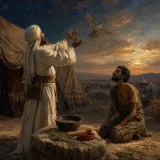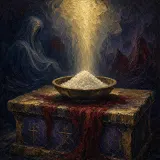
The big picture
After chapter 13’s exclusions, chapter 14 is about return. The priest first goes outside the camp to examine a person whose condition has already healed. Cleansing then unfolds through birds, washing, shaving, waiting, offerings, blood, and oil, with full restoration happening in stages rather than by one declaration. The ear, thumb, and toe reappear from priestly consecration, marking the seriousness of restored standing without turning the person into a priest. Poverty again receives a complete route, not a discounted half-ritual. The chapter then transfers the same attention to houses in Canaan. Suspicion leads to inspection, waiting, repair, and only then, if the affliction returns, demolition. A healed house can even receive atonement language, showing again that ritual cleansing is broader than forgiveness for personal wrongdoing.
In this chapter
- Healing Precedes the Cleansing Ceremony Leviticus 14:1-9
The way back begins with a fact that can be missed: the person is healed before the cleansing ceremony starts.
- An Ear, a Thumb, and a Toe Appear Again Leviticus 14:10-20
On the eighth day, the restored person reaches the tabernacle doorway with a full set of offerings, and the body is marked in a way that recalls priestly consecration.
- The Poorer Person Returns by the Same Route Leviticus 14:21-32
Poverty does not create a second-class route back into the community.
- The Householder Reports an Appearance, Not a Verdict Leviticus 14:33-42
The focus moves from a healed person to a suspicious house in the land of Canaan.
- A Returning Mark Changes the Response Leviticus 14:43-47
The turning point is recurrence.
- A House Can Be Cleansed, but It Has Not Confessed Leviticus 14:48-57
A repaired house can receive the opposite verdict.


Scripture beside the summary
Leviticus · King James Version · 57Leviticus 14:1-9
Healing Precedes the Cleansing Ceremony
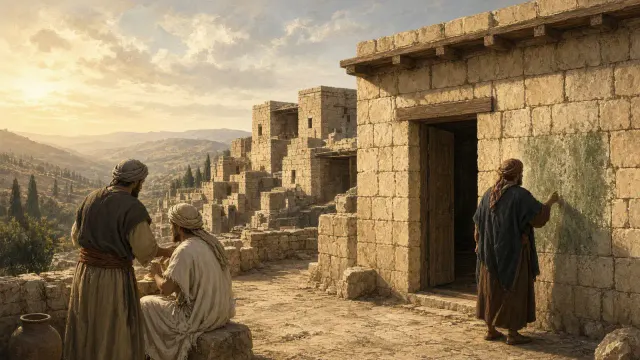
The way back begins with a fact that can be missed: the person is healed before the cleansing ceremony starts. The priest goes outside the camp to examine the former sufferer, rather than performing a rite that causes the healing. Recognition follows recovery. The first stage uses two clean birds, running water, an earthen vessel, cedar, scarlet, and hyssop. One bird is killed, the other is involved in the sprinkling and then released into the open field. Leviticus gives those actions without assigning a complete symbolic dictionary to every material. Washing and shaving follow, and the person may reenter the camp but not yet the tent. Another seven days pass before a second thorough shaving and washing. Restoration is therefore staged. Matthew later preserves the same sequence when priestly examination and the Mosaic gift follow a healing that has already occurred.
Deep dive
The opening condition is that the affliction has healed. The priest does not leave the camp to administer a treatment that produces the healing; he goes to inspect it. That distinction keeps recognition and restoration separate from the cause of recovery. It also makes the movement personal and geographical: the official who can recognize a return must first go to the person still outside.
One bird is killed over running water in an earthen vessel, while the living bird, cedar wood, scarlet, and hyssop are involved in the sprinkling rite. The living bird is then released. Death and release belong visibly to the ceremony, but the chapter does not assign a complete symbolic explanation to each material. Washing and shaving allow entrance into the camp, though not yet into the person’s own tent. Another seven days and another thorough washing and shaving follow. Restoration happens in stages. Matthew 8:4 later refers directly to priestly examination and the gift Moses commanded after Jesus has already healed the man, preserving the same distinction between healing and its prescribed recognition.
Words to trace: priest, bird, clean, wash, water, cleansed
Verse-by-verse path
- Leviticus 14:1
Moses alone is addressed for the cleansing of a person; Aaron is named again only at verse 33, when the subject turns to houses. The chapter is the sequel to 13:46, which left the afflicted living outside the camp with no word yet about a way back.
- Leviticus 14:2
In the day of his cleansing gives the rite a date on the calendar, a day that can be looked forward to. He shall be brought unto the priest, yet the next verse sends the priest out to him. Brought here means the case is referred, not that the man crosses the boundary first.
- Leviticus 14:3
Healed is nirpa, a passive form of rapha, the verb of Exodus 15:26, I am the LORD that healeth thee. No healer is named and no treatment is described. When Jesus told a cleansed leper to shew thyself to the priest (Mark 1:44), this is the inspection he meant.
- Leviticus 14:4
The birds are tsipporim, the general word for small birds such as sparrows, not the pigeons of the altar. Scarlet is shani, a crimson dye made from the kermes insect, and hyssop is the plant that painted the Passover blood (Exodus 12:22). The same trio returns for the red heifer in Numbers 19:6.
- Leviticus 14:5
Running water is mayim chayyim, literally living water: water from a spring or stream rather than a cistern. The same phrase is behind Jeremiah’s fountain of living waters (Jeremiah 2:13). The bird is killed over the vessel so its blood falls into the fresh water and mixes with it.
- Leviticus 14:6
The living bird is dipped into the blood of the dead one, and goes into the mixture alongside the other three items. The Mishnah (Negaim 14:1) describes the cedar and hyssop bound together with the scarlet thread, making a sprinkler with the bird held beside it.
- Leviticus 14:7
The verdict clean is spoken at the first stage, before washing or shaving. The living bird is let loose into the open field, literally upon the face of the field. Two birds, one killed and one released, anticipates the two goats of 16:8–22, one slain and one sent away.
- Leviticus 14:8
The first washing and shaving let him back inside the camp, but tarry abroad out of his tent keeps him from his own home for a week. Later Jewish interpretation took this as a week without marital relations, a reading of the tent as the household rather than the building.
- Leviticus 14:9
Head, beard, eyebrows, and then even all his hair. The eyebrows, gabboth ‘enayim, the arches of the eyes, are named nowhere else in the Bible. A body shaved this completely looks almost newborn; Numbers 8:7 prescribes a full shave for the Levites at their dedication too.
Leviticus 14:1-9
King James Version1And the LORD spake unto Moses, saying,
2This shall be the law of the leper in the day of his cleansing: He shall be brought unto the priest:
3And the priest shall go forth out of the camp; and the priest shall look, and, behold, if the plague of leprosy be healed in the leper;
4Then shall the priest command to take for him that is to be cleansed two birds alive and clean, and cedar wood, and scarlet, and hyssop:
5And the priest shall command that one of the birds be killed in an earthen vessel over running water:
6As for the living bird, he shall take it, and the cedar wood, and the scarlet, and the hyssop, and shall dip them and the living bird in the blood of the bird that was killed over the running water:
7And he shall sprinkle upon him that is to be cleansed from the leprosy seven times, and shall pronounce him clean, and shall let the living bird loose into the open field.
8And he that is to be cleansed shall wash his clothes, and shave off all his hair, and wash himself in water, that he may be clean: and after that he shall come into the camp, and shall tarry abroad out of his tent seven days.
9But it shall be on the seventh day, that he shall shave all his hair off his head and his beard and his eyebrows, even all his hair he shall shave off: and he shall wash his clothes, also he shall wash his flesh in water, and he shall be clean.
Leviticus 14:10-20
An Ear, a Thumb, and a Toe Appear Again
On the eighth day, the restored person reaches the tabernacle doorway with a full set of offerings, and the body is marked in a way that recalls priestly consecration. Blood from the trespass offering touches the right ear, right thumb, and right great toe; oil is later placed on those same spots over the blood, with more oil poured on the head. The parallel to Aaron’s installation is deliberate enough to notice but not strong enough to turn the cleansed person into a priest. What is being restored is standing within the sacred community, not priestly office. Trespass, sin, burnt, and grain offerings then complete the process, with atonement and cleanness repeatedly named. The chapter never identifies a hidden moral crime that caused the original affliction. These rites address return after uncleanness. Blood, oil, location, and sacrifice make that return public, ordered, and recognized before the LORD.

Deep dive
The eighth-day rite takes place at the tabernacle entrance, bringing the restored person from the camp’s exterior to the sanctuary’s appointed place of approach. The blood of the trespass offering is applied to the right ear, thumb, and great toe, followed by oil at those same locations. Those bodily points recall Aaron’s consecration in chapter 8. The parallel marks a serious restoration to sacred community life, although it does not make the formerly afflicted person a priest.
The oil also has its own movements: sprinkling before the LORD and application of what remains upon the head. The trespass, sin, burnt, and grain offerings then form an ordered completion, with atonement and cleanness repeatedly named. The chapter does not identify a personal crime that caused the original affliction, so the trespass offering should not be used to invent one. These rites address the person’s standing after a period of exclusion. Blood, oil, offerings, and location all make that return something recognized within the community’s sanctuary order, not merely a private assertion that the condition has improved.
Words to trace: offering, priest, right, hand, cleansed, LORD
Verse-by-verse path
- Leviticus 14:10
A log, about a third of a litre of oil, is a measure named only in this chapter (verses 10, 12, 15, 21 and 24). Three tenth deals, three tenths of an ephah of fine flour, is about three times the grain of an ordinary offering. The eighth day marks a new beginning after the week.
- Leviticus 14:11
The priest that maketh him clean is a title in Hebrew, hammetaher, the cleansing priest. The verb for present, he’emid, means to cause to stand: the man himself is set before the LORD with his animals, as if he too were being presented.
- Leviticus 14:12
A trespass offering, asham, is waved with the oil before it is slaughtered. Waving is unusual for an asham, and the pairing of a lamb with oil in a wave offering recalls the consecration portions of 8:27. It is the first of the four offerings of the eighth day.
- Leviticus 14:13
The holy place here is the north side of the altar, where 1:11 and 4:24 place the killing of burnt and sin offerings. The comparison as the sin offering is the priest’s, so is the trespass offering restates 7:7: one law for both, and the meat belongs to the officiating priest.
- Leviticus 14:14
Tip of the ear is tenuk, a word found only in these rites and in Aaron’s ordination (Exodus 29:20; Leviticus 8:23–24). The right side is named each time. The blood is applied to the living person, where most blood in Leviticus goes onto the altar.
- Leviticus 14:15
The priest pours oil into the palm of his own left hand, and the Hebrew stresses his own. His hand becomes the vessel for the rest of the rite. Oil is poured, not smeared, so it is a measured, visible amount he holds up and uses.
- Leviticus 14:16
Oil sprinkled seven times before the LORD happens almost nowhere else; the nearest parallel is Moses sprinkling the altar with oil seven times at the consecration in 8:11. The right finger dips and the left hand holds, a division of labour between the priest’s two hands.
- Leviticus 14:17
The oil goes upon the blood of the trespass offering, not beside it. The Hebrew says the oil is placed on top of the blood already on the ear, thumb and toe, so the marking is layered, blood first and oil over it.
- Leviticus 14:18
The rest of the oil is poured on the head. Aaron received oil on his head at his anointing (8:12), and Psalm 133:2 lingers on it running down to his beard. Here the same gesture is made for an ordinary Israelite, man or woman, who has come back from outside the camp.
- Leviticus 14:19
The sin offering is the ewe lamb of verse 10, since 4:32 names a female lamb for an individual’s sin offering. Afterward he shall kill the burnt offering: the order is fixed, the removal of uncleanness first and the offering of complete dedication second.
- Leviticus 14:20
He shall be clean is the third pronouncement of the rite. At verse 7 he was clean enough to enter the camp, at verse 9 his home, and now the sanctuary. The Hebrew uses the same word each time, but each stage opens a door further in.
Leviticus 14:10-20
King James Version10And on the eighth day he shall take two he lambs without blemish, and one ewe lamb of the first year without blemish, and three tenth deals of fine flour for a meat offering, mingled with oil, and one log of oil.
11And the priest that maketh him clean shall present the man that is to be made clean, and those things, before the LORD, at the door of the tabernacle of the congregation:
12And the priest shall take one he lamb, and offer him for a trespass offering, and the log of oil, and wave them for a wave offering before the LORD:
13And he shall slay the lamb in the place where he shall kill the sin offering and the burnt offering, in the holy place: for as the sin offering is the priest’s, so is the trespass offering: it is most holy:
14And the priest shall take some of the blood of the trespass offering, and the priest shall put it upon the tip of the right ear of him that is to be cleansed, and upon the thumb of his right hand, and upon the great toe of his right foot:
15And the priest shall take some of the log of oil, and pour it into the palm of his own left hand:
16And the priest shall dip his right finger in the oil that is in his left hand, and shall sprinkle of the oil with his finger seven times before the LORD:
17And of the rest of the oil that is in his hand shall the priest put upon the tip of the right ear of him that is to be cleansed, and upon the thumb of his right hand, and upon the great toe of his right foot, upon the blood of the trespass offering:
18And the remnant of the oil that is in the priest’s hand he shall pour upon the head of him that is to be cleansed: and the priest shall make an atonement for him before the LORD.
19And the priest shall offer the sin offering, and make an atonement for him that is to be cleansed from his uncleanness; and afterward he shall kill the burnt offering:
20And the priest shall offer the burnt offering and the meat offering upon the altar: and the priest shall make an atonement for him, and he shall be clean.
Leviticus 14:21-32
The Poorer Person Returns by the Same Route
Poverty does not create a second-class route back into the community. The reduced provision is carefully defined: one lamb remains for the trespass offering, the grain amount is smaller, and two birds replace the additional livestock otherwise required for the sin and burnt offerings. The oil remains. Then Leviticus repeats the essential actions almost in full, including presentation before the LORD, blood on ear, thumb, and toe, oil on the same places, and the concluding offerings. That repetition matters because it refuses to treat the poorer person’s restoration as an abbreviated footnote. The rite is less expensive, not less complete. The same priestly recognition and stated atonement are present. Leviticus has already made economic accommodations for offerings and childbirth; here it prevents limited resources from leaving a healed person permanently stranded between recovery and formal restoration. Affordability changes components, not the legitimacy of the return.

Deep dive
The concession is carefully specified rather than left to improvisation. One lamb remains for the trespass offering, but two birds replace the sin and burnt offerings that would otherwise require additional animals. The grain quantity is reduced, while the log of oil remains. Poverty changes particular components of the rite; it does not require the person to supply the entire more costly set eventually in order to complete the return.
The account then repeats the central actions: presentation before the LORD, blood on the ear, thumb, and toe, oil applied in the appointed way, and the final offerings. The repetition gives the less expensive provision a full description rather than a dismissive instruction to do something approximately similar. The same priestly recognition and stated atonement are present. Leviticus has already made economic provision for ordinary offerings and childbirth; here the provision addresses someone emerging from exclusion. Limited resources are not allowed to turn a healed condition into an indefinitely unfinished ritual restoration.
Words to trace: offering, priest, hand, right, LORD, trespass
Verse-by-verse path
- Leviticus 14:21
If he be poor translates dal, one who is thin or low. Cannot get so much is literally his hand does not reach. The trespass lamb is not reduced; only the grain drops, from three tenth deals to one, and the other two animals are replaced.
- Leviticus 14:22
Such as he is able to get is again his hand reaching, and it recurs in verses 30, 31 and 32. Turtledoves or young pigeons were the offering of the poor throughout Leviticus (5:7; 12:8), birds that could be trapped or kept near the house at little cost.
- Leviticus 14:23
The date does not move. The poorer man comes on the eighth day, to the same door, before the LORD, exactly as the richer one. Poverty changes what he carries, not when he may come or where he may stand.
- Leviticus 14:24
The lamb and the log are waved as in verse 12, and the Hebrew does not abbreviate. Its full restatement in verses 24 to 29 is itself the provision: the poorer man hears every step of his own rite rather than being told to do the same, but less.
- Leviticus 14:25
Of the richer man’s animals, the lamb of the trespass offering is the one never replaced by a bird. An inference from the text: the rite needs enough blood to mark ear, thumb and toe, and that part of the ceremony is untouched by the reduction.
- Leviticus 14:26
The palm of his own left hand, again. The verse is shorter than verse 15 but keeps the same careful detail that the priest’s own hand is the vessel, so there is no cheaper substitute for the priest’s part either.
- Leviticus 14:27
Seven times recurs through this chapter: seven sprinklings of blood on the person (verse 7), seven days outside the tent (verse 8), seven sprinklings of oil (verses 16 and 27), and seven sprinklings of the house (verse 51). Seven is the number of completion running through each stage.
- Leviticus 14:28
The wording shifts slightly from verse 17. Here the oil goes upon the place of the blood, not upon the blood itself, as though the earlier application may have dried or been wiped. The rabbis argued over the difference; the Hebrew makes it deliberately.
- Leviticus 14:29
The last of the oil goes on the head, and none is left over. Some was sprinkled toward the sanctuary, some marked the body, and the remainder crowns the person. The single log is spent entirely on the one being restored.
- Leviticus 14:30
He shall offer the one of the turtledoves: the bird offerings follow the procedure of 1:14–17 and 5:7–10, the neck wrung by the priest at the altar, the blood drained against its side. The poor man’s offering is handled at the altar like any other.
- Leviticus 14:31
Even such as he is able to get is the third time in three verses that the text returns to what his hand can reach. The meat offering is still included, and the atonement before the LORD is word for word the same as for the richer man.
- Leviticus 14:32
The closing formula names the person by his means: him whose hand is not able to get. Of the closing headings in these chapters, this is the only one that sets apart a law for the poor by name, as though the reduced rite deserved its own title.
Leviticus 14:21-32
King James Version21And if he be poor, and cannot get so much; then he shall take one lamb for a trespass offering to be waved, to make an atonement for him, and one tenth deal of fine flour mingled with oil for a meat offering, and a log of oil;
22And two turtledoves, or two young pigeons, such as he is able to get; and the one shall be a sin offering, and the other a burnt offering.
23And he shall bring them on the eighth day for his cleansing unto the priest, unto the door of the tabernacle of the congregation, before the LORD.
24And the priest shall take the lamb of the trespass offering, and the log of oil, and the priest shall wave them for a wave offering before the LORD:
25And he shall kill the lamb of the trespass offering, and the priest shall take some of the blood of the trespass offering, and put it upon the tip of the right ear of him that is to be cleansed, and upon the thumb of his right hand, and upon the great toe of his right foot:
26And the priest shall pour of the oil into the palm of his own left hand:
27And the priest shall sprinkle with his right finger some of the oil that is in his left hand seven times before the LORD:
28And the priest shall put of the oil that is in his hand upon the tip of the right ear of him that is to be cleansed, and upon the thumb of his right hand, and upon the great toe of his right foot, upon the place of the blood of the trespass offering:
29And the rest of the oil that is in the priest’s hand he shall put upon the head of him that is to be cleansed, to make an atonement for him before the LORD.
30And he shall offer the one of the turtledoves, or of the young pigeons, such as he can get;
31Even such as he is able to get, the one for a sin offering, and the other for a burnt offering, with the meat offering: and the priest shall make an atonement for him that is to be cleansed before the LORD.
32This is the law of him in whom is the plague of leprosy, whose hand is not able to get that which pertaineth to his cleansing.
Leviticus 14:33-42
The Householder Reports an Appearance, Not a Verdict
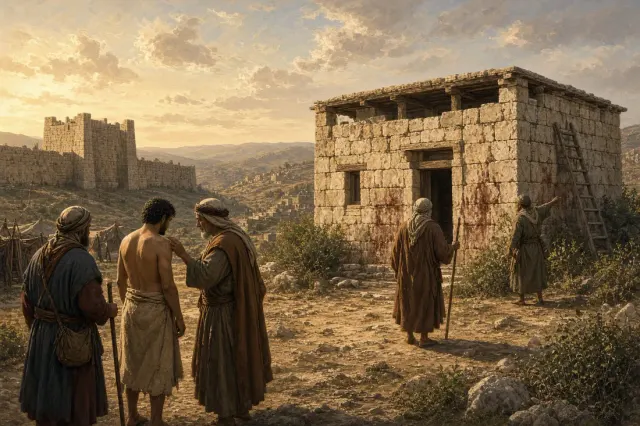
The focus moves from a healed person to a suspicious house in the land of Canaan. The owner does not pronounce the building unclean. He reports cautiously, “it seemeth to me,” and the priest investigates. Before entering, the house is emptied so its contents are not unnecessarily swept into whatever verdict follows. That small step shows the procedure trying to limit consequences before certainty exists. If the marks meet the stated description, the house is shut seven days and inspected again. Spread can lead to removal of affected stones, scraping of the interior, disposal of material outside the city, and replacement plaster. Even then demolition has not yet been ordered. Leviticus builds a sequence of report, examination, waiting, and repair. The householder may know the building best, but the final ritual classification belongs to the priest, and suspicion is not allowed to skip straight to destruction.
Deep dive
The setting shifts explicitly to houses in the land Israel is to receive. The LORD speaks of putting the affliction in a house, yet no particular owner’s wrongdoing is named as its cause. The owner’s report is deliberately tentative: "it seemeth to me". Living in the building does not make the owner the authority who pronounces its ritual status.
Before inspection, the priest orders the contents removed so that they are not all made unclean by the house’s eventual classification. The procedure considers the consequences for possessions before issuing the verdict. A seven-day closure can then be followed by removal of affected stones, scraping of the interior, and replacement of stones and plaster. Removed material goes to an unclean place outside the city. The sequence does not rush from an alarming mark to total demolition. It distinguishes report from judgment and repair from destruction, with further inspection deciding whether the first intervention has been sufficient.
Words to trace: house, plague, priest, place, stones, unclean
Verse-by-verse path
- Leviticus 14:33
Aaron is addressed again, as at the start of chapter 13. The instruction about houses is spoken to both brothers in the wilderness, where Israel lived in tents and had no stone houses at all.
- Leviticus 14:34
The first mention of Canaan in Leviticus. Which I give to you for a possession promises the land in the present tense. And I put the plague makes the LORD the subject, yet the verse attributes no fault to the owner; it simply says where the affliction comes from.
- Leviticus 14:35
It seemeth to me there is as it were a plague: the owner hedges twice. The Mishnah (Negaim 12:5) says that even a learned man must say as it were rather than give a verdict, since the verdict belongs to the priest alone.
- Leviticus 14:36
Emptying the house first means only what is inside at the verdict becomes unclean. The rabbis drew from this that the Torah takes care of Israel’s property, down to its earthenware jars, which otherwise would have to be broken (11:33).
- Leviticus 14:37
Hollow strakes translates sheqa‘aruroth, a word found only here: depressions or streaks in the wall. Strake was the 1611 spelling of streak, used also for the peeled white strakes on Jacob’s rods (Genesis 30:37). The colours are the greenish and reddish of the garments in 13:49.
- Leviticus 14:38
The priest goes out of the house to the door and shuts it from there. He closes the house from its threshold, standing on the boundary between the building and the street, the same place where the offerings were brought at the tabernacle door.
- Leviticus 14:39
On the seventh day the priest comes again, the one week of watching. For a house, spreading after seven days leads to repair, not to immediate destruction, a step no skin case in chapter 13 had.
- Leviticus 14:40
The setting has become a city, not the camp. Houses in Canaan were built of fieldstone set in mud mortar, so a stone could be taken out and replaced. The unclean place without the city is a designated dump beyond the walls.
- Leviticus 14:41
Scraped within round about: the whole inner surface is scraped, not just around the mark. The dust is literally dust, ‘aphar, the plaster scraped off, and it too is carried outside to the unclean place.
- Leviticus 14:42
Other morter is ‘aphar again, the same word as the dust of verse 41. New earth replaces old. Plaister is tuach, to coat or smear, the verb Ezekiel 13:10–15 uses for daubing a wall with untempered mortar.
Leviticus 14:33-42
King James Version33And the LORD spake unto Moses and unto Aaron, saying,
34When ye be come into the land of Canaan, which I give to you for a possession, and I put the plague of leprosy in a house of the land of your possession;
35And he that owneth the house shall come and tell the priest, saying, It seemeth to me there is as it were a plague in the house:
36Then the priest shall command that they empty the house, before the priest go into it to see the plague, that all that is in the house be not made unclean: and afterward the priest shall go in to see the house:
37And he shall look on the plague, and, behold, if the plague be in the walls of the house with hollow strakes, greenish or reddish, which in sight are lower than the wall;
38Then the priest shall go out of the house to the door of the house, and shut up the house seven days:
39And the priest shall come again the seventh day, and shall look: and, behold, if the plague be spread in the walls of the house;
40Then the priest shall command that they take away the stones in which the plague is, and they shall cast them into an unclean place without the city:
41And he shall cause the house to be scraped within round about, and they shall pour out the dust that they scrape off without the city into an unclean place:
42And they shall take other stones, and put them in the place of those stones; and he shall take other morter, and shall plaister the house.
Leviticus 14:43-47
A Returning Mark Changes the Response
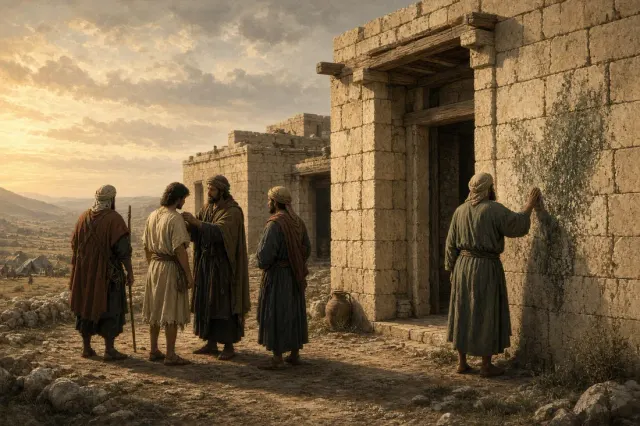
The turning point is recurrence. Stones have already been removed, walls scraped, and the house replastered. If the affliction returns and spreads after that intervention, the priest now declares a “fretting leprosy” in the house, and the structure is dismantled. Stones, timber, and plaster are carried outside the city to an unclean place. The severity of the outcome makes the earlier stages more important, not less. Leviticus did not begin with demolition; it arrived there after inspection, waiting, repair, and a failed attempt at restoration. The section also distinguishes levels of contact during the closure. Merely entering makes a person unclean until evening, while lying down or eating inside requires washing clothes as well. Even within a condemned space, the rules do not flatten every interaction into one response. The law remains specific about what a person actually does in the house.
Deep dive
The decisive case is recurrence after the affected stones have been removed and the house has been scraped and replastered. The earlier repair has already supplied an opportunity for a different outcome. When the affliction returns in the way described, the priest’s ruling leads to dismantling the structure and carrying its materials outside the city to an unclean place.
The regulations also distinguish degrees of contact while the house is shut up. Entering makes a person unclean until evening; lying down or eating there requires washing clothes as well. These details keep the judgment from being confined to the walls alone, but they do not establish that every object anywhere nearby is equally affected. The chapter follows specific acts inside a specifically restricted place. Its progression is firm without being instantaneous: suspected damage, examination, waiting, repair, and recurrence precede the final destruction. The loss of a house is substantial enough that each stage matters to the account’s design.
Words to trace: house, unclean, break, clothes, plague, stones
Verse-by-verse path
- Leviticus 14:43
Three clauses stack up: after the stones, after the scraping, after the plastering. The repetition lists everything that has been tried, so the recurrence that follows is weighed against the full repair.
- Leviticus 14:44
Fretting leprosy in the house uses mam’ereth, the malignant affliction of garments in 13:51. The word is now applied to stone and timber, so one term runs from skin through cloth to buildings.
- Leviticus 14:45
Stones, timber and mortar are all the materials of a Canaanite house, and every one is carried out of the city. A house was a family’s dwelling in a land given as a possession (verse 34); losing one was a serious matter, which is why the repair came first.
- Leviticus 14:46
All the while it is shut up is literally all the days he shut it. Going inside, even briefly, makes a person unclean until evening. The contamination attaches to the enclosed space, so crossing the threshold is itself contact.
- Leviticus 14:47
Lying down and eating mean staying, not passing through, and they add washing the clothes. The distinction matches the one for carcasses in 11:24–25: a brief touch against prolonged contact.
Leviticus 14:43-47
King James Version43And if the plague come again, and break out in the house, after that he hath taken away the stones, and after he hath scraped the house, and after it is plaistered;
44Then the priest shall come and look, and, behold, if the plague be spread in the house, it is a fretting leprosy in the house: it is unclean.
45And he shall break down the house, the stones of it, and the timber thereof, and all the morter of the house; and he shall carry them forth out of the city into an unclean place.
46Moreover he that goeth into the house all the while that it is shut up shall be unclean until the even.
47And he that lieth in the house shall wash his clothes; and he that eateth in the house shall wash his clothes.
Leviticus 14:48-57
A House Can Be Cleansed, but It Has Not Confessed
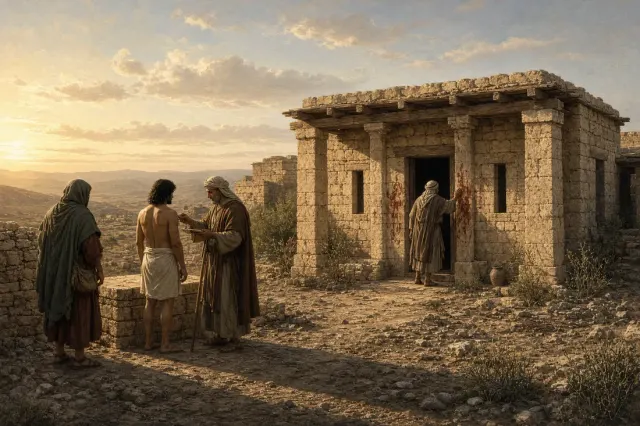
A repaired house can receive the opposite verdict. If the affliction does not spread after replastering, the priest pronounces the building clean because the condition is healed. The cleansing rite then reuses the two birds, cedar wood, scarlet, hyssop, blood, and running water seen earlier in the person’s restoration, with the living bird released into the open field. Verse 53 even says the priest makes “an atonement for the house.” A house has not committed a moral offense or confessed from its walls, so the wording is a strong check against reducing every use of atonement to personal forgiveness. Here it concerns removal of an unclean condition and restored status. The chapter closes by gathering skin, scalp, garments, and houses under the priestly responsibility to teach when something is unclean and when it is clean. Both verdicts belong to faithful discernment.
Deep dive
A successful repair produces a different conclusion. If the condition has not spread, the priest pronounces the house clean because the affliction is healed. The bird, water, cedar, scarlet, and hyssop rite returns, this time for the building. The living bird is released outside the city into the open field, and the house is cleansed.
Verse 53 even speaks of making atonement for the house. That wording is an important check on the assumption that every use of atonement must refer to forgiving a morally guilty individual. A wall has no conscience to confess from. Here the action addresses the removal of an unclean condition and the building’s restored status. The final list reaches across skin, garments, and houses, closing the two chapters with the task of teaching when something is unclean and when it is clean. The priest’s work includes both verdicts. Exclusion is real, but it is not the only conclusion the law equips him to pronounce.
Words to trace: house, bird, cedar, clean, hyssop, leprosy
Verse-by-verse path
- Leviticus 14:48
The plague is healed, nirpa, the word used of the person in verse 3. A house is said to be healed, a strong word to use of a building, and it frames what follows as the same kind of recognition that was given to a body.
- Leviticus 14:49
Two birds, cedar, scarlet and hyssop: the same materials as verse 4 for the person. This time they are not described as alive and clean, though both are clearly assumed. The same kit that restored a body now restores a building.
- Leviticus 14:50
This time the priest himself kills the bird; at verse 5 he commanded someone else to do it. The difference is small in English and clear in Hebrew. Otherwise the vessel, the running water and the method are identical.
- Leviticus 14:51
The order of the list changes to cedar, hyssop, scarlet, and the running water is named alongside the blood. The house is sprinkled seven times, as the person was in verse 7.
- Leviticus 14:52
Six instruments are listed, each introduced by with: blood, running water, the living bird, cedar, hyssop, scarlet. Even the bird that will fly away is named as a means of cleansing, not simply a witness.
- Leviticus 14:53
Out of the city into the open fields: the bird goes beyond the settlement, as the goat of 16:22 goes to a land not inhabited. The house has now been sprinkled, and the verdict is the plain one, it shall be clean.
- Leviticus 14:54
The summary gathers the two chapters under one heading, all manner of plague of leprosy, and names the scall of 13:30 in particular, as though the scalp case were a distinct enough category to list on its own.
- Leviticus 14:55
Garment and house sit side by side: woven cloth and built stone, the two man-made things the affliction can reach. The summary keeps them separate from the body cases in the next verse.
- Leviticus 14:56
A rising, a scab, a bright spot: se’eth, sappachath, bahereth, the three words of 13:2, in the same order. The two chapters end with the vocabulary with which they began.
- Leviticus 14:57
To teach is lehoroth, from the same root as torah; law here is teaching. When it is unclean, and when it is clean is literally in the day of the unclean and in the day of the clean, as if each verdict were a day on the calendar.
Leviticus 14:48-57
King James Version48And if the priest shall come in, and look upon it, and, behold, the plague hath not spread in the house, after the house was plaistered: then the priest shall pronounce the house clean, because the plague is healed.
49And he shall take to cleanse the house two birds, and cedar wood, and scarlet, and hyssop:
50And he shall kill the one of the birds in an earthen vessel over running water:
51And he shall take the cedar wood, and the hyssop, and the scarlet, and the living bird, and dip them in the blood of the slain bird, and in the running water, and sprinkle the house seven times:
52And he shall cleanse the house with the blood of the bird, and with the running water, and with the living bird, and with the cedar wood, and with the hyssop, and with the scarlet:
53But he shall let go the living bird out of the city into the open fields, and make an atonement for the house: and it shall be clean.
54This is the law for all manner of plague of leprosy, and scall,
55And for the leprosy of a garment, and of a house,
56And for a rising, and for a scab, and for a bright spot:
57To teach when it is unclean, and when it is clean: this is the law of leprosy.
Questions to keep in mind while reading
- Identify the people addressed and the covenant setting.
- Distinguish rescue, worship, holiness, justice, and community responsibility.
- Read commands in their literary and covenant context before making a modern application.
Text first
Where readers differ
The chapter summary begins with what the passage says and how its parts fit together. It does not assume one denomination has already settled every question. Where a conclusion depends on a tradition, literary theory, or historical reconstruction, that dependence is named openly.
The KJV text is presented first. Interpretive conclusions are labeled, and differences are introduced only when they help a reader understand why serious communities do not always reach the same answer.
Comparative interpretive notes for this chapter are in preparation. Until reviewed notes are ready, this page separates the KJV text from summary and application without claiming that serious readers agree on every question.
Questions beneath the surface
- What account of God, human freedom, responsibility, and the good life emerges from Leviticus 14?
- Which tension does the chapter refuse to resolve quickly?
- What changes when the chapter is read as part of the whole canon rather than as an isolated moral lesson?
- Where might a sincere reader confuse a familiar tradition with something the text states directly?
Questions for serious personal contemplation
These open-ended questions make room for tension, honest response, prayer, and conclusions that remain accountable to the chapter.
Observe without rushing
What part of Leviticus 14 makes you stop, feel unsettled, or feel surprised, and why?
Which detail in the passage would be easiest to overlook? How does that detail change your understanding?
Where do you see tension between what happens and this focus: A healed person being examined outside the camp and a house being inspected for spreading contamination?
What important question does the passage leave open instead of resolving quickly?
Examine your inner life honestly
Which person, response, fear, or desire in the passage feels most like your own life right now?
What assumption about God, other people, or yourself does this text challenge?
Which part would you rather soften, avoid, or explain away too quickly? What might that reaction reveal?
If this Scripture could ask you one direct question, what do you think it would ask?
Respond with wisdom and courage
What do you need to remember, confess, grieve, thank God for, or trust after reading this passage?
How might another faithful person read this situation differently without ignoring the text?
What obedient response would be costly, uncomfortable, or slow, yet still faithful to Scripture?
What question will you carry into prayer this week, and which verses will you keep in front of you?
Music and video connected to the passage
Related media appears when its Scripture reference overlaps this study. Music and video can illuminate a theme while the biblical text remains the foundation.