The big picture
This long chapter is built around looking carefully and, when necessary, looking again. Suspicious marks on skin, scalp, beard, bald areas, garments, and leather do not all receive the same verdict. Depth, hair color, spread, raw flesh, fading, recurrence, and the history of an injury can change the classification. A seven-day separation often functions as deliberate uncertainty rather than a sentence already decided. Leviticus even pauses to say that ordinary baldness and some pale spots are clean. When uncleanness is established, the social cost can be severe, including life outside the camp, yet the category is not presented as proof of a particular moral offense. The priest’s work is diagnostic in the ritual sense: to distinguish clean from unclean without pretending every unusual appearance means the same thing.
In this chapter
- A Suspicious Spot Is Not a Settled Verdict Leviticus 13:1-8
A suspicious patch of skin is not automatically a final verdict.
- More Whiteness Does Not Always Mean More Uncleanness Leviticus 13:9-17
This section overturns the instinct that more visible whiteness must always mean more uncleanness.
- A Healed Injury Can Leave a Mark Without Establishing the Same Condition Leviticus 13:18-28
A healed boil or burn can leave a mark, and Leviticus refuses to treat every mark as proof of the same affliction.
- Baldness Is Not Uncleanness Leviticus 13:29-44
Head and beard conditions bring hair into the examination in a different way.
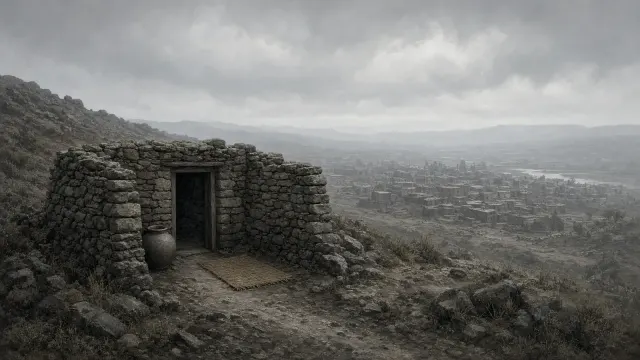
- The Verdict Has a Public Cost Leviticus 13:45-46
Once a person is pronounced unclean in this condition, the ruling becomes public and costly.
- Even Cloth Can Require Another Inspection Leviticus 13:47-59
The same broad affliction category now reaches wool, linen, woven material, leather, and objects made from skin.
Scripture beside the summary
Leviticus · King James Version · 59Leviticus 13:1-8
A Suspicious Spot Is Not a Settled Verdict
A suspicious patch of skin is not automatically a final verdict. The priest looks for specific signs such as depth, changed hair, and spread, and when the evidence is incomplete he does something strikingly untheatrical: he waits. Seven days can be followed by another inspection and, if needed, another seven-day interval. A mark that fades and does not spread may be declared clean, while one that later spreads must be shown again. The KJV’s “leprosy” translates a category broader than a single modern disease, as the same terminology will later be applied to garments and houses. Leviticus is therefore giving a ritual classification system based on observable signs, not handing the priest a modern diagnosis. His authority includes uncertainty. He is not praised for issuing the harshest answer fastest. Sometimes the faithful action is to shut the case for a week, then look again.

Deep dive
The Hebrew term tsaraath, rendered "leprosy" in the KJV, covers a broader textual category than one modern diagnosis. Brown–Driver–Briggs lists its use for conditions of people, garments, and houses. That range matters before any attempt is made to identify every case with a single present-day disease. Leviticus is describing priestly classifications through observable signs, including appearance, depth, hair color, and spread.
The first inspection does not always produce a final verdict. Seven days may be followed by another examination, and then another interval if the signs remain uncertain. A fading mark that has not spread can be declared clean, with washing required; a mark that spreads later must be shown again. The procedure makes room for a changed conclusion because the condition itself can change. The priest is not rewarded for sounding certain immediately. His authority includes waiting, looking again, and distinguishing a suspicious appearance from the signs that actually establish uncleanness.
Words to trace: priest, plague, skin, flesh, look, scab
Verse-by-verse path
- Leviticus 13:1
Aaron is addressed with Moses again, as in 11:1. The long instruction that follows is a manual for priests, and every verdict in it is spoken by one: nobody pronounces himself clean or unclean in this chapter.
- Leviticus 13:2
Three technical words open the chapter: se’eth, a swelling or rising; sappachath, a scab or eruption; and bahereth, a bright or shiny spot. Plague is nega‘, literally a stroke or touch. The sufferer shall be brought, a passive verb that suggests someone else has often noticed first.
- Leviticus 13:3
Two signs together settle the first case: hair in the patch turned white, and the patch looking deeper than the surrounding skin. The Hebrew says in sight, as it appears, so the priest judges by appearance alone. He does not touch, treat or prescribe; he looks twice in one verse and speaks.
- Leviticus 13:4
Shut up is hisgir, from sagar, the root used when the LORD shut Noah into the ark (Genesis 7:16). The spot is white but shallow and the hair unchanged, so neither sign is present. The response to incomplete evidence is a week of quarantine.
- Leviticus 13:5
At a stay translates a phrase meaning it has stood still in the priest’s eyes. No growth and no retreat, so the case is neither closed nor escalated, and the priest adds another seven days. Fourteen days is the longest this first procedure runs.
- Leviticus 13:6
Somewhat dark means faded or dim, the colour going out of the spot. It is but a scab, mispachath, a harmless eruption. Even a clean verdict ends with washing the clothes, since two weeks under suspicion leave their own residue to be dealt with.
- Leviticus 13:7
The case can reopen. Seen of the priest for his cleansing refers to the clean verdict of verse 6; a spot that spreads afterwards is brought back. A pronouncement once made is not treated as beyond revision when the body shows something new.
- Leviticus 13:8
The shortest verdict yet. Spreading, pasah, is the single sign that turns the doubtful case into the defined one, and the priest names it without further delay: it is a leprosy. The waiting of verses 4 to 7 has done its work.
Leviticus 13:1-8
King James Version1And the LORD spake unto Moses and Aaron, saying,
2When a man shall have in the skin of his flesh a rising, a scab, or bright spot, and it be in the skin of his flesh like the plague of leprosy; then he shall be brought unto Aaron the priest, or unto one of his sons the priests:
3And the priest shall look on the plague in the skin of the flesh: and when the hair in the plague is turned white, and the plague in sight be deeper than the skin of his flesh, it is a plague of leprosy: and the priest shall look on him, and pronounce him unclean.
4If the bright spot be white in the skin of his flesh, and in sight be not deeper than the skin, and the hair thereof be not turned white; then the priest shall shut up him that hath the plague seven days:
5And the priest shall look on him the seventh day: and, behold, if the plague in his sight be at a stay, and the plague spread not in the skin; then the priest shall shut him up seven days more:
6And the priest shall look on him again the seventh day: and, behold, if the plague be somewhat dark, and the plague spread not in the skin, the priest shall pronounce him clean: it is but a scab: and he shall wash his clothes, and be clean.
7But if the scab spread much abroad in the skin, after that he hath been seen of the priest for his cleansing, he shall be seen of the priest again:
8And if the priest see that, behold, the scab spreadeth in the skin, then the priest shall pronounce him unclean: it is a leprosy.
Leviticus 13:9-17
More Whiteness Does Not Always Mean More Uncleanness
This section overturns the instinct that more visible whiteness must always mean more uncleanness. A white swelling with white hair and raw flesh is pronounced unclean, yet a condition that has spread so completely that the whole surface has turned white can be declared clean. If raw flesh appears again, the verdict changes back. The priest’s judgment therefore depends on the combination of signs present at the time, not on a simple scale from small patch to large patch. Leviticus also allows the classification to change when the condition changes. A person is not necessarily fixed forever in the first status assigned. The priest examines what is actually there, and when raw flesh turns white again another inspection can produce a clean verdict. The law is demanding, but it is not crude. Visible difference alone is not enough; the prescribed evidence must govern the conclusion.

Deep dive
This paragraph resists an easy assumption that the largest visible area must represent the worst ritual status. A swelling with white hair and raw flesh is unclean. Yet when the condition covers the person so completely that the skin has turned white, the priest may pronounce the person clean. Raw flesh appearing within that condition reverses the judgment again.
The decisive issue is the combination of specified signs, not a simple scale from little discoloration to much discoloration. The passage therefore cannot be reduced to a general instruction to remove anyone whose skin looks unusual. It demands closer discrimination than that. It also does not tell the priest to cure the condition before making a ruling. His declaration recognizes the status indicated by what he sees at that examination. When the raw flesh changes and becomes white again, another inspection is required. The law’s repeated movement between unclean and clean shows that the classification is responsive to the condition rather than necessarily a permanent identity assigned to the person.
Words to trace: priest, flesh, leprosy, plague, unclean, white
Verse-by-verse path
- Leviticus 13:9
A new case begins with a fresh heading, the plague already in a man. The opening verb is again passive, he shall be brought, as though the community delivers him to the priest rather than the man coming forward of his own accord.
- Leviticus 13:10
Quick raw flesh is michyat basar chai, literally a sign of living flesh: exposed, raw tissue. Quick is old English for alive, as in the quick and the dead. White swelling, whitened hair and raw flesh together make the fullest set of signs in the chapter.
- Leviticus 13:11
Old leprosy is nosheneth, an aged or chronic condition, one that has been there long enough to be clear at first sight. For that reason the priest shall not shut him up. Waiting exists to resolve doubt, and where there is none, the week is not imposed.
- Leviticus 13:12
From his head even to his foot, wheresoever the priest looketh: the scope is total, and the priest inspects the whole body. The phrase is built to leave no uncovered patch of skin that could complicate the verdict of the next verse.
- Leviticus 13:13
The surprising ruling. Complete whiteness, with no raw flesh anywhere, is pronounced clean. The priest shall consider is the same verb for seeing used throughout; he looks and concludes. Miriam’s skin was white as snow (Numbers 12:10), but she was shut out of the camp; the whiteness alone was not the test.
- Leviticus 13:14
One sign reverses everything. The Hebrew says on the day raw flesh appears, so the change is immediate, not held over for another week. Six words in the English turn the clean man of verse 13 unclean.
- Leviticus 13:15
The priest sees before he speaks, and the reason is given in the verdict itself: for the raw flesh is unclean. The ruling rests on the tissue, not on the person’s history or conduct, and ends with the chapter’s recurring label, it is a leprosy.
- Leviticus 13:16
Turn again is the ordinary Hebrew verb for returning, shuv. The raw flesh can go back to white, and when it does, the man himself comes to the priest. For once he is the subject of the verb, coming rather than being brought.
- Leviticus 13:17
The case closes where verse 13 did, with the whole body white and the man pronounced clean. The three verses from 14 to 17 show the same person moving from clean to unclean and back again as the skin changes.
Leviticus 13:9-17
King James Version9When the plague of leprosy is in a man, then he shall be brought unto the priest;
10And the priest shall see him: and, behold, if the rising be white in the skin, and it have turned the hair white, and there be quick raw flesh in the rising;
11It is an old leprosy in the skin of his flesh, and the priest shall pronounce him unclean, and shall not shut him up: for he is unclean.
12And if a leprosy break out abroad in the skin, and the leprosy cover all the skin of him that hath the plague from his head even to his foot, wheresoever the priest looketh;
13Then the priest shall consider: and, behold, if the leprosy have covered all his flesh, he shall pronounce him clean that hath the plague: it is all turned white: he is clean.
14But when raw flesh appeareth in him, he shall be unclean.
15And the priest shall see the raw flesh, and pronounce him to be unclean: for the raw flesh is unclean: it is a leprosy.
16Or if the raw flesh turn again, and be changed unto white, he shall come unto the priest;
17And the priest shall see him: and, behold, if the plague be turned into white; then the priest shall pronounce him clean that hath the plague: he is clean.
Leviticus 13:18-28
A Healed Injury Can Leave a Mark Without Establishing the Same Condition
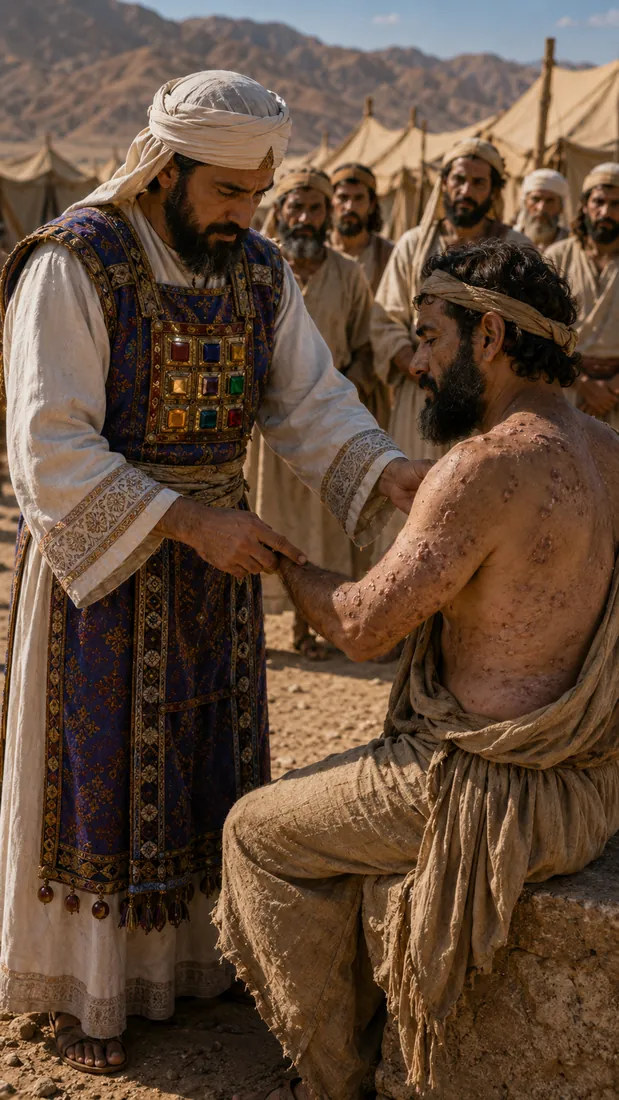
A healed boil or burn can leave a mark, and Leviticus refuses to treat every mark as proof of the same affliction. The history of the spot matters. The priest examines depth, hair color, and whether the area spreads, while an uncertain case again receives a seven-day interval. A stable mark may be identified as the scar or inflammation left by the earlier injury and pronounced clean. The parallel instructions for boils and burns protect against two opposite errors. A developing condition should not be dismissed simply because it began at the site of an old injury, but an ordinary scar should not be promoted into a more serious ritual category without the required signs. The law’s repetition creates room for evidence to develop. What matters is not merely that the skin looks different, but how the mark behaves over time and how it compares with the features the priest has been told to recognize.
Deep dive
The point of origin matters. A mark left where a boil has healed is not automatically treated as the same thing as the condition already described, and a mark within a burn receives a parallel but separately stated procedure. The priest looks for depth, changes in the hair, and subsequent spread. Where those signs are absent or unclear, the seven-day interval returns.
The possibility of an ordinary scar is expressly preserved. A stable mark can be identified as the result of the earlier injury rather than a reason for continued exclusion. Leviticus is not collapsing every damaged patch of skin into one category. The repeated wording is doing protective work in both directions: it prevents a developing condition from being dismissed too soon, and it prevents the remains of an injury from being given a more serious status without the prescribed evidence. The priest’s conclusion must answer to the particular mark, its history as described in the case, and what a later inspection actually reveals.
Words to trace: priest, skin, white, bright, pronounce, spot
Verse-by-verse path
- Leviticus 13:18
A boil, shechin, is the word for the boils of the sixth plague in Exodus 9:9 and for the sores that covered Job (Job 2:7). The sentence opens on a body that has already healed; the question is only what the healed place now shows.
- Leviticus 13:19
White, and somewhat reddish renders lavan adamdameth, the doubled form adamdam meaning pinkish, a faint red. The spot is shewed to the priest: in 1611 English shew is the older spelling of show, and the whole chapter runs on things being shown and seen.
- Leviticus 13:20
Lower than the skin says what verse 3 said with deeper: the patch sits beneath the surrounding surface. Broken out of the boil names the origin: the condition has blossomed from the old wound, using the verb parach, to bud or break out, the word used of blossoming plants.
- Leviticus 13:21
No white hairs, not sunken, and faded: all three warning signs are missing, so the patch gets the single week of watching. Unlike verse 5, no second week is prescribed for the boil case; one inspection after seven days decides it.
- Leviticus 13:22
Spread much abroad is the doubled phrase pasoh tifseh, spreading it spreads, a Hebrew way of stressing that the growth is plain. The verdict is shorter than any before it: it is a plague, the bare word nega‘ without further label.
- Leviticus 13:23
A burning boil is tsarebeth hashechin, the scar of the boil. Tsarebeth comes from a verb for scorching, and the idea is a puckered mark like the tightened skin left by heat. It stays where it is, and staying is the sign of an old wound, not an active condition.
- Leviticus 13:24
The second origin is a burn, mikvath esh, literally a burning of fire. Quick flesh that burneth is the raw tissue of the healing wound. Burns were common in households built around open hearths and clay ovens, so this was a practical case, not a rare one.
- Leviticus 13:25
The signs are the same as for the boil: whitened hair and depth. Wherefore the priest shall pronounce him unclean ties the verdict tightly to the evidence, and the sentence is laid out in the order of the inspection, seeing first, reasoning second, pronouncing last.
- Leviticus 13:26
The burn case mirrors verse 21 almost word for word. The Hebrew law often states parallel cases in full rather than saying likewise, so that a priest reading any one paragraph has the whole procedure in front of him without needing to cross-reference.
- Leviticus 13:27
On the seventh day comes the one inspection, as the boil received. Spread much abroad settles the burn as unclean. The term here is the full phrase, plague of leprosy, where verse 22 said only plague.
- Leviticus 13:28
An inflammation of the burning is tsarebeth hamikvah, the scar of the burn, the same word as the burning boil in verse 23. The Hebrew uses the exact term twice so that the two healed injuries are recognised as belonging to one class: scars, and clean.
Leviticus 13:18-28
King James Version18The flesh also, in which, even in the skin thereof, was a boil, and is healed,
19And in the place of the boil there be a white rising, or a bright spot, white, and somewhat reddish, and it be shewed to the priest;
20And if, when the priest seeth it, behold, it be in sight lower than the skin, and the hair thereof be turned white; the priest shall pronounce him unclean: it is a plague of leprosy broken out of the boil.
21But if the priest look on it, and, behold, there be no white hairs therein, and if it be not lower than the skin, but be somewhat dark; then the priest shall shut him up seven days:
22And if it spread much abroad in the skin, then the priest shall pronounce him unclean: it is a plague.
23But if the bright spot stay in his place, and spread not, it is a burning boil; and the priest shall pronounce him clean.
24Or if there be any flesh, in the skin whereof there is a hot burning, and the quick flesh that burneth have a white bright spot, somewhat reddish, or white;
25Then the priest shall look upon it: and, behold, if the hair in the bright spot be turned white, and it be in sight deeper than the skin; it is a leprosy broken out of the burning: wherefore the priest shall pronounce him unclean: it is the plague of leprosy.
26But if the priest look on it, and, behold, there be no white hair in the bright spot, and it be no lower than the other skin, but be somewhat dark; then the priest shall shut him up seven days:
27And the priest shall look upon him the seventh day: and if it be spread much abroad in the skin, then the priest shall pronounce him unclean: it is the plague of leprosy.
28And if the bright spot stay in his place, and spread not in the skin, but it be somewhat dark; it is a rising of the burning, and the priest shall pronounce him clean: for it is an inflammation of the burning.
Leviticus 13:29-44
Baldness Is Not Uncleanness
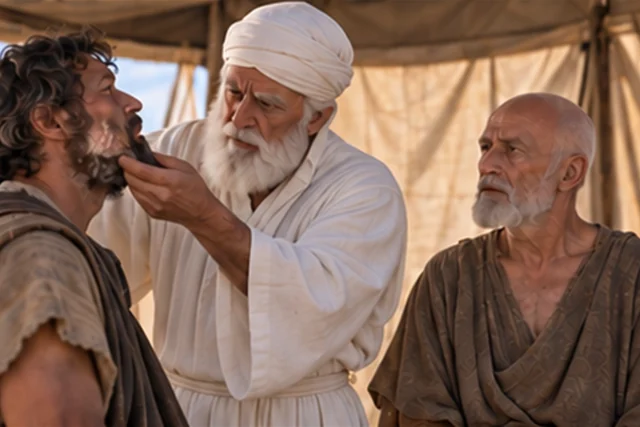
Head and beard conditions bring hair into the examination in a different way. Thin yellow hair can support a verdict of uncleanness, while later black hair can indicate healing. Where the evidence remains uncertain, the affected area is preserved for inspection while surrounding hair is shaved and another waiting period follows. Then Leviticus goes out of its way to clear ordinary appearances that might otherwise attract suspicion. Certain pale spots are clean. A man whose hair falls out is bald, “yet is he clean.” A receding hairline receives the same plain verdict. Only when the specified reddish-white sore appears in the bald area does the more serious classification return. This is one of the chapter’s sharpest reminders that priestly discrimination is not synonymous with exclusion. The priest must know how to identify the concerning condition, but he must also know when visible difference is simply an ordinary human feature.
Deep dive
Hair becomes especially important when the affected area is the head or beard. Thin yellow hair and the appearance of the lesion inform the initial assessment; the later growth of black hair is identified as a sign of healing. Shaving around, but not over, the affected area makes subsequent inspection possible. The details belong to observation, not to an invented moral meaning assigned to each hair color.
The chapter then deliberately clears two appearances that might otherwise invite suspicion. Certain white spots are clean, and ordinary loss of hair is clean. A receding hairline does not, by itself, require a priestly verdict against its owner. The law becomes restrictive only when the specified reddish-white condition appears in the bald area. This is one of the chapter’s most concrete examples of discrimination doing something other than excluding. The priest must be able to say that a visible difference is not the condition under examination. The lengthy list includes authorization to leave an unaffected person’s ordinary life alone.
Words to trace: priest, scall, skin, bald, head, clean
Verse-by-verse path
- Leviticus 13:29
A man or woman: the first time the chapter names women explicitly. The head and the beard are hairy places where the earlier sign of whitening hair cannot work the same way, so a separate procedure is needed.
- Leviticus 13:30
A dry scall is netheq, from a verb meaning to tear out or pull away, probably a condition that makes hair fall out in patches. Scall was a common English word for scabby disease of the scalp. The warning sign changes: thin yellow hair, where the skin cases looked for white.
- Leviticus 13:31
No black hair in it: the Hebrew text here reads black, which puzzles many commentators, since yellow was the sign in verse 30. Some suggest the text originally read yellow. The King James follows the Hebrew as it stands, and the procedure is the usual seven days.
- Leviticus 13:32
Three conditions must be met at the seventh day: not spread, no yellow hair, not deeper than the skin. It is the most thorough checklist in the chapter so far, laid out before the procedure unique to hair that follows in the next verse.
- Leviticus 13:33
He shall be shaven, but the scall shall he not shave. The hair around the patch is removed so its edges can be seen clearly next time, while the patch itself keeps its hair for inspection. It is a practical measure that makes the second look reliable.
- Leviticus 13:34
After two weeks, the patch that has neither spread nor sunk is declared clean. The ending repeats verse 6 exactly, wash his clothes and be clean, the same two steps back into ordinary life whatever part of the body was under suspicion.
- Leviticus 13:35
The warning of verse 7 returns for the scalp. After his cleansing means after the verdict of verse 34. A spreading patch after a clean ruling sends the person back, and the ruling is reopened.
- Leviticus 13:36
The priest shall not seek for yellow hair: once spreading is seen, the other sign becomes irrelevant. The instruction limits the inspection; he is not to go hunting for secondary evidence when the decisive sign is already in front of him.
- Leviticus 13:37
Black hair grown up in the patch is the sign of healing. The priest here records a recovery that has already happened, the scall is healed, before he pronounces anything. His word follows the body; it does not cause the cure.
- Leviticus 13:38
Bright spots, even white bright spots: the doubled phrase stresses how pale they look. A new category, again for a man or a woman, and the kind of pale blotch that would have made any neighbour anxious.
- Leviticus 13:39
Darkish white means dull, not glossy. A freckled spot is bohaq, a word that survives in Arabic as the name of a harmless skin whitening. Groweth in the skin describes something that simply blooms there, and the verdict is brief: he is clean.
- Leviticus 13:40
The man whose hair is fallen off is qereach, bald at the back or crown. Yet is he clean. Elisha was mocked as a bald head in 2 Kings 2:23, but baldness itself is given no ritual meaning here at all.
- Leviticus 13:41
Forehead bald is gibbeach, a receding hairline at the front of the head. Hebrew has a separate word for each kind of baldness, and both are covered so that neither could be mistaken for a sign of disease.
- Leviticus 13:42
A white reddish sore in the bald patch changes the case. The chapter’s phrase for pinkish white returns from verse 19. Sprung up is the verb parach again, breaking out like a blossom, used also in verse 20 and here applied to scalp that has no hair left to judge by.
- Leviticus 13:43
As the leprosy appeareth in the skin of the flesh: the bald scalp is judged like ordinary skin, since without hair the signs of verses 30 to 37 cannot apply. Rising is se’eth, the swelling of verse 2, so the chapter ties its end back to its beginning.
- Leviticus 13:44
Utterly unclean is the Hebrew doubled verb, tamme’ yetamme’enu, he shall surely pronounce him unclean. His plague is in his head is literally on his head, and the phrase is formal, stating where the condition lies as the last line of the diagnostic section.
Leviticus 13:29-44
King James Version29If a man or woman have a plague upon the head or the beard;
30Then the priest shall see the plague: and, behold, if it be in sight deeper than the skin; and there be in it a yellow thin hair; then the priest shall pronounce him unclean: it is a dry scall, even a leprosy upon the head or beard.
31And if the priest look on the plague of the scall, and, behold, it be not in sight deeper than the skin, and that there is no black hair in it; then the priest shall shut up him that hath the plague of the scall seven days:
32And in the seventh day the priest shall look on the plague: and, behold, if the scall spread not, and there be in it no yellow hair, and the scall be not in sight deeper than the skin;
33He shall be shaven, but the scall shall he not shave; and the priest shall shut up him that hath the scall seven days more:
34And in the seventh day the priest shall look on the scall: and, behold, if the scall be not spread in the skin, nor be in sight deeper than the skin; then the priest shall pronounce him clean: and he shall wash his clothes, and be clean.
35But if the scall spread much in the skin after his cleansing;
36Then the priest shall look on him: and, behold, if the scall be spread in the skin, the priest shall not seek for yellow hair; he is unclean.
37But if the scall be in his sight at a stay, and that there is black hair grown up therein; the scall is healed, he is clean: and the priest shall pronounce him clean.
38If a man also or a woman have in the skin of their flesh bright spots, even white bright spots;
39Then the priest shall look: and, behold, if the bright spots in the skin of their flesh be darkish white; it is a freckled spot that groweth in the skin; he is clean.
40And the man whose hair is fallen off his head, he is bald; yet is he clean.
41And he that hath his hair fallen off from the part of his head toward his face, he is forehead bald: yet is he clean.
42And if there be in the bald head, or bald forehead, a white reddish sore; it is a leprosy sprung up in his bald head, or his bald forehead.
43Then the priest shall look upon it: and, behold, if the rising of the sore be white reddish in his bald head, or in his bald forehead, as the leprosy appeareth in the skin of the flesh;
44He is a leprous man, he is unclean: the priest shall pronounce him utterly unclean; his plague is in his head.
Leviticus 13:45-46
The Verdict Has a Public Cost
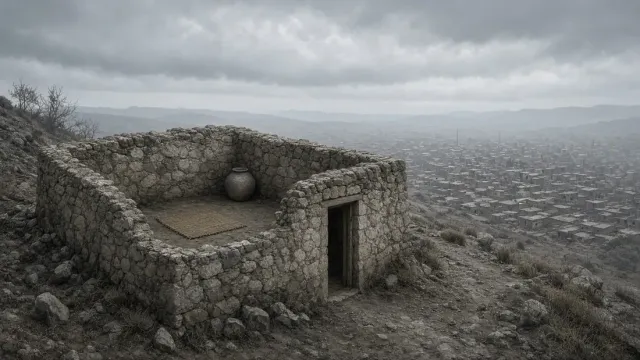
Once a person is pronounced unclean in this condition, the ruling becomes public and costly. Torn clothing, an uncovered head, a covering over the upper lip, and the cry “Unclean, unclean” make the status visible to others. The person then lives outside the camp for as long as the condition remains. Leviticus does not reduce this to a private label in a priestly ledger. The verdict alters clothing, speech, residence, and social proximity. Yet the passage does not identify a particular personal sin as the cause of the affliction, nor does it offer a psychological portrait of the person who must live apart. The stated burden is enough. The separation is real and potentially prolonged. That is why the next chapter’s movement matters so much: restoration begins when the priest goes outside the camp to inspect someone whose condition has healed. Exclusion is severe, but it is not written as irreversible.
Deep dive
The torn clothes, uncovered head, covered upper lip, and announcement of uncleanness make the condition publicly recognizable. Torn garments and an uncovered head were forbidden to Aaron and his remaining sons during their service in chapter 10; here comparable gestures are required. The same outward action can have a different significance according to a person’s situation within the sanctuary’s order.
The dwelling outside the camp gives the ruling a substantial social consequence. This is more than a label entered in a record. The person’s place within the community changes for as long as the condition persists. Yet these verses do not name a particular sin as its cause, and they do not give a psychological portrait of the afflicted person. The account’s own weight lies in the stated separation. Chapter 14 will address the movement back, including the important fact that the priest must go outside the camp to examine someone whose condition has healed.
Words to trace: unclean, plague, bare, camp, clothes, covering
Verse-by-verse path
- Leviticus 13:45
Four public signs: torn clothes, uncovered or unkempt hair, a hand over the upper lip, and the cry. The covering of the lip is a gesture of mourning (Ezekiel 24:17, Micah 3:7). Lamentations 4:15 turns the cry around, as passers-by shout Depart ye; it is unclean at Jerusalem’s own people.
- Leviticus 13:46
He shall dwell alone uses the same word, badad, as Balaam’s description of Israel in Numbers 23:9, a people that shall dwell alone. King Uzziah lived out his days in a several house (2 Chronicles 26:21), and in Luke 17:12 ten lepers stood afar off from Jesus.
Leviticus 13:45-46
King James Version45And the leper in whom the plague is, his clothes shall be rent, and his head bare, and he shall put a covering upon his upper lip, and shall cry, Unclean, unclean.
46All the days wherein the plague shall be in him he shall be defiled; he is unclean: he shall dwell alone; without the camp shall his habitation be.
Leviticus 13:47-59
Even Cloth Can Require Another Inspection
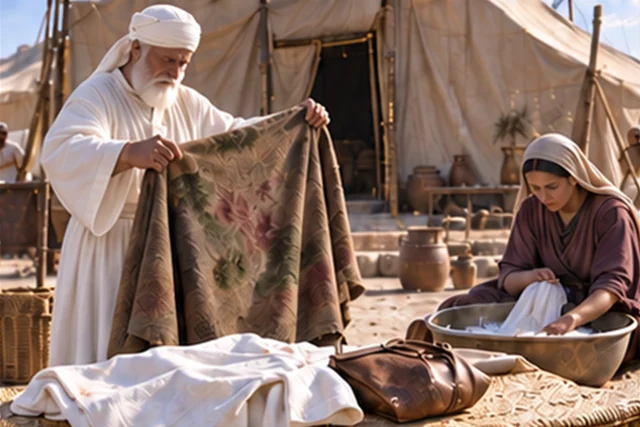
The same broad affliction category now reaches wool, linen, woven material, leather, and objects made from skin. That alone shows why the KJV’s “leprosy” cannot be reduced to one modern human disease throughout the chapter. Greenish or reddish marks are inspected, isolated, washed, and checked again for spread or persistence. The response is graduated. An affected section may be torn out, an article may be washed again and pronounced clean, or persistent damage may require the whole thing to be burned. Leviticus does not identify the material phenomenon with laboratory precision, and modern proposals such as mould remain proposals rather than statements in the text. What the chapter gives is a disciplined sequence of observation and response. Cloth is not destroyed at the first suspicion, but neither is recurring damage ignored. The priest’s task still ends in one of two clear judgments: clean or unclean.
Deep dive
The same category of affliction is now applied to garments and leather, confirming that the KJV’s "leprosy" cannot be read as one modern human disease throughout the chapter. The text names greenish or reddish appearances and follows whether the mark spreads. Its identification in modern material terms is uncertain; mould or fungal damage is often proposed, but Leviticus gives observable signs and procedures rather than a laboratory diagnosis.
The response is graduated. An article may be shut up for inspection, washed, examined again, or have an affected portion torn out. Burning is required where the condition persists or recurs under the stated criteria. The possibility of washing and a clean verdict remains present beside the possibility of destruction. This closing section extends the priest’s work from bodies to the materials of daily life without making the treatment of cloth a model for the treatment of people. A garment may be burned; the human regulations have prescribed examination, separation, and the possibility of return.
Words to trace: plague, garment, skin, warp, woof, thing
Verse-by-verse path
- Leviticus 13:47
Woollen or linen are the two cloths of ancient Israel, one from the flocks and one from the flax fields. The same word, nega‘, used for a stroke on the skin, is now applied to a garment, which shows the Hebrew category is wider than any disease.
- Leviticus 13:48
Warp and woof are the two sets of threads in woven cloth: the warp stretched lengthwise on the loom, the woof passed across it. Some think the Hebrew here refers to spun yarn not yet woven. Either way the law reaches down to the threads themselves.
- Leviticus 13:49
Greenish and reddish are both doubled colour words in Hebrew, yeraqraq and adamdam, meaning a tinge rather than the full colour. Yeraqraq is the word Psalm 68:13 uses for the sheen of gold on a dove’s feathers. The object is shown to the priest as a person would be.
- Leviticus 13:50
The priest shuts up the garment for seven days, the same verb and the same period as for a person in verse 4. The article is set aside and watched as though it were under the same kind of observation.
- Leviticus 13:51
Fretting leprosy is tsara‘ath mam’ereth, a malignant or painful affliction, from a root used in Ezekiel 28:24 of a pricking brier. Fretting in 1611 meant eating or gnawing away, as moth frets a garment. Spreading after a week is the sign here, as with skin.
- Leviticus 13:52
He shall therefore burn that garment. The verb for burn is saraph, the complete destruction used for the remains of the sin offering outside the camp (4:12). Cloth cannot be sent outside the camp to wait for healing as a person can, so fire takes the place of separation.
- Leviticus 13:53
If the mark has not spread, burning is not the next step. The chapter allows the article the same benefit of doubt a person received in verses 4 and 5, and the verses that follow describe a second chance.
- Leviticus 13:54
The priest commands, but others do the washing: they wash the thing. His role is to direct and to look, not to handle. Another seven days follows, so the garment faces the same fourteen-day course of watching as a person with a doubtful spot.
- Leviticus 13:55
Fret inward is pechetheth, a hollow or an eaten-out place. Bare within or without uses the very words for bald at the back and bald in front, qarachath and gabbachath, from verses 40 to 42. The worn place on cloth is described like a bald patch.
- Leviticus 13:56
If the mark has faded after washing, the affected piece is torn out and the rest kept. Rend it out uses the verb qara‘, the same verb as the torn clothes of the leper in verse 45, now applied to cutting away the damaged section.
- Leviticus 13:57
A spreading plague is poracheth, breaking out or blossoming, the verb used of the skin in verses 20 and 42. If the mark returns in the remaining cloth, repair has failed, and the whole article goes into the fire.
- Leviticus 13:58
Washed the second time: a single wash put the garment under watch in verse 54, and a second wash, once the mark has gone, restores it. Two washings, a week apart, bring the cloth back into use as clean.
- Leviticus 13:59
The closing formula names the task in two infinitives, to pronounce it clean, or to pronounce it unclean. The verdict of clean comes first in the Hebrew, though the chapter has spent more words on uncleanness. Chapter 14 turns to the ritual for someone who has been healed.
Leviticus 13:47-59
King James Version47The garment also that the plague of leprosy is in, whether it be a woollen garment, or a linen garment;
48Whether it be in the warp, or woof; of linen, or of woollen; whether in a skin, or in any thing made of skin;
49And if the plague be greenish or reddish in the garment, or in the skin, either in the warp, or in the woof, or in any thing of skin; it is a plague of leprosy, and shall be shewed unto the priest:
50And the priest shall look upon the plague, and shut up it that hath the plague seven days:
51And he shall look on the plague on the seventh day: if the plague be spread in the garment, either in the warp, or in the woof, or in a skin, or in any work that is made of skin; the plague is a fretting leprosy; it is unclean.
52He shall therefore burn that garment, whether warp or woof, in woollen or in linen, or any thing of skin, wherein the plague is: for it is a fretting leprosy; it shall be burnt in the fire.
53And if the priest shall look, and, behold, the plague be not spread in the garment, either in the warp, or in the woof, or in any thing of skin;
54Then the priest shall command that they wash the thing wherein the plague is, and he shall shut it up seven days more:
55And the priest shall look on the plague, after that it is washed: and, behold, if the plague have not changed his colour, and the plague be not spread; it is unclean; thou shalt burn it in the fire; it is fret inward, whether it be bare within or without.
56And if the priest look, and, behold, the plague be somewhat dark after the washing of it; then he shall rend it out of the garment, or out of the skin, or out of the warp, or out of the woof:
57And if it appear still in the garment, either in the warp, or in the woof, or in any thing of skin; it is a spreading plague: thou shalt burn that wherein the plague is with fire.
58And the garment, either warp, or woof, or whatsoever thing of skin it be, which thou shalt wash, if the plague be departed from them, then it shall be washed the second time, and shall be clean.
59This is the law of the plague of leprosy in a garment of woollen or linen, either in the warp, or woof, or any thing of skins, to pronounce it clean, or to pronounce it unclean.
Questions to keep in mind while reading
- Identify the people addressed and the covenant setting.
- Distinguish rescue, worship, holiness, justice, and community responsibility.
- Read commands in their literary and covenant context before making a modern application.
Text first
Where readers differ
The chapter summary begins with what the passage says and how its parts fit together. It does not assume one denomination has already settled every question. Where a conclusion depends on a tradition, literary theory, or historical reconstruction, that dependence is named openly.
The KJV text is presented first. Interpretive conclusions are labeled, and differences are introduced only when they help a reader understand why serious communities do not always reach the same answer.
Comparative interpretive notes for this chapter are in preparation. Until reviewed notes are ready, this page separates the KJV text from summary and application without claiming that serious readers agree on every question.
Questions beneath the surface
- What account of God, human freedom, responsibility, and the good life emerges from Leviticus 13?
- Which tension does the chapter refuse to resolve quickly?
- What changes when the chapter is read as part of the whole canon rather than as an isolated moral lesson?
- Where might a sincere reader confuse a familiar tradition with something the text states directly?
Questions for serious personal contemplation
These open-ended questions make room for tension, honest response, prayer, and conclusions that remain accountable to the chapter.
Observe without rushing
What part of Leviticus 13 makes you stop, feel unsettled, or feel surprised, and why?
Which detail in the passage would be easiest to overlook? How does that detail change your understanding?
Where do you see tension between what happens and this focus: Leviticus 13 develops its own movement around priest, plague, skin, leprosy, unclean?
What important question does the passage leave open instead of resolving quickly?
Examine your inner life honestly
Which person, response, fear, or desire in the passage feels most like your own life right now?
What assumption about God, other people, or yourself does this text challenge?
Which part would you rather soften, avoid, or explain away too quickly? What might that reaction reveal?
If this Scripture could ask you one direct question, what do you think it would ask?
Respond with wisdom and courage
What do you need to remember, confess, grieve, thank God for, or trust after reading this passage?
How might another faithful person read this situation differently without ignoring the text?
What obedient response would be costly, uncomfortable, or slow, yet still faithful to Scripture?
What question will you carry into prayer this week, and which verses will you keep in front of you?
Music and video connected to the passage
Related media appears when its Scripture reference overlaps this study. Music and video can illuminate a theme while the biblical text remains the foundation.