

The big picture
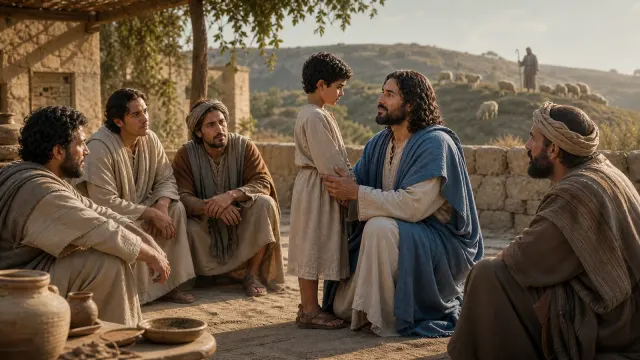
A question about greatness is answered by placing a child in the middle of the disciples’ argument. The Book of Matthew shifts attention from rank to humility, reception, and the severe responsibility not to make vulnerable believers stumble. The concern narrows further to one straying sheep, whose absence is not treated as a rounding error in a flock of one hundred. That same recovery logic shapes correction within the community: the first conversation is private, the circle widens only when necessary, and the stated aim is to “gain” the brother rather than to win a public quarrel. Peter’s attempt to put a number on forgiveness then opens into a parable of wildly unequal debts. A servant receives cancellation of an obligation he could never realistically repay, then seizes a fellow servant over a far smaller debt. The chapter makes mercy received and mercy withheld impossible to separate. Greatness is measured downward, toward the child, the straying one, the offending brother, and the debtor asking for patience.
Central truth
Jesus answers the disciples’ contest over greatness by requiring humility, care for vulnerable and wandering people, patient pursuit of reconciliation, and forgiveness shaped by the mercy already received.

The study notes have a page of their own
The movement by movement analysis, the words to trace, the verse by verse notes and where readers differ are written for someone studying alone. They are on the Deep Personal Reflections page for this chapter. This page is the lesson.
A chapter-specific teaching brief
These anchors come from this chapter itself. They help a teacher use the Level 1 overview, the Level 2 study, and the Scripture text as one lesson.
Open with the chapter’s first image
Matthew 18:1: “At the same time came the disciples unto Jesus, saying, Who is the greatest in the kingdom of heaven?”
Slow down at the turning point
Matthew 18:16: “But if he will not hear thee, then take with thee one or two more, that in the mouth of two or three witnesses every word may be established.”
Keep this word trail visible
heaven, little, lord, brother, Father, hear
What to explain, in order
Teach the passage in this order. Each step names the verses it rests on, so every point can be shown in the text before it is applied.
Matthew 18:1-5
The child in the middle
Open with the disciples' question about greatness, and notice that it comes right after Jesus has spoken again of his death (17:22-23). Then the action: Jesus calls a child and places him in the midst. Explain "converted" here as turned around, a change of direction, not a change of religion. The child stands for a person without status who receives rather than earns. Teach this first because the whole chapter is about how the community treats its least members, and Jesus sets one of them at the centre before he says a word about rules.
Matthew 18:6-10
Do not make the little ones fall
Explain "offend" throughout this paragraph as to cause to stumble, the same word as in 16:23. The little ones are now believers who are vulnerable, whether children or the weak in faith. The millstone is the heavy upper stone of a mill, drawn by a donkey; Jesus pictures a man drowned under it. Then the hand, foot and eye: say plainly these are figures of speech for removing whatever leads into sin, and that the church has never read them as commands to injure the body. Close with 18:10 and the Father's attention to the small.
Matthew 18:11-14
One sheep is worth the search
Read the parable of the lost sheep in this setting: the straying one is one of the little ones of verse 6. Note that verse 11, "For the Son of man is come to save that which was lost", stands in the page's Bible and is not printed in many modern versions; read it, and do not make the lesson depend on it. The shepherd goes "into the mountains", which is costly and risky. Put the weight on verse 14: the Father wills that none of these perish. This step bridges warning and restoration, because the shepherd's search is the model for verses 15-17.
Matthew 18:15-20
Gaining a brother
Teach the steps in order and keep repeating their aim: to gain the brother. Explain "trespass" as sin, a real wrong, not a mere annoyance. Witnesses come from Deuteronomy 19:15 and protect both sides from false accusation. "The church" here means the local gathering of disciples. Explain heathen and publican as outsiders, and remind the class how Jesus treated publicans. Then binding and loosing (compare 16:19) and the promise of his presence among two or three. Say clearly that this is a path for ordinary sin between believers, and that abuse or crime must be reported to proper authorities, not kept private.
Matthew 18:21-22
How often must I forgive
Peter thinks he is being generous with seven times; some teachers of his day said three. Jesus answers "Until seventy times seven", which is not a ledger of four hundred and ninety but a way of saying forgiveness is not counted. Some hear an echo of Lamech's boast of seventy and sevenfold vengeance in Genesis 4:24, reversed. Teach this as the question the parable answers. Make clear that forgiving is not the same as pretending no wrong was done, nor the same as trusting again at once.
Matthew 18:23-35
The servant who would not forgive
Tell the parable in three scenes: the king and the huge debt, the servant and the small one, the king again. Explain the money: a talent was a vast sum, often reckoned at many years of a labourer's wages, so ten thousand of them is beyond counting; a penny was a day's wage. The servant's plea and his fellow's plea are identical, which is the sting. Close on 18:35 without softening it: the Father will do likewise to those who forgive not "from your hearts". Explain the tormentors as jailers, and keep the focus on the mercy that should have changed him.
Where learners get stuck
The misreadings this passage tends to produce, and how to answer each from the text.
"Jesus says children are innocent, so we should be like them by being naive."
Jesus names the quality he means: "Whosoever therefore shall humble himself as this little child" (18:4). It is lowliness, not innocence or naivety. Elsewhere he tells the disciples to be "wise as serpents, and harmless as doves" (10:16). The child shows a person with no claim to rank, who receives the kingdom as a gift. That is the turning of 18:3.
"Forgiving seventy times seven means I must let someone keep hurting me and stay quiet."
Forgiveness in 18:21-35 is releasing a debt from the heart, not allowing a wrong to continue. The same chapter tells the wronged person to go and tell the brother "his fault" (18:15), to bring witnesses and to tell the church, and the opening warning in 18:6 is fierce against anyone who harms little ones. A person in danger should seek safety and help. Forgiveness and protection belong together in this chapter.
"Where two or three are gathered means God only hears prayer when two people pray together."
Jesus taught private prayer in 6:6, "pray to thy Father which is in secret". The promise of 18:19-20 belongs to a paragraph about two or three witnesses and the church deciding a hard case, and it assures them that Jesus is present in their decision. It is a comfort for small gatherings, not a rule that solitary prayer goes unheard.
"The parable means God's forgiveness can be lost if I slip up once."
The servant is not condemned for one lapse. He received mercy beyond measure and then refused any mercy at all, seizing his fellow "by the throat" (18:28). The warning of 18:35 is against a heart that will not forgive. Teach it seriously, as Jesus does, and teach that a person who struggles to forgive and brings that struggle to God is not the man in the parable.
Learning objectives
- Explain the child’s role in Jesus’ answer about greatness.
- Identify the seriousness of causing little ones to stumble.
- Connect the wandering sheep with the Father’s concern.
- Trace the stated stages of addressing a brother’s offence.
- Read the two-or-three promise within its surrounding instructions.
- Explain the debt contrast in the unforgiving servant parable.
Teacher preparation
- Read Matthew 18:1–35; connect the greatness question with humility, protection, restoration, and forgiveness.
- Gloss converted as turned, offend as cause to stumble, and talents and pence as different monetary units.
- Prepare a debt comparison without assigning exact modern currency equivalents; the first servant cannot pay, and the difference is enormous.
- Explain the hand-and-eye warnings as forceful imagery, never instructions for self-injury or punishment of another person.
- Set a safeguarding boundary: private correction must not be used to silence reports of abuse or require unsafe confrontation.
Evidence and interpretation checks
Explicit
Locate humility, concern for the wandering one, gaining a brother, and forgiveness from the heart in Matthew 18:4, 14–15, and 35.
Scripture-supported
Compare Matthew 18:16 with Deuteronomy 19:15; multiple witnesses establish the matter rather than merely increasing pressure on the accused.
Strong inference
Read Matthew 18:12–17 together; infer that the pursuit of a wandering sheep and the pursuit of a brother share a restorative concern.
Possible or traditional reading
Present individual guardian-angel readings of Matthew 18:10 as traditional interpretations; the verse does not explain a one-angel-per-person assignment.
Limit
State that Matthew 18:15–35 is not a complete safeguarding procedure and does not define forgiveness as pretending harm never occurred.
Discussion with answer guidance
1. What does placing a child among the disciples answer about greatness?
What a good answer contains
The disciples ask "Who is the greatest" and Jesus answers by setting a child "in the midst of them" (18:1-2). The child is not praised for being sinless or sweet; the point is stated in 18:4: "Whosoever therefore shall humble himself as this little child, the same is greatest". A child in that world had no rank and no claim. Verse 3 goes further: without that turning, they "shall not enter" at all. A good answer says greatness is measured by lowliness, and adds verse 5, that receiving such a child receives Jesus. A weak answer turns the scene into a remark about children being cute.
Show teacher guidance
Read 18:1–5: Jesus specifies humbling oneself. Do not substitute an idealized claim that children never sin or simply say that the youngest person should hold authority.
2. Why are the warnings about little ones and stumbling so severe?
What a good answer contains
Because the little ones "believe in me" (18:6) and are precious to the Father. To "offend" them is to make them stumble and fall away, not to hurt their feelings. The millstone image says that drowning would be better than doing it. Verses 8-9 turn the same severity inward: cut off whatever makes you stumble, because "everlasting fire" is worse. Verse 10 gives the reason not to despise them: "in heaven their angels do always behold the face of my Father". A good answer reads the hand and eye sayings as a figure for radical seriousness, never as instructions for self-harm.
Show teacher guidance
Use 18:6–10 to identify the responsibility not to cause vulnerable believers to fall. Distinguish stumbling from minor annoyance, and reject literal injury as the intended classroom application.
3. What does the one wandering sheep reveal about the Father’s concern?
What a good answer contains
The shepherd leaves the ninety and nine and goes into the mountains after the one "gone astray" (18:12), and when he finds it "he rejoiceth more of that sheep" (18:13). Jesus draws the meaning plainly: "it is not the will of your Father which is in heaven, that one of these little ones should perish" (18:14). A good answer says the Father's attention goes to the one in danger, and that this sets the pattern for how the disciples should treat the straying. A weak answer worries about the ninety-nine left behind, which the parable does not address.
Show teacher guidance
Read 18:12–14: the search and joy focus on the endangered one. Do not infer that the ninety-nine become worthless or turn the illustration into a complete livestock-management plan.
4. What is the goal of the escalating conversation in verses 15–17?
What a good answer contains
The goal is stated in the first step: "if he shall hear thee, thou hast gained thy brother" (18:15). The process begins privately, "between thee and him alone", widens only if needed to "one or two more" (18:16), and reaches "the church" only after that (18:17). A good answer sees restoration, not punishment, as the aim at every stage, and notes that treating someone as "an heathen man and a publican" still leaves them as people Jesus seeks (9:10-13). A weak answer uses the passage to justify gossip or public shaming, or to keep a victim of abuse silent.
Show teacher guidance
Begin with gaining the brother, then trace private speech, witnesses, and the church. Distinguish accountable restoration from gossip, humiliation, or an unsafe demand for secrecy.
5. Why should verses 19–20 be read beside the witnesses and community decisions?
What a good answer contains
Because they close the paragraph on church discipline, and "two or three" picks up "two or three witnesses" from 18:16. The promise that "there am I in the midst of them" (18:20) assures a small gathered community making a hard decision that Jesus stands with them, and 18:18 says their binding and loosing is ratified in heaven. A good answer keeps that setting while still allowing the wider comfort of Jesus' presence with any small gathering in his name. A weak answer turns 18:19 into a formula: find one person to agree and anything will be granted.
Show teacher guidance
Notice their setting in 18:15–20 and Jesus’ presence among those gathered in his name. Do not turn two agreeing people into a mechanism guaranteeing any desired outcome.
6. What makes the forgiven servant’s treatment of his fellowservant so appalling?
What a good answer contains
The debt he was forgiven was ten thousand talents (18:24), a sum no servant could ever repay; his fellowservant owed him "an hundred pence" (18:28), a few months' wages. He begged "Have patience with me, and I will pay thee all" and was forgiven the whole debt; he hears the very same words from his fellow and still throws him in prison (18:29-30). His lord's question is the heart of it: "Shouldest not thou also have had compassion on thy fellowservant, even as I had pity on thee?" (18:33). A good answer keeps the warning of 18:35 and the phrase "from your hearts".
Show teacher guidance
Compare 18:24–33: an unpayable debt is cancelled, yet he refuses the same plea for patience over a much smaller debt. Keep the master’s serious final warning in 18:34–35.
Responsible application
Heart and habits
Ask learners to explain why a fictional forgiven debtor’s mercy should change his treatment of another debtor, without requiring anyone to name a grievance.
Relationships and community
Draft a safe response to an invented ordinary disagreement using witnesses and restoration, clearly separating this exercise from handling abuse.
Notice the missing person
Design a fictional group’s caring response when someone withdraws, without treating pursuit as permission to disregard boundaries.
Session plans
Two timings of the same lesson. The shorter keeps the reading, the central discussion and one response; the longer gives the confusions and the application their own time.
45 minutes
Who is greatest
Read 18:1-5. Take question one and confusion one. Ask what the child had that the disciples lacked.
Stumbling blocks
Read 18:6-10 and take question two. Say plainly that the hand and eye sayings are figures of speech.
The lost sheep
Read 18:11-14 and take question three.
Gaining a brother
Read 18:15-20. Draw the steps as a widening circle. Take questions four and five, then confusion three.
Seventy times seven
Read 18:21-35 as one scene. Take question six and confusions two and four.
Handout
Read the key verse together and pray silently for one person each learner needs to forgive.
90 minutes
Opening
Ask how a group usually decides who matters most. Then read 17:22-23 and 18:1 to show what the disciples were discussing.
The child
Read 18:1-5. Take question one and confusion one. Compare 19:13-15 briefly.
Little ones and stumbling
Read 18:6-10. Take question two. Ask what in a church could cause a young believer to fall away.
The shepherd
Read 18:11-14 with Ezekiel 34:11-16. Take question three.
Restoration in steps
Read 18:15-20 with Deuteronomy 19:15. Take questions four and five and confusion three. State clearly how abuse is handled differently.
Forgiveness without counting
Read 18:21-35. Act out the two pleas side by side. Take question six and confusions two and four.
Application
In pairs, use the application on noticing the missing person, and plan one way to seek out someone who has drifted.
Handout and prayer
Read the key verse and pray the Lord's Prayer line from 6:12 together.
Adapting the lesson
Children
Have a child stand in the middle while you read 18:2, and tell them Jesus thinks children matter very much. Hide a toy sheep and let them search for it, then read 18:14. Tell the servant parable with two piles of paper, one huge and one tiny. Leave out the millstone and the cutting off of hands, and tell them to always speak to a trusted adult if anyone hurts them.
Youth
Ask who is invisible in their school or group, then read 18:10. Let them work through the steps of 18:15-17 using an invented disagreement and see how much gossip it rules out. Be explicit that this pattern does not apply to abuse or danger. Use the parable to talk about grudges they are carrying, without asking them to name anyone.
Adults
Spend real time on 18:15-20, since adults run churches and families and often skip the private first step. Make the distinction between ordinary sin and abuse unmistakable, including the duty to report. On forgiveness, give space for those deeply wronged and separate forgiveness from reconciliation and from trust. Ask what the ten thousand talents mean for how they see their own debts.
One to one
If the person is struggling to forgive, read 18:27 first, the mercy they have received, before 18:35. Ask whether there is anyone they are avoiding the private conversation of 18:15 with, and whether it is safe to have it. If they have been harmed, say clearly that forgiving does not mean returning to danger, and help them find support.
Song and video learning lab
A song or video may interpret, compress, or dramatize the text. Its value becomes clearer when its choices are compared with Scripture.
- Before the media: the exact passage and its central movement.
- During the media: the words, people, events, and emotions the artist emphasizes.
- After the media: what it clarifies, what it leaves out, and what belongs back in the biblical text.
Handout
One page for learners to take home. The print button prints this section alone.
Matthew 18
The passage in brief
The disciples ask who is greatest, and Jesus sets a child among them: whoever humbles himself like this child is greatest. He warns sternly against causing his little ones to stumble and tells of a shepherd who leaves ninety-nine sheep to find one. He teaches how to go to a brother who has sinned, aiming to win him back, and promises to be present where two or three gather in his name. When Peter asks how often to forgive, Jesus tells of a servant forgiven a huge debt who refused to forgive a small one.
A verse to keep
Shouldest not thou also have had compassion on thy fellowservant, even as I had pity on thee?
Matthew 18:33 · King James Version
Questions to take home
What does Jesus say makes someone greatest in 18:4?
What is the goal of going to a brother alone in 18:15?
How does the size of the two debts in 18:24 and 18:28 help you understand forgiveness?
This week
Thank God this week for one specific thing he has forgiven you, before you think about anyone who has wronged you.
Music and video connected to the passage
Related media appears when its Scripture reference overlaps this study. Music and video can illuminate a theme while the biblical text remains the foundation.
 The Debt He Would Not ForgiveMatthew 18:21-35Listen to related music →Before the Cock CrowMatthew 26:47-75; Mark 14:43-72; Luke 22:47-62; John 18:1-27Listen to related music →
 Behold the ManMatthew 27:1-31; Mark 15:1-20; Luke 22:63-23:25; John 18:28-19:16Listen to related music →
 Matthew, Part TwoMatthew 14:1-28:20Listen to related music →