Objects of the Bible

The linen cloths

Two men looked at the same folded cloth and one of them believed because of how it was lying.

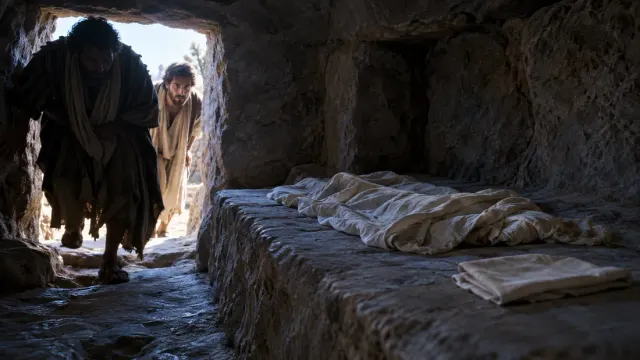
John reports the footrace and loses it, and then reports what each man saw in the order they saw it. He stoops down and looks in without entering: he saw the linen clothes lying. Peter arrives behind him and goes straight in, and sees more: the linen clothes lie, and the napkin, that was about his head, not lying with the linen clothes, but wrapped together in a place by itself. Then the other disciple goes in, and saw, and believed.

Where it appearsJohn 20 · Luke 24 · John 11

Scroll down to the account
The linen cloths

The movements, in the order the text gives them.

The Account of The linen cloths

  1. 01

    John 20:3-5

    He stooping down, and looking in, saw the linen clothes

    The younger man arrives first and stops at the entrance, and the account gives no reason for the hesitation.

    Arriving first does not mean entering first. The other disciple outruns Peter, reaches the tomb, and stops short of going inside. The Book of John is remarkably particular about the difference. It records the running, the order of arrival, and the bending down, but does not explain the pause. Reverence, fear, and deference to Peter are possible suggestions, not information supplied by the verse.

    The linen is the first specific thing this disciple is reported seeing inside the tomb. That detail links the morning directly to the burial in John 19:40, where Joseph and Nicodemus wound Jesus' body in linen with the spices. Something belonging to that burial remains visible, although the person buried is absent. The cloth is therefore not decorative scenery added around a general declaration that the tomb was empty. It is an observed remnant of what happened to a particular body. The approach has been urgent; the first sight is quiet. After all that running, the account rests on cloth lying still.

    Verse by verse

    1. 20:4

      The other disciple is identified in John 20:2 as the disciple whom Jesus loved. His personal name is not supplied in this passage.

    2. 20:5

      John records that he did not enter at first, but does not state why. The linen connects the scene with the burial described in 19:40.
    John 20:3-5

    King James Version · 3 verses

    20:3Peter therefore went forth, and that other disciple, and came to the sepulchre.

    20:4So they ran both together: and the other disciple did outrun Peter, and came first to the sepulchre.

    20:5And he stooping down, and looking in, saw the linen clothes lying; yet went he not in.

    John 20:3-5: He stooping down, and looking in, saw the linen clothes
  2. 02

    John 20:6-7

    Wrapped together in a place by itself

    The detail that convinces is a tidiness. Nothing about the scene reads as a robbery or a removal.

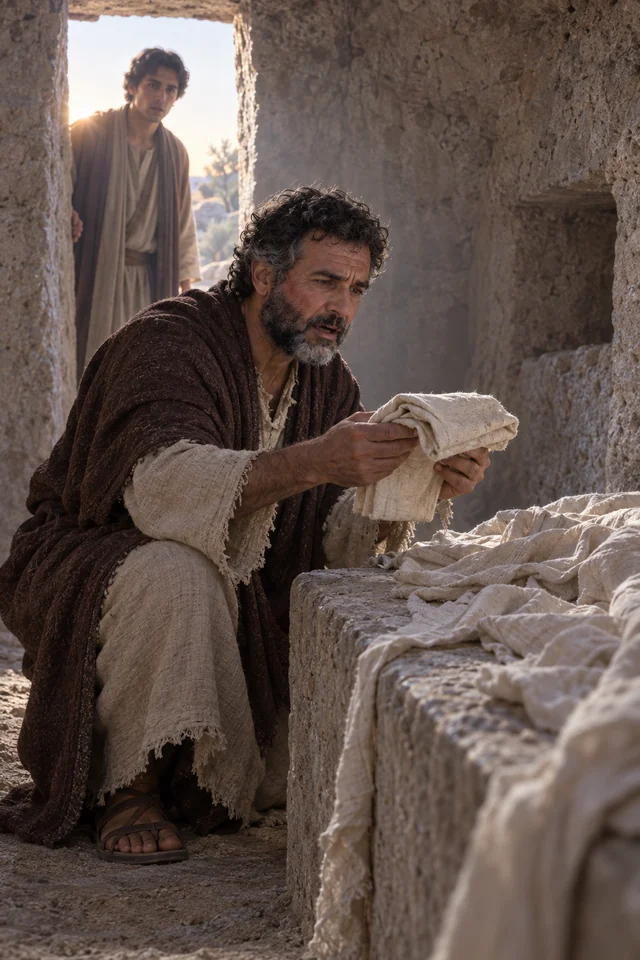
    The headcloth gets its own location. Peter sees the linen wrappings, then the cloth that had been about Jesus' head, separate from them and wrapped together. The distinction is small enough to be overlooked and deliberate enough to deserve attention. John does not simply report discarded burial materials; he distinguishes one piece from the others and records where it was not lying.

    Napkin here means a cloth used around the head, not evidence that a dining custom is being reenacted. The passage gives no table setting, no signal between master and servant, and no explanation that a particular fold announces a return. Nor does it identify who arranged the cloth or describe the body's passage through the wrappings. Those additions can sound wonderfully definite while outrunning the evidence. The actual detail is both more restrained and more substantial: the material used in burial remains available for inspection, and the headcloth is separately located. The body has not been found. The burial cloths have.

    Verse by verse

    1. 20:7

      Soudarion, translated napkin, is a Latin-derived word for a cloth or handkerchief. Here its stated use is around Jesus' head.

    2. 20:7

      In a place by itself distinguishes the headcloth from the other linen. The distance between them and the person who arranged it are not specified.

    John 20:6-7

    King James Version · 2 verses

    20:6Then cometh Simon Peter following him, and went into the sepulchre, and seeth the linen clothes lie,

    20:7And the napkin, that was about his head, not lying with the linen clothes, but wrapped together in a place by itself.

    John 20:6-7: Wrapped together in a place by itself
  3. 03

    John 20:8

    He saw, and believed

    The belief is dated precisely and attributed to the sight rather than to a word, which the next verse underlines.

    The first man to reach the tomb is now the second to enter it, and the new word is believed. Speed has occupied several lines; the inward response receives four words: he saw, and believed. There is no recorded speech from the disciple and no inventory of deductions. The Book of John gives this response far more weight than space.

    Read as recognition of the resurrection, the sentence places belief before an encounter with the risen Jesus and before the scriptural understanding mentioned in verse 9. That is a striking sequence. It is not, however, the only reading Christians have given it, because the verb does not explicitly say what the disciple believed. Augustine understood it as belief in Mary's report that the body had been removed. The distinction deserves acknowledgment without letting the debate swallow the scene. John joins seeing and believing, but does not state that a particular fold alone caused belief or reproduce the disciple's reasoning. The visible objects are described closely. The response is stated briefly. A small sentence carries the turn.

    Verse by verse

    1. 20:8

      Believed has no explicit object in this sentence. Its relation to Mary's report in 20:2 and the statement in 20:9 has produced differing interpretations.

    2. 20:8

      The other disciple sees inside the tomb before the risen Jesus appears to Mary in 20:14-16. This verse records no spoken confession.

    John 20:8

    King James Version · 1 verse

    20:8Then went in also that other disciple, which came first to the sepulchre, and he saw, and believed.

    John 20:8: He saw, and believed
  4. 04

    John 20:9

    As yet they knew not the scripture

    The Book of John admits they had not worked it out from the text, which makes the evidence do all of the work.

    Must is the arresting word. The disciples' unfinished understanding concerns not merely an extraordinary event, but the scriptural necessity that Jesus rise from the dead. A missing body can be investigated as a discovery; the claim that resurrection belongs to God's declared purpose requires another kind of understanding. John keeps those questions related without pretending that they were grasped all at once.

    As yet matters just as much. This is a description of an early limit, not a permanent verdict on the disciples or a claim that Scripture had nothing to say. The Book of John does not place their later understanding into their mouths before they possessed it. Nor does this verse identify a single Old Testament passage as the explanation they lacked. It states the substance rather than supplying a quotation. The linen can show what has been left in the tomb; it cannot itself pronounce the word must. For that, the account directs attention beyond the burial materials to the Scripture they had not yet understood.

    Verse by verse

    1. 20:9

      The Greek dei means it is necessary or must. The verse presents resurrection as scriptural necessity, not simply an unexpected possibility.

    2. 20:9

      The scripture is not identified by a quotation here. Assigning this sentence to one specific Old Testament verse remains an interpretive proposal.

    John 20:9

    King James Version · 1 verse

    20:9For as yet they knew not the scripture, that he must rise again from the dead.

    John 20:9: As yet they knew not the scripture
  5. 05

    John 11:43-44

    Bound hand and foot with graveclothes

    The earlier raising ends with a man needing to be unwrapped, which is precisely what the tomb in John 20 does not show.

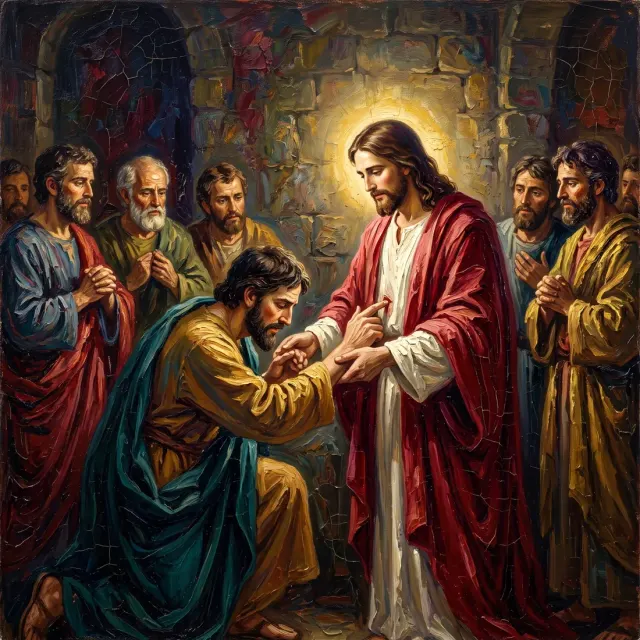
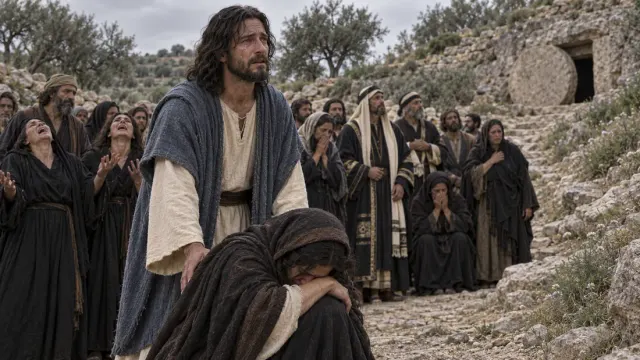
    Lazarus is alive, but he is still dressed for burial. The graveclothes have not vanished with the restoration of life, and the cloth remains around his face. The Book of John makes the contrast almost painfully physical: the man who was dead has come out, yet the arrangements made for his death are still binding his hands and feet.

    Two commands frame the emergence. The first is addressed to Lazarus and summons him out; the second is addressed to the people nearby and tells them to release him. Those present do not perform the life-giving act, but there is ordinary work for their hands once he is before them. John does not explain the mechanics of his movement while bound, and an invented demonstration would add less than it promised. The comparison with John 20 is stronger without it. Lazarus emerges carrying his burial wrappings and needs others to remove them. At Jesus' tomb, the visitors find the wrappings without the body. In one scene, the cloth comes out with the man. In the other, it stays behind.

    Verse by verse

    1. 11:43

      Jesus calls Lazarus by name. The verse does not explain the naming by claiming that otherwise every dead person would have emerged.

    2. 11:44

      The command to unbind Lazarus is addressed to those nearby. John describes the bindings but does not explain how he moved while wearing them.

    John 11:43-44

    King James Version · 2 verses

    11:43And when he thus had spoken, he cried with a loud voice, Lazarus, come forth.

    11:44And he that was dead came forth, bound hand and foot with graveclothes: and his face was bound about with a napkin. Jesus saith unto them, Loose him, and let him go.

    John 11:43-44: Bound hand and foot with graveclothes

Why it matters

What is being described is an absence of disturbance. Grave robbers do not unwrap a body, and they certainly do not fold the head cloth and set it aside. The account is careful to note that this happened before they understood anything: for as yet they knew not the scripture, that he must rise again from the dead. The belief comes from the arrangement of cloth on a shelf and not from an argument. The contrast is with Lazarus, who came out of his tomb still bound hand and foot and needed other people to free him.

2 songs

The music

Every song in the catalogue whose passage falls inside these chapters.

  1. John 11:1-46

    Lazarus, Come Forth

  2. John 20:1-31

    These Are Written That Ye Might Believe

    Play here
    Open song pageRead lyrics

Nearby

All the objects

Report an error on this page