Objects of the Bible

The mantle of Elijah

A working coat thrown over a man ploughing, and the only thing left on the ground afterwards.

It is a rough garment, probably of hair, the sort a prophet was known by. Elijah uses it three times and never explains it. The first time he does not even stop walking: he passed by him, and cast his mantle upon him. Elisha is ploughing with twelve yoke of oxen when this happens, which tells you he is a wealthy man, and the response is to burn the plough, boil the oxen on the fire and feed the people before leaving.

Where it appears1 Kings 19 · 2 Kings 2

Scroll down to the account
The mantle of Elijah

The movements, in the order the text gives them.

The Account of The mantle of Elijah

  1. 01

    1 Kings 19:19

    He cast his mantle upon him

    The call is a gesture and nothing else. No sentence is recorded, and the man is at work with twelve yoke of oxen when it happens.

    The mantle has just covered Elijah's face before it falls across another man's shoulders. At Horeb, in verse 13, Elijah wraps himself in it as he approaches the divine voice. In the field, the same garment makes a public claim on Elisha. A piece of clothing carries the connection between the encounter on the mountain and the work appointed there.

    There is no recorded speech in this verse. Elijah passes, throws the mantle, and keeps moving far enough for Elisha to run after him. The gesture is not unexplained within the chapter: God has already named Elisha as the prophet who will stand in Elijah's place. The field scene gives that command a physical form.

    Twelve yoke of oxen make this a substantial agricultural setting, though the verse does not itemize ownership or income. Elisha is with the twelfth team, working rather than waiting for a ceremony. The interruption therefore has a real location and a real occupation to interrupt. The call does not arrive in a palace or at a prepared platform. It lands on a man behind a pair of oxen.

    Verse by verse

    1. 19:19

      A yoke is a pair of working oxen; twelve yoke describes twelve pairs, with Elisha at the twelfth.

    2. 19:19

      The gesture follows the instruction in 1 Kings 19:16 to appoint Elisha as prophet in Elijah's place.

    3. 19:19

      The passage does not record oil being poured over Elisha here, despite the earlier command using the language of anointing.
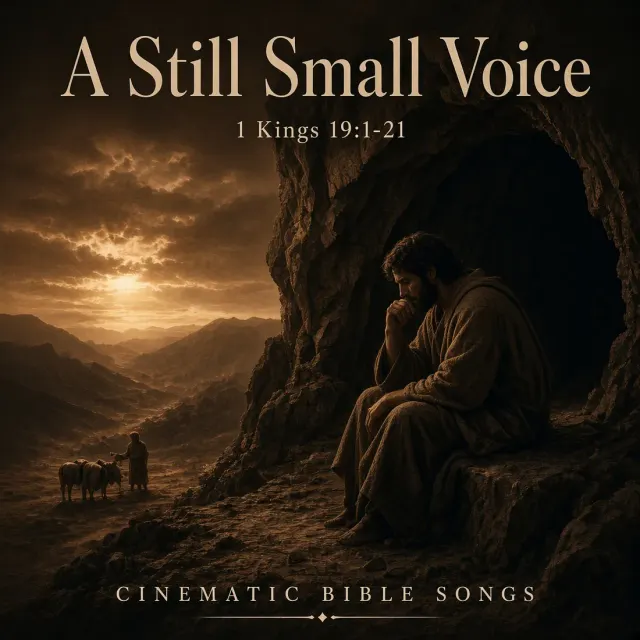
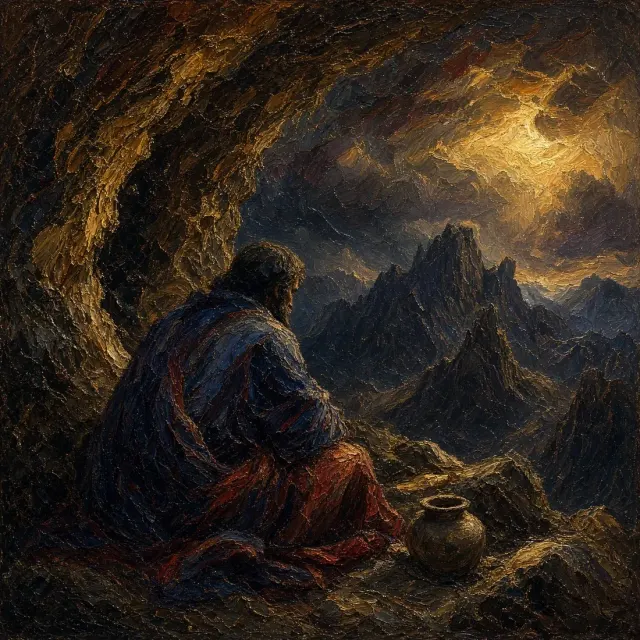
    1 Kings 19:19

    King James Version · 1 verse

    19:19So he departed thence, and found Elisha the son of Shaphat, who was plowing with twelve yoke of oxen before him, and he with the twelfth: and Elijah passed by him, and cast his mantle upon him.

    1 Kings 19:19: He cast his mantle upon him
  2. 02

    1 Kings 19:20-21

    He slew them, and boiled their flesh

    The reply is to destroy the equipment and cook the livestock for the neighbours, which leaves nothing to come back to.

    The farming equipment becomes fuel for cooking the farming animals. That is a farewell with very little room for pretending that nothing has changed. Elisha does not merely leave a tool beside the field; the implements help prepare the meal by which his departure is marked. The text specifies one yoke, not the destruction of all twelve teams.

    There is generosity in the stated action: he gives the food to the people, and they eat. There is also finality in what has been consumed. Both observations come from the meal itself, without needing an invented speech about burning every bridge. His request to kiss his parents acknowledges the household he is leaving; the passage does not present affection for them as disobedience.

    Then comes the deliberately modest description of his new position: ministered unto him. The mantle has signaled a prophetic future, but the next named work is service to Elijah. Second Kings 3:11 later remembers Elisha as the man who poured water on Elijah's hands. He does not exchange the plough for immediate prominence. He exchanges one kind of work for another.

    Verse by verse

    1. 19:20

      Elijah's reply is read either as permission with a reminder of the call or as a sharper challenge. The next verse records Elisha returning briefly and then following.

    2. 19:21

      Instruments of the oxen refers to their working equipment, used here in preparing the meal.

    3. 19:21

      Ministered means served or attended. The later description in 2 Kings 3:11 makes that service concrete.

    1 Kings 19:20-21

    King James Version · 2 verses

    19:20And he left the oxen, and ran after Elijah, and said, Let me, I pray thee, kiss my father and my mother, and then I will follow thee. And he said unto him, Go back again: for what have I done to thee?

    19:21And he returned back from him, and took a yoke of oxen, and slew them, and boiled their flesh with the instruments of the oxen, and gave unto the people, and they did eat. Then he arose, and went after Elijah, and ministered unto him.

    1 Kings 19:20-21: He slew them, and boiled their flesh
  3. 03

    2 Kings 2:8

    He wrapped it together, and smote the waters

    The mantle is used as a tool, and the crossing repeats a crossing the reader already knows from Joshua.

    Elijah folds his coat before striking a river with it. The physical action is almost plain enough to pass unnoticed, until the Jordan divides. The garment is not replaced by a more impressive instrument for the occasion. The mantle already associated with the prophet's calling becomes the object in his hand at the crossing.

    Dry ground is the phrase that gives the scene its wider resonance. Israel crossed the sea on dry ground in Exodus 14, and crossed this river on dry ground in Joshua 3. Second Kings places Elijah and Elisha within that same history of a passage made where water had stood. The company is now only two men, but the echo is unmistakable.

    The verse keeps saying they two. The crossing is shared; Elisha does not stand on the bank receiving a description of what Elijah can do. He passes through the opened way beside him. Fifty prophetic associates watch from a distance in the preceding verse, but the two men are together at the water. The mantle marks authority without making that authority a spectacle performed merely for the spectators.

    Verse by verse

    1. 2:8

      Wrapped it together describes folding or rolling the mantle before the blow.

    2. 2:8

      Hither and thither means to one side and the other; the wording describes a divided passage.

    3. 2:8

      Dry ground explicitly links the crossing in its wording to the earlier passages through the sea and the Jordan.

    2 Kings 2:8

    King James Version · 1 verse

    2:8And Elijah took his mantle, and wrapped it together, and smote the waters, and they were divided hither and thither, so that they two went over on dry ground.

    2 Kings 2:8: He wrapped it together, and smote the waters
  4. 04

    2 Kings 2:13-14

    Where is the LORD God of Elijah

    The successor picks up the coat and asks a question instead of announcing an office, and the answer comes in the water.

    Elisha has torn his own clothes, but he does not tear Elijah's mantle. The preceding verse records the first action; this passage records the second garment being taken up. Loss and succession stand side by side in cloth. Grief is not denied, and the work is not buried with the absent master.

    At the bank, Elisha names the LORD God of Elijah. His appeal does not ask where the garment's secret power has gone. The mantle is in his hand; the decisive question concerns the God who acted through its former wearer. That distinction prevents the object from swallowing the meaning of the passage.

    The water divides again, with the same hither and thither used when Elijah struck it. The repetition answers the appeal through an event rather than an explanatory speech. One man crosses back where two had crossed outward, yet the divine action is not diminished by the change of prophet. Elisha receives no new mantle with his own name on it. He takes up what fell, stands at the same river, and finds that Elijah's departure has not made Elijah's God absent.

    Verse by verse

    1. 2:13

      Fell from him connects the mantle directly to Elijah's departure; Elisha picks it up rather than receiving it in a recorded handover.

    2. 2:14

      Elisha invokes the LORD God of Elijah, not Elijah himself.

    3. 2:14

      The repeated division of the Jordan supplies the immediate evidence that the prophetic work continues through Elisha.

    2 Kings 2:13-14

    King James Version · 2 verses

    2:13He took up also the mantle of Elijah that fell from him, and went back, and stood by the bank of Jordan;

    2:14And he took the mantle of Elijah that fell from him, and smote the waters, and said, Where is the LORD God of Elijah? and when he also had smitten the waters, they parted hither and thither: and Elisha went over.

    2 Kings 2:13-14: Where is the LORD God of Elijah
  5. 05

    2 Kings 2:15

    The spirit of Elijah doth rest on Elisha

    The verdict is delivered by onlookers at a distance, based on a river rather than on a title.

    The observers identify the spirit, not merely the coat. A familiar garment could have been carried home as a keepsake; the opened Jordan is another matter. Their declaration follows the crossing and interprets what they have seen: the spirit of Elijah rests on Elisha. The visible object is important, but the sentence refuses to make it sufficient by itself.

    The movement of the observers also changes. They had stood at a distance; now they come to meet him and bow. The recognition is public. Elisha does not need to announce his own promotion before the group that knew his master. The event at the river has supplied the evidence.

    Yet the following verses do not turn these men into people who understand everything at once. They recognize Elisha and still insist on sending a search party for Elijah. Second Kings allows acknowledgment and incomplete understanding to occupy the same scene. That makes the declaration more exact, not less important. What they can affirm here is the continuation of prophetic authority. The mantle has reached another hand, and the community has seen more than a change of wardrobe.

    Verse by verse

    1. 2:15

      Sons of the prophets names a prophetic group or community; it does not require biological descent from prophets.

    2. 2:15

      Bowing to the ground here expresses recognition and honor. The verse does not call Elisha divine.

    3. 2:15

      The observers' subsequent request to search for Elijah appears in 2 Kings 2:16-18; recognition of Elisha does not erase that sequence.

    2 Kings 2:15

    King James Version · 1 verse

    2:15And when the sons of the prophets which were to view at Jericho saw him, they said, The spirit of Elijah doth rest on Elisha. And they came to meet him, and bowed themselves to the ground before him.

    2 Kings 2:15: The spirit of Elijah doth rest on Elisha

Why it matters

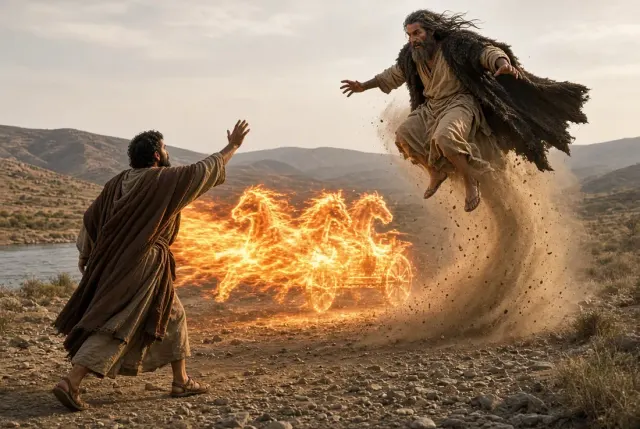
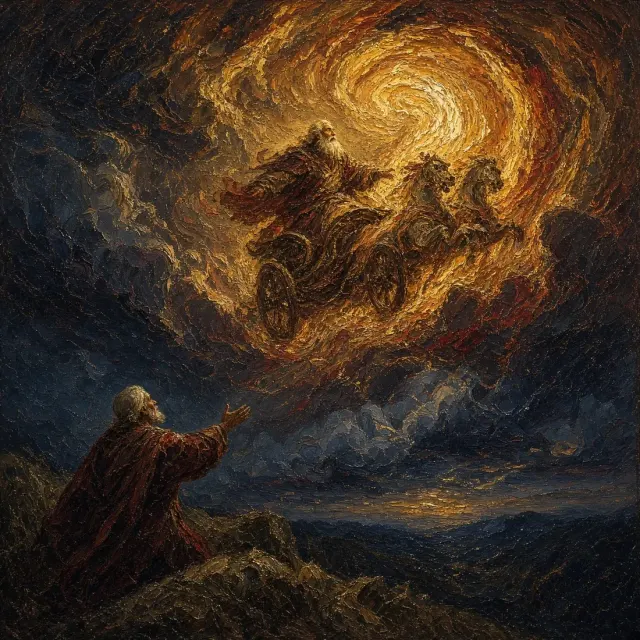
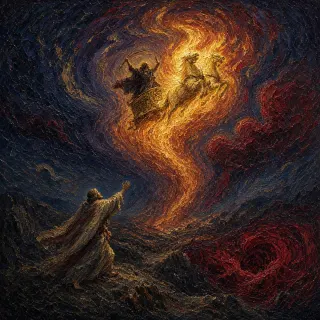
The second and third uses are a pair. Elijah wraps it together and strikes the Jordan and the water divides, and the two of them go over on dry ground. Then the chariot comes and Elijah is gone, and the mantle falls. Elisha picks it up, goes back to the bank, strikes the same water and asks a question rather than making a claim: where is the LORD God of Elijah. The water divides again. The sons of the prophets watching from Jericho draw the only conclusion available, and they draw it from the river rather than from the sky.

3 songs

The music

Every song in the catalogue whose passage falls inside these chapters.

  1. 1 Kings 19

    A Still Small Voice

  2. 2 Kings 1:1-2:18

    A Chariot of Fire

  3. 2 Kings 2

    The Chariot of Fire

Nearby

All the objects

Report an error on this page