Objects of the Bible

The seamless robe

Four soldiers, four shares, and one garment that could not be divided without ruining it.

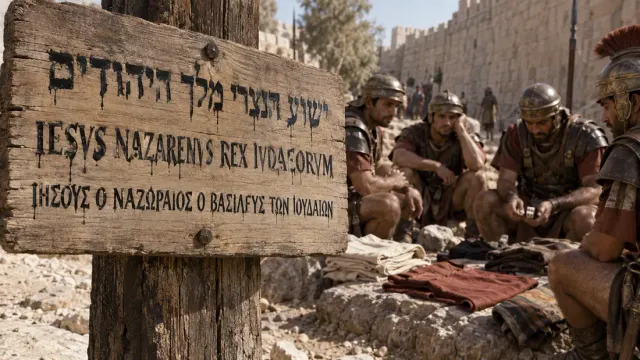
John is the only writer who explains the arithmetic. The soldiers, when they had crucified Jesus, took his garments, and made four parts, to every soldier a part; and also his coat. Executioners had a customary right to the clothing, and a man wore roughly five items, so four men and five garments divides cleanly until you reach the last one. Now the coat was without seam, woven from the top throughout. Cutting it into four would produce four pieces of cloth and no coat.

Where it appearsJohn 19 · Psalms 22

Scroll down to the account
The seamless robe

The movements, in the order the text gives them.

The Account of The seamless robe

  1. 01

    John 19:23

    To every soldier a part

    The distribution is described in the flat language of a property division, in the middle of the crucifixion narrative.

    Four shares. The number belongs to the clothes, but it also counts the men dividing them: to every soldier a part. The Book of John brings the execution down to the level of an allocation of property. Jesus has not yet died, and his belongings are already being distributed as though their owner has no further claim. The brutality is not confined to the nails. It includes the ordinary business conducted beneath them.

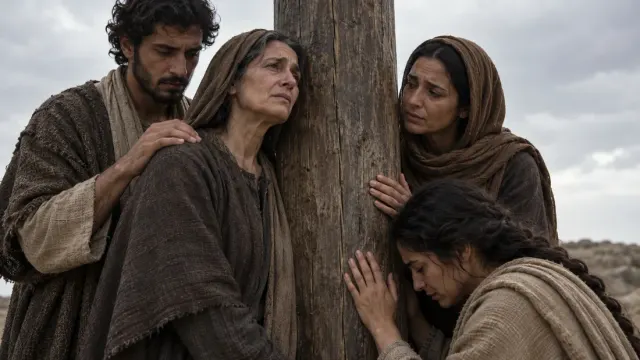
    The verse distinguishes the garments divided among the soldiers from the tunic considered separately. It does not provide a complete wardrobe inventory, and four parts does not necessarily mean four named items. That restraint matters. The details actually given are sharp enough: four recipients, divided clothing, and one garment left intact for a different means of assignment. Immediately afterward, John places Jesus' mother and the other women beside the cross. Property is being apportioned in one sentence; human relationships remain painfully present in the next.

    Verse by verse

    1. 19:23

      Four portions, one for each soldier, indicates four participants in this distribution. It does not count every soldier present at the execution.

    2. 19:23

      The verse does not identify each item in the four shares or give the names of the soldiers receiving them.
    John 19:23

    King James Version · 1 verse

    19:23Then the soldiers, when they had crucified Jesus, took his garments, and made four parts, to every soldier a part; and also his coat: now the coat was without seam, woven from the top throughout.

    John 19:23: To every soldier a part
  2. 02

    John 19:23

    Without seam, woven from the top throughout

    One line of technical description about weaving, which is the only detail given about anything he wore.

    The construction of the tunic interrupts the account of the crucifixion. Without seam, woven from the top throughout. John spends words on how a garment is made because that physical detail explains what the soldiers do with it. A single woven piece cannot become four intact tunics. Their decision to keep it whole is grounded in the object in front of them, not in an announced reverence for its wearer.

    Later Christian readers found more in that wholeness, especially an image of the church's unity. Such readings belong to the garment's interpretive history, but they should not erase John's immediate connection between its construction and the casting of lots. Nor does the verse name its maker, price, color, or material. Mary is not identified as its weaver, and the garment is not explicitly called a priestly vestment. The contrast requires none of those additions. The tunic's fabric is preserved while the man who wore it remains exposed to execution.

    Verse by verse

    1. 19:23

      Arraphos means not sewn together, or seamless. It describes the garment's construction rather than naming a special kind of cloth.

    2. 19:23

      John does not state that only priests could wear such a tunic, or that Jesus' garment had been made by his mother.

    John 19:23

    King James Version · 1 verse

    19:23Then the soldiers, when they had crucified Jesus, took his garments, and made four parts, to every soldier a part; and also his coat: now the coat was without seam, woven from the top throughout.

    John 19:23: Without seam, woven from the top throughout
  3. 03

    John 19:24

    Let us not rend it, but cast lots for it

    The decision is made on practical grounds by men who had no idea they were completing a quotation.

    The soldiers reach an agreement about what must not be damaged. It is the tunic. Their stated proposal preserves the garment whole and settles ownership by lots, while the man to whom it belonged remains on the cross. The contrast does not require an invented conversation about money or a claim that the soldiers understood the garment symbolically. Their own words have already established what receives their practical attention.

    John then gives the action a second frame: the fulfillment of Scripture. The division of clothing and the casting of lots correspond to the two clauses quoted from Psalm 22:18. A choice made among the soldiers is also an event John locates within that scriptural pattern. Neither side of the sentence is canceled by the other. The soldiers make their proposal; the book identifies the fulfillment. These things therefore the soldiers did closes the paragraph without naming the winner. The preserved information is not who acquired a tunic, but what their handling of it fulfilled.

    Verse by verse

    1. 19:24

      The text says that lots determined ownership. It does not describe dice, their markings, or any wager beyond the assignment of the garment.

    2. 19:24

      The explicit Scripture quotation is Psalm 22:18. John does not report that the soldiers quoted the psalm themselves.

    John 19:24

    King James Version · 1 verse

    19:24They said therefore among themselves, Let us not rend it, but cast lots for it, whose it shall be: that the scripture might be fulfilled, which saith, They parted my raiment among them, and for my vesture they did cast lots. These things therefore the soldiers did.

    John 19:24: Let us not rend it, but cast lots for it
  4. 04

    Psalm 22:18

    They parted my garments among them

    Two actions in two lines, written a thousand years earlier, and both of them happen at the same execution.

    The sufferer is still speaking while other people distribute his clothes. That is the indignity inside this verse. His possessions have become available to others before his cry for help has ended. In the surrounding lines, enemies encircle him, his body is exposed, and their staring accompanies the division of his garments. This is not an isolated prediction floating free of human distress. It belongs to a prayer whose speaker is being stripped of protection and treated as already finished.

    John's quotation brings that whole setting of humiliation into contact with the crucifixion. The connection is specific enough to name both distribution and lots, but the psalm is larger than those two actions. It moves from abandonment and danger toward answered prayer, praise in the congregation, and worship among the nations. That movement should not be used to hurry past the nakedness and helplessness of verse 18. The later praise has weight because the earlier distress has not been made polite.

    Verse by verse

    1. 22:18

      Vesture means clothing or a garment. It is not the name of a separate ceremonial object.

    2. 22:18

      The two clauses stand within the same lament. John 19:24 explicitly identifies their fulfillment in the soldiers' actions.

    Psalm 22:18

    King James Version · 1 verse

    22:18They part my garments among them, and cast lots upon my vesture.

    Psalm 22:18: They parted my garments among them
  5. 05

    Psalm 22:16-17

    They pierced my hands and my feet

    The surrounding verses describe a form of execution that did not exist when the psalm was written.

    The body is surrounded, exposed, and watched. The dogs and the assembly of the wicked place the sufferer inside a ring of hostility, while hands, feet, and bones make the distress physical rather than abstract. I may tell all my bones uses tell in its older sense of count. The line is not a report of broken bones; it describes a body whose vulnerability is on display. They look and stare. The gaze itself belongs to the affliction.

    The KJV's pierced has a substantial textual discussion behind it, but that difficulty should neither be hidden nor allowed to swallow the passage. Whatever judgment is made among the ancient readings, the surrounding verses consistently depict a threatened, exposed sufferer. Christian interpretation reads these lines alongside the Gospel accounts of Jesus' crucifixion, where Psalm 22 is explicitly invoked elsewhere. The connection does not turn every poetic detail into a medical diagram. The psalm gives suffering a voice, and that voice includes the humiliation of being watched.

    Verse by verse

    1. 22:16

      The textual question concerns the phrase at hands and feet. The surrounding description of encirclement and hostility is not in dispute on that account.

    2. 22:17

      Tell means count here. The verse does not say that the bones were broken, nor does it supply a clinical description of the injuries.

    Psalm 22:16-17

    King James Version · 2 verses

    22:16For dogs have compassed me: the assembly of the wicked have inclosed me: they pierced my hands and my feet.

    22:17I may tell all my bones: they look and stare upon me.

    Psalm 22:16-17: They pierced my hands and my feet

Why it matters

So they gamble instead, and John quotes the psalm they are unknowingly acting out: they parted my raiment among them, and for my vesture they did cast lots. The psalm is a thousand years old and its two lines describe two different actions, division and gambling, which is exactly what happens at the foot of the cross for entirely practical reasons. The account does not press the point. It states what the soldiers said, what they did, and what had been written, and lets them sit next to each other.

2 songs

The music

Every song in the catalogue whose passage falls inside these chapters.

  1. John 19:1-37

    It is Finished

    Play here
    Open song pageRead lyrics
  2. Psalm 22:1-31

    You Did Not Hide Your Face

Nearby

All the objects

Report an error on this page