Objects of the Bible

The star

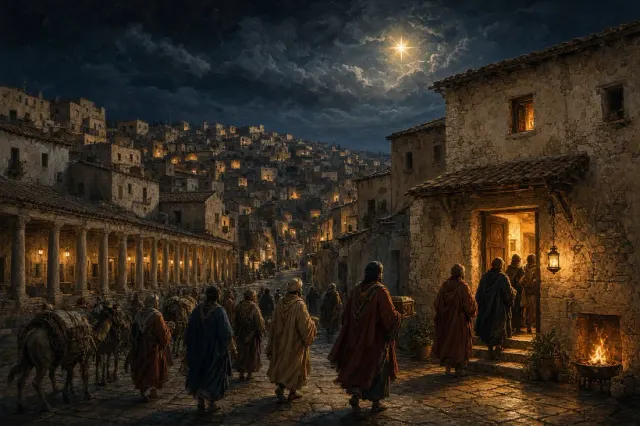
It got them to the right country and then stopped being useful, which is why they had to ask directions.

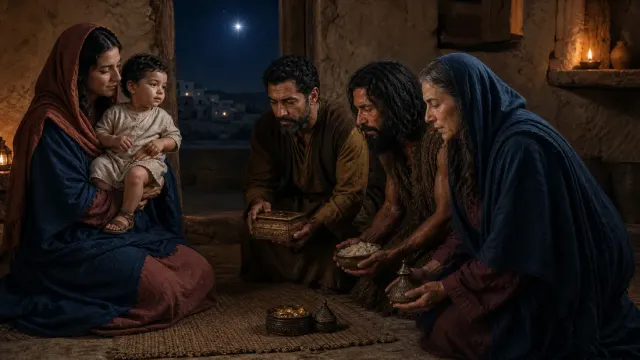
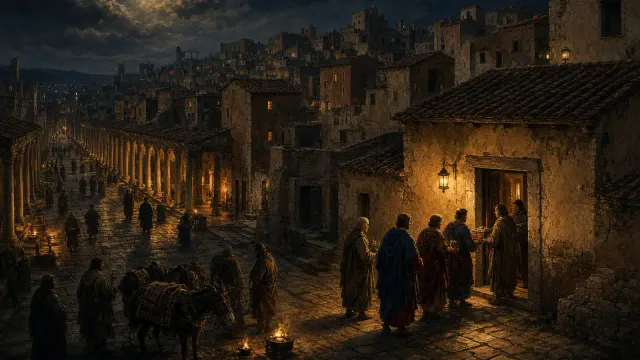
Matthew never says how many magi there were, never calls them kings, and never says they arrived at a stable. What he does say is that they came from the east to Jerusalem, which is the wrong city, and asked where is he that is born King of the Jews, for we have seen his star in the east, and are come to worship him. The sign got them to a nation. The address came from a scroll, read out by scribes who did not travel to see whether it was true.

Where it appearsMatthew 2

Scroll down to the account
The star

The movements, in the order the text gives them.

The Account of The star

  1. 01

    Matthew 2:1-2

    We have seen his star in the east

    Foreign astrologers read a sign correctly and arrive at the capital, which is a reasonable guess and the wrong one.

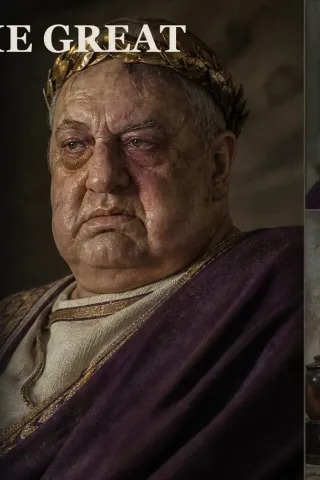
    The visitors ask where the king is, not whether there is one. Born King of the Jews is an awkward announcement to make in the days of Herod the king. Matthew places both titles within two verses, and the collision is already there before Herod says a word. One king occupies the capital. The other has to be found.

    The star gives the visitors a reason to travel, but their opening question shows that it has not supplied every detail. Matthew does not describe their route to Jerusalem or say that the star disappeared. Those familiar additions go beyond the passage. What the text does give is more interesting than a flawless set of directions: men arriving from outside Israel recognize a royal birth that the capital has not announced. Their knowledge is real and incomplete. They know whose star it is, and they know the purpose of their journey. The address still requires asking.

    Verse by verse

    1. 2:1

      Wise men translates magoi. Matthew supplies neither their number nor their names, and does not call them kings.

    2. 2:2

      Numbers 24:17 pairs a Star from Jacob with a Sceptre from Israel. It offers a royal scriptural echo, not proof that the visitors had read that passage.
    Matthew 2:1-2

    King James Version · 2 verses

    2:1Now when Jesus was born in Bethlehem of Judaea in the days of Herod the king, behold, there came wise men from the east to Jerusalem,

    2:2Saying, Where is he that is born King of the Jews? for we have seen his star in the east, and are come to worship him.

    Matthew 2:1-2: We have seen his star in the east
  2. 02

    Matthew 2:3-6

    All Jerusalem with him

    The scribes produce the right answer from Micah in a moment, and nobody in the room acts on it except the foreigners.

    Jerusalem can locate the promised ruler without celebrating his arrival. That is the uncomfortable distinction in these verses. The visitors bring a question, the king summons expertise, and the experts produce a place. Nobody has to excavate an obscure clue. Bethlehem is named plainly.

    Yet the atmosphere is trouble, not welcome. Matthew explicitly includes the city in Herod's disturbance without explaining every inhabitant's reason. It would be careless to assign one motive to them all. The sharper observation is the contrast itself: the place with the chief priests and scribes possesses the relevant text, while the visitors from the east are the ones described as seeking the child.

    The quotation also refuses to leave Bethlehem small. Its importance is measured by the ruler who comes from it, not by its standing beside Jerusalem. Herod has convened a consultation about a possible rival and received a description of the ruler of God's people. The answer is accurate. It is not reassuring.

    Verse by verse

    1. 2:3

      Troubled describes both Herod and Jerusalem. The verse does not say that every person was troubled for the same reason.

    2. 2:6

      The Greek verb behind rule is poimaino, to shepherd. Micah 5:4 also portrays the coming ruler feeding his people.

    Matthew 2:3-6

    King James Version · 4 verses

    2:3When Herod the king had heard these things, he was troubled, and all Jerusalem with him.

    2:4And when he had gathered all the chief priests and scribes of the people together, he demanded of them where Christ should be born.

    2:5And they said unto him, In Bethlehem of Judaea: for thus it is written by the prophet,

    2:6And thou Bethlehem, in the land of Juda, art not the least among the princes of Juda: for out of thee shall come a Governor, that shall rule my people Israel.

    Matthew 2:3-6: All Jerusalem with him
  3. 03

    Matthew 2:9

    The star went before them

    The guidance arrives late and locally, after the scroll has done the work of naming the town.

    The movement becomes precise here. The star goes before them, comes to the place, and stands over it. Matthew is no longer recording only a distant sighting connected with a royal birth. He describes guidance that ends where the child is.

    The king has sent the visitors to Bethlehem, but the sentence does not end with the king's information. It turns on and, lo, and the star takes the foreground. The written prophecy has supplied the town; the sign now accompanies the final approach. Those two forms of direction stand together rather than competing for the credit.

    The account names the destination with striking restraint: where the young child was. No measurements, brightness scale, or explanation of the heavens is supplied. Attempts to identify a comet or planetary conjunction have to address the movement described here, not just an impressive light at approximately the right date. Matthew's interest is exact but not astronomical. The sign reaches its destination when it reaches him.

    Verse by verse

    1. 2:9

      This is the first explicit statement that the star went before the visitors. Earlier verses report the sighting and the journey without describing continuous guidance.

    2. 2:9

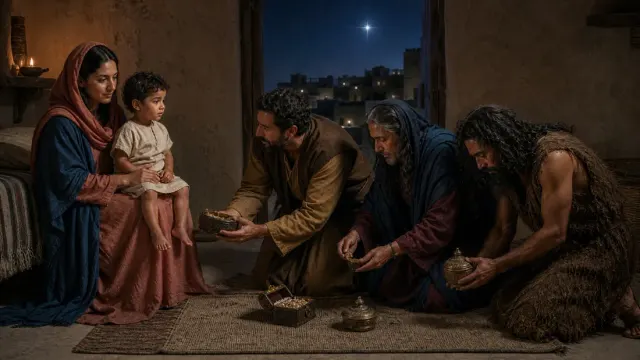
      The following scene identifies their destination as a house in 2:11. Matthew does not place this visit at a manger.

    Matthew 2:9

    King James Version · 1 verse

    2:9When they had heard the king, they departed; and, lo, the star, which they saw in the east, went before them, till it came and stood over where the young child was.

    Matthew 2:9: The star went before them
  4. 04

    Matthew 2:10

    They rejoiced with exceeding great joy

    The sentence is piled with intensifiers and it describes the reaction to the sign rather than to the child.

    Matthew spends an entire verse refusing to settle for glad. They rejoiced, with joy, great joy, exceedingly. The Greek piles up the expression, and the King James lets the pile stand. Exceeding great joy is not a decorative improvement added by the translators. The abundance belongs to the sentence.

    Its placement matters. The visitors have not yet entered the house or opened their treasures. Their joy answers the sight of the star, while the preceding scene in Jerusalem answered news of the birth with disturbance. Matthew names the reactions rather than leaving them to be imagined. The same child is at the center of both responses, but the responses could hardly be farther apart.

    There is no need to supply tears, cheering, or private speeches. The text has already raised its voice through repetition. These travelers, who began by asking for a location, now meet guidance described in unmistakably concrete terms. Before Matthew records their kneeling, he records their delight.

    Verse by verse

    1. 2:10

      The Greek expression combines the verb for rejoicing with the related noun joy, then adds great and exceedingly.

    2. 2:10

      The verse explicitly states joy. It does not explicitly say the star had vanished, so joy alone cannot establish a period of disappearance.

    Matthew 2:10

    King James Version · 1 verse

    2:10When they saw the star, they rejoiced with exceeding great joy.

    Matthew 2:10: They rejoiced with exceeding great joy
  5. 05

    Matthew 2:12

    They departed into their own country another way

    The last instruction comes in a dream and is purely practical. The visit ends with an evasion.

    The return journey has a new authority. Herod ordered the visitors to bring him information; God warns them not to return to him. The conflict is expressed through a road rather than a speech. They depart into their own country another way.

    That last phrase is geography before it is anything else. Matthew is not describing a newly adopted personality or giving a general formula for spiritual change. He records a route that prevents Herod from receiving the report he requested. His claim to want worshippers' directions is exposed by the danger named in the next verse: he intends to destroy the child.

    The star is not mentioned again in their departure. The account has moved from a sight in the heavens to Scripture cited in the capital, then to guidance outside it, and finally to a warning in sleep. The visitors are not restricted to a single kind of direction. Their last recorded action is also their answer to Herod. No report arrives.

    Verse by verse

    1. 2:12

      Another way specifies a different route home. The actual road and border crossing are not identified.

    2. 2:12

      Being warned of God translates a verb for receiving divine instruction. Matthew does not describe the imagery of the dream or quote its exact words.

    Matthew 2:12

    King James Version · 1 verse

    2:12And being warned of God in a dream that they should not return to Herod, they departed into their own country another way.

Why it matters

Then the star does something a star cannot do. It went before them, till it came and stood over where the young child was. Whatever the account means by that, it is used for the last two miles rather than the first thousand. And Matthew records their reaction before the arrival, not after it: when they saw the star, they rejoiced with exceeding great joy. The account of the visit is short, the gifts are listed in one verse, and the warning that turns them home by another way arrives in a dream.

2 songs

The music

Every song in the catalogue whose passage falls inside these chapters.

  1. Matthew 1-2; Luke 2:1-38

    Glory in the Highest

  2. Matthew 2:1-23

    The Star and the Sword

    Play here
    Open song pageRead lyrics

Nearby

All the objects

Report an error on this page