Objects of the Bible

The writing on the wall

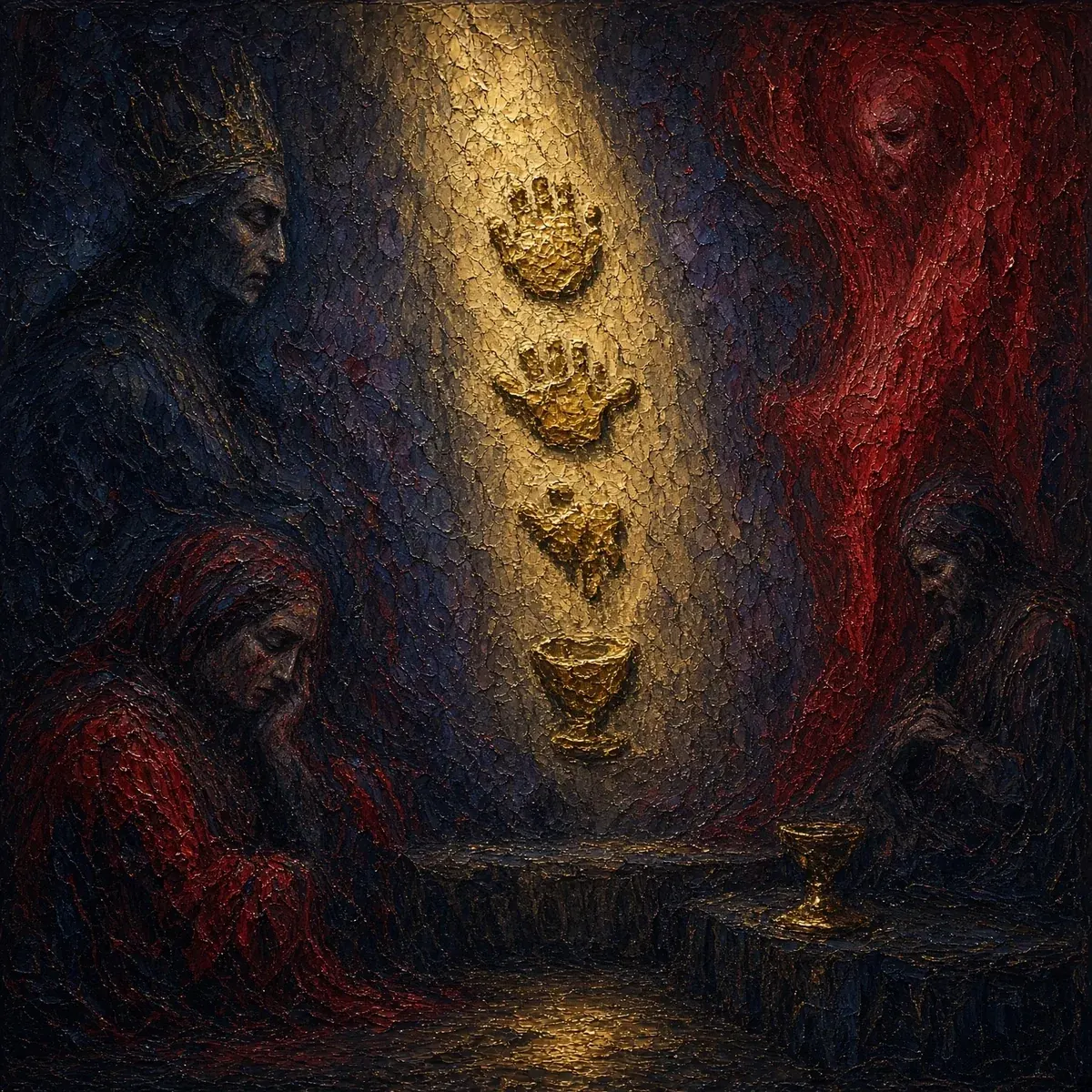
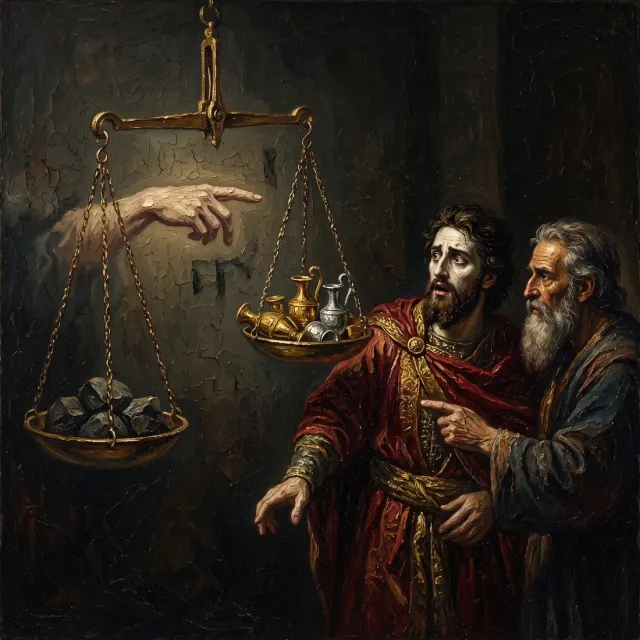
Three words and a repetition, written on plaster by a hand with nothing attached to it.

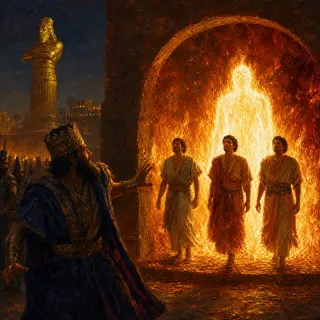
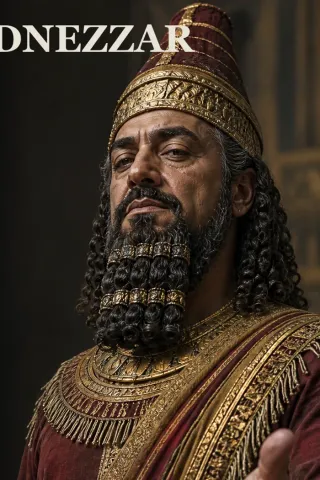
Belshazzar is holding a feast for a thousand of his lords while the Medes and Persians are outside the city. He sends for the vessels taken out of the temple at Jerusalem, so that the king, and his princes, his wives, and his concubines, might drink therein. They drink wine and praise the gods of gold, and of silver, of brass, of iron, of wood, and of stone. In the same hour came forth fingers of a man’s hand, and wrote over against the candlestick upon the plaister of the wall.

Where it appearsDaniel 5

Scroll down to the account
The writing on the wall

The movements, in the order the text gives them.

The Account of The writing on the wall

  1. 01

    Daniel 5:2-4

    They drank wine, and praised the gods of gold

    The sacrilege is deliberate and the account lists the metals, which is the same list the golden image belonged to.

    The cups arrive with their history attached. Twice in two verses the Book of Daniel identifies them with the temple at Jerusalem. These are not simply the expensive drinking vessels brought out for an important occasion. Their former use is the point of the present one. Belshazzar orders objects taken from the house of God into a banquet where other gods receive the praise.

    The opening of the book has already supplied a crucial distinction: the Lord gave Jerusalem's king and some of the temple vessels into Nebuchadnezzar's hand (1:2). Their capture was not proof that Babylon's gods had overpowered Israel's God. Now the captured vessels become instruments of a celebration that treats their divine owner as irrelevant. The metal has changed rooms, not masters.

    Gold and silver appear on both sides of the scene: in the vessels being handled and in the gods being honored. Brass, iron, wood, and stone complete the list. The wording keeps the material plainly visible beneath the religious acclaim. In verse 23 Daniel will name what these gods lack: sight, hearing, and knowledge. The banquet has plenty of precious metal. That is not the same as a living god.

    Verse by verse

    1. 5:2

      The vessels connect this feast with the opening seizure described in Daniel 1:2. Their origin, not merely their monetary value, makes their use significant.

    2. 5:2

      The passage identifies wine drinking but does not describe Belshazzar as unconscious of his actions. Daniel 5:22-23 specifically holds him responsible for what he knows and does.

    3. 5:4

      The six materials identify the objects receiving praise. Daniel 5:23 returns to this list and contrasts their inability to perceive with the God who holds the king's breath.

    Daniel 5:2-4

    King James Version · 3 verses

    5:2Belshazzar, whiles he tasted the wine, commanded to bring the golden and silver vessels which his father Nebuchadnezzar had taken out of the temple which was in Jerusalem; that the king, and his princes, his wives, and his concubines, might drink therein.

    5:3Then they brought the golden vessels that were taken out of the temple of the house of God which was at Jerusalem; and the king, and his princes, his wives, and his concubines, drank in them.

    5:4They drank wine, and praised the gods of gold, and of silver, of brass, of iron, of wood, and of stone.

    Daniel 5:2-4: They drank wine, and praised the gods of gold
  2. 02

    Daniel 5:5-6

    His knees smote one against another

    The reaction is described physically rather than emotionally, joint by joint, which is the most undignified sentence about any king in the book.

    The writing appears on the king's own wall, opposite the lampstand. The location matters: this is not a report carried in from some distant sanctuary. The intrusion occupies the royal room itself, on its plaster, within the king's sight. Fingers write, and the king sees part of a hand. No face, voice, or accompanying body is described. The Book of Daniel gives exactly enough to make the writing visible and refuses to furnish a whole apparition.

    Belshazzar's body supplies the response before anyone supplies an interpretation. His expression changes, his thoughts trouble him, his lower body gives way, and his knees strike together. None of that fear has to be imagined into the passage. It is already there, reported in a descending sequence from face to knees. The man whose command brought the vessels into the room cannot command his own legs to remain steady.

    The contrast is also one of hands. The feast began with holy vessels in human hands; Daniel's explanation will identify the God in whose hand the king's breath rests (5:23-24). A visible fragment of a hand interrupts a ruler whose whole body now betrays his alarm.

    Verse by verse

    1. 5:5

      Over against means opposite or facing. The verse does not identify the lampstand as an object taken from Jerusalem.

    2. 5:5

      Plaister is the KJV spelling of plaster. The account describes the visible part of a hand without describing a complete body.

    3. 5:6

      The joints of his loins were loosed describes the collapse of his bodily composure. A particular medical diagnosis or claim of incontinence goes beyond what this wording explicitly states.

    Daniel 5:5-6

    King James Version · 2 verses

    5:5In the same hour came forth fingers of a man’s hand, and wrote over against the candlestick upon the plaister of the wall of the king’s palace: and the king saw the part of the hand that wrote.

    5:6Then the king’s countenance was changed, and his thoughts troubled him, so that the joints of his loins were loosed, and his knees smote one against another.

    Daniel 5:5-6: His knees smote one against another
  3. 03

    Daniel 5:10-12

    There is a man in thy kingdom

    The queen supplies the institutional memory. The court had forgotten an official who had served the previous administration.

    There is a man in thy kingdom. The queen's answer begins with someone already available, not with a new technique or a more expensive reward. The court's present failure is set beside a record of interpretation that the kingdom already possesses. Her contribution is memory, and it changes whom the king calls.

    Nebuchadnezzar's name keeps returning. In verse 11 the queen says thy father three times, tying Daniel's reputation to the earlier reign with unusual insistence. Light, understanding, and wisdom had been found in him then; the present emergency does not require those qualities to be invented afresh. Her speech moves from what Daniel has demonstrated to the simple instruction that he be brought in. The solution to the court's confusion is a person the previous court had already recognized.

    The two names at the end need to remain distinct. Daniel is the man whom the king named Belteshazzar; Belshazzar is the ruler whose feast has been interrupted. Their similarity can blur the scene in a hurried reading. One is waiting for the writing to be explained. The other is known for explaining what leaves royal specialists at a loss. The queen knows which name to call.

    Verse by verse

    1. 5:10

      The queen is not named, and the passage does not specify her precise family relationship to Belshazzar. Identifying a particular woman requires evidence beyond these verses.

    2. 5:11

      The spirit of the holy gods is the queen's description. Her religious vocabulary should not automatically be turned into a fully developed confession of Israel's faith.

    3. 5:12

      Hard sentences means riddles or difficult sayings, not harsh criminal penalties. The Aramaic term is ahidan.

    4. 5:12

      Belteshazzar is Daniel's court name, already given in Daniel 1:7. It is not the name Belshazzar, borne by the king in this chapter.

    Daniel 5:10-12

    King James Version · 3 verses

    5:10Now the queen, by reason of the words of the king and his lords, came into the banquet house: and the queen spake and said, O king, live for ever: let not thy thoughts trouble thee, nor let thy countenance be changed:

    5:11There is a man in thy kingdom, in whom is the spirit of the holy gods; and in the days of thy father light and understanding and wisdom, like the wisdom of the gods, was found in him; whom the king Nebuchadnezzar thy father, the king, I say, thy father, made master of the magicians, astrologers, Chaldeans, and soothsayers;

    5:12Forasmuch as an excellent spirit, and knowledge, and understanding, interpreting of dreams, and shewing of hard sentences, and dissolving of doubts, were found in the same Daniel, whom the king named Belteshazzar: now let Daniel be called, and he will shew the interpretation.

  4. 04

    Daniel 5:17-23

    Thou hast not humbled thine heart, though thou knewest all this

    Before reading the writing he delivers a history lesson, and the charge is not ignorance but knowing better.

    Daniel declines the payment before he explains the inscription. The king can keep the gifts or give them elsewhere; the writing will still be read. That separates the interpretation from the reward at the outset. Its meaning is not something the court can purchase into a more favorable shape.

    Then comes history before handwriting. Nebuchadnezzar's authority was real and extensive: people lived or died, rose or fell, at his decision. Daniel does not minimize that power. He identifies its source. The Most High gave it, and when the king's heart rose in pride, the throne could not protect him from being brought down. Grass, wild asses, and dew replace the surroundings of royal command. The point is not a speculative diagnosis of his condition. It is the knowledge at which the account arrives: the Most High rules and appoints. Nebuchadnezzar's authority was never the highest authority.

    The charge against Belshazzar turns on five small words: though thou knewest all this. He is not blamed for failing to uncover an obscure event. Daniel says he knew and did not humble himself. The temple vessels now return as evidence, alongside the praise offered to gods that cannot see, hear, or know. Against that unresponsive company stands the God who holds the king's breath and owns all his ways. The accusation comes down from the scale of kingdoms to the small necessity of breathing. Belshazzar has used a borrowed breath to praise gods that have none.

    Verse by verse

    1. 5:17

      Daniel rejects the gifts as the basis of his service but immediately agrees to read and interpret. His refusal is not a refusal to answer.

    2. 5:20-21

      Pride and humiliation are explicit in Daniel's explanation. Naming a modern illness is a separate proposal, not a diagnosis supplied by the text.

    3. 5:22

      Though thou knewest all this makes prior knowledge central to the accusation. The charge is not merely membership in Nebuchadnezzar's family.

    4. 5:23

      The same temple vessels and list of materials from 5:2-4 return inside Daniel's explanation. The details of the banquet become the particulars of the charge.

    5. 5:23

      Breath makes dependence immediate and physical. The God whom Belshazzar has not honored is described as sustaining his very life.

    Daniel 5:17-23

    King James Version · 7 verses

    5:17Then Daniel answered and said before the king, Let thy gifts be to thyself, and give thy rewards to another; yet I will read the writing unto the king, and make known to him the interpretation.

    5:18O thou king, the most high God gave Nebuchadnezzar thy father a kingdom, and majesty, and glory, and honour:

    5:19And for the majesty that he gave him, all people, nations, and languages, trembled and feared before him: whom he would he slew; and whom he would he kept alive; and whom he would he set up; and whom he would he put down.

    5:20But when his heart was lifted up, and his mind hardened in pride, he was deposed from his kingly throne, and they took his glory from him:

    5:21And he was driven from the sons of men; and his heart was made like the beasts, and his dwelling was with the wild asses: they fed him with grass like oxen, and his body was wet with the dew of heaven; till he knew that the most high God ruled in the kingdom of men, and that he appointeth over it whomsoever he will.

    5:22And thou his son, O Belshazzar, hast not humbled thine heart, though thou knewest all this;

    5:23But hast lifted up thyself against the Lord of heaven; and they have brought the vessels of his house before thee, and thou, and thy lords, thy wives, and thy concubines, have drunk wine in them; and thou hast praised the gods of silver, and gold, of brass, iron, wood, and stone, which see not, nor hear, nor know: and the God in whose hand thy breath is, and whose are all thy ways, hast thou not glorified:


  5. 05

    Daniel 5:25-30

    Mene, mene, tekel, upharsin

    Three weights and a pun. The words are units of currency, read as a verdict, and the chapter ends in one sentence.

    The inscription contains a repetition, but Daniel gives three explanations: numbered, weighed, divided. Each reaches a different part of Belshazzar's position. The kingdom's course has been counted and brought to its end. The king himself has been weighed and found deficient. The kingdom is assigned to other hands. This is more precise than a general announcement that trouble is coming.

    The change from kingdom to person is especially sharp. MENE concerns the kingdom; TEKEL addresses the man. A great domain does not supply the missing weight in the ruler's own balance. PERES then names the transfer to the Medes and Persians. The words are not explained as a timetable for a distant generation, and the chapter gives no instructions for turning their letters into an elaborate code. It supplies Daniel's interpretation and the event that follows it.

    The reward ceremony still takes place. Daniel had refused to make the answer depend on payment, yet Belshazzar orders the robe, gold chain, and proclamation. The text does not turn that order into a retraction of Daniel's earlier words. It puts royal honors immediately beside the king's death that same night. Gold goes around Daniel's neck. The kingdom leaves Belshazzar's hands.

    Verse by verse

    1. 5:25

      MENE is written twice. The inscription has four written word groups but three distinct terms in Daniel's explanation.

    2. 5:27

      Found wanting means found deficient, not found desiring something. The weighing concerns the king himself.

    3. 5:28

      The interpretation names the Medes and Persians. It does not explain the shape, arrangement, or writing direction of the letters on the wall.

    4. 5:29

      Belshazzar orders the honors even after Daniel's refusal in 5:17. The passage does not say that Daniel had bargained for them.

    5. 5:30

      The verse names the night of Belshazzar's death but neither his killer nor the military method by which the city was entered.

    Daniel 5:25-30

    King James Version · 6 verses

    5:25And this is the writing that was written, MENE, MENE, TEKEL, UPHARSIN.

    5:26This is the interpretation of the thing: MENE; God hath numbered thy kingdom, and finished it.

    5:27TEKEL; Thou art weighed in the balances, and art found wanting.

    5:28PERES; Thy kingdom is divided, and given to the Medes and Persians.

    5:29Then commanded Belshazzar, and they clothed Daniel with scarlet, and put a chain of gold about his neck, and made a proclamation concerning him, that he should be the third ruler in the kingdom.

    5:30In that night was Belshazzar the king of the Chaldeans slain.

Why it matters

The detail everyone remembers is the king’s reaction, and the account does not spare him: his countenance was changed, and his thoughts troubled him, so that the joints of his loins were loosed, and his knees smote one against another. Nobody can read it. The queen remembers a man from the previous reign. Daniel arrives, refuses the gifts, gives the old king’s history back to the new one first, and then reads four words: mene, mene, tekel, upharsin. Numbered, numbered, weighed, divided. In that night was Belshazzar the king of the Chaldeans slain.

2 songs

The music

Every song in the catalogue whose passage falls inside these chapters.

  1. Daniel 5:1-31

    Mene, Mene, Tekel, Upharsin

  2. Daniel 5

    Weighed in the Balances

Nearby

All the objects

Report an error on this page