
New · FreePlay The Witnesses The in-depth puzzle battle quest through Bible history

People of the Bible

Naaman

Came with silver, gold and a letter from his king, and was cured by washing seven times in a river he had insulted.

Naaman is commander of the army of Syria, a great man with his master and honourable, and a leper. The information that could help him comes from a captive Israelite girl waiting on his wife, which is the smallest voice in the chapter. He arrives at Elisha’s door with horses and chariots and ten talents of silver, and the prophet does not come out; he sends a servant with an instruction. Naaman is furious at the rivers named and at the lack of ceremony, and it is his own servants who talk him round.

Where he appears2 Kings 5

Scroll down to the account
Naaman

The movements, in the order the text gives them.

The Account of Naaman

  1. 01

    2 Kings 5:1-5

    The little maid

    A girl taken captive from Israel says to her mistress that the prophet in Samaria would recover him. That sentence travels up through the household to the king and becomes a diplomatic mission.

    The LORD has already been active in Naaman's life before Naaman knows whom to thank. The opening credits Syria's deliverance to Israel's God, and credits it through this Syrian commander. His later confession does not introduce God into territory from which God was absent. It catches Naaman up with the first sentence.

    Then a great man is set beside a little maid. He has rank, reputation, royal access, and a disease none of those things removes. She has been carried away from Israel and placed in service, but she knows where help can be found. The passage records her useful, generous words without supplying a speech about her feelings toward her captors. Her information travels upward through the household until a king acts on it. The king adds silver, gold, clothes, and a letter to another king. The girl had mentioned a prophet. The royal arrangements are already making the route more complicated.

    Verse by verse

    1. 5:1

      The LORD is explicitly credited with giving deliverance to Syria. The battle and the defeated enemy are not identified here.

    2. 5:2

      The captive girl remains unnamed, and the chapter does not say that she was freed afterward. Her exact age and her family's fate are also unstated.

    3. 5:5

      The girl points to the prophet in Samaria; the king sends a letter to the king of Israel. Verses 6-8 expose the difference between royal authority and the help being sought.
    2 Kings 5:1-5

    King James Version · 5 verses

    5:1Now Naaman, captain of the host of the king of Syria, was a great man with his master, and honourable, because by him the LORD had given deliverance unto Syria: he was also a mighty man in valour, but he was a leper.

    5:2And the Syrians had gone out by companies, and had brought away captive out of the land of Israel a little maid; and she waited on Naaman’s wife.

    5:3And she said unto her mistress, Would God my lord were with the prophet that is in Samaria! for he would recover him of his leprosy.

    5:4And one went in, and told his lord, saying, Thus and thus said the maid that is of the land of Israel.

    5:5And the king of Syria said, Go to, go, and I will send a letter unto the king of Israel. And he departed, and took with him ten talents of silver, and six thousand pieces of gold, and ten changes of raiment.

    2 Kings 5:1-5: The little maid
  2. 02

    2 Kings 5:9-12

    Are not Abana and Pharpar better

    He expects the prophet to come out, stand, call on the name and wave his hand over the place. He is sent a message instead and goes away in a rage.

    Naaman has already arranged the ceremony in his head. His own words supply the directions: the prophet will come out, stand, invoke his God, move his hand over the affected place, and cure him. Elisha sends a messenger. The difference between the expected reception and the actual instruction is where Naaman's anger gathers. Behold, I thought is doing a great deal of work.

    His comparison of rivers then moves the argument onto ground the command never occupied. Elisha has not announced that Jordan contains better water than Damascus. He has given a particular instruction with a particular promise. Naaman answers as though the subject were river quality. Horses and a chariot have brought him to the right door, but his preferred version of the encounter nearly carries him away from it. The obstacle is not that the prophet demands something impossible. The prophet has declined to perform what Naaman expected.

    Verse by verse

    1. 5:10

      Elisha sends a messenger rather than appearing himself. The passage does not name that messenger or explain the decision in an additional speech.

    2. 5:11

      The Hebrew verb behind strike his hand describes waving or moving the hand. Naaman expects a gesture over the affected place, not necessarily a blow.

    3. 5:12

      The superiority of the Damascus rivers is Naaman's argument. The passage does not make a geographical comparison of water purity its explanation of the cure.

    2 Kings 5:9-12

    King James Version · 4 verses

    5:9So Naaman came with his horses and with his chariot, and stood at the door of the house of Elisha.

    5:10And Elisha sent a messenger unto him, saying, Go and wash in Jordan seven times, and thy flesh shall come again to thee, and thou shalt be clean.

    5:11But Naaman was wroth, and went away, and said, Behold, I thought, He will surely come out to me, and stand, and call on the name of the LORD his God, and strike his hand over the place, and recover the leper.

    5:12Are not Abana and Pharpar, rivers of Damascus, better than all the waters of Israel? may I not wash in them, and be clean? So he turned and went away in a rage.

    2 Kings 5:9-12: Are not Abana and Pharpar better
  3. 03

    2 Kings 5:13-14

    If he had bid you do some great thing

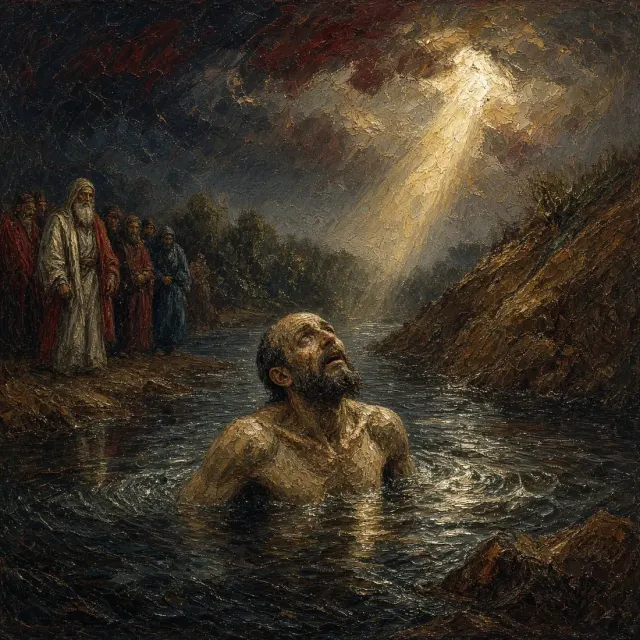
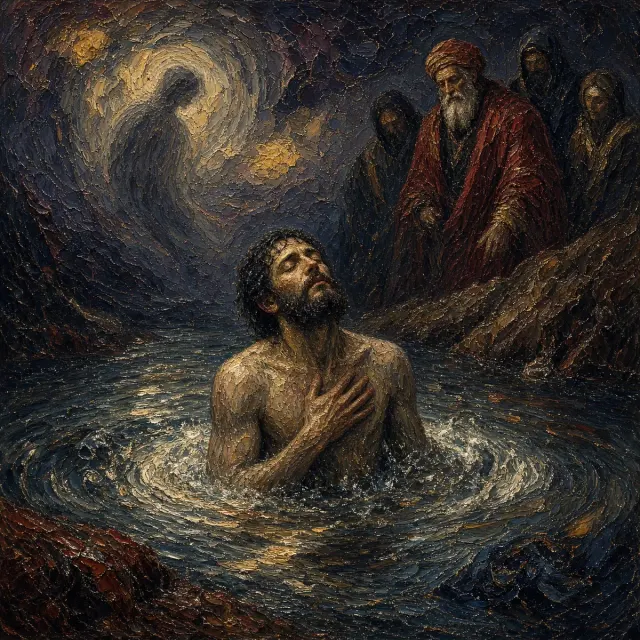
    His servants reason with him gently. He goes down and dips seven times, and his flesh comes back like the flesh of a little child.

    The servants do not answer anger with flattery or stage a rebellion. They address Naaman as My father and expose a mismatch in his own response. A difficult command would have received his effort; the simple one has received his contempt. They do not ask him to trust their medical knowledge. They bring him back to the words he has already been given.

    The cure itself takes one verse. The long argument belongs to Naaman; the fulfillment needs no comparable performance. According to the saying of the man of God gives the action its measure. Then the mighty man's flesh becomes like the flesh of a little child. He has not won a contest of endurance, secured preferential treatment, or purchased a more impressive method. The commander who arrived with gifts and instructions for the prophet has finally followed an instruction himself.

    Verse by verse

    1. 5:13

      My father is respectful address from the servants, not a statement that Naaman is their biological father. Their objection is reasoned rather than insulting.

    2. 5:14

      The verse reports seven immersions and then restored flesh. It does not describe gradual improvement after each separate immersion.

    2 Kings 5:13-14

    King James Version · 2 verses

    5:13And his servants came near, and spake unto him, and said, My father, if the prophet had bid thee do some great thing, wouldest thou not have done it? how much rather then, when he saith to thee, Wash, and be clean?

    5:14Then went he down, and dipped himself seven times in Jordan, according to the saying of the man of God: and his flesh came again like unto the flesh of a little child, and he was clean.

  4. 04

    2 Kings 5:15-19

    Two mules’ burden of earth

    He offers payment and Elisha refuses in front of him. He asks instead for soil to take home, and for pardon when his duty puts him in the house of Rimmon, and is told to go in peace.

    He arrived with silver and gold; now he asks to take home soil. The altered cargo fits the altered declaration. Naaman no longer speaks merely of the LORD as the prophet's God. He confesses that there is no God in all the earth but in Israel, then commits his sacrifices to the LORD alone. Elisha's refusal of payment prevents the exchange from closing as a successful purchase. The gift cannot acquire a price afterward.

    The request about Rimmon keeps the ending from becoming artificially tidy. Naaman expects to support his king physically in a temple where that king worships another god. He asks pardon for the bowing his service will involve. Elisha answers, Go in peace. Readers differ over how far that answer endorses the proposed conduct, but it does not contain a detailed ruling. The text records an exclusive confession, a concrete difficulty, and a brief farewell. It does not pretend that a cleansed body has removed every complication from the road home.

    Verse by verse

    1. 5:15-16

      Blessing here is an offered gift. Elisha's repeated refusal distinguishes the healing from a paid transaction.

    2. 5:17

      Earth in the request is adamah, soil or ground. The exact use of the two mule-loads is not described beyond Naaman's stated intention to sacrifice to the LORD.

    3. 5:18

      Naaman describes his king leaning on his hand during worship in Rimmon's temple. The passage identifies a real conflict of duties, not a second declaration of allegiance to Rimmon.

    4. 5:19

      Go in peace is Elisha's entire recorded reply. Whether it grants specific permission or dismisses Naaman without resolving every question is an interpretive dispute.

    2 Kings 5:15-19

    King James Version · 5 verses

    5:15And he returned to the man of God, he and all his company, and came, and stood before him: and he said, Behold, now I know that there is no God in all the earth, but in Israel: now therefore, I pray thee, take a blessing of thy servant.

    5:16But he said, As the LORD liveth, before whom I stand, I will receive none. And he urged him to take it; but he refused.

    5:17And Naaman said, Shall there not then, I pray thee, be given to thy servant two mules’ burden of earth? for thy servant will henceforth offer neither burnt offering nor sacrifice unto other gods, but unto the LORD.

    5:18In this thing the LORD pardon thy servant, that when my master goeth into the house of Rimmon to worship there, and he leaneth on my hand, and I bow myself in the house of Rimmon: when I bow down myself in the house of Rimmon, the LORD pardon thy servant in this thing.

    5:19And he said unto him, Go in peace. So he departed from him a little way.

Why it matters

The chapter is built entirely out of people below the line doing the work: a slave girl, a household servant, and a prophet’s messenger. Naaman’s cure costs him nothing but his dignity, and Elisha will not take a penny for it, which is the point Gehazi misses in the next scene. He goes home asking for two mules’ load of Israelite earth so he can worship the LORD on it in a foreign country, and Jesus names him at Nazareth as the one leper who was cleansed.

2 songs

The music

Every song in the catalogue whose passage falls inside these chapters.

  1. 2 Kings 4:38-5:27

    Wash and Be Clean

  2. 2 Kings 5

    Wash in Jordan

Nearby

All the people

Report an error on this page