Places of the Bible

The seven churches of Asia

Not a list. A postal route, in the order a courier leaving the coast would actually ride it.

Ephesus, Smyrna, Pergamos, Thyatira, Sardis, Philadelphia, Laodicea. Laid on a map they form a rough circle: north up the coast from Ephesus to Smyrna and Pergamos, then inland and south east to Thyatira and Sardis, then on to Philadelphia and Laodicea. That is a delivery round. The order in the text is the order a rider would take, which means the book was written to be carried, read out, and passed along.

Where it appearsRevelation 2 to 3

Scroll down to the account
The seven churches of Asia

The movements, in the order the text gives them.

The Account of The seven churches of Asia

  1. 01

    Revelation 2:8-10

    I know thy poverty, but thou art rich

    Smyrna gets no rebuke and no promise of relief either, only a length of time: ye shall have tribulation ten days.

    The richest words in the letter sit inside parentheses: but thou art rich. Smyrna's poverty is real, and Christ does not rename empty pockets abundance. He gives a second assessment alongside the first. Material deprivation has not made this congregation spiritually bankrupt. Laodicea will receive the exact reverse diagnosis: a church announcing its wealth is told that it is poor. The same speaker knows the difference.

    Nor does his approval buy Smyrna an escape from suffering. Prison lies ahead, and faithful unto death allows the possibility that fidelity will cost life itself. The promise comes from one who was dead, and is alive, so death is not being discussed from a safe distance. His own description supplies the reason that the crown can still be called life. The ten days place a limit on the trial, however the number is understood; they do not turn the trial into something painless. Unlike several neighboring letters, this one contains no rebuke. The congregation under pressure is not told that pressure proves its failure. Christ names its poverty, knows its suffering, and calls it rich.

    Verse by verse

    1. 2:8

      The first and the last, which was dead, and is alive repeats the self-description in Revelation 1:17-18. The promise to Smyrna is anchored in the identity of its speaker.

    2. 2:9

      The hostile accusation concerns a group opposing the church in Smyrna. It is not a statement about every Jewish person, and it must not be expanded into one.

    3. 2:10

      The ten days have been read as a literal period or a symbolic, limited trial. The passage does not identify ten rulers or supply dates for a predictive calendar.
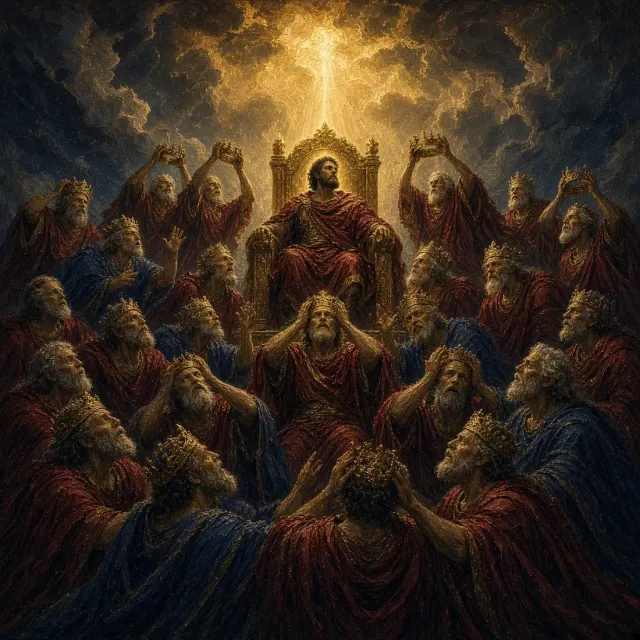
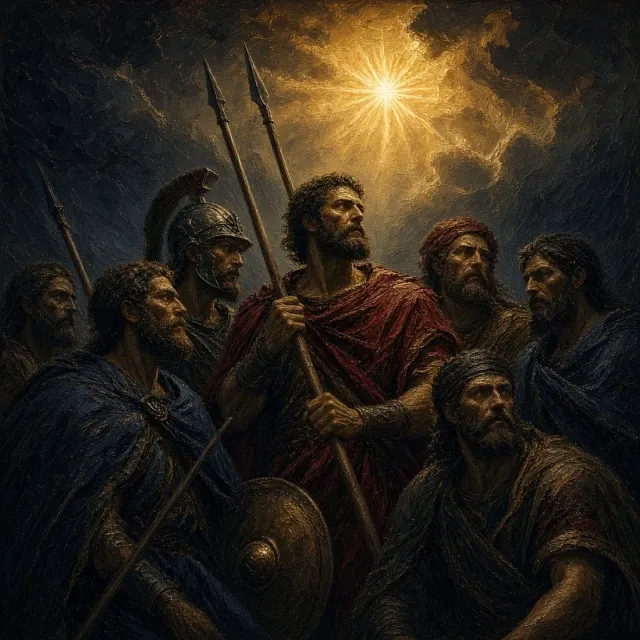
    Revelation 2:8-10

    King James Version · 3 verses

    2:8And unto the angel of the church in Smyrna write; These things saith the first and the last, which was dead, and is alive;

    2:9I know thy works, and tribulation, and poverty, (but thou art rich) and I know the blasphemy of them which say they are Jews, and are not, but are the synagogue of Satan.

    2:10Fear none of those things which thou shalt suffer: behold, the devil shall cast some of you into prison, that ye may be tried; and ye shall have tribulation ten days: be thou faithful unto death, and I will give thee a crown of life.

    Revelation 2:8-10: I know thy poverty, but thou art rich
  2. 02

    Revelation 2:12-13

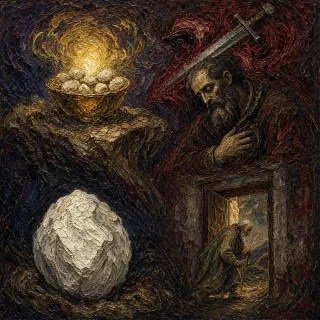
    Even where Satan’s seat is

    Pergamos is described by its address before it is described by its conduct, and the commendation accounts for the address.

    Antipas receives a name; the manner of his execution receives none. That restraint leaves the fact bare. A faithful man has been killed among these believers, and their refusal to deny Christ has continued through days in which the cost was no longer hypothetical. The letter does not praise courage in the abstract. It names the dead man beside whom that courage was tested.

    Where thou dwellest matters as much as what the church has done. The reference to Satan's dwelling appears twice, enclosing the account of its faithfulness. Christ knows the location, not merely the congregation's reputation. Yet the sharp sword belongs to him, and verse 16 identifies it as the sword of his mouth. This is not an instruction for the church to arm itself against the city. It is an assertion that the final word of judgment belongs to Christ. The following verses also rebuke tolerated false teaching, so endurance under persecution does not make every other judgment sound. Pergamos can be commended for holding Christ's name and corrected for what it permits. The letter does both without erasing Antipas.

    Verse by verse

    1. 2:12

      Revelation 2:16 locates the sword in Christ's mouth, as does Revelation 1:16. Its immediate function is judgment through his word.

    2. 2:13

      Seat translates thronos, throne. The passage names no particular altar or building, so a precise archaeological identification remains an interpretation.

    3. 2:13

      This is the New Testament's only mention of Antipas. It does not identify his executioners or describe an instrument of death.

    Revelation 2:12-13

    King James Version · 2 verses

    2:12And to the angel of the church in Pergamos write; These things saith he which hath the sharp sword with two edges;

    2:13I know thy works, and where thou dwellest, even where Satan’s seat is: and thou holdest fast my name, and hast not denied my faith, even in those days wherein Antipas was my faithful martyr, who was slain among you, where Satan dwelleth.

    Revelation 2:12-13: Even where Satan’s seat is
  3. 03

    Revelation 3:1-3

    Thou hast a name that thou livest, and art dead

    Sardis is told to be watchful, in a city whose fortress had twice been taken by men climbing the cliff while the guards slept.

    Sardis has a reputation that its condition cannot support. A name that thou livest, and art dead puts public standing and Christ's assessment in the same sentence, with no polite distance between them. Works are present; satisfactory completion is not. The problem is therefore not simply that nothing happens in Sardis. Activity and life have become dangerously easy to confuse.

    The commands that follow are striking precisely because the opening verdict is so severe. Watch, strengthen, remember, hold fast, repent. The remaining things are ready to die, which means the warning addresses what can still be strengthened rather than merely announcing a finished funeral. Sardis is not directed toward a novelty but back toward what it received and heard. The threatened arrival like a thief makes vigilance urgent without supplying a timetable. Surprise is the point of the comparison, not a hidden method for calculating the hour. Even the diagnosis is discriminating: verse 4 identifies a few names whose garments remain undefiled. The church's impressive name conceals death; the faithful names within it have not been overlooked. Reputation does not do the examining here.

    Verse by verse

    1. 3:1

      Name here means reputation, not merely the congregation's title. Verse 4 uses names for particular people, sharpening the contrast between collective reputation and individual recognition.

    2. 3:2

      Perfect translates a form of pleroo, to fill or bring to completion. The wording concerns works not found complete before God.

    3. 3:3

      The thief comparison stresses an unexpected arrival. The conditional warning is directed to Sardis and does not specify the hour or an exact historical event.

    Revelation 3:1-3

    King James Version · 3 verses

    3:1And unto the angel of the church in Sardis write; These things saith he that hath the seven Spirits of God, and the seven stars; I know thy works, that thou hast a name that thou livest, and art dead.

    3:2Be watchful, and strengthen the things which remain, that are ready to die: for I have not found thy works perfect before God.

    3:3Remember therefore how thou hast received and heard, and hold fast, and repent. If therefore thou shalt not watch, I will come on thee as a thief, and thou shalt not know what hour I will come upon thee.

    Revelation 3:1-3: Thou hast a name that thou livest, and art dead
  4. 04

    Revelation 3:7-8

    An open door, and no man can shut it

    Philadelphia is told it has a little strength, and that is stated as a fact rather than as a criticism.

    Little strength is not the complaint. Philadelphia receives that description beside two unqualified acknowledgments: it has kept Christ's word and has not denied his name. A congregation with limited power has nevertheless remained faithful. The letter does not mistake weakness for disloyalty, any more than the letter to Sardis mistakes a thriving reputation for life.

    The key appears before the open door, and that order fixes the emphasis. Access rests with the one who holds David's key, not with the strongest local opponents. No man shutteth, no man openeth, no man can shut it: the repeated negatives put the limits around other people's authority. Interpretations differ over whether the open door chiefly pictures entry into the kingdom or an opportunity for witness, an image Paul uses elsewhere. The royal key from Isaiah makes Christ's authority over admission central in either reading. This is not simply a pleasant metaphor for an unspecified opportunity. It answers a vulnerable congregation with a named keeper and an effective decision. Philadelphia has little strength. The person holding the key does not share its limitation.

    Verse by verse

    1. 3:7

      Isaiah 22:20-22 identifies Eliakim son of Hilkiah and describes the authority represented by David's key. Revelation reuses the opening-and-shutting formula.

    2. 3:8

      Little strength describes limited power; the verse does not name it as a sin. Keeping the word and not denying the name are explicit commendations.

    3. 3:8

      Open-door readings emphasize either kingdom access or an opportunity for witness. Paul's missionary use of the image appears in 1 Corinthians 16:9, 2 Corinthians 2:12, and Colossians 4:3.

    Revelation 3:7-8

    King James Version · 2 verses

    3:7And to the angel of the church in Philadelphia write; These things saith he that is holy, he that is true, he that hath the key of David, he that openeth, and no man shutteth; and shutteth, and no man openeth;

    3:8I know thy works: behold, I have set before thee an open door, and no man can shut it: for thou hast a little strength, and hast kept my word, and hast not denied my name.

    Revelation 3:7-8: An open door, and no man can shut it
  5. 05

    Revelation 3:15-20

    I would thou wert cold or hot

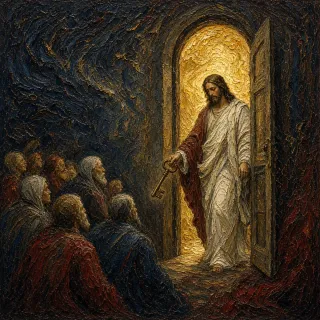
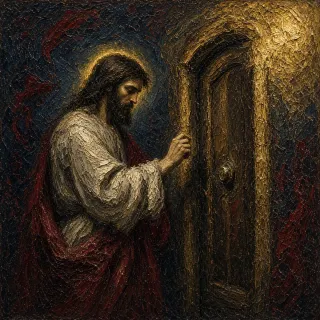
    The complaint is about temperature in a town whose water arrived tepid, and it ends with a knock at a door from outside.

    Laodicea has completed its own assessment and found nothing missing. Christ supplies a rather different inventory: poor, blind, naked. The sting is in knowest not. This church is not merely needy; it is unable to recognize its need while confidently announcing the opposite. Gold, clothing, and eyesalve answer the three deficiencies with uncomfortable precision. The congregation that needs nothing is advised to obtain everything it lacks from Christ.

    The temperature language is deliberately unpleasant. Lukewarmness produces rejection, pictured as being spewed from the mouth, and the text does not soften the image. Yet cold and hot are both preferred to the present condition, so the passage cannot simply be reduced to a scale on which colder always means worse. The sharpest clarification comes in verse 19: the rebuke is an expression of love. Correction is not evidence that the speaker has ceased to care.

    Then the scene becomes a doorway and a shared meal. This famous invitation is addressed first to a church, not to an unidentified crowd outside it, while any man makes room for an individual response within that setting. The mutual wording matters: he will eat with the person who opens, and that person with him. The letter moves from a mouth rejecting what is offered to a table of restored fellowship. The severity is real. So is the invitation.

    Verse by verse

    1. 3:15-16

      The passage prefers both cold and hot to lukewarm. It does not identify a particular aqueduct, water source, or route between neighboring cities.

    2. 3:17-18

      The offered gold, white clothing, and eyesalve correspond to poverty, nakedness, and blindness. The counsel overturns the church's own assessment rather than confirming its prosperity.

    3. 3:19

      Love is explicitly given as the basis of rebuke and discipline. The severity of the preceding images must be read alongside that statement.

    4. 3:20

      The addressee is the Laodicean church, identified in verse 14. The phrase any man makes the invitation personal without removing its congregational setting.

    Revelation 3:15-20

    King James Version · 6 verses

    3:15I know thy works, that thou art neither cold nor hot: I would thou wert cold or hot.

    3:16So then because thou art lukewarm, and neither cold nor hot, I will spue thee out of my mouth.

    3:17Because thou sayest, I am rich, and increased with goods, and have need of nothing; and knowest not that thou art wretched, and miserable, and poor, and blind, and naked:

    3:18I counsel thee to buy of me gold tried in the fire, that thou mayest be rich; and white raiment, that thou mayest be clothed, and that the shame of thy nakedness do not appear; and anoint thine eyes with eyesalve, that thou mayest see.

    3:19As many as I love, I rebuke and chasten: be zealous therefore, and repent.

    3:20Behold, I stand at the door, and knock: if any man hear my voice, and open the door, I will come in to him, and will sup with him, and he with me.

    Revelation 3:15-20: I would thou wert cold or hot

Why it matters

Each letter is built to the same frame and the local details are never generic. Smyrna, a city that had been destroyed and rebuilt, is told about one which was dead and is alive. Sardis, an acropolis famously captured twice by climbers at night, is told to watch. Laodicea sat between a hot spring at Hierapolis and cold water at Colosse, and received both by aqueduct lukewarm, which is the charge against it. Two of the seven get no complaint at all, and both of those are the ones under pressure.

10 songs

The music

Every song in the catalogue whose passage falls inside these chapters.

  1. Revelation 1-3

    The Voice Like Many Waters

  2. Revelation 2:8-11

    Faithful unto Death

  3. Revelation 2:1–29

    Hear What the Spirit Saith I

  4. Revelation 2:12-17

    Hidden Manna and a White Stone

  5. Revelation 2:18-29

    Hold Fast till He Comes

  6. Revelation 2:1-7

    Thou Hast Left Thy First Love

  7. Revelation 3:7-13

    A Door No Man Can Shut

  8. Revelation 3:1-6

    A Name That Thou Livest

  9. Revelation 3:14-22

    At the Door He Knocks

  10. Revelation 3:1–22

    Hear What the Spirit Saith II

Nearby

All the places

Report an error on this page