
Places of the Bible

Patmos

A small island used for exile, and the return address on the last book of the Bible.

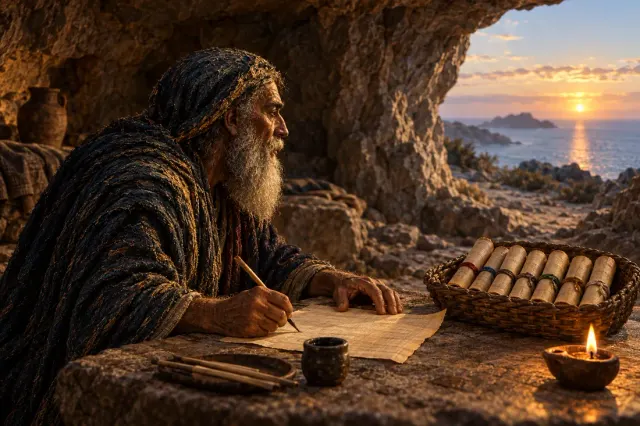
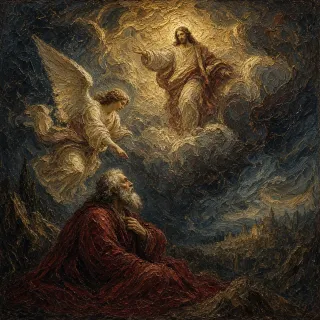
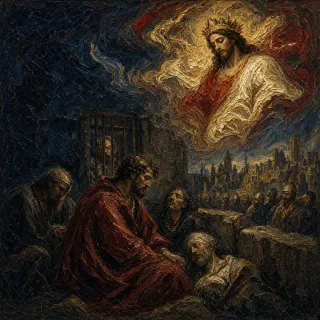
Patmos is about thirteen square miles of rock in the Aegean, forty miles off the coast of Asia Minor. Rome used islands like it for relegatio, a sentence of banishment rather than imprisonment, usually handed to people who were a nuisance rather than a danger. John states the address and the reason in one line and then never mentions the place again: I John, who also am your brother, and companion in tribulation, was in the isle that is called Patmos, for the word of God, and for the testimony of Jesus Christ.

Where it appearsRevelation 1

Scroll down to the account

The movements, in the order the text gives them.

The Account of Patmos

  1. 01

    Revelation 1:3

    Blessed is he that readeth, and they that hear

    The book assumes it will be read to a room. The blessing is on the reader and the listeners before a word of the vision arrives.

    The blessing includes the people listening. Revelation's opening does not reserve its benefit for the person holding the manuscript, much less for a specialist who can identify every image. One reads; others hear. Before any elaborate explanation of its symbols, the book places its words within reach of a gathered audience.

    The sentence then adds keep. Hearing is not treated as an achievement complete in itself, and prophecy is not reduced to advance information. The words are to be held and observed. That is a statement about the book's intended reception, not an invitation to replace its difficult passages with agreeable generalities. Its claims on conduct belong beside its visions.

    For the time is at hand gives the opening its urgency. Different readings of Revelation debate how that nearness relates to particular events, but the first audience is not addressed as though the message concerns everybody except them. The words have arrived for their hearing and keeping. The opening blessing makes a striking frame for such a formidable book: the first human arrangement it describes is not an army. It is someone reading aloud.

    Verse by verse

    1. 1:3

      The Greek has a singular reader and plural hearers. This strongly suggests public reading, rather than requiring every hearer to possess a separate manuscript.

    2. 1:3

      Keep translates tereo, to guard, preserve, or observe. Here the written prophecy is something to heed, not merely to hear pronounced.

    3. 1:3

      At hand means near. Interpretations differ over the scope and fulfillment of the prophetic events, but the wording itself conveys urgency.
    Revelation 1:3

    King James Version · 1 verse

    1:3Blessed is he that readeth, and they that hear the words of this prophecy, and keep those things which are written therein: for the time is at hand.

    Revelation 1:3: Blessed is he that readeth, and they that hear
  2. 02

    Revelation 1:9

    Your brother, and companion in tribulation

    He introduces himself by shared circumstance rather than by office, and gives the legal reason for his address without complaint.

    John introduces the island through a relationship. Before Patmos becomes a setting for visions, its resident calls himself a brother and companion. He does not begin this sentence by putting a rank between himself and the congregations. What he shares with them is named before where he is separated from them.

    The sequence is arresting: tribulation, kingdom, patience. The kingdom has not removed the pressure, and patience is not merely waiting for an inconvenient afternoon to end. It is endurance within allegiance to Jesus Christ. These terms occupy the same declaration of fellowship. The man who writes about rule and victory locates himself among people who must continue under strain.

    His presence on Patmos is connected with the word of God and the testimony of Jesus Christ. Those phrases have already described his witness in verse 2. The message and the personal cost are not separate subjects accidentally touching. The island supplies a geographical address; the testimony explains why that address matters. Distance from the churches has not become a claim to stand above them. He remains their companion.

    Verse by verse

    1. 1:9

      Companion translates synkoinonos, one who shares with others. John's participation includes the kingdom and endurance as well as affliction.

    2. 1:9

      Patience here carries the sense of endurance. The verse gives no description of a cave, prison cell, mine, or daily labor imposed on John.

    Revelation 1:9

    King James Version · 1 verse

    1:9I John, who also am your brother, and companion in tribulation, and in the kingdom and patience of Jesus Christ, was in the isle that is called Patmos, for the word of God, and for the testimony of Jesus Christ.

    Revelation 1:9: Your brother, and companion in tribulation
  3. 03

    Revelation 1:10-12

    I turned to see the voice that spake with me

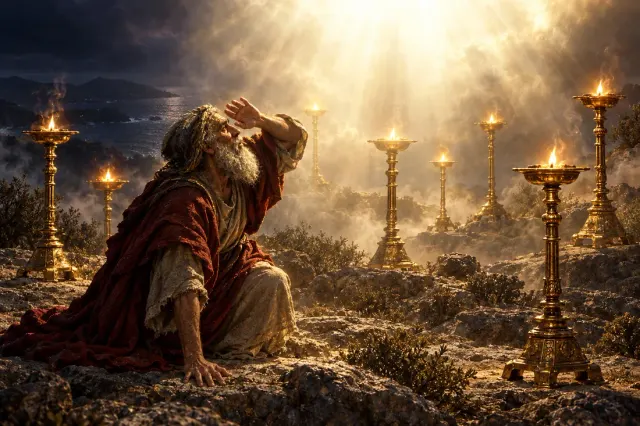
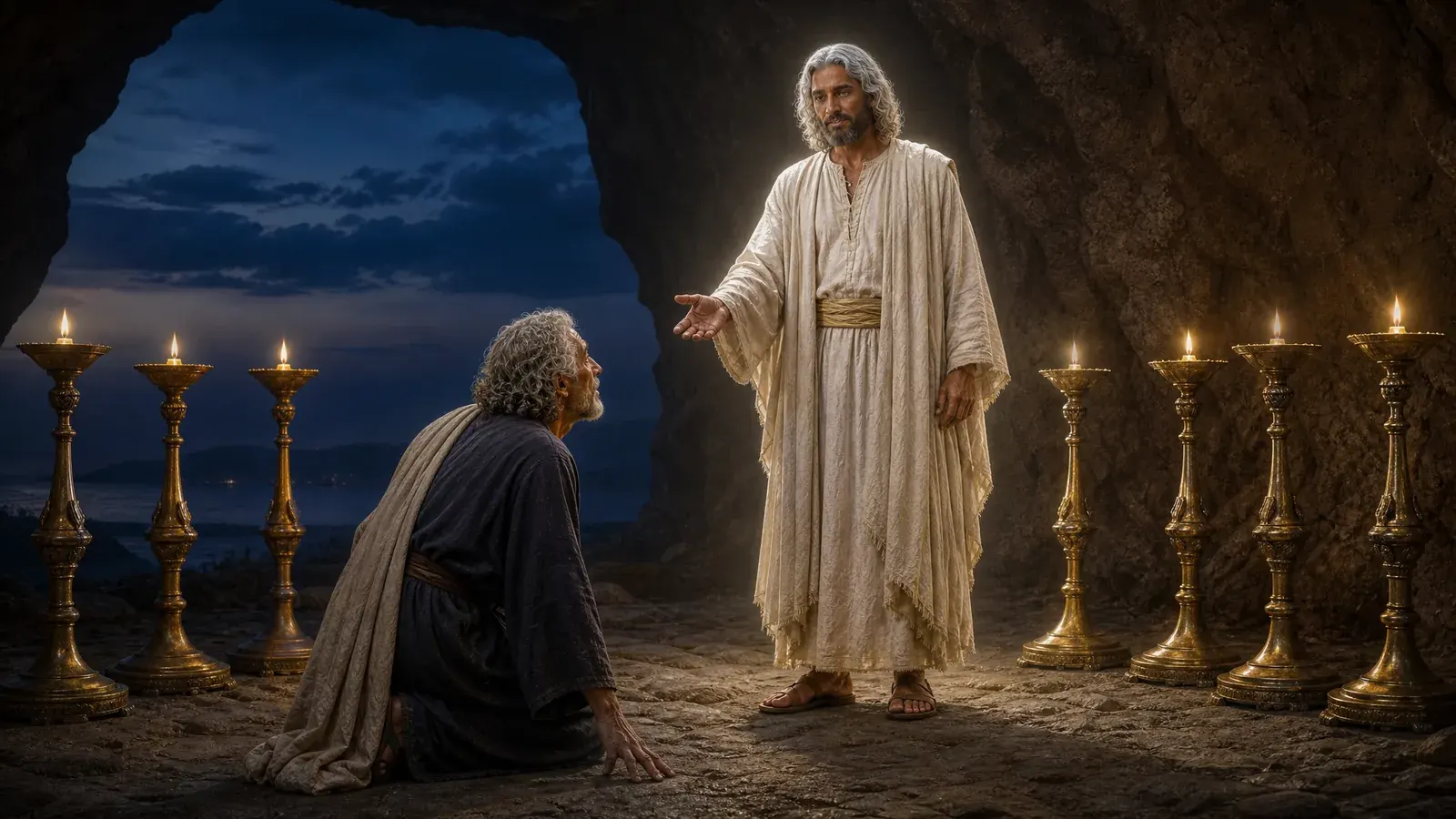
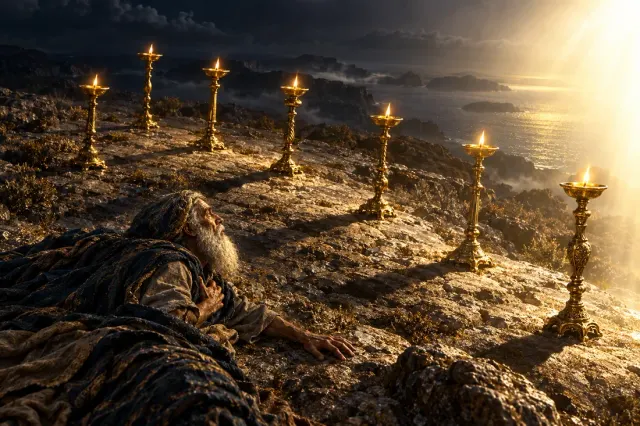
    The vision begins behind him and he has to turn. What he sees first is not a person but seven lampstands.

    The first instruction attached to the voice is practical: write, and send. The vision has destinations. Its scale does not make the seven congregations too small to receive it; their names are spoken into the commission itself.

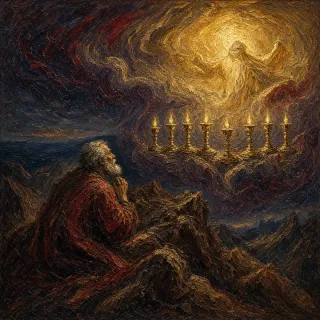
    John hears before he sees. He turns to see the voice, a compact expression for seeking the speaker, and the first objects named after the turn are seven golden lampstands. The next verse places the Son of man among them. The churches are therefore not merely addresses attached to a message about something happening far away. Once verse 20 explains the lampstands, the opening sight locates Christ in their midst.

    The trumpet comparison describes the great voice; it does not require an instrument in someone's hands. The force belongs to a speaker whose words become writing for communities beyond the island. John is in the Spirit, but the commission does not end in an unshared experience. Hearing, turning, seeing, writing, sending: the movement is toward communication. Patmos is the place of reception, not the intended limit of the revelation.

    Verse by verse

    1. 1:10

      In the Spirit describes the character of the visionary experience. The expression reappears in Revelation 4:2 and does not state that John's body has left Patmos.

    2. 1:11

      Asia here is the Roman province containing the named churches, not the modern continent in its full extent. The commission names actual recipients.

    3. 1:12

      Candlesticks translates a word for lampstands. The imagery concerns supports for lamps, not necessarily modern wax candles.

    Revelation 1:10-12

    King James Version · 3 verses

    1:10I was in the Spirit on the Lord’s day, and heard behind me a great voice, as of a trumpet,

    1:11Saying, I am Alpha and Omega, the first and the last: and, What thou seest, write in a book, and send it unto the seven churches which are in Asia; unto Ephesus, and unto Smyrna, and unto Pergamos, and unto Thyatira, and unto Sardis, and unto Philadelphia, and unto Laodicea.

    1:12And I turned to see the voice that spake with me. And being turned, I saw seven golden candlesticks;

    Revelation 1:10-12: I turned to see the voice that spake with me
  4. 04

    Revelation 1:17

    I fell at his feet as dead

    The man who had leaned on him at supper goes down like a corpse, and the first words he hears are fear not.

    The hand that holds the seven stars is laid upon the fallen man. The movement from the vast to the particular is already in the text. Revelation does not soften the blazing appearance before recording the touch; it places the touch within that majesty.

    John falls as dead. The comparison describes his response without saying that he has died and been resurrected. Nor is the reassuring speech a denial that the sight is overwhelming. The ground of reassurance is the speaker's identity: the first and the last. What John cannot master by strength is met by authority that reaches beyond his own span of life.

    The next verse makes the identity still more definite. The living one has been dead and is alive for evermore. That declaration gives weight to the hand upon someone lying as dead. Power over death and attention to one stricken witness stand together. The passage does not exchange the terrible brightness for a gentler, lesser Christ. The same Christ who overwhelms John reaches toward him. The stars have not made the man beneath notice.

    Verse by verse

    1. 1:17

      As dead is a comparison, not a report of John's actual death. The verse records collapse and reassurance without describing a resurrection of John.

    2. 1:17

      The right hand has already been associated with the seven stars in verse 16. Its touch joins the vision's authority to its personal address.

    Revelation 1:17

    King James Version · 1 verse

    1:17And when I saw him, I fell at his feet as dead. And he laid his right hand upon me, saying unto me, Fear not; I am the first and the last:

    Revelation 1:17: I fell at his feet as dead
  5. 05

    Revelation 1:19-20

    Write the things which thou hast seen

    The commission comes with an explanation of the imagery attached, which is the only time the book explains its own symbols on the spot.

    The mystery is followed by an explanation. The seven stars are identified, and so are the lampstands. Revelation begins its symbolic teaching by interpreting part of its own imagery, not by declaring that every striking object must remain an insoluble riddle.

    That explanation changes the force of the scene. The golden lampstands are congregations, including communities that will receive both praise and rebuke. Their place around Christ is neither a reward for being flawless nor a decorative backdrop for his appearance. They belong to the subject of the vision. The image gives their existence a setting larger than the pressures visible in their streets.

    The command to write also reaches across what John has seen, what is, and what will follow. Readers divide over how precisely this sentence outlines the rest of the book; the commission itself plainly includes more than a private recollection. The revelation is to become a written communication. The seven churches are not left to discover whether their names fit somewhere in a code. At this point, at least, the explanation is supplied. The lampstands are them.

    Verse by verse

    1. 1:19

      Some readings take verse 19 as a three-part chronological outline; others understand its categories more broadly. The verse should not be made to settle every later sequence on its own.

    2. 1:20

      Angelos can mean a heavenly angel or a human messenger. The identity of the churches' angels is disputed, with heavenly representatives and human leaders among the principal readings.

    3. 1:20

      The lampstands are explicitly identified as churches. This interpretation is given by the passage, rather than inferred solely from the number seven.

    Revelation 1:19-20

    King James Version · 2 verses

    1:19Write the things which thou hast seen, and the things which are, and the things which shall be hereafter;

    1:20The mystery of the seven stars which thou sawest in my right hand, and the seven golden candlesticks. The seven stars are the angels of the seven churches: and the seven candlesticks which thou sawest are the seven churches.

    Revelation 1:19-20: Write the things which thou hast seen

Why it matters

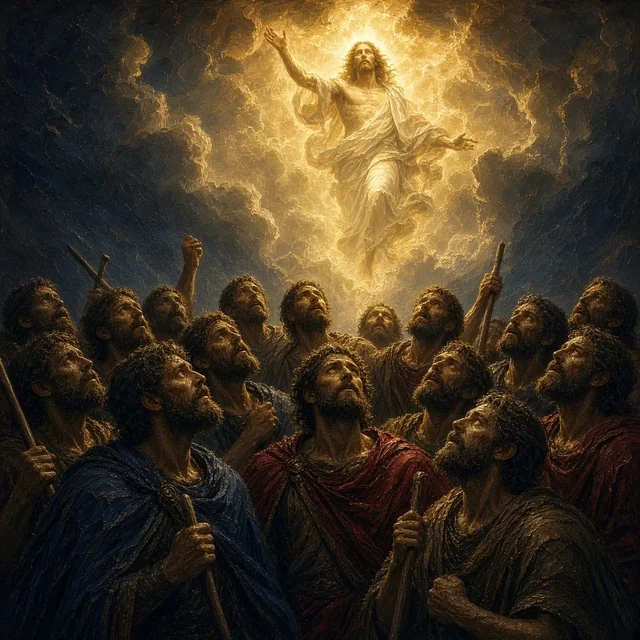
What follows is the only book in the Bible that opens by blessing the person reading it aloud and the people listening. The vision starts behind him. He hears a voice first, turns to see it, and what he sees is a figure among seven candlesticks whose description is assembled almost entirely from Daniel and Ezekiel. He falls at his feet as dead. The hand that lifts him is the same hand holding seven stars, and the first instruction he is given is to write.

4 songs

The music

Every song in the catalogue whose passage falls inside these chapters.

  1. Revelation 1:9-16

    Among the Seven Golden Candlesticks

  2. Revelation 1:1-8

    Behold, He Cometh with Clouds

  3. Revelation 1:1–20

    The Alpha and Omega

  4. Revelation 1-3

    The Voice Like Many Waters

Nearby

All the places

Report an error on this page