The big picture
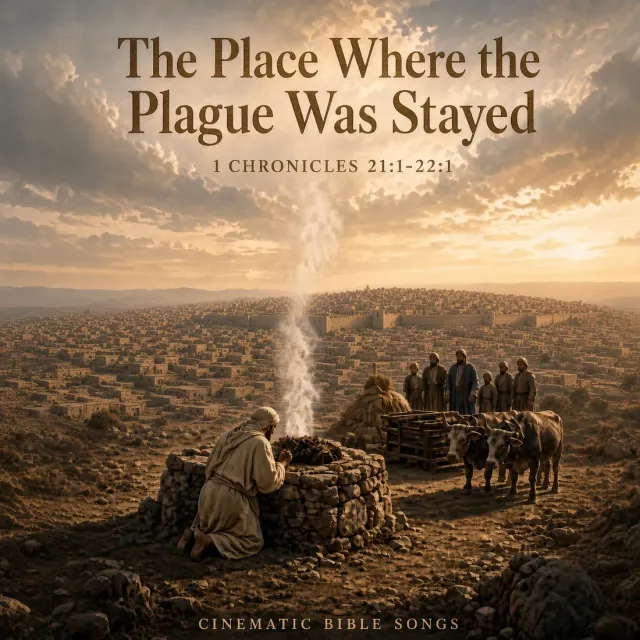
David, king of Israel, orders a count of the nation's fighting men. Israel is God's people, and Joab, David's army chief, objects to the order. Satan, the enemy who stirs David against Israel, stands behind the decision. A plague follows, and David must face the harm his act has brought. The crisis reaches Jerusalem, his royal city, and ends at a threshing floor where grain is separated from its husks.
In this chapter
- Joab Objects but Carries Out the Count 1 Chronicles 21:1-6
Satan urges David to count Israel.
- David Confesses and Chooses God's Mercy 1 Chronicles 21:7-13
God is displeased with the count and strikes Israel.
- God Stops the Angel Over Jerusalem 1 Chronicles 21:14-17
The plague kills seventy thousand men.
- David Pays for the Place of Sacrifice 1 Chronicles 21:18-26
The angel tells Gad to send David to build an altar on Ornan's floor.
- The Sword Is Put Away 1 Chronicles 21:27-30
God commands the angel to return its sword to the sheath.
Central truth
David's wrongful count brings deadly judgement on Israel, but God stops the destruction and answers the king at a newly built altar.

Scripture beside the summary
1 Chronicles · King James Version · 301 Chronicles 21:1-6
Joab Objects but Carries Out the Count
Satan urges David to count Israel. David orders Joab and the people's rulers to bring him a total from across the land. Joab hopes God will make the people far more numerous, but questions the need for the count. He warns that the order will bring guilt on Israel. David's command prevails. Joab reports one million one hundred thousand fighting men in Israel and four hundred seventy thousand in Judah, one part of the nation. He leaves two tribes uncounted because he finds the order so offensive. The king has ignored a clear warning.
In everyday life
A data supervisor refuses to call an intrusive staff survey harmless. She explains the risk to the owner, who insists that the numbers be collected anyway. She returns with an incomplete file, still troubled by the order. Rank has overruled a serious objection. David's count is named as sin against God, not merely poor data practice.
Notice
1 Chronicles 21:3 Joab questions the purpose of a count while wishing the people greater strength. His objection is not a wish for fewer people or a weaker kingdom.
1 Chronicles 21:1-6
King James Version1And Satan stood up against Israel, and provoked David to number Israel.
2And David said to Joab and to the rulers of the people, Go, number Israel from Beer-sheba even to Dan; and bring the number of them to me, that I may know it.
3And Joab answered, The LORD make his people an hundred times so many more as they be: but, my lord the king, are they not all my lord’s servants? why then doth my lord require this thing? why will he be a cause of trespass to Israel?
4Nevertheless the king’s word prevailed against Joab. Wherefore Joab departed, and went throughout all Israel, and came to Jerusalem.
5And Joab gave the sum of the number of the people unto David. And all they of Israel were a thousand thousand and an hundred thousand men that drew sword: and Judah was four hundred threescore and ten thousand men that drew sword.
6But Levi and Benjamin counted he not among them: for the king’s word was abominable to Joab.
1 Chronicles 21:7-13
David Confesses and Chooses God's Mercy
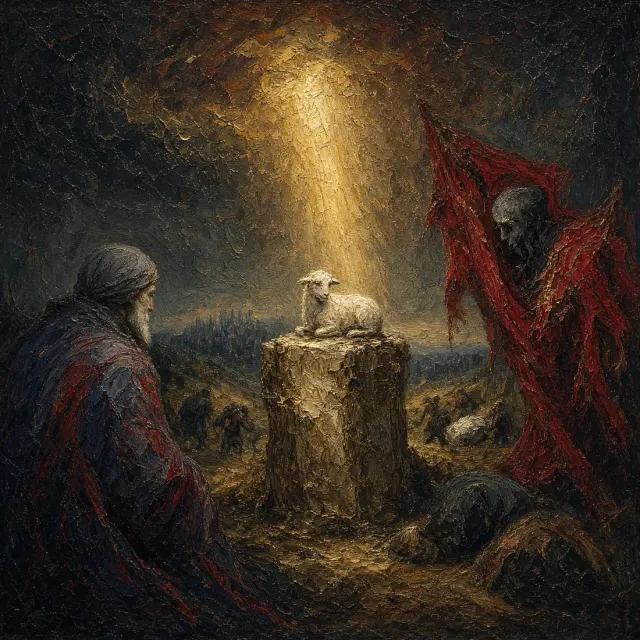
God is displeased with the count and strikes Israel. David admits great sin and asks God to remove his guilt. God sends Gad, a seer who speaks his message, with three choices. David must face three years of famine, three months of defeat by enemies, or three days of plague through God's angel. David is deeply distressed. He chooses to fall into God's hands because his mercy is great, rather than into human hands. The confession does not remove every consequence, and the choice offers no painless outcome.
In everyday life
The ship's captain admits an error that has put the vessel at risk. Several costly options remain, and he chooses the one directed by rescuers he trusts. He does not pretend that admitting fault has made the danger vanish. Trust guides a hard decision. David chooses God's judgement because of divine mercy, not a rescuer's technical skill.
Notice
1 Chronicles 21:13 David bases his choice on God's mercy while still expecting judgement. The answer holds trust and dread together rather than treating punishment as something he welcomes.
1 Chronicles 21:7-13
King James Version7And God was displeased with this thing; therefore he smote Israel.
8And David said unto God, I have sinned greatly, because I have done this thing: but now, I beseech thee, do away the iniquity of thy servant; for I have done very foolishly.
9And the LORD spake unto Gad, David’s seer, saying,
10Go and tell David, saying, Thus saith the LORD, I offer thee three things: choose thee one of them, that I may do it unto thee.
11So Gad came to David, and said unto him, Thus saith the LORD, Choose thee
12Either three years’ famine; or three months to be destroyed before thy foes, while that the sword of thine enemies overtaketh thee; or else three days the sword of the LORD, even the pestilence, in the land, and the angel of the LORD destroying throughout all the coasts of Israel. Now therefore advise thyself what word I shall bring again to him that sent me.
13And David said unto Gad, I am in a great strait: let me fall now into the hand of the LORD; for very great are his mercies: but let me not fall into the hand of man.
1 Chronicles 21:14-17
God Stops the Angel Over Jerusalem
The plague kills seventy thousand men. God sends an angel toward Jerusalem, then commands it to stop the destruction. The angel stands by the threshing floor of Ornan, a Jebusite resident. David sees the drawn sword stretched over the city. He and the elders fall on their faces in rough mourning clothes. David names himself as the one who ordered the count. He asks that punishment fall on him and his family instead of the people, whom he compares to sheep. His plea owns responsibility for harm far wider than his own household.

In everyday life
A hospital liaison reads a list of deaths to an official whose earlier decision exposed many people to danger. The official stops defending the paperwork and names his own part in the loss. Nothing in the room makes those deaths smaller. The families remain the centre of the grief. David faces a plague and angel sent by God.
Notice
1 Chronicles 21:17 David calls the people sheep while identifying himself as the guilty leader. His request turns from explaining the order to asking protection for those suffering because of it.
1 Chronicles 21:14-17
King James Version14So the LORD sent pestilence upon Israel: and there fell of Israel seventy thousand men.
15And God sent an angel unto Jerusalem to destroy it: and as he was destroying, the LORD beheld, and he repented him of the evil, and said to the angel that destroyed, It is enough, stay now thine hand. And the angel of the LORD stood by the threshingfloor of Ornan the Jebusite.
16And David lifted up his eyes, and saw the angel of the LORD stand between the earth and the heaven, having a drawn sword in his hand stretched out over Jerusalem. Then David and the elders of Israel, who were clothed in sackcloth, fell upon their faces.
17And David said unto God, Is it not I that commanded the people to be numbered? even I it is that have sinned and done evil indeed; but as for these sheep, what have they done? let thine hand, I pray thee, O LORD my God, be on me, and on my father’s house; but not on thy people, that they should be plagued.
1 Chronicles 21:18-26
David Pays for the Place of Sacrifice
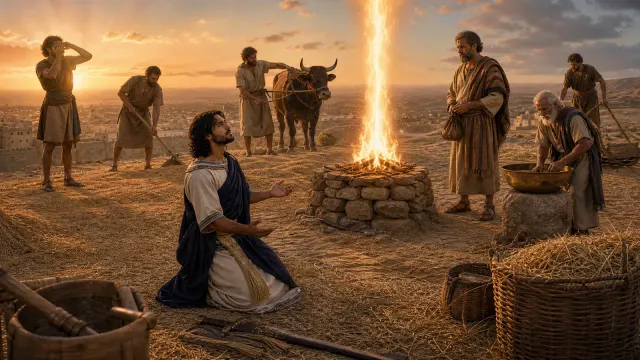
The angel tells Gad to send David to build an altar on Ornan's floor. Ornan sees the angel while threshing wheat, and his sons hide. When David arrives, Ornan offers the site, animals, grain and wood without payment. David refuses to offer God something that has cost him nothing. He pays six hundred gold shekels, a weight used for payment, for the place. He builds an altar and brings offerings to God. Fire comes from heaven in answer. The place of fear becomes a place where David calls on God.
In everyday life
A restaurateur offers to cover a neighbour's repair bill after damaging the neighbour's delivery van. When the neighbour waives payment, she insists on paying the real cost herself. An apology paid for entirely by the injured person would leave her responsibility untouched. David purchases a sacrificial site, and God answers the offering with fire from heaven.
Notice
1 Chronicles 21:24 David refuses to take Ornan's property and call it his own gift to God. The sacrifice must involve a real cost borne by the king himself.
1 Chronicles 21:18-26
King James Version18Then the angel of the LORD commanded Gad to say to David, that David should go up, and set up an altar unto the LORD in the threshingfloor of Ornan the Jebusite.
19And David went up at the saying of Gad, which he spake in the name of the LORD.
20And Ornan turned back, and saw the angel; and his four sons with him hid themselves. Now Ornan was threshing wheat.
21And as David came to Ornan, Ornan looked and saw David, and went out of the threshingfloor, and bowed himself to David with his face to the ground.
22Then David said to Ornan, Grant me the place of this threshingfloor, that I may build an altar therein unto the LORD: thou shalt grant it me for the full price: that the plague may be stayed from the people.
23And Ornan said unto David, Take it to thee, and let my lord the king do that which is good in his eyes: lo, I give thee the oxen also for burnt offerings, and the threshing instruments for wood, and the wheat for the meat offering; I give it all.
24And king David said to Ornan, Nay; but I will verily buy it for the full price: for I will not take that which is thine for the LORD, nor offer burnt offerings without cost.
25So David gave to Ornan for the place six hundred shekels of gold by weight.
26And David built there an altar unto the LORD, and offered burnt offerings and peace offerings, and called upon the LORD; and he answered him from heaven by fire upon the altar of burnt offering.
1 Chronicles 21:27-30
The Sword Is Put Away
God commands the angel to return its sword to the sheath. David sees that God has answered at Ornan's threshing floor and continues to sacrifice there. The tabernacle, the worship tent made under Moses, Israel's earlier leader, is at Gibeon, another town. Its burnt-offering altar is there too. Yet David is afraid to go there to seek God because of the angel's sword. The danger has stopped, but its effect on him remains. Worship now takes place where God has met him in the crisis.
In everyday life
The earthquake survivor returns to a temporary shelter after officials reopen the usual meeting hall. The safety notice is real, but her body still remembers the fear of that night. She meets neighbours where help first reached her. Relief does not instantly erase dread. David's fear follows an encounter with God's armed angel and a divine answer.
Notice
1 Chronicles 21:30 David's fear remains after the sword is put away. The end of the immediate threat does not mean that the encounter has ceased to shape his actions.
1 Chronicles 21:27-30
King James Version27And the LORD commanded the angel; and he put up his sword again into the sheath thereof.
28At that time when David saw that the LORD had answered him in the threshingfloor of Ornan the Jebusite, then he sacrificed there.
29For the tabernacle of the LORD, which Moses made in the wilderness, and the altar of the burnt offering, were at that season in the high place at Gibeon.
30But David could not go before it to enquire of God: for he was afraid because of the sword of the angel of the LORD.
Details worth noticing
The opening image
1 Chronicles 21:1 begins with “And Satan stood up against Israel, and provoked David to number Israel.”
Where the chapter turns
1 Chronicles 21:17 forms a natural hinge: “And David said unto God, Is it not I that commanded the people to be numbered? even I it is that have sinned and done evil indeed; but as for these sheep…”
The final note
1 Chronicles 21:30 leaves the reader with “But David could not go before it to enquire of God: for he was afraid because of the sword of the angel of the LORD.”
A word trail through the chapter
The words LORD, David, Israel, Ornan, angel, sword help reveal the chapter’s repeated concerns.
KJV words made clear
- unto
- to
- thee
- you
- thou
- you
- thy
- your
- doth
- does
Music and video connected to the passage
Related media appears when its Scripture reference overlaps this study. Music and video can illuminate a theme while the biblical text remains the foundation.