The big picture
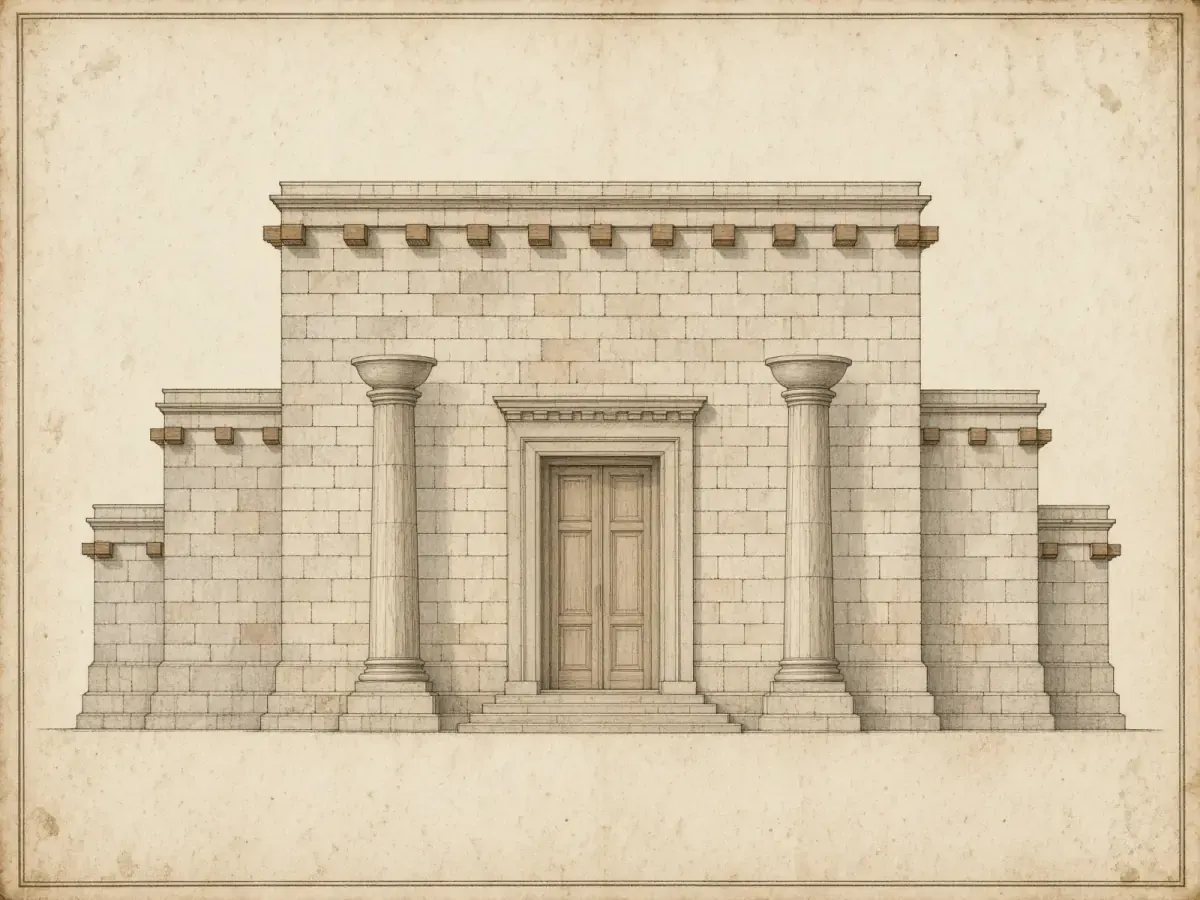
Solomon, king of Israel, the people gathered for worship, stands beside the newly finished temple. This building will serve as their sacred meeting place. The ark, a chest holding the terms of God's bond with them, has been brought in. Now the king turns from the building to those who will pray there. He thinks of guilt, failed crops, war and forced removal from home. His prayer asks God for help that walls and gold cannot supply.
In this chapter
- The Completed House Fulfils God's Promise 2 Chronicles 6:1-11
Solomon speaks of God's dwelling in thick darkness, then presents the house built as a lasting place for him.
- The King Kneels and Asks for Continuity 2 Chronicles 6:12-17
Solomon stands on a bronze platform in the court, then kneels before the people with his hands raised.
- Heaven Cannot Hold the God Who Hears 2 Chronicles 6:18-21
Solomon asks whether God will truly dwell with people on earth.
- Solomon Prays About Guilt Defeat and Drought 2 Chronicles 6:22-27
An oath at the altar can follow a wrong done to a neighbour.
- Every Person's Hidden Grief Is Known 2 Chronicles 6:28-31
The prayer turns to famine, disease, damaged crops, insects and enemy siege.
- Foreigners and Distant Fighters Can Pray 2 Chronicles 6:32-35
Solomon includes a foreigner who hears of God's greatness and comes from far away to pray.
- Exiles Can Turn Back from Far Away 2 Chronicles 6:36-39
Solomon recognises that everyone sins.
- The Prayer Ends with Welcome and Mercy 2 Chronicles 6:40-42
The closing requests ask God to watch and listen to prayer in this place.
Central truth
Solomon asks the God no house can contain to hear, judge and forgive people who turn toward him through the temple.

Scripture beside the summary
2 Chronicles · King James Version · 422 Chronicles 6:1-11
The Completed House Fulfils God's Promise
Solomon speaks of God's dwelling in thick darkness, then presents the house built as a lasting place for him. He turns and blesses the people standing before him. God has fulfilled his promise to David, Solomon's father. God chose Jerusalem, the royal city, and David as king. David's wish to build was good, but his son was to carry it out. Solomon now holds the throne and has built the house. He has placed the ark inside. The finished work gives him reason to praise God's kept word before claiming his own success.
In everyday life
The civic archivist opens a hall promised by a former council long before she joined the project. She reads the original pledge aloud as residents enter. The finished rooms connect an old word with a present fact. Her own work belongs within a promise that preceded her. Solomon credits God with choosing the city, king and builder.
Notice
2 Chronicles 6:10 Solomon joins his place on the throne with the finished house. Both are named as the fulfilment of what God had promised before the work began.
2 Chronicles 6:1-11
King James Version1Then said Solomon, The LORD hath said that he would dwell in the thick darkness.
2But I have built an house of habitation for thee, and a place for thy dwelling for ever.
3And the king turned his face, and blessed the whole congregation of Israel: and all the congregation of Israel stood.
4And he said, Blessed be the LORD God of Israel, who hath with his hands fulfilled that which he spake with his mouth to my father David, saying,
5Since the day that I brought forth my people out of the land of Egypt I chose no city among all the tribes of Israel to build an house in, that my name might be there; neither chose I any man to be a ruler over my people Israel:
6But I have chosen Jerusalem, that my name might be there; and have chosen David to be over my people Israel.
7Now it was in the heart of David my father to build an house for the name of the LORD God of Israel.
8But the LORD said to David my father, Forasmuch as it was in thine heart to build an house for my name, thou didst well in that it was in thine heart:
9Notwithstanding thou shalt not build the house; but thy son which shall come forth out of thy loins, he shall build the house for my name.
10The LORD therefore hath performed his word that he hath spoken: for I am risen up in the room of David my father, and am set on the throne of Israel, as the LORD promised, and have built the house for the name of the LORD God of Israel.
11And in it have I put the ark, wherein is the covenant of the LORD, that he made with the children of Israel.
2 Chronicles 6:12-17
The King Kneels and Asks for Continuity
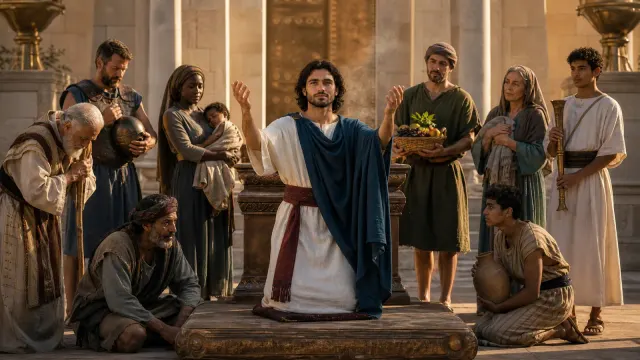
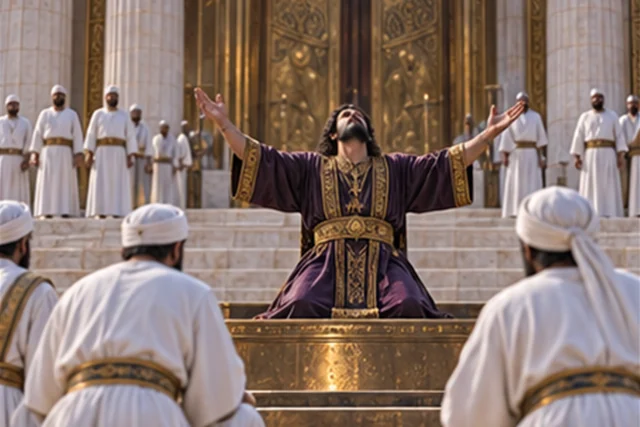
Solomon stands on a bronze platform in the court, then kneels before the people with his hands raised. He praises God as unlike any other, keeping covenant and mercy toward wholehearted servants. God has kept the promise made to David, and Solomon asks that the promised royal line continue. That promise includes a condition: David's descendants must watch their conduct and follow God's law. The king prays in public as a servant who needs help. He cannot turn his inherited throne into a claim that obedience no longer matters.
In everyday life
The park chair kneels beside neighbours planting a memorial tree. She asks the trustees to preserve the fund that supports their park. Her committee role still depends on promises others must keep. She also accepts the duties attached to the fund. Solomon prays to the unique covenant-keeping God, not to a human trust.
Notice
2 Chronicles 6:13 Everyone gathered can see the king on his knees. His posture places royal authority beneath the God whose help he is asking for openly.
2 Chronicles 6:12-17
King James Version12And he stood before the altar of the LORD in the presence of all the congregation of Israel, and spread forth his hands:
13For Solomon had made a brasen scaffold, of five cubits long, and five cubits broad, and three cubits high, and had set it in the midst of the court: and upon it he stood, and kneeled down upon his knees before all the congregation of Israel, and spread forth his hands toward heaven,
14And said, O LORD God of Israel, there is no God like thee in the heaven, nor in the earth; which keepest covenant, and shewest mercy unto thy servants, that walk before thee with all their hearts:
15Thou which hast kept with thy servant David my father that which thou hast promised him; and spakest with thy mouth, and hast fulfilled it with thine hand, as it is this day.
16Now therefore, O LORD God of Israel, keep with thy servant David my father that which thou hast promised him, saying, There shall not fail thee a man in my sight to sit upon the throne of Israel; yet so that thy children take heed to their way to walk in my law, as thou hast walked before me.
17Now then, O LORD God of Israel, let thy word be verified, which thou hast spoken unto thy servant David.
2 Chronicles 6:18-21
Heaven Cannot Hold the God Who Hears
Solomon asks whether God will truly dwell with people on earth. Even the highest heaven cannot hold him, much less this house. Yet Solomon asks God to attend to his cry and keep watch over the place bearing his name, day and night. He asks for the people's prayers toward it to be heard as well. God will hear from heaven, his dwelling place, and forgive. The temple gives the people a place toward which to turn. It does not make God small enough to fit within the building.

In everyday life
The ham-radio operator adjusts a small receiver in her attic and listens for a distant reply. The set gives her a point of contact without containing the source of the voice. Its size does not measure the reach of the exchange. Solomon asks the living God to hear and forgive, not merely to send a message.
Notice
2 Chronicles 6:18 Solomon himself denies that the house can contain God. His prayer holds together a chosen place for worship and a God greater than every created space.
2 Chronicles 6:18-21
King James Version18But will God in very deed dwell with men on the earth? behold, heaven and the heaven of heavens cannot contain thee; how much less this house which I have built!
19Have respect therefore to the prayer of thy servant, and to his supplication, O LORD my God, to hearken unto the cry and the prayer which thy servant prayeth before thee:
20That thine eyes may be open upon this house day and night, upon the place whereof thou hast said that thou wouldest put thy name there; to hearken unto the prayer which thy servant prayeth toward this place.
21Hearken therefore unto the supplications of thy servant, and of thy people Israel, which they shall make toward this place: hear thou from thy dwelling place, even from heaven; and when thou hearest, forgive.
2 Chronicles 6:22-27
Solomon Prays About Guilt Defeat and Drought
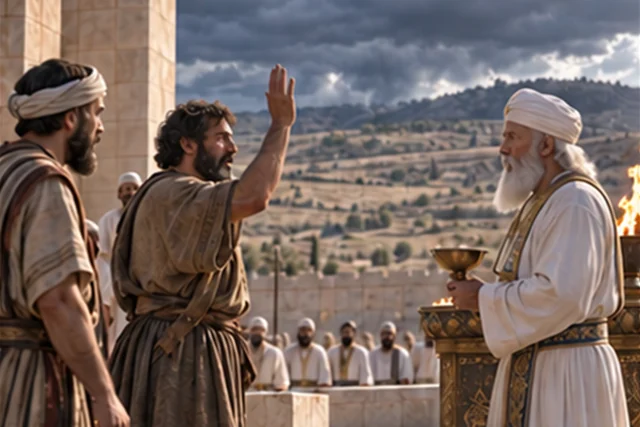
An oath at the altar can follow a wrong done to a neighbour. Solomon asks God to judge it. The guilty should receive the result of the wrong, and the innocent should be cleared. He then speaks of Israel losing a battle because of sin. If the people turn back and confess, he asks God to forgive and restore them to their land. He makes a similar plea for drought brought by sin. After prayer and changed conduct, may God forgive, teach the right way and send rain. Justice and mercy both belong in these requests.
In everyday life
The dispute mediator listens as two tenants give opposing accounts of a damaged flat. One needs correction and the other needs to be cleared. Ending the argument without facing the truth would not repair it. She also leaves room for an honest admission and repair. Solomon asks God for judgement, forgiveness and the restoration of land and rain.
Notice
2 Chronicles 6:27 Teaching accompanies the request for rain after drought. Relief is joined to learning the way to live, rather than returning unchanged to the same conduct.
2 Chronicles 6:22-27
King James Version22If a man sin against his neighbour, and an oath be laid upon him to make him swear, and the oath come before thine altar in this house;
23Then hear thou from heaven, and do, and judge thy servants, by requiting the wicked, by recompensing his way upon his own head; and by justifying the righteous, by giving him according to his righteousness.
24And if thy people Israel be put to the worse before the enemy, because they have sinned against thee; and shall return and confess thy name, and pray and make supplication before thee in this house;
25Then hear thou from the heavens, and forgive the sin of thy people Israel, and bring them again unto the land which thou gavest to them and to their fathers.
26When the heaven is shut up, and there is no rain, because they have sinned against thee; yet if they pray toward this place, and confess thy name, and turn from their sin, when thou dost afflict them;
27Then hear thou from heaven, and forgive the sin of thy servants, and of thy people Israel, when thou hast taught them the good way, wherein they should walk; and send rain upon thy land, which thou hast given unto thy people for an inheritance.
2 Chronicles 6:28-31
Every Person's Hidden Grief Is Known
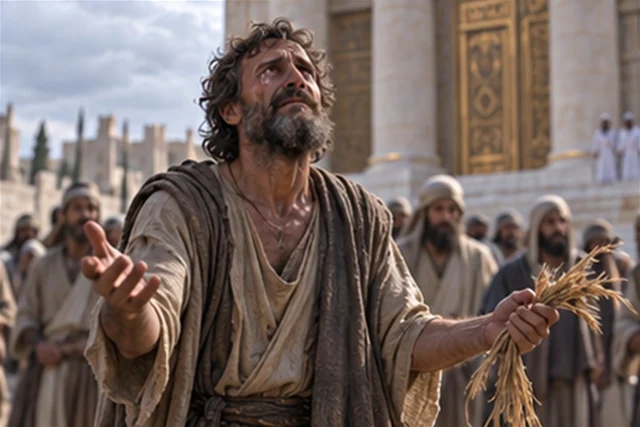
The prayer turns to famine, disease, damaged crops, insects and enemy siege. Solomon includes any suffering that moves a person or the whole people to stretch out hands in prayer. Each knows a particular wound and grief. He asks God to hear from heaven, forgive and deal with each according to their ways. Only God knows every human heart. The aim is a people who honour him and follow his ways throughout their lives in the land. National trouble does not erase the private pain within each person's plea.
In everyday life
The hospice visitor stops beside a patient who has said little during the group meeting. A public list of symptoms has not captured the fear held inside that bed. She listens without assuming that every patient grieves in the same way. Attention moves from the ward to one person. Solomon says God alone fully knows each heart.
Notice
2 Chronicles 6:29 The prayer names each person's own wound and grief within a shared disaster. The gathered people are not treated as though they all carry an identical pain.
2 Chronicles 6:28-31
King James Version28If there be dearth in the land, if there be pestilence, if there be blasting, or mildew, locusts, or caterpillers; if their enemies besiege them in the cities of their land; whatsoever sore or whatsoever sickness there be:
29Then what prayer or what supplication soever shall be made of any man, or of all thy people Israel, when every one shall know his own sore and his own grief, and shall spread forth his hands in this house:
30Then hear thou from heaven thy dwelling place, and forgive, and render unto every man according unto all his ways, whose heart thou knowest; (for thou only knowest the hearts of the children of men:)
31That they may fear thee, to walk in thy ways, so long as they live in the land which thou gavest unto our fathers.
2 Chronicles 6:32-35
Foreigners and Distant Fighters Can Pray
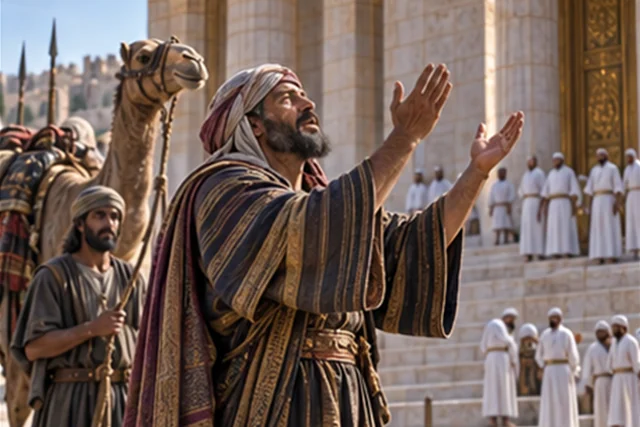
Solomon includes a foreigner who hears of God's greatness and comes from far away to pray. He asks God to answer so every people will know and honour him. The house is not named only for Israel's private benefit. Solomon also prays for Israelites sent by God to fight. When they face toward the chosen city and house, may God hear their plea and uphold their cause. The requests reach in two directions: outsiders can approach, and the people away from home can still seek God's help.
In everyday life
The reception volunteer welcomes a visitor who has travelled far to use a specialist library. She helps him find the desk and respects the effort that brought him there. The building's purpose reaches people outside its local membership. Access matters because the visitor has come with a real need. Solomon asks God to answer foreign prayer and sustain his sent fighters.
Notice
2 Chronicles 6:33 Solomon asks that foreign prayers be heard so all peoples know God. The request gives the temple's name a reach extending past Israel's own borders.
2 Chronicles 6:32-35
King James Version32Moreover concerning the stranger, which is not of thy people Israel, but is come from a far country for thy great name’s sake, and thy mighty hand, and thy stretched out arm; if they come and pray in this house;
33Then hear thou from the heavens, even from thy dwelling place, and do according to all that the stranger calleth to thee for; that all people of the earth may know thy name, and fear thee, as doth thy people Israel, and may know that this house which I have built is called by thy name.
34If thy people go out to war against their enemies by the way that thou shalt send them, and they pray unto thee toward this city which thou hast chosen, and the house which I have built for thy name;
35Then hear thou from the heavens their prayer and their supplication, and maintain their cause.
2 Chronicles 6:36-39
Exiles Can Turn Back from Far Away
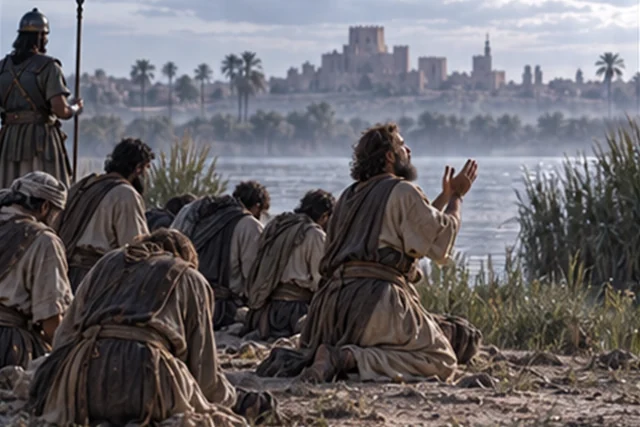
Solomon recognises that everyone sins. He imagines God giving the people over to enemies who carry them into another land. There they may come to their senses, admit their wrongdoing and return to God with their whole hearts. Facing toward their land, chosen city and temple, they can still pray. Solomon asks God to hear from heaven, uphold their cause and forgive. Distance and defeat are not treated as reasons prayer must cease. The plea depends on sincere return to God, not on the captives first reaching the temple doors.
In everyday life
The imprisoned father writes a letter admitting the harm he denied before his sentence. He cannot walk home to repair the relationship at once, but he stops using distance as a reason for silence. The letter begins with responsibility rather than excuses. Solomon prays for a whole exiled people to return inwardly to God and receive forgiveness.
Notice
2 Chronicles 6:38 The captives are still in the foreign land when they turn with their whole hearts. Their return to God begins before any return to their own soil.
2 Chronicles 6:36-39
King James Version36If they sin against thee, (for there is no man which sinneth not,) and thou be angry with them, and deliver them over before their enemies, and they carry them away captives unto a land far off or near;
37Yet if they bethink themselves in the land whither they are carried captive, and turn and pray unto thee in the land of their captivity, saying, We have sinned, we have done amiss, and have dealt wickedly;
38If they return to thee with all their heart and with all their soul in the land of their captivity, whither they have carried them captives, and pray toward their land, which thou gavest unto their fathers, and toward the city which thou hast chosen, and toward the house which I have built for thy name:
39Then hear thou from the heavens, even from thy dwelling place, their prayer and their supplications, and maintain their cause, and forgive thy people which have sinned against thee.
2 Chronicles 6:40-42
The Prayer Ends with Welcome and Mercy
The closing requests ask God to watch and listen to prayer in this place. He calls on God to come to his resting place with the ark of his strength. He asks that the priests be clothed with salvation, meaning God's saving help, and that faithful people rejoice in goodness. Finally, he asks God not to reject his anointed king. May God remember the mercies shown to David. The long prayer ends in dependence. A completed house still needs the welcome, help and kindness that only God can give.
In everyday life
The shelter manager finishes arranging beds and stands by the open door as the first residents arrive. Prepared rooms are only the beginning; the place must become a source of safety and care for those entering. She asks the team to stay attentive after the opening night. Solomon seeks God's saving presence and covenant mercy in the temple.
Notice
2 Chronicles 6:42 The final request returns to mercy associated with David. Solomon does not close by pointing to the cost of the building as a reason God owes him an answer.
2 Chronicles 6:40-42
King James Version40Now, my God, let, I beseech thee, thine eyes be open, and let thine ears be attent unto the prayer that is made in this place.
41Now therefore arise, O LORD God, into thy resting place, thou, and the ark of thy strength: let thy priests, O LORD God, be clothed with salvation, and let thy saints rejoice in goodness.
42O LORD God, turn not away the face of thine anointed: remember the mercies of David thy servant.
Details worth noticing
The opening image
2 Chronicles 6:1 begins with “Then said Solomon, The LORD hath said that he would dwell in the thick darkness.”
Where the chapter turns
2 Chronicles 6:23 forms a natural hinge: “Then hear thou from heaven, and do, and judge thy servants, by requiting the wicked, by recompensing his way upon his own head; and by justifying the…”
The final note
2 Chronicles 6:42 leaves the reader with “O LORD God, turn not away the face of thine anointed: remember the mercies of David thy servant.”
A word trail through the chapter
The words Israel, house, LORD, people, name, land help reveal the chapter’s repeated concerns.
KJV words made clear
- behold
- look, or pay close attention
- unto
- to
- thee
- you
- thou
- you
- thy
- your
Music and video connected to the passage
Related media appears when its Scripture reference overlaps this study. Music and video can illuminate a theme while the biblical text remains the foundation.