The big picture
Hail has destroyed much of Egypt's crops, but some grain remains. Pharaoh, the country's king, still holds Israel, God's people, in slavery. Moses and Aaron, the brothers sent to demand release, return with a warning about locusts. Even the king's servants now see their country collapsing. Negotiations follow, yet Pharaoh keeps trying to decide who can leave and what they must leave behind. Darkness will bring the land to a halt.
In this chapter
- Locusts Will Eat What Remains Exodus 10:1-6
God says later generations must hear about these signs.
- Pharaoh Offers Release to Men Alone Exodus 10:7-11
Pharaoh's servants urge him to let the men go.
- The Locusts Leave Nothing Green Exodus 10:12-20
The rod extends over Egypt in Moses' hand, and an east wind blows all day and night.
- Darkness Holds Egypt Still Exodus 10:21-23
At God's command, Moses stretches his hand toward the sky.
- Moses Refuses to Leave the Herds Exodus 10:24-29
Pharaoh now permits the children to go but demands that flocks and herds stay behind.
Central truth
Pharaoh's attempts to control the terms of release fail as locusts consume the remaining food and darkness stops ordinary life.
Scripture beside the summary
Exodus · King James Version · 29Exodus 10:1-6
Locusts Will Eat What Remains
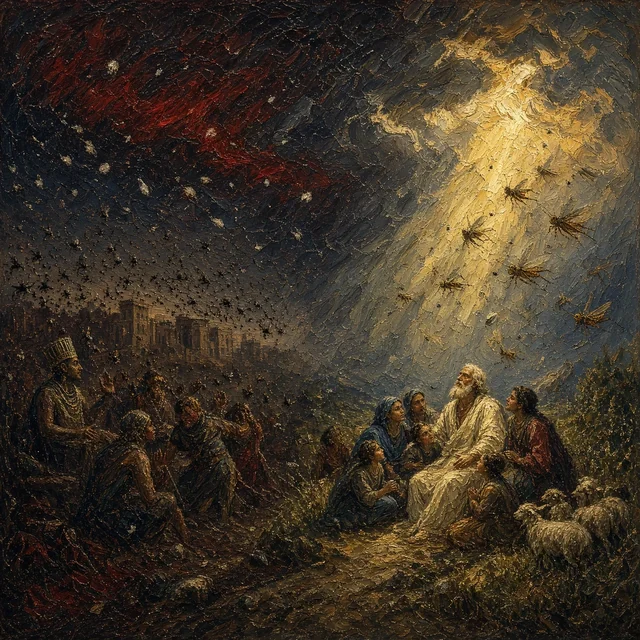
God says later generations must hear about these signs. Parents will tell their children so they can know him. Moses and Aaron ask Pharaoh how long he will refuse to humble himself. If he still holds the people, locusts will arrive the next day. They will cover the ground, consume what the hail left, and fill homes throughout Egypt. No earlier generation there has seen such a swarm. Moses leaves after delivering the warning. The remaining food is now threatened, and the king has another chance to hear before the disaster comes.
In everyday life
A crop adviser points a greenhouse owner toward the last healthy rows after a fungal outbreak. She warns that ignoring the next treatment deadline will leave nothing to harvest. His children listen nearby as he dismisses her again. What happens now will become part of their family memory. The adviser forecasts crop loss; God's signs also reveal who he is to later generations.
Notice
Exodus 10:2 The signs are meant to be told across generations. The confrontation concerns what future families will know about God as well as Pharaoh's immediate answer.
Exodus 10:1-6
King James Version1And the LORD said unto Moses, Go in unto Pharaoh: for I have hardened his heart, and the heart of his servants, that I might shew these my signs before him:
2And that thou mayest tell in the ears of thy son, and of thy son’s son, what things I have wrought in Egypt, and my signs which I have done among them; that ye may know how that I am the LORD.
3And Moses and Aaron came in unto Pharaoh, and said unto him, Thus saith the LORD God of the Hebrews, How long wilt thou refuse to humble thyself before me? let my people go, that they may serve me.
4Else, if thou refuse to let my people go, behold, to morrow will I bring the locusts into thy coast:
5And they shall cover the face of the earth, that one cannot be able to see the earth: and they shall eat the residue of that which is escaped, which remaineth unto you from the hail, and shall eat every tree which groweth for you out of the field:
6And they shall fill thy houses, and the houses of all thy servants, and the houses of all the Egyptians; which neither thy fathers, nor thy fathers’ fathers have seen, since the day that they were upon the earth unto this day. And he turned himself, and went out from Pharaoh.
Exodus 10:7-11
Pharaoh Offers Release to Men Alone
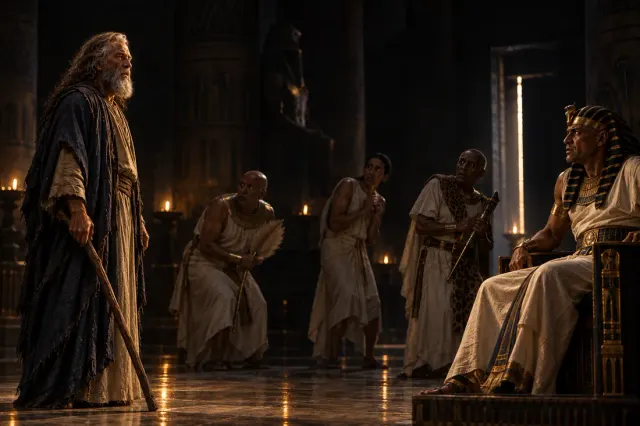
Pharaoh's servants urge him to let the men go. They ask whether he still fails to see that Egypt is ruined. The brothers are brought back, and Pharaoh asks who intends to leave. Moses includes young and old, sons and daughters, flocks and herds. The whole people must hold a feast to the LORD. Pharaoh rejects that answer and allows only the men, accusing the request of concealing harmful intent. He has the brothers driven out. His servants see the cost of refusal, but he still tries to keep part of the people under his control.
In everyday life
An employer offers travel papers to migrant workers but locks away the documents belonging to their families. A worker points to his children beside the packed bags and refuses to leave them behind. The offered exit still keeps the household dependent on the employer. Pharaoh's demand holds an entire people, not the papers of a work crew.
Notice
Exodus 10:9 Moses names children and older people together with the working adults. Worship and release concern the whole people, not only men able to travel alone.
Exodus 10:7-11
King James Version7And Pharaoh’s servants said unto him, How long shall this man be a snare unto us? let the men go, that they may serve the LORD their God: knowest thou not yet that Egypt is destroyed?
8And Moses and Aaron were brought again unto Pharaoh: and he said unto them, Go, serve the LORD your God: but who are they that shall go?
9And Moses said, We will go with our young and with our old, with our sons and with our daughters, with our flocks and with our herds will we go; for we must hold a feast unto the LORD.
10And he said unto them, Let the LORD be so with you, as I will let you go, and your little ones: look to it; for evil is before you.
11Not so: go now ye that are men, and serve the LORD; for that ye did desire. And they were driven out from Pharaoh’s presence.
Exodus 10:12-20
The Locusts Leave Nothing Green
The rod extends over Egypt in Moses' hand, and an east wind blows all day and night. By morning, an unmatched swarm of locusts arrives. They darken the ground and eat the remaining plants and fruit until nothing green remains. Pharaoh quickly summons the brothers, admits sin against God and them, and begs for this deadly trouble to end. Moses prays. God sends a strong west wind that carries every locust into the Red sea, the body of water named here. Yet the LORD hardens Pharaoh's heart, and he still refuses release.
In everyday life
A market gardener stands among bare stems after an insect swarm passes. His supplier hears his urgent apology for ignoring warnings and helps clear the remaining pests. As soon as the insects are gone, he refuses the changes he promised. Empty beds remain around him. Removing pests from a garden is not God's judgment on a kingdom.
Notice
Exodus 10:19 The wind removes every locust, but it does not restore the crops they ate. Relief from the plague leaves Egypt with real losses.
Exodus 10:12-20
King James Version12And the LORD said unto Moses, Stretch out thine hand over the land of Egypt for the locusts, that they may come up upon the land of Egypt, and eat every herb of the land, even all that the hail hath left.
13And Moses stretched forth his rod over the land of Egypt, and the LORD brought an east wind upon the land all that day, and all that night; and when it was morning, the east wind brought the locusts.
14And the locusts went up over all the land of Egypt, and rested in all the coasts of Egypt: very grievous were they; before them there were no such locusts as they, neither after them shall be such.
15For they covered the face of the whole earth, so that the land was darkened; and they did eat every herb of the land, and all the fruit of the trees which the hail had left: and there remained not any green thing in the trees, or in the herbs of the field, through all the land of Egypt.
16Then Pharaoh called for Moses and Aaron in haste; and he said, I have sinned against the LORD your God, and against you.
17Now therefore forgive, I pray thee, my sin only this once, and intreat the LORD your God, that he may take away from me this death only.
18And he went out from Pharaoh, and intreated the LORD.
19And the LORD turned a mighty strong west wind, which took away the locusts, and cast them into the Red sea; there remained not one locust in all the coasts of Egypt.
20But the LORD hardened Pharaoh’s heart, so that he would not let the children of Israel go.
Exodus 10:21-23
Darkness Holds Egypt Still
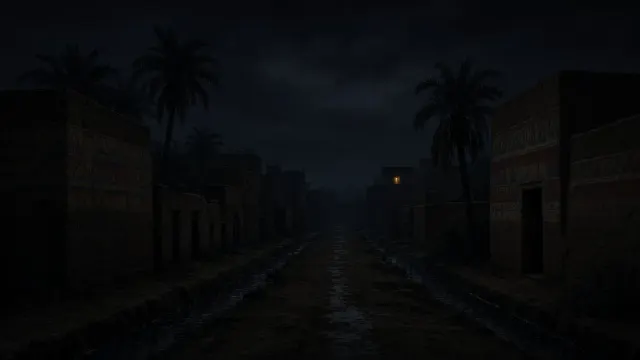
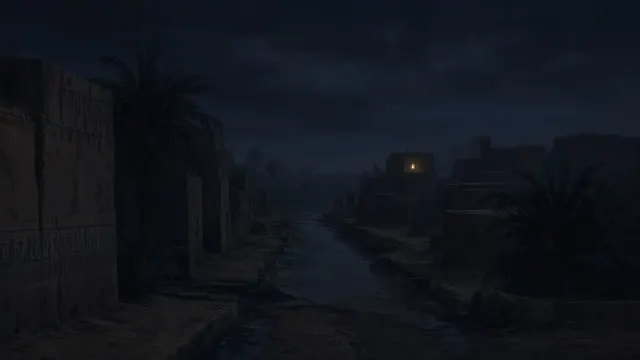
At God's command, Moses stretches his hand toward the sky. Thick darkness covers Egypt for three days. It is described as darkness that can be felt. Neighbours are hidden from each other by the dark. No one gets up to move about for those three days. Israel's households, however, have light where they live. This plague interrupts even the basic ability to move and meet. No bargaining or imitation appears within these verses. The country sits under darkness, while the people Pharaoh refuses to free receive a different condition in their homes.
In everyday life
An underground rail worker switches off his failed torch and stays beside the platform wall. Without light, he cannot judge the edge or see the colleague calling nearby. He waits instead of risking another step. A lit refuge remains out of sight down the tunnel. Egypt's darkness lasts by God's command and spares Israel's dwellings.
Notice
Exodus 10:23 The contrast is between Egyptian immobility and light in Israel's homes. The same land contains sharply different experiences under the announced plague.
Exodus 10:21-23
King James Version21And the LORD said unto Moses, Stretch out thine hand toward heaven, that there may be darkness over the land of Egypt, even darkness which may be felt.
22And Moses stretched forth his hand toward heaven; and there was a thick darkness in all the land of Egypt three days:
23They saw not one another, neither rose any from his place for three days: but all the children of Israel had light in their dwellings.
Exodus 10:24-29
Moses Refuses to Leave the Herds
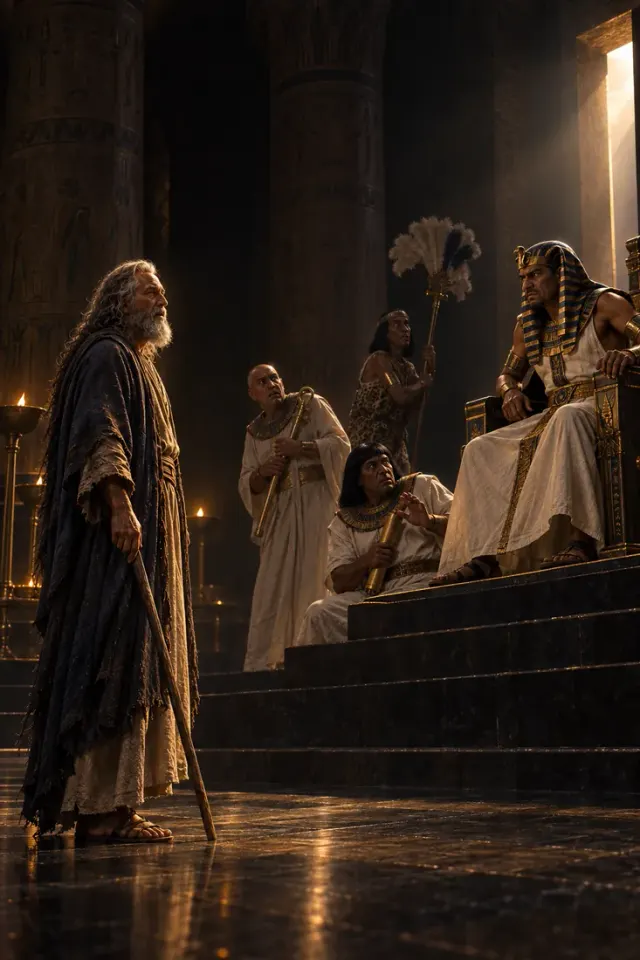
Pharaoh now permits the children to go but demands that flocks and herds stay behind. Moses refuses. Animals are needed for sacrifice, and they will not know every requirement until they arrive. Not one hoof is to remain. The LORD hardens Pharaoh's heart, and the king refuses release again. Pharaoh then orders Moses away and threatens death if he appears before him again. Moses accepts that they will not meet in that way again. The discussion ends without agreement, with the king turning from conditions to a direct threat.
In everyday life
A removals driver watches a former landlord open the front door but block access to a family's tools and van. The father says they cannot begin again without the things needed for their work. The landlord orders him off the property. Permission that keeps necessities captive is incomplete. Israel needs the herds for worship commanded by God.
Notice
Exodus 10:26 Moses says the needed sacrifices are not yet fully known. Leaving animals behind would let Pharaoh limit obedience to instructions God has still to give.
Exodus 10:24-29
King James Version24And Pharaoh called unto Moses, and said, Go ye, serve the LORD; only let your flocks and your herds be stayed: let your little ones also go with you.
25And Moses said, Thou must give us also sacrifices and burnt offerings, that we may sacrifice unto the LORD our God.
26Our cattle also shall go with us; there shall not an hoof be left behind; for thereof must we take to serve the LORD our God; and we know not with what we must serve the LORD, until we come thither.
27But the LORD hardened Pharaoh’s heart, and he would not let them go.
28And Pharaoh said unto him, Get thee from me, take heed to thyself, see my face no more; for in that day thou seest my face thou shalt die.
29And Moses said, Thou hast spoken well, I will see thy face again no more.
Details worth noticing
The opening image
Exodus 10:1 begins with “And the LORD said unto Moses, Go in unto Pharaoh: for I have hardened his heart, and the heart of his servants, that I might shew these my signs before…”
Where the chapter turns
Exodus 10:16 forms a natural hinge: “Then Pharaoh called for Moses and Aaron in haste; and he said, I have sinned against the LORD your God, and against you.”
The final note
Exodus 10:29 leaves the reader with “And Moses said, Thou hast spoken well, I will see thy face again no more.”
A word trail through the chapter
The words LORD, Moses, Egypt, land, Pharaoh, serve help reveal the chapter’s repeated concerns.
KJV words made clear
- residue
- What remains after loss or removal, here the crops left after hail.
- snare
- A trap, used here for a source of ruin.
Music and video connected to the passage
Related media appears when its Scripture reference overlaps this study. Music and video can illuminate a theme while the biblical text remains the foundation.