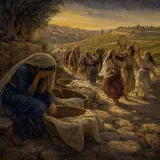
The big picture
Promises of return now reach every family of Israel, God's people. Through Jeremiah, his prophet, God speaks to those scattered from the northern and southern kingdoms. Grief over lost children is answered with hope, and roads of departure become routes home. The restored life includes fields, worship, and a new covenant. In that binding relationship, God's law is written within the people. The chapter joins familiar work and shared joy to forgiveness and lasting belonging, grounded in the Creator's own faithfulness.
In this chapter
- Lasting Love Will Rebuild Shared Life Jeremiah 31:1-6
Every family among God's people is included in his promise of belonging.
- The Returning Company Includes the Vulnerable Jeremiah 31:7-14
Singing and prayer are called for as God promises to save the surviving community.
- A Weeping Mother Hears of Returning Children Jeremiah 31:15-20
A lament is heard at Ramah, a town associated here with the people's grief.
- The Road Home Is Marked for Renewal Jeremiah 31:21-26
God tells the exiles to set up road markers and attend to the route they travelled away.
- Renewal Comes with Personal Accountability Jeremiah 31:27-30
Both kingdoms will be filled with people and animals, God says.
- The New Covenant Reaches the Heart Jeremiah 31:31-34
God promises a new covenant with both parts of his people.
- Creation Bears Witness to Lasting Belonging Jeremiah 31:35-40
God sets the paths of the sun, moon, and stars.
Central truth
Gathering and joy are promised to the scattered people, along with a new covenant marked by inward knowledge of God and forgiveness.

Scripture beside the summary
Jeremiah · King James Version · 40Jeremiah 31:1-6
Lasting Love Will Rebuild Shared Life
Every family among God's people is included in his promise of belonging. Those surviving the sword find favour and rest after wilderness hardship. He speaks of love that lasts and kindness that draws them to him. The people will be rebuilt and again dance with instruments. They will plant vineyards in Samaria, the northern hill country, and enjoy their fruit. Watchmen in Ephraim, a northern tribal region, will call people to worship at Zion, the holy hill in Jerusalem, their city of worship. Renewal joins food, celebration, and worship across places once marked by division and loss.
In everyday life
A vineyard worker returns to a neglected family slope and plants new vines where old rows have disappeared. Neighbours begin arranging a shared harvest meal while the plants are still small. The return has room for work and celebration together. God promises lasting love and restored worship for a people, not only a productive vineyard.
Notice
Jeremiah 31:5 The planters will eat the fruit of their own vines. Restoration includes enjoying the ordinary result of their labour rather than planting for someone else to seize.
Jeremiah 31:1-6
King James Version1At the same time, saith the LORD, will I be the God of all the families of Israel, and they shall be my people.
2Thus saith the LORD, The people which were left of the sword found grace in the wilderness; even Israel, when I went to cause him to rest.
3The LORD hath appeared of old unto me, saying, Yea, I have loved thee with an everlasting love: therefore with lovingkindness have I drawn thee.
4Again I will build thee, and thou shalt be built, O virgin of Israel: thou shalt again be adorned with thy tabrets, and shalt go forth in the dances of them that make merry.
5Thou shalt yet plant vines upon the mountains of Samaria: the planters shall plant, and shall eat them as common things.
6For there shall be a day, that the watchmen upon the mount Ephraim shall cry, Arise ye, and let us go up to Zion unto the LORD our God.
Jeremiah 31:7-14
The Returning Company Includes the Vulnerable
Singing and prayer are called for as God promises to save the surviving community. He will gather them from the north and distant places, including blind and disabled people and women pregnant or giving birth. He will lead them with tears and prayer beside water on a level path. He calls himself their father. Nations must hear that the God who scattered the flock will gather and guard it. Freed from a stronger captor, the people will enjoy grain, wine, oil, and livestock. Mourning becomes joy, and priests and households alike share his goodness.

In everyday life
A reunion transport organiser checks that the returning group's route includes ramps, rest stops, and room for a woman nearing childbirth. She does not plan only for those who travel fastest. The route must serve the whole group. God gathers and sustains an exiled people as Father and shepherd, which transport planning cannot guarantee.
Notice
Jeremiah 31:8 People who find travel difficult are named among those returning. Their presence shows that the promised gathering is not limited to the strong and mobile.
Jeremiah 31:7-14
King James Version7For thus saith the LORD; Sing with gladness for Jacob, and shout among the chief of the nations: publish ye, praise ye, and say, O LORD, save thy people, the remnant of Israel.
8Behold, I will bring them from the north country, and gather them from the coasts of the earth, and with them the blind and the lame, the woman with child and her that travaileth with child together: a great company shall return thither.
9They shall come with weeping, and with supplications will I lead them: I will cause them to walk by the rivers of waters in a straight way, wherein they shall not stumble: for I am a father to Israel, and Ephraim is my firstborn.
10Hear the word of the LORD, O ye nations, and declare it in the isles afar off, and say, He that scattered Israel will gather him, and keep him, as a shepherd doth his flock.
11For the LORD hath redeemed Jacob, and ransomed him from the hand of him that was stronger than he.
12Therefore they shall come and sing in the height of Zion, and shall flow together to the goodness of the LORD, for wheat, and for wine, and for oil, and for the young of the flock and of the herd: and their soul shall be as a watered garden; and they shall not sorrow any more at all.
13Then shall the virgin rejoice in the dance, both young men and old together: for I will turn their mourning into joy, and will comfort them, and make them rejoice from their sorrow.
14And I will satiate the soul of the priests with fatness, and my people shall be satisfied with my goodness, saith the LORD.
Jeremiah 31:15-20
A Weeping Mother Hears of Returning Children
A lament is heard at Ramah, a town associated here with the people's grief. Rahel, an ancestral mother, is pictured weeping for absent children and refusing comfort. God promises that they will return from enemy land, giving hope for her future. Ephraim, standing for the northern people, then admits to being stubborn under correction and asks God to turn him back. Shame and regret follow learning. God responds as a father who still remembers a dear son despite speaking against him. His deep concern will result in mercy.

In everyday life
An aunt waits on a railway platform with news that her missing nephew is coming home. His mother keeps looking down the empty tracks, still unable to take it in. The aunt holds her hand as the first carriage comes into view. Rahel stands for a whole people whose return God promises, not one family's reunion.
Notice
Jeremiah 31:20 God remembers the dear son even after speaking against him. The correction has not erased affection, and the promised mercy comes from that continuing bond.
Jeremiah 31:15-20
King James Version15Thus saith the LORD; A voice was heard in Ramah, lamentation, and bitter weeping; Rahel weeping for her children refused to be comforted for her children, because they were not.
16Thus saith the LORD; Refrain thy voice from weeping, and thine eyes from tears: for thy work shall be rewarded, saith the LORD; and they shall come again from the land of the enemy.
17And there is hope in thine end, saith the LORD, that thy children shall come again to their own border.
18I have surely heard Ephraim bemoaning himself thus; Thou hast chastised me, and I was chastised, as a bullock unaccustomed to the yoke: turn thou me, and I shall be turned; for thou art the LORD my God.
19Surely after that I was turned, I repented; and after that I was instructed, I smote upon my thigh: I was ashamed, yea, even confounded, because I did bear the reproach of my youth.
20Is Ephraim my dear son? is he a pleasant child? for since I spake against him, I do earnestly remember him still: therefore my bowels are troubled for him; I will surely have mercy upon him, saith the LORD.
Jeremiah 31:21-26
The Road Home Is Marked for Renewal
God tells the exiles to set up road markers and attend to the route they travelled away. They are called to return to their cities. God also announces a new thing involving a woman surrounding a man; the precise meaning is unclear. In the restored land, people will again bless the home of justice and holiness. Farmers and shepherds will live together in its towns. God will satisfy the weary and replenish those weighed down by sorrow. The speaker then wakes from sleep that has been sweet, after hearing this promise of renewed life.

In everyday life
The cave guide touches an arrow fixed to the rock on the outward route. Her tired group follows these marks back towards daylight. At each fork she checks the next arrow before taking a step, until the entrance opens ahead. God promises to renew a nation's life, while her marked route only leads people out of a cave.
Notice
Jeremiah 31:21 The return follows the route once used to leave. Marking that road turns remembered departure into practical guidance for coming home rather than treating the loss as forgotten.
Jeremiah 31:21-26
King James Version21Set thee up waymarks, make thee high heaps: set thine heart toward the highway, even the way which thou wentest: turn again, O virgin of Israel, turn again to these thy cities.
22How long wilt thou go about, O thou backsliding daughter? for the LORD hath created a new thing in the earth, A woman shall compass a man.
23Thus saith the LORD of hosts, the God of Israel; As yet they shall use this speech in the land of Judah and in the cities thereof, when I shall bring again their captivity; The LORD bless thee, O habitation of justice, and mountain of holiness.
24And there shall dwell in Judah itself, and in all the cities thereof together, husbandmen, and they that go forth with flocks.
25For I have satiated the weary soul, and I have replenished every sorrowful soul.
26Upon this I awaked, and beheld; and my sleep was sweet unto me.
Jeremiah 31:27-30
Renewal Comes with Personal Accountability
Both kingdoms will be filled with people and animals, God says. He pictures them as seed sown into land. He watched over uprooting and destruction; now he will watch over building and planting. A familiar saying about fathers eating sour grapes while children's teeth suffer will no longer describe the people's judgement. Each will die for personal wrongdoing. Whoever eats the sour fruit will feel its effect. The renewed community is not invited to deny the past, but its members cannot explain their own standing only through what earlier generations did.
In everyday life
A learner driver blames his father's poor teaching after striking a gatepost. The instructor points to the clear warning he ignored that morning. His father's mistakes are real, but they did not turn the wheel at that moment. Jeremiah speaks of guilt that brings death, not responsibility for a damaged car.
Notice
Jeremiah 31:30 The sour grape's effect belongs to the one who eats it. The image makes personal responsibility concrete instead of allowing present guilt to be assigned entirely to ancestors.
Jeremiah 31:27-30
King James Version27Behold, the days come, saith the LORD, that I will sow the house of Israel and the house of Judah with the seed of man, and with the seed of beast.
28And it shall come to pass, that like as I have watched over them, to pluck up, and to break down, and to throw down, and to destroy, and to afflict; so will I watch over them, to build, and to plant, saith the LORD.
29In those days they shall say no more, The fathers have eaten a sour grape, and the children’s teeth are set on edge.
30But every one shall die for his own iniquity: every man that eateth the sour grape, his teeth shall be set on edge.
Jeremiah 31:31-34
The New Covenant Reaches the Heart
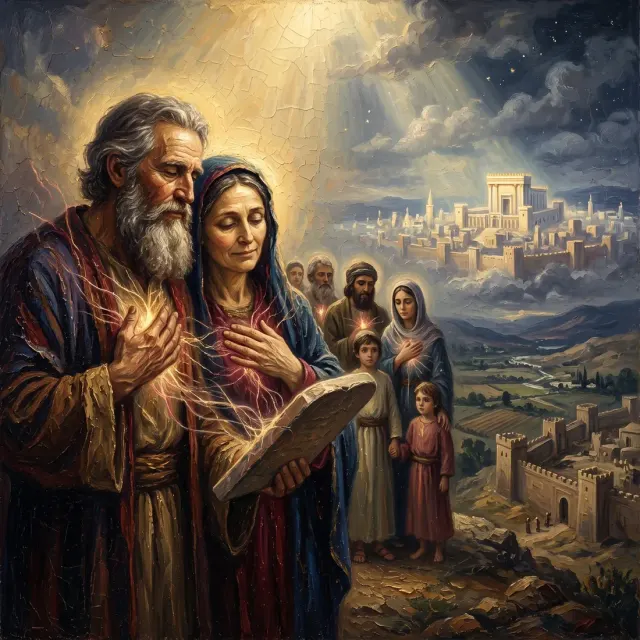
God promises a new covenant with both parts of his people. It will differ from the covenant their ancestors broke after he led them out of Egypt, the land of slavery. He had cared for them like a husband, yet they betrayed that bond. Now he will place his law within them and write it on their hearts. They will belong to him, and he to them. All will know him, from least to greatest, without needing the same call from neighbours. He will forgive their guilt and no longer hold their sin against them.
In everyday life
The pastry apprentice shapes a loaf by feel as her teacher watches from across the bench. The recipe card stays tucked away. Practice has made each fold familiar, so she no longer stops for an order at every step. God's promised bond includes forgiveness and knowing him, which learned movements in a bakery cannot give.
Notice
Jeremiah 31:34 Knowing the Lord extends from least to greatest. The promise removes rank as a barrier to that knowledge and joins it directly to God's forgiveness of sin.
Jeremiah 31:31-34
King James Version31Behold, the days come, saith the LORD, that I will make a new covenant with the house of Israel, and with the house of Judah:
32Not according to the covenant that I made with their fathers in the day that I took them by the hand to bring them out of the land of Egypt; which my covenant they brake, although I was an husband unto them, saith the LORD:
33But this shall be the covenant that I will make with the house of Israel; After those days, saith the LORD, I will put my law in their inward parts, and write it in their hearts; and will be their God, and they shall be my people.
34And they shall teach no more every man his neighbour, and every man his brother, saying, Know the LORD: for they shall all know me, from the least of them unto the greatest of them, saith the LORD: for I will forgive their iniquity, and I will remember their sin no more.
Jeremiah 31:35-40
Creation Bears Witness to Lasting Belonging
God sets the paths of the sun, moon, and stars. He pledges to keep his people too. They will cease to be a nation only if that fixed order fails. He will reject them all only if humans can measure the sky and search earth's depths. Then he describes the city's new limits, using towers, gates, and hills to trace them. The land where corpses and ashes lie will also belong wholly to him. His pledge reaches ground once made unclean by death. The rebuilt city will never again be torn down.
In everyday life
A land surveyor extends a rebuilding map across an abandoned waste site once excluded from plans. The boundary line now includes ground everyone had written off. She checks each marker before placing the final stake. God guarantees a holy city's lasting future by his rule over creation; a surveyor can only record planned boundaries.
Notice
Jeremiah 31:40 Ground associated with bodies and ashes is included in the holy city. Renewal reaches places marked by uncleanness rather than rebuilding only the already honoured areas.
Jeremiah 31:35-40
King James Version35Thus saith the LORD, which giveth the sun for a light by day, and the ordinances of the moon and of the stars for a light by night, which divideth the sea when the waves thereof roar; The LORD of hosts is his name:
36If those ordinances depart from before me, saith the LORD, then the seed of Israel also shall cease from being a nation before me for ever.
37Thus saith the LORD; If heaven above can be measured, and the foundations of the earth searched out beneath, I will also cast off all the seed of Israel for all that they have done, saith the LORD.
38Behold, the days come, saith the LORD, that the city shall be built to the LORD from the tower of Hananeel unto the gate of the corner.
39And the measuring line shall yet go forth over against it upon the hill Gareb, and shall compass about to Goath.
40And the whole valley of the dead bodies, and of the ashes, and all the fields unto the brook of Kidron, unto the corner of the horse gate toward the east, shall be holy unto the LORD; it shall not be plucked up, nor thrown down any more for ever.
Details worth noticing
The opening image
Jeremiah 31:1 begins with “At the same time, saith the LORD, will I be the God of all the families of Israel, and they shall be my people.”
Where the chapter turns
Jeremiah 31:20 forms a natural hinge: “Is Ephraim my dear son? is he a pleasant child? for since I spake against him, I do earnestly remember him still: therefore my bowels are troubled for him…”
The final note
Jeremiah 31:40 leaves the reader with “And the whole valley of the dead bodies, and of the ashes, and all the fields unto the brook of Kidron, unto the corner of the horse gate toward the east…”
A word trail through the chapter
The words LORD, Israel, days, house, people, covenant help reveal the chapter’s repeated concerns.
KJV words made clear
- tabrets
- Small percussion instruments played during celebration and dancing.
- waymarks
- Markers placed along a road to show travellers the route.
- husbandmen
- Farmers who cultivate land and care for its crops.
- satiated
- Fully satisfied or supplied with what was needed.
Music and video connected to the passage
Related media appears when its Scripture reference overlaps this study. Music and video can illuminate a theme while the biblical text remains the foundation.