The big picture
Nicodemus visits Jesus at night. He is a religious leader from the Pharisees, a group strict about God's law. He recognises a teacher helped by God, but Jesus speaks of a new birth that unsettles his categories. The chapter connects this birth with God's Spirit, the lifting up of the Son, and God's love for the world. Later, John the Baptist faces concern that Jesus is drawing a larger following. He responds with joy that the one he announced is taking the central place.
In this chapter
- Nicodemus Hears of Birth from the Spirit John 3:1-8
Nicodemus tells Jesus that his signs show God's presence with him.
- The Son Must Be Lifted Up John 3:9-15
Nicodemus asks how this can happen.
- God’s Love Offers Life in the Light John 3:16-21
God loves the world and gives his unique Son so that believers receive lasting life rather than perish.
- John Welcomes His Own Smaller Place John 3:22-30
Jesus and his followers spend time in Judæa, the southern region, where baptism is taking place.
- The Son Speaks What Comes from Heaven John 3:31-36
The one from above stands above all, while earthly people speak from their limited place.
Central truth
God gives new life through his Son and Spirit, calling people out of darkness into a trust that receives rather than controls.

Scripture beside the summary
John · King James Version · 36John 3:1-8
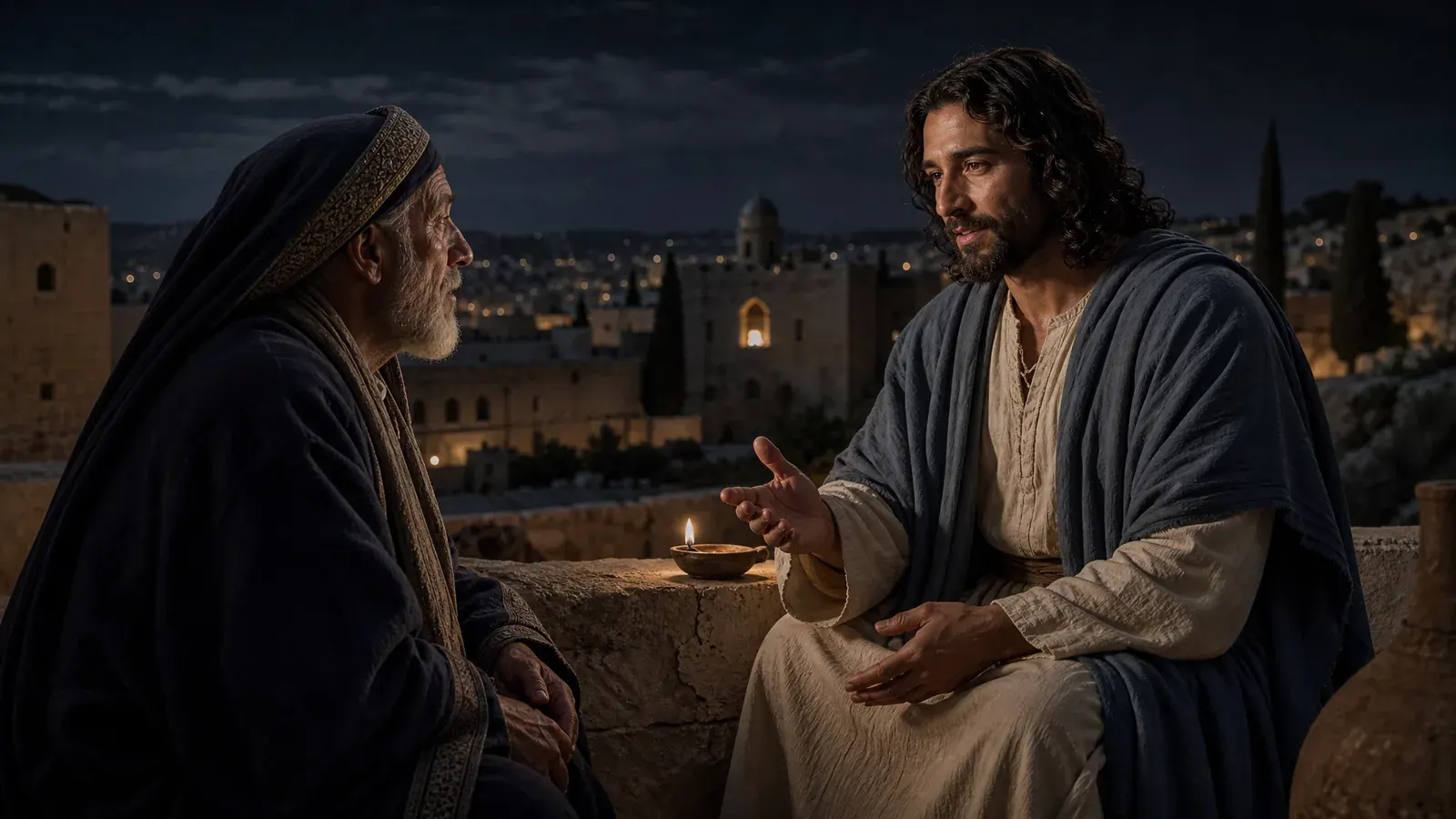
Nicodemus Hears of Birth from the Spirit
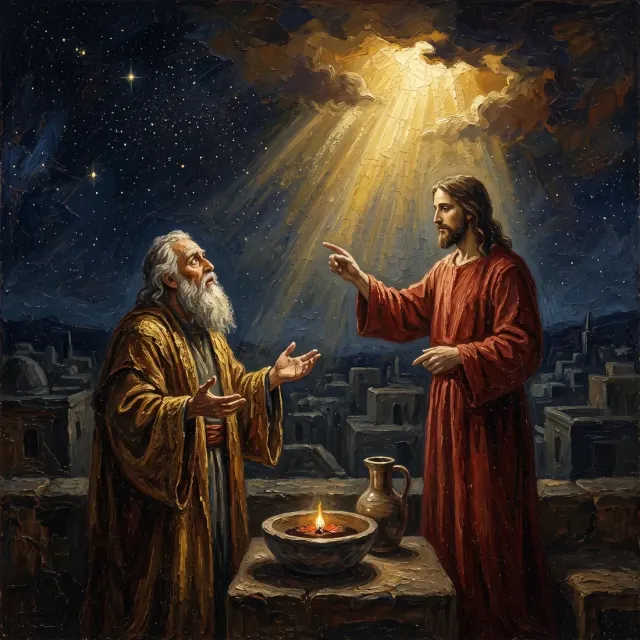
Nicodemus tells Jesus that his signs show God's presence with him. Jesus replies that seeing God's kingdom requires being born again. Nicodemus imagines repeating physical birth and asks how an old man can do that. Jesus speaks of birth through water and the Spirit. Christians differ on how water here relates to baptism and cleansing. Human birth gives human life; God's Spirit gives spiritual life. Jesus compares the Spirit's work to wind whose sound can be heard even though its route is beyond control. Nicodemus needs a life God gives, not a way to restart his body or add another achievement to his religious standing.
In everyday life
An adoption applicant sits with a child who asks which exam earns a place in the new home. The adult explains that belonging is being offered through a relationship, not through a score the child can control. Receiving is different from producing. Jesus speaks of birth by God's Spirit, not the human legal process of adoption.
Notice
John 3:8 Wind can be heard without being controlled by the hearer. Jesus uses its freedom to describe the Spirit's work rather than offering Nicodemus a technique.
John 3:1-8
King James Version1There was a man of the Pharisees, named Nicodemus, a ruler of the Jews:
2The same came to Jesus by night, and said unto him, Rabbi, we know that thou art a teacher come from God: for no man can do these miracles that thou doest, except God be with him.
3Jesus answered and said unto him, Verily, verily, I say unto thee, Except a man be born again, he cannot see the kingdom of God.
4Nicodemus saith unto him, How can a man be born when he is old? can he enter the second time into his mother’s womb, and be born?
5Jesus answered, Verily, verily, I say unto thee, Except a man be born of water and of the Spirit, he cannot enter into the kingdom of God.
6That which is born of the flesh is flesh; and that which is born of the Spirit is spirit.
7Marvel not that I said unto thee, Ye must be born again.
8The wind bloweth where it listeth, and thou hearest the sound thereof, but canst not tell whence it cometh, and whither it goeth: so is every one that is born of the Spirit.
John 3:9-15
The Son Must Be Lifted Up
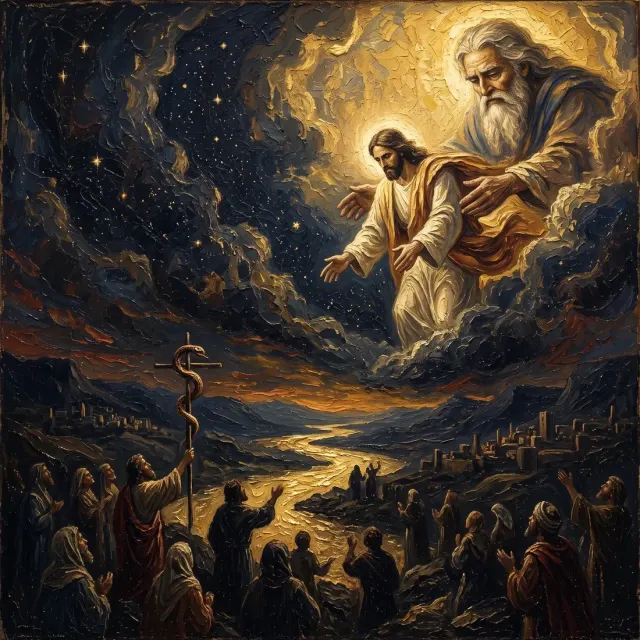
Nicodemus asks how this can happen. Jesus questions how a teacher of Israel, God's people, has missed it. The problem is not lack of religious rank but failure to receive testimony. If earthly comparisons are resisted, heavenly truth will also be hard to receive. Jesus identifies himself as the Son of man who came from heaven. He recalls Moses, the lawgiver, lifting a serpent in the wilderness. In a similar way the Son of man must be lifted up so those believing in him receive eternal life instead of perishing. The image points toward his death as the means through which life is given.
In everyday life
A navigation tutor asks an experienced sailor to trust a rescue beacon rather than his own guess through fog. His years at sea do not create sight where there is none. The signal offers a point on which to act. Jesus is himself lifted up to give eternal life, not only a guide marking a safe route.
Notice
John 3:14 Jesus links being lifted up with the gift of life to believers. The coming death is presented as the way of rescue, not a defeat outside God's purpose.
John 3:9-15
King James Version9Nicodemus answered and said unto him, How can these things be?
10Jesus answered and said unto him, Art thou a master of Israel, and knowest not these things?
11Verily, verily, I say unto thee, We speak that we do know, and testify that we have seen; and ye receive not our witness.
12If I have told you earthly things, and ye believe not, how shall ye believe, if I tell you of heavenly things?
13And no man hath ascended up to heaven, but he that came down from heaven, even the Son of man which is in heaven.
14And as Moses lifted up the serpent in the wilderness, even so must the Son of man be lifted up:
15That whosoever believeth in him should not perish, but have eternal life.
John 3:16-21
God’s Love Offers Life in the Light
God loves the world and gives his unique Son so that believers receive lasting life rather than perish. The Son is sent to save, not merely to condemn. Yet refusing him leaves people under judgement because they reject the one God gives. John explains this through light and darkness. People doing evil avoid the light because it exposes their deeds. Those living truthfully come into it, showing that their work depends on God. The difference is not only a shortage of information. Love of hidden wrongdoing can make a person resist the light that offers rescue. God's gift calls for a real response.
In everyday life
A homeowner discovers dangerous wiring but refuses the electrician's lamp because it will reveal repairs he concealed from buyers. The offer of help becomes unwelcome because he wants the fault to stay hidden. Light is resisted for what it exposes. God gives his Son for salvation, not only an expert offering to correct a house's defects.
Notice
John 3:21 Coming to the light reveals deeds done in God. Truthful response does not claim independence from God but allows that dependence to be seen.
John 3:16-21
King James Version16For God so loved the world, that he gave his only begotten Son, that whosoever believeth in him should not perish, but have everlasting life.
17For God sent not his Son into the world to condemn the world; but that the world through him might be saved.
18He that believeth on him is not condemned: but he that believeth not is condemned already, because he hath not believed in the name of the only begotten Son of God.
19And this is the condemnation, that light is come into the world, and men loved darkness rather than light, because their deeds were evil.
20For every one that doeth evil hateth the light, neither cometh to the light, lest his deeds should be reproved.
21But he that doeth truth cometh to the light, that his deeds may be made manifest, that they are wrought in God.
John 3:22-30
John Welcomes His Own Smaller Place
Jesus and his followers spend time in Judæa, the southern region, where baptism is taking place. John baptizes at Ænon near Salim, a place with abundant water. A dispute about cleansing leads his followers to complain that people are going to Jesus. John says a person receives only what heaven gives. He had never claimed to be the Christ, God's promised king, but the messenger sent ahead. He compares himself to a bridegroom's friend, delighted to hear the groom arrive. Jesus' growing place fulfils John's joy. His own public role must become smaller because the one he served has come.
In everyday life
The wedding best man checks the room one last time, then steps away as the couple enters. Guests turn from his announcements to the people the day is for. He smiles because losing the room's attention means his task has succeeded. John yields to God's Christ, not merely to a friend receiving ceremonial honour.
Notice
John 3:30 John's smaller role is necessary as Jesus takes the greater place. He measures success by the coming one's place, not by retaining his own audience.
John 3:22-30
King James Version22After these things came Jesus and his disciples into the land of Judæa; and there he tarried with them, and baptized.
23And John also was baptizing in Ænon near to Salim, because there was much water there: and they came, and were baptized.
24For John was not yet cast into prison.
25Then there arose a question between some of John’s disciples and the Jews about purifying.
26And they came unto John, and said unto him, Rabbi, he that was with thee beyond Jordan, to whom thou barest witness, behold, the same baptizeth, and all men come to him.
27John answered and said, A man can receive nothing, except it be given him from heaven.
28Ye yourselves bear me witness, that I said, I am not the Christ, but that I am sent before him.
29He that hath the bride is the bridegroom: but the friend of the bridegroom, which standeth and heareth him, rejoiceth greatly because of the bridegroom’s voice: this my joy therefore is fulfilled.
30He must increase, but I must decrease.
John 3:31-36
The Son Speaks What Comes from Heaven
The one from above stands above all, while earthly people speak from their limited place. Jesus testifies to what he has seen and heard, even though many refuse it. Receiving his testimony affirms that God is true. The one God sends speaks God's words and receives the Spirit without measure. The Father loves the Son and places everything in his hands. Trust in the Son brings eternal life; refusing him leaves a person without that life and under God's wrath. The chapter returns to the weight of response. Jesus is not one competing teacher among equals but the Son entrusted with the Father's gift of life.
In everyday life
A mountain-weather observer returns from the summit with measurements while people in the valley guess from patches of cloud. Accepting her report means trusting evidence from a place they have not reached. The sources of knowledge are unequal. Jesus speaks from heaven as the Father's Son, not from a higher viewpoint reached by human effort.
Notice
John 3:35 The Father's love and his gift of all things to the Son belong together. The Son's authority is described within that relationship, not as a rival claim.
John 3:31-36
King James Version31He that cometh from above is above all: he that is of the earth is earthly, and speaketh of the earth: he that cometh from heaven is above all.
32And what he hath seen and heard, that he testifieth; and no man receiveth his testimony.
33He that hath received his testimony hath set to his seal that God is true.
34For he whom God hath sent speaketh the words of God: for God giveth not the Spirit by measure unto him.
35The Father loveth the Son, and hath given all things into his hand.
36He that believeth on the Son hath everlasting life: and he that believeth not the Son shall not see life; but the wrath of God abideth on him.
Details worth noticing
The opening image
John 3:1 begins with “There was a man of the Pharisees, named Nicodemus, a ruler of the Jews:”
Where the chapter turns
John 3:21 forms a natural hinge: “But he that doeth truth cometh to the light, that his deeds may be made manifest, that they are wrought in God.”
The final note
John 3:36 leaves the reader with “He that believeth on the Son hath everlasting life: and he that believeth not the Son shall not see life; but the wrath of God abideth on him.”
A word trail through the chapter
The words born, believeth, verily, cometh, heaven, Jesus help reveal the chapter’s repeated concerns.
KJV words made clear
- listeth
- Wishes or chooses, used here of the wind.
- only begotten
- Describes the Son’s unique relationship to the Father.
- wrath
- God’s settled opposition and judgement against sin.
Music and video connected to the passage
Related media appears when its Scripture reference overlaps this study. Music and video can illuminate a theme while the biblical text remains the foundation.