The big picture
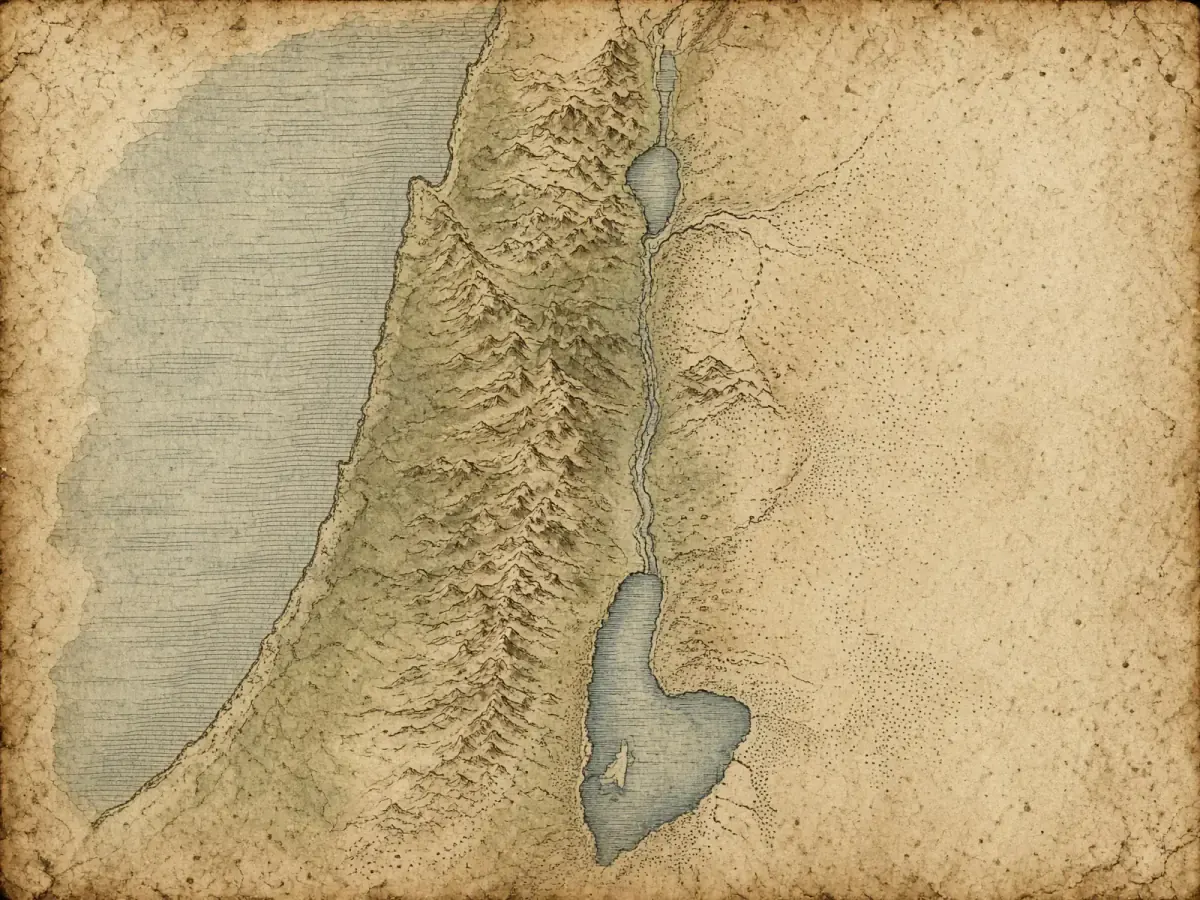
Travelling north, the teacher Jesus stops tired beside a well. He is in Samaria, a region between Judæa in the south and Galilee in the north. A woman comes for water and finds herself speaking with someone who knows her life and offers a deeper gift. Their conversation crosses a long divide between peoples and opens a question about true worship. Her invitation brings the town to hear him. Later, a father's request for his dying son becomes another occasion to trust Jesus' word before seeing the result.
In this chapter
- A Tired Traveller Stops at Jacob’s Well John 4:1-6
Pharisees, members of a strict religious group, hear that Jesus is gaining and baptizing more followers than John, the earlier preacher.
- A Request for Water Opens a Greater Offer John 4:7-15
A Samaritan woman arrives to draw water while the followers buy food in town.
- Known by Jesus and Invited to True Worship John 4:16-26
Jesus asks the woman to call her husband.
- The Followers Are Shown a Ready Harvest John 4:27-38
The followers return, surprised that Jesus is speaking with a woman, but do not challenge him.
- The Town Hears Jesus for Itself John 4:39-42
Many Samaritans believe because of the woman's testimony that Jesus knew her life.
- A Father Trusts Before Seeing His Son John 4:43-54
After two days Jesus enters Galilee, where people welcome him because they saw his signs at Jerusalem.
Central truth
Jesus offers lasting life across social boundaries and draws people from second-hand reports toward trust in his own word.

Scripture beside the summary
John · King James Version · 54John 4:1-6
A Tired Traveller Stops at Jacob’s Well
Pharisees, members of a strict religious group, hear that Jesus is gaining and baptizing more followers than John, the earlier preacher. John notes that Jesus' followers perform the baptisms rather than Jesus himself. He leaves Judæa, the southern region, for Galilee in the north, passing through Samaria. Near Sychar, a Samaritan town, he stops at land linked with Jacob, a forefather of the people, and his son Joseph. Jacob's well is there. Weary from travel, Jesus sits beside it around midday. The account begins this encounter with bodily tiredness and thirst, not with a crowd seeking a public sign.

In everyday life
A walking surveyor stops beside a village pump after a long road and sets down his bag. His official task does not remove tired legs or the need for water. The pause puts him beside residents he has not planned to meet. Jesus' weariness is real, yet the encounter will offer life no surveyor can give.
Notice
John 4:6 Jesus sits because he is weary. John places the giver of living water within ordinary human thirst rather than describing a body untouched by fatigue.
John 4:1-6
King James Version1When therefore the Lord knew how the Pharisees had heard that Jesus made and baptized more disciples than John,
2(Though Jesus himself baptized not, but his disciples,)
3He left Judæa, and departed again into Galilee.
4And he must needs go through Samaria.
5Then cometh he to a city of Samaria, which is called Sychar, near to the parcel of ground that Jacob gave to his son Joseph.
6Now Jacob’s well was there. Jesus therefore, being wearied with his journey, sat thus on the well: and it was about the sixth hour.
John 4:7-15
A Request for Water Opens a Greater Offer
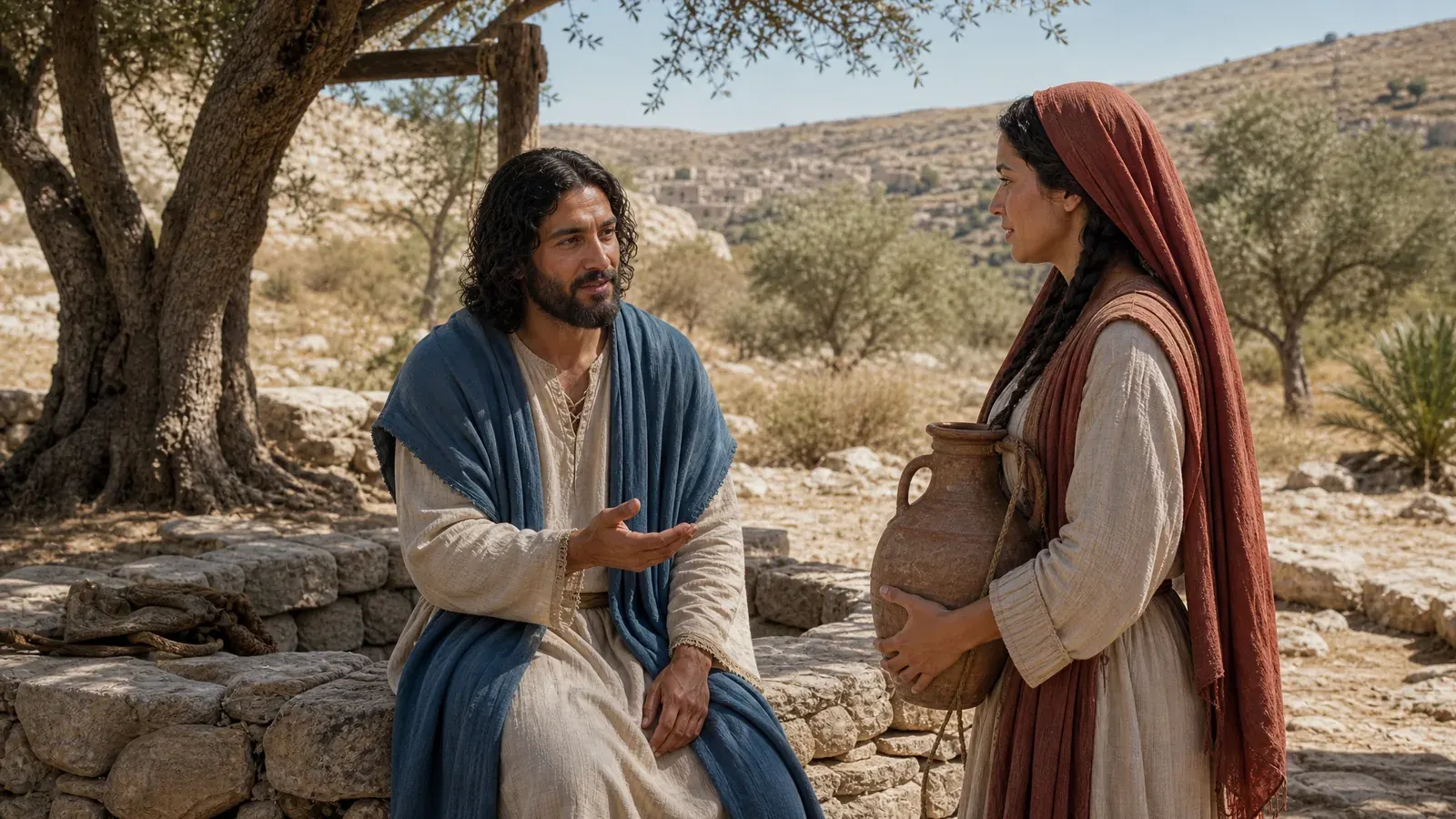
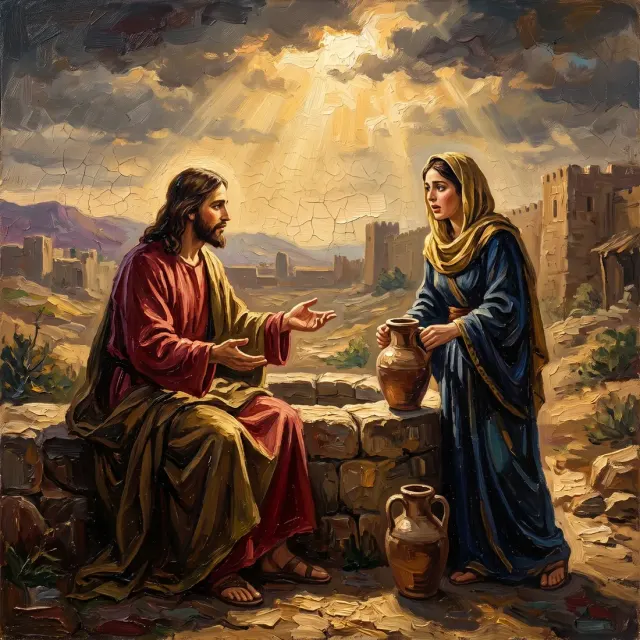
A Samaritan woman arrives to draw water while the followers buy food in town. Jesus asks for a drink. She is surprised that a Jew, a member of a people divided from Samaritans, would ask her. He says that if she knew God's gift and who speaks, she would ask him for living water. She sees a deep well and no bucket and asks whether he is greater than Jacob. Jesus says well water leaves thirst returning. His gift becomes an inner spring of eternal life. She asks for it, still thinking of relief from thirst and the daily task of drawing water.
In everyday life
A community-garden newcomer asks a long-time rival for help carrying a water can. The small request opens a conversation neither would have started through an argument about their groups. Practical need gives them a place to meet. Jesus goes on to offer eternal life, not merely a shared task that eases suspicion.
Notice
John 4:14 The promised water becomes a spring within the recipient. Jesus describes a lasting source of life rather than one improved drink from the well.
John 4:7-15
King James Version7There cometh a woman of Samaria to draw water: Jesus saith unto her, Give me to drink.
8(For his disciples were gone away unto the city to buy meat.)
9Then saith the woman of Samaria unto him, How is it that thou, being a Jew, askest drink of me, which am a woman of Samaria? for the Jews have no dealings with the Samaritans.
10Jesus answered and said unto her, If thou knewest the gift of God, and who it is that saith to thee, Give me to drink; thou wouldest have asked of him, and he would have given thee living water.
11The woman saith unto him, Sir, thou hast nothing to draw with, and the well is deep: from whence then hast thou that living water?
12Art thou greater than our father Jacob, which gave us the well, and drank thereof himself, and his children, and his cattle?
13Jesus answered and said unto her, Whosoever drinketh of this water shall thirst again:
14But whosoever drinketh of the water that I shall give him shall never thirst; but the water that I shall give him shall be in him a well of water springing up into everlasting life.
15The woman saith unto him, Sir, give me this water, that I thirst not, neither come hither to draw.
John 4:16-26
Known by Jesus and Invited to True Worship
Jesus asks the woman to call her husband. She says she has none, and he confirms that she has had five husbands and now lives with a man who is not her husband. He does not explain the causes of that history. She recognises a prophet and asks about worship on her people's mountain or in Jerusalem, the temple city. Jesus says salvation comes through the Jews, yet the Father's worship will no longer be bound to that location dispute. God seeks worship in spirit and truth. She mentions the coming Messias, the Christ or promised deliverer. Jesus identifies himself as the one she awaits.
In everyday life
A migrant historian listens to a visitor's complicated family record without filling its gaps with gossip. Being accurately heard lets the visitor ask the question that has troubled her about belonging. The conversation moves from hidden history to a larger hope. Jesus knows the woman's life directly and reveals himself as Christ, unlike a careful human listener.
Notice
John 4:26 Jesus identifies himself directly in response to her hope for the Messias. The conversation has moved far from an argument about whose well or mountain is greater.
John 4:16-26
King James Version16Jesus saith unto her, Go, call thy husband, and come hither.
17The woman answered and said, I have no husband. Jesus said unto her, Thou hast well said, I have no husband:
18For thou hast had five husbands; and he whom thou now hast is not thy husband: in that saidst thou truly.
19The woman saith unto him, Sir, I perceive that thou art a prophet.
20Our fathers worshipped in this mountain; and ye say, that in Jerusalem is the place where men ought to worship.
21Jesus saith unto her, Woman, believe me, the hour cometh, when ye shall neither in this mountain, nor yet at Jerusalem, worship the Father.
22Ye worship ye know not what: we know what we worship: for salvation is of the Jews.
23But the hour cometh, and now is, when the true worshippers shall worship the Father in spirit and in truth: for the Father seeketh such to worship him.
24God is a Spirit: and they that worship him must worship him in spirit and in truth.
25The woman saith unto him, I know that Messias cometh, which is called Christ: when he is come, he will tell us all things.
26Jesus saith unto her, I that speak unto thee am he.
John 4:27-38
The Followers Are Shown a Ready Harvest
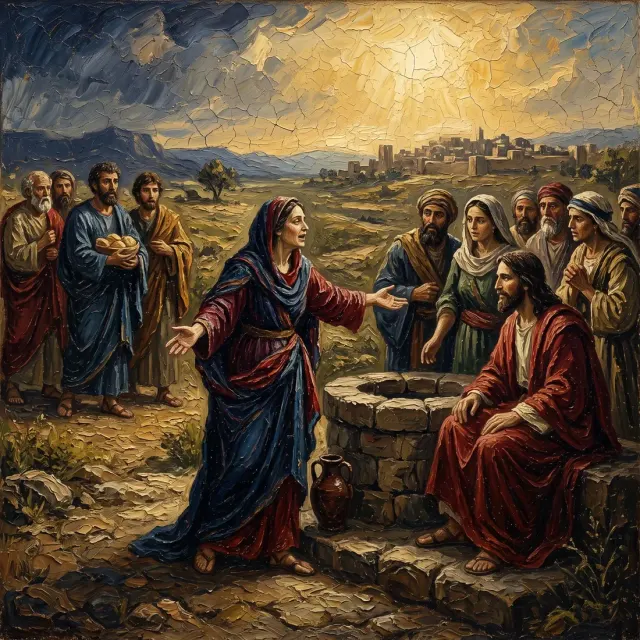
The followers return, surprised that Jesus is speaking with a woman, but do not challenge him. She leaves her jar and invites the town to meet the man who knows her life. People begin coming. Meanwhile the followers urge Jesus to eat. He speaks of food they do not know: doing the will and completing the work of the one who sent him. They need not wait for a distant harvest. People are ready now, and the gathering brings eternal life. Others have done earlier work, and these followers share its fruit. The woman's invitation and the town's movement give this teaching a concrete setting.
In everyday life
An orchard volunteer arrives for harvest and realises that years of pruning, watering, and patient work by others made this day possible. She fills baskets with gratitude instead of claiming the crop as her own achievement. Earlier and later workers share the joy. Jesus speaks of people receiving eternal life, not fruit gathered from trees.
Notice
John 4:38 Jesus reminds the followers that others have laboured before them. Receiving the harvest does not make them the sole cause of the result.
John 4:27-38
King James Version27And upon this came his disciples, and marvelled that he talked with the woman: yet no man said, What seekest thou? or, Why talkest thou with her?
28The woman then left her waterpot, and went her way into the city, and saith to the men,
29Come, see a man, which told me all things that ever I did: is not this the Christ?
30Then they went out of the city, and came unto him.
31In the mean while his disciples prayed him, saying, Master, eat.
32But he said unto them, I have meat to eat that ye know not of.
33Therefore said the disciples one to another, Hath any man brought him ought to eat?
34Jesus saith unto them, My meat is to do the will of him that sent me, and to finish his work.
35Say not ye, There are yet four months, and then cometh harvest? behold, I say unto you, Lift up your eyes, and look on the fields; for they are white already to harvest.
36And he that reapeth receiveth wages, and gathereth fruit unto life eternal: that both he that soweth and he that reapeth may rejoice together.
37And herein is that saying true, One soweth, and another reapeth.
38I sent you to reap that whereon ye bestowed no labour: other men laboured, and ye are entered into their labours.
John 4:39-42
The Town Hears Jesus for Itself
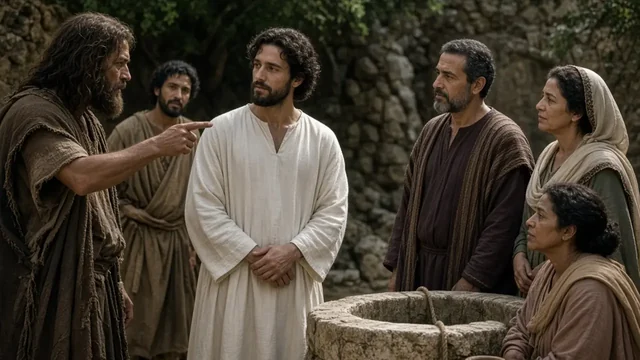
Many Samaritans believe because of the woman's testimony that Jesus knew her life. They ask him to stay, and he remains two days. Hearing his own words leads many more to believe. They tell the woman that their confidence now rests on what they have heard themselves. They recognise him as the Christ and Saviour of the world. Her witness has not become worthless; it has led them to the person it named. Their confession also reaches wider than their own town or people. The one welcomed across an old boundary is identified as Saviour for a world larger than either side.
In everyday life
A village reading circle invites a poet after one member recommends her work. During two evenings they hear and question her themselves. They thank the first reader, but their judgement now rests on direct encounter rather than borrowed enthusiasm. The Samaritans confess the world's Saviour, not a writer whose work wins a new audience.
Notice
John 4:42 Their confession names the world rather than only their own people. The town's local encounter leads to a claim with a far wider reach.
John 4:39-42
King James Version39And many of the Samaritans of that city believed on him for the saying of the woman, which testified, He told me all that ever I did.
40So when the Samaritans were come unto him, they besought him that he would tarry with them: and he abode there two days.
41And many more believed because of his own word;
42And said unto the woman, Now we believe, not because of thy saying: for we have heard him ourselves, and know that this is indeed the Christ, the Saviour of the world.
John 4:43-54
A Father Trusts Before Seeing His Son
After two days Jesus enters Galilee, where people welcome him because they saw his signs at Jerusalem. John recalls that a prophet lacks honour at home, qualifying this sign-based welcome. At Cana, a town where Jesus changed water to wine, an official asks him to heal a son dying in Capernaum, another town. Jesus challenges dependence on visible wonders, then tells the father his son lives. The man trusts the word and leaves. Servants meet him with news of recovery. Its hour matches Jesus' statement, and the whole household believes. The father acts on the promise before evidence meets him on the road.
In everyday life
A father leaves a hospital desk after a trusted surgeon tells him the operation has succeeded. He has not yet seen his son. He begins the walk to the ward with relief before the reunion confirms the report. Trust moves before direct sight. Jesus heals from a distance by his word, not by reporting work already performed in surgery.
Notice
John 4:50 The man starts home because he believes Jesus' word. The later timing confirms a trust he has already acted on, rather than creating it from nothing.
John 4:43-54
King James Version43Now after two days he departed thence, and went into Galilee.
44For Jesus himself testified, that a prophet hath no honour in his own country.
45Then when he was come into Galilee, the Galilæans received him, having seen all the things that he did at Jerusalem at the feast: for they also went unto the feast.
46So Jesus came again into Cana of Galilee, where he made the water wine. And there was a certain nobleman, whose son was sick at Capernaum.
47When he heard that Jesus was come out of Judæa into Galilee, he went unto him, and besought him that he would come down, and heal his son: for he was at the point of death.
48Then said Jesus unto him, Except ye see signs and wonders, ye will not believe.
49The nobleman saith unto him, Sir, come down ere my child die.
50Jesus saith unto him, Go thy way; thy son liveth. And the man believed the word that Jesus had spoken unto him, and he went his way.
51And as he was now going down, his servants met him, and told him, saying, Thy son liveth.
52Then enquired he of them the hour when he began to amend. And they said unto him, Yesterday at the seventh hour the fever left him.
53So the father knew that it was at the same hour, in the which Jesus said unto him, Thy son liveth: and himself believed, and his whole house.
54This is again the second miracle that Jesus did, when he was come out of Judæa into Galilee.
Details worth noticing
The opening image
John 4:1 begins with “When therefore the Lord knew how the Pharisees had heard that Jesus made and baptized more disciples than John,”
Where the chapter turns
John 4:27 forms a natural hinge: “And upon this came his disciples, and marvelled that he talked with the woman: yet no man said, What seekest thou? or, Why talkest thou with her?”
The final note
John 4:54 leaves the reader with “This is again the second miracle that Jesus did, when he was come out of Judæa into Galilee.”
A word trail through the chapter
The words Jesus, woman, water, worship, cometh, disciples help reveal the chapter’s repeated concerns.
KJV words made clear
- meat
- Food or nourishment, not only animal flesh in this chapter.
- nobleman
- An official connected with a royal household or court.
Music and video connected to the passage
Related media appears when its Scripture reference overlaps this study. Music and video can illuminate a theme while the biblical text remains the foundation.