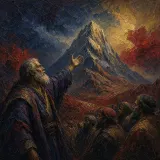
The big picture
Judah, a tribe in the south, has received its share. The next land goes to the children of Joseph, an ancestor of two tribes. Israel, the nation now settling the land, counts Ephraim and Manasseh as separate tribal groups. Their shared southern border is traced before Ephraim's own portion receives closer attention. Some of Ephraim's towns lie inside Manasseh's land. In one city, the earlier people stay and are forced to serve their new rulers.
In this chapter
- Joseph's Two Tribes Receive a Shared Border Joshua 16:1-4
The land for Joseph's family starts by Jordan, the river, near the town of Jericho.
- Ephraim Has Towns Within Manasseh's Territory Joshua 16:5-9
Towns and streams mark out Ephraim's own land.
- Gezer's People Remain Under Compulsory Service Joshua 16:10
The Canaanites living in Gezer are not driven out by Ephraim.
Central truth
Ephraim receives land and towns but leaves Gezer's people in place, forcing them to serve instead of driving them out.
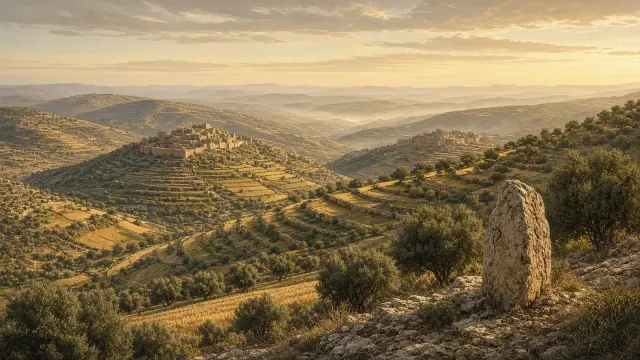

Scripture beside the summary
Joshua · King James Version · 10Joshua 16:1-4
Joseph's Two Tribes Receive a Shared Border
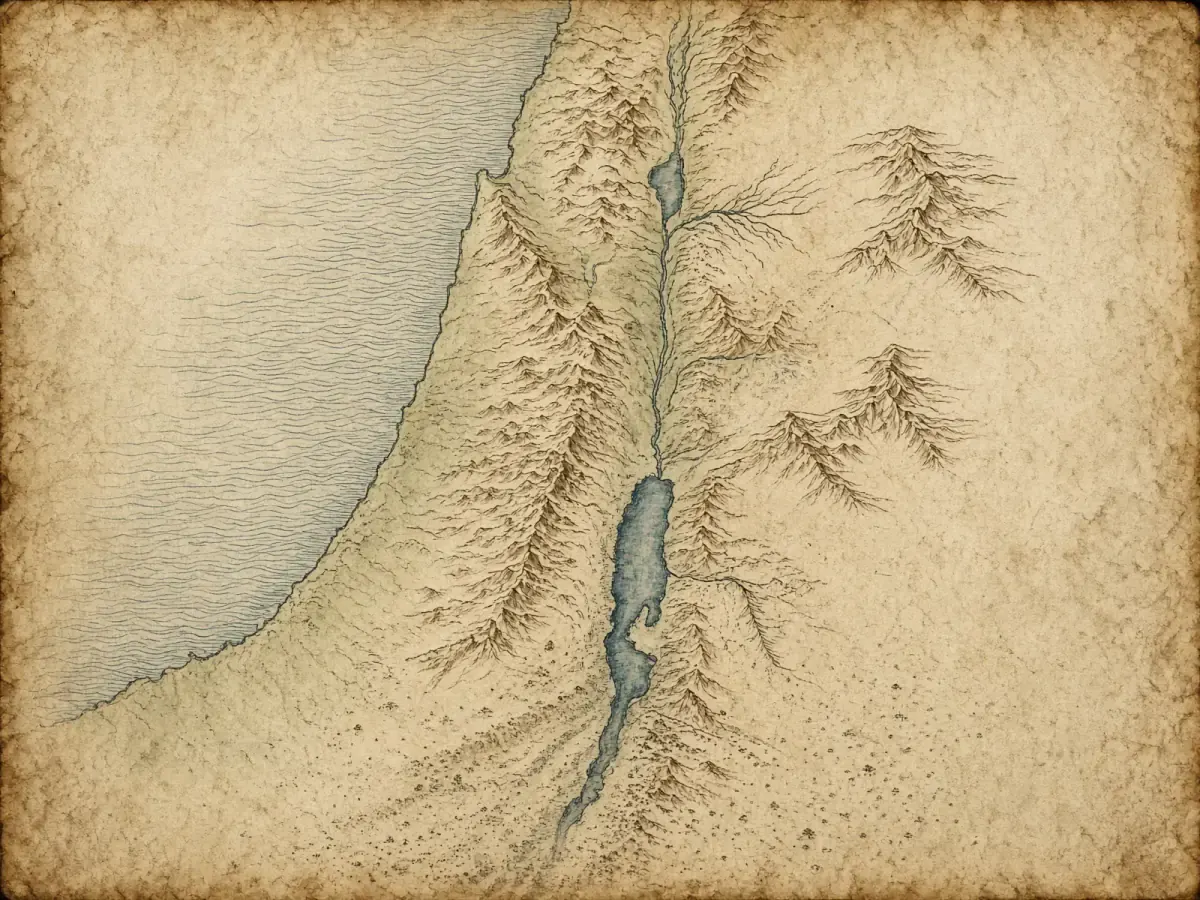
The land for Joseph's family starts by Jordan, the river, near the town of Jericho. Its edge rises through dry country and hills before reaching the western sea. Named towns mark turns along the route. Manasseh and Ephraim are the two tribes that receive this land. Both come from Joseph, but each has its own share. The broad outline gives their common edge. The account then turns to the separate lands within it, first taking a closer look at Ephraim.
In everyday life
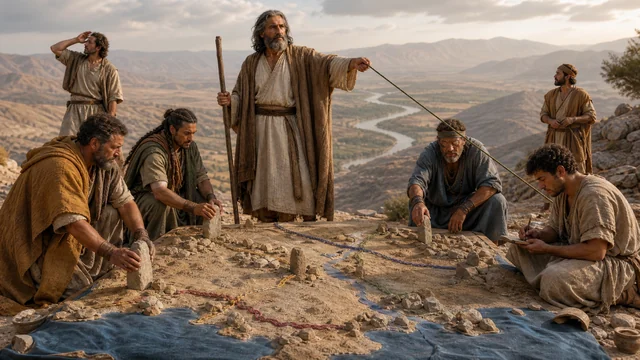
The twin siblings unroll a woodland deed on a sawmill bench after inheriting their grandfather's land. They trace its outside edge together before marking the separate areas each will manage. One family connection holds two distinct shares. Joseph's descendants receive land as tribes within God's promise, not through a modern private will.
Notice
Joshua 16:4 Manasseh and Ephraim are both named as Joseph's children receiving land. They share a forefather. Even so, each receives land as a tribe in its own right.
Joshua 16:1-4
King James Version1And the lot of the children of Joseph fell from Jordan by Jericho, unto the water of Jericho on the east, to the wilderness that goeth up from Jericho throughout mount Beth-el,
2And goeth out from Beth-el to Luz, and passeth along unto the borders of Archi to Ataroth,
3And goeth down westward to the coast of Japhleti, unto the coast of Beth-horon the nether, and to Gezer: and the goings out thereof are at the sea.
4So the children of Joseph, Manasseh and Ephraim, took their inheritance.
Joshua 16:5-9
Ephraim Has Towns Within Manasseh's Territory
Towns and streams mark out Ephraim's own land. Parts of its edge reach the sea and the river Jordan. The Kanah stream forms another part of the border. These limits define the share given to its families. Yet a line around one block does not tell the whole account. Some of Ephraim's towns sit inside Manasseh's land. Their villages belong to Ephraim too. Those separate places are kept in the record so that their owners are clear despite the wider border around them.
In everyday life
The exhibition steward colours a floor plan for two craft guilds in a fair hall. She adds three small display spaces for one guild inside the other's row. Members check the labels before carrying in their stands. A straight line would miss these shared edges. Ephraim receives permanent towns, rather than spaces booked for a weekend fair.
Notice
Joshua 16:9 The separate towns within Manasseh's share are explicitly retained for Ephraim. The borders are more complex than two blocks separated by a single line.
Joshua 16:5-9
King James Version5And the border of the children of Ephraim according to their families was thus: even the border of their inheritance on the east side was Ataroth-addar, unto Beth-horon the upper;
6And the border went out toward the sea to Michmethah on the north side; and the border went about eastward unto Taanath-shiloh, and passed by it on the east to Janohah;
7And it went down from Janohah to Ataroth, and to Naarath, and came to Jericho, and went out at Jordan.
8The border went out from Tappuah westward unto the river Kanah; and the goings out thereof were at the sea. This is the inheritance of the tribe of the children of Ephraim by their families.
9And the separate cities for the children of Ephraim were among the inheritance of the children of Manasseh, all the cities with their villages.
Joshua 16:10
Gezer's People Remain Under Compulsory Service
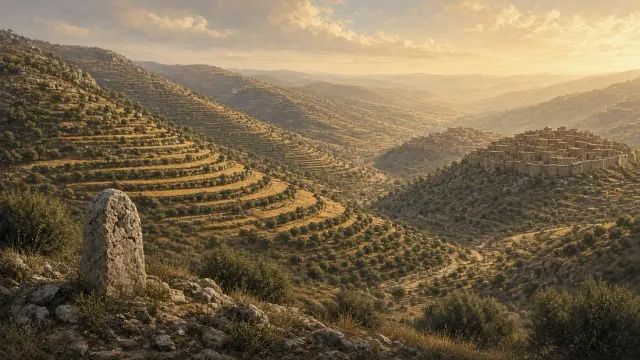
The Canaanites living in Gezer are not driven out by Ephraim. They keep their homes among the tribe, but must serve under tribute. That means work or payment imposed by the group that now rules. Staying does not make the two peoples equals. Nor does this forced service count as removal. The chapter ends with a town where the conquest is unfinished. Having a share drawn out on the ground does not mean every place within it has been fully taken.
In everyday life
A mine inspector reads a labour book at the pit. Nearby residents must supply work under the company's control. Their homes remain. Staying does not free them from demands made by the stronger group. She notes the obligation beside each entry. Gezer's arrangement follows conquest under an ancient people, not company ownership.
Notice
Joshua 16:10 Remaining in Gezer does not mean living without subjection. The verse joins staying in the town with tribute, preserving both parts of the people's situation.
Joshua 16:10
King James Version10And they drave not out the Canaanites that dwelt in Gezer: but the Canaanites dwell among the Ephraimites unto this day, and serve under tribute.
Details worth noticing
The opening image
Joshua 16:1 begins with “And the lot of the children of Joseph fell from Jordan by Jericho, unto the water of Jericho on the east, to the wilderness that goeth up from Jericho…”
Where the chapter turns
Joshua 16:5 forms a natural hinge: “And the border of the children of Ephraim according to their families was thus: even the border of their inheritance on the east side was Ataroth-addar…”
The final note
Joshua 16:10 leaves the reader with “And they drave not out the Canaanites that dwelt in Gezer: but the Canaanites dwell among the Ephraimites unto this day, and serve under tribute.”
A word trail through the chapter
The words children, border, Beth, Ephraim, inheritance, Jericho help reveal the chapter’s repeated concerns.
KJV words made clear
- tribute
- Compulsory payment or service imposed by a ruling people on those under its power.
Music and video connected to the passage
Related media appears when its Scripture reference overlaps this study. Music and video can illuminate a theme while the biblical text remains the foundation.