
The big picture
Leaving the temple, God's worship centre in Jerusalem, the chief city of worship, Jesus, the teacher and healer, predicts its destruction. His followers ask when it will happen. They also ask about his return and the end of the world. He answers with warnings about false claims, great suffering, and the need to stay ready. Christians differ on how these events relate to Jerusalem's fall and Jesus' future return. The warning against guessing and neglect remains clear: his followers do not know the day or hour.
In this chapter
- The Temple Will Be Destroyed Matthew 24:1-3
As Jesus walks away, his followers draw his attention to the temple buildings.
- Early Troubles Are Not the End Matthew 24:4-14
Jesus first warns them against being misled.
- Flee Danger and Reject False Claims Matthew 24:15-28
Jesus refers to Daniel, an earlier prophet, and a hateful, ruinous thing standing in the holy place.
- Heaven Reveals the Coming King Matthew 24:29-35
After the suffering, Jesus describes darkness in the sky and shaken heavenly forces.
- The Day Cannot Be Calculated Matthew 24:36-44
Only Jesus' Father knows the day and hour.
- Readiness Means Faithful Care Matthew 24:45-51
Jesus pictures a servant put in charge of feeding the household while its master is away.
Central truth
Jesus warns of deception and severe suffering, promising his return while calling his followers to faithful readiness without a known date.

Scripture beside the summary
Matthew · King James Version · 51Matthew 24:1-3
The Temple Will Be Destroyed
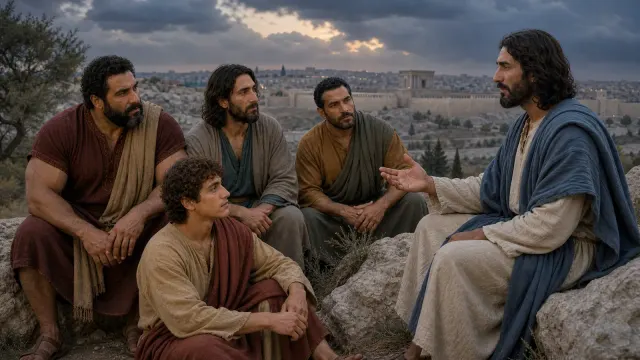
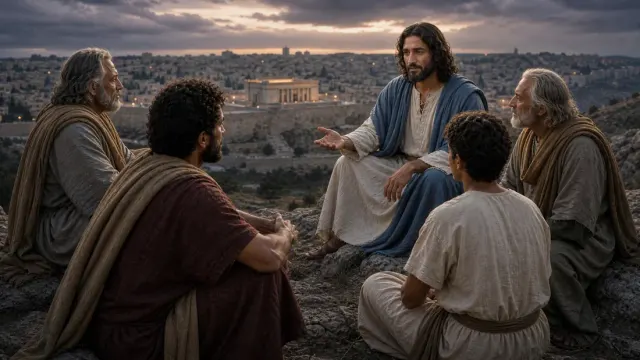
As Jesus walks away, his followers draw his attention to the temple buildings. His reply overturns their sense of safety. The whole place will be pulled apart, leaving none of its stones in place. Jesus then sits on the mount of Olives, a ridge near the city. His followers approach him away from the crowd. They want to know when this ruin will come. They also ask how they will recognise his return and the world's end. These questions about loss, return, and the future prompt the warnings that follow.
In everyday life
A stone conservator leads an apprentice around a grand hall and points to deep cracks beneath the carved walls. The apprentice has been praising the roof and now asks how long it will stand. Its splendour no longer proves its safety. Jesus predicts the temple's destruction; the conservator judges visible damage and lacks that certainty.
Notice
Matthew 24:3 Several questions come from the followers in one approach. Their concern includes the temple's fall, Jesus' coming, and the end, which helps explain the breadth of his answer.
Matthew 24:1-3
King James Version1And Jesus went out, and departed from the temple: and his disciples came to him for to shew him the buildings of the temple.
2And Jesus said unto them, See ye not all these things? verily I say unto you, There shall not be left here one stone upon another, that shall not be thrown down.
3And as he sat upon the mount of Olives, the disciples came unto him privately, saying, Tell us, when shall these things be? and what shall be the sign of thy coming, and of the end of the world?
Matthew 24:4-14
Early Troubles Are Not the End
Jesus first warns them against being misled. Many will claim his name and pretend to be the Christ, God's promised king. Wars, food shortages, plagues, and earthquakes will come, but these are the start of pain rather than proof that the end has arrived. His followers will face hatred, betrayal, and killing because they belong to him. False prophets will deceive many, and spreading sin will weaken love. Jesus promises rescue to those who endure. The good news of God's kingdom will reach every nation before the end comes. Fear and claims of secret knowledge must not set the course for his followers.
In everyday life
A coastal radio volunteer listens to callers confuse each warning tone with an order to abandon the whole town. She reads the current notice aloud and keeps the channel clear for verified reports. Panic grows when people treat every sign as the last one. Jesus speaks of worldwide suffering and witness, not a local weather alert.
Notice
Matthew 24:8 Jesus calls these troubles the beginning of pain. Their severity does not give his followers permission to declare that the end has already arrived.
Matthew 24:4-14
King James Version4And Jesus answered and said unto them, Take heed that no man deceive you.
5For many shall come in my name, saying, I am Christ; and shall deceive many.
6And ye shall hear of wars and rumours of wars: see that ye be not troubled: for all these things must come to pass, but the end is not yet.
7For nation shall rise against nation, and kingdom against kingdom: and there shall be famines, and pestilences, and earthquakes, in divers places.
8All these are the beginning of sorrows.
9Then shall they deliver you up to be afflicted, and shall kill you: and ye shall be hated of all nations for my name’s sake.
10And then shall many be offended, and shall betray one another, and shall hate one another.
11And many false prophets shall rise, and shall deceive many.
12And because iniquity shall abound, the love of many shall wax cold.
13But he that shall endure unto the end, the same shall be saved.
14And this gospel of the kingdom shall be preached in all the world for a witness unto all nations; and then shall the end come.
Matthew 24:15-28
Flee Danger and Reject False Claims
Jesus refers to Daniel, an earlier prophet, and a hateful, ruinous thing standing in the holy place. He tells people in Judaea, the region around Jerusalem, to flee into the hills. They must not return for goods or clothes. Pregnancy, nursing, winter, and the sabbath, the weekly holy rest day, will make flight harder. The suffering will be so great that lives depend on God shortening it. False messiahs and prophets will display wonders and claim that Christ is hidden nearby. Jesus says not to follow them. His arrival as the Son of man, his title for himself, will be plain like lightning across the sky. He adds an image of birds gathering where a dead body lies.
In everyday life
An evacuation helper writes the names of arriving families on a board at a safe checkpoint. Several have left coats and papers behind. She guides them toward blankets instead of sending them back into danger, and checks rumours against the marked route. Jesus warns of unmatched distress and false saviours, not one managed evacuation.
Notice
Matthew 24:17 The order against going downstairs for possessions leaves no room for packing. Jesus describes a danger urgent enough to make delay itself a threat.
Matthew 24:15-28
King James Version15When ye therefore shall see the abomination of desolation, spoken of by Daniel the prophet, stand in the holy place, (whoso readeth, let him understand:)
16Then let them which be in Judaea flee into the mountains:
17Let him which is on the housetop not come down to take any thing out of his house:
18Neither let him which is in the field return back to take his clothes.
19And woe unto them that are with child, and to them that give suck in those days!
20But pray ye that your flight be not in the winter, neither on the sabbath day:
21For then shall be great tribulation, such as was not since the beginning of the world to this time, no, nor ever shall be.
22And except those days should be shortened, there should no flesh be saved: but for the elect’s sake those days shall be shortened.
23Then if any man shall say unto you, Lo, here is Christ, or there; believe it not.
24For there shall arise false Christs, and false prophets, and shall shew great signs and wonders; insomuch that, if it were possible, they shall deceive the very elect.
25Behold, I have told you before.
26Wherefore if they shall say unto you, Behold, he is in the desert; go not forth: behold, he is in the secret chambers; believe it not.
27For as the lightning cometh out of the east, and shineth even unto the west; so shall also the coming of the Son of man be.
28For wheresoever the carcase is, there will the eagles be gathered together.
Matthew 24:29-35
Heaven Reveals the Coming King
After the suffering, Jesus describes darkness in the sky and shaken heavenly forces. The Son of man will come in the clouds with great glory. The peoples of the earth will mourn, and angels will gather his chosen people from every direction. A fig tree's new leaves show that summer is near. In a similar way, these signs show that the event is close. Jesus says this generation will not pass before these things occur. Christians read the timing and the meaning of generation differently. Yet Jesus states firmly that his words will outlast both earth and sky.

In everyday life
An orchard keeper touches new buds on a branch and tells an apprentice that the growing season has turned. She cannot name the hour each fruit will ripen, but the bare winter stage is over. Signs give real knowledge without a full calendar. Jesus promises his own coming and lasting words, not the usual cycle of crops.
Notice
Matthew 24:35 Jesus places his words above the lasting strength of earth and sky. His followers receive a firm promise even while questions about timing remain.
Matthew 24:29-35
King James Version29Immediately after the tribulation of those days shall the sun be darkened, and the moon shall not give her light, and the stars shall fall from heaven, and the powers of the heavens shall be shaken:
30And then shall appear the sign of the Son of man in heaven: and then shall all the tribes of the earth mourn, and they shall see the Son of man coming in the clouds of heaven with power and great glory.
31And he shall send his angels with a great sound of a trumpet, and they shall gather together his elect from the four winds, from one end of heaven to the other.
32Now learn a parable of the fig tree; When his branch is yet tender, and putteth forth leaves, ye know that summer is nigh:
33So likewise ye, when ye shall see all these things, know that it is near, even at the doors.
34Verily I say unto you, This generation shall not pass, till all these things be fulfilled.
35Heaven and earth shall pass away, but my words shall not pass away.
Matthew 24:36-44
The Day Cannot Be Calculated
Only Jesus' Father knows the day and hour. Even heaven's angels do not know it. Jesus compares the suddenness to the days of Noe, the man who entered the ark before the flood. People kept eating, drinking, and marrying until the flood swept them away. Daily life gave them no sense that the decisive hour had come. Jesus then pictures two field workers and two women grinding grain: one is taken and one left. Christians differ about who is taken and who remains. A householder cannot schedule a thief's arrival but can remain alert. Jesus tells his followers to stay ready because he will come at an hour they do not expect.
In everyday life
A jewellery-shop caretaker checks the locks each night without knowing whether anyone will try the door. She does not wait for a dated warning before securing the cases. Her routine reflects a risk whose timing she cannot predict. Jesus speaks of his return and decisive judgement, not of preventing a burglary.
Notice
Matthew 24:36 Jesus draws a clear boundary around knowledge of the date. His teaching asks for readiness, not a calculation that angels themselves cannot make.
Matthew 24:36-44
King James Version36But of that day and hour knoweth no man, no, not the angels of heaven, but my Father only.
37But as the days of Noe were, so shall also the coming of the Son of man be.
38For as in the days that were before the flood they were eating and drinking, marrying and giving in marriage, until the day that Noe entered into the ark,
39And knew not until the flood came, and took them all away; so shall also the coming of the Son of man be.
40Then shall two be in the field; the one shall be taken, and the other left.
41Two women shall be grinding at the mill; the one shall be taken, and the other left.
42Watch therefore: for ye know not what hour your Lord doth come.
43But know this, that if the goodman of the house had known in what watch the thief would come, he would have watched, and would not have suffered his house to be broken up.
44Therefore be ye also ready: for in such an hour as ye think not the Son of man cometh.
Matthew 24:45-51
Readiness Means Faithful Care
Jesus pictures a servant put in charge of feeding the household while its master is away. If the master returns and finds him doing that work, he rewards him with greater trust. Another servant treats the delay as leave to abuse his fellow servants and get drunk. The master arrives without warning. Jesus describes a brutal punishment: the man is cut apart and assigned the fate of hypocrites, with grief and pain. Readiness is therefore more than watching for signs. It includes how a person uses entrusted power and treats those who depend on that care during the wait.
In everyday life
A boarding-kennel assistant fills water bowls and measures each animal's meal while the owner is away. No return time is posted, but hungry animals still need care at the right hour. The assistant's work continues without a visit to prompt it. Jesus' warning concerns human abuse and final judgement, not an employer's review of animal care.
Notice
Matthew 24:46 The faithful servant is found doing his assigned work. His readiness shows in care already being given, rather than in a successful guess about the return.
Matthew 24:45-51
King James Version45Who then is a faithful and wise servant, whom his lord hath made ruler over his household, to give them meat in due season?
46Blessed is that servant, whom his lord when he cometh shall find so doing.
47Verily I say unto you, That he shall make him ruler over all his goods.
48But and if that evil servant shall say in his heart, My lord delayeth his coming;
49And shall begin to smite his fellowservants, and to eat and drink with the drunken;
50The lord of that servant shall come in a day when he looketh not for him, and in an hour that he is not aware of,
51And shall cut him asunder, and appoint him his portion with the hypocrites: there shall be weeping and gnashing of teeth.
Details worth noticing
The opening image
Matthew 24:1 begins with “And Jesus went out, and departed from the temple: and his disciples came to him for to shew him the buildings of the temple.”
Where the chapter turns
Matthew 24:23 forms a natural hinge: “Then if any man shall say unto you, Lo, here is Christ, or there; believe it not.”
The final note
Matthew 24:51 leaves the reader with “And shall cut him asunder, and appoint him his portion with the hypocrites: there shall be weeping and gnashing of teeth.”
A word trail through the chapter
The words coming, days, heaven, lord, deceive, hour help reveal the chapter’s repeated concerns.
KJV words made clear
- tribulation
- Great suffering or distress caused by harsh events.
- elect
- People God has chosen as his own.
- goodman
- The man responsible for a house or household.
Music and video connected to the passage
Related media appears when its Scripture reference overlaps this study. Music and video can illuminate a theme while the biblical text remains the foundation.