The big picture
Mary Magdalene and the other Mary, two women who followed Jesus, return to his tomb after the weekly rest day. Jesus, the teacher they saw killed, is no longer dead. An angel announces his rising, and Jesus meets them himself. Guards are paid to spread a different account. Meanwhile, the remaining eleven close followers go to the meeting he promised. The book ends with his command to teach people from every nation and his promise to remain with those he sends.
In this chapter
- An Angel Opens the Guarded Tomb Matthew 28:1-4
At dawn after the sabbath, the weekly holy rest day, the two women come to see the tomb.
- The Women Receive News and a Task Matthew 28:5-7
The angel tells the women not to be afraid.
- Jesus Meets the Women Himself Matthew 28:8-10
The women leave in fear and great joy and run to tell the followers.
- Money Buys a False Account Matthew 28:11-15
Some guards enter Jerusalem, the city near the tomb, and report what happened to the chief priests, the senior worship leaders.
- Worship and Doubt at the Meeting Matthew 28:16-17
The eleven followers travel to the mountain in Galilee that Jesus has named.
- A Mission Reaches Every Nation Matthew 28:18-20
Jesus approaches and says he has received all authority in heaven and on earth.
Central truth
After rising, Jesus meets his followers and sends them to every nation, promising his presence as they teach and baptize.

Scripture beside the summary
Matthew · King James Version · 20Matthew 28:1-4
An Angel Opens the Guarded Tomb
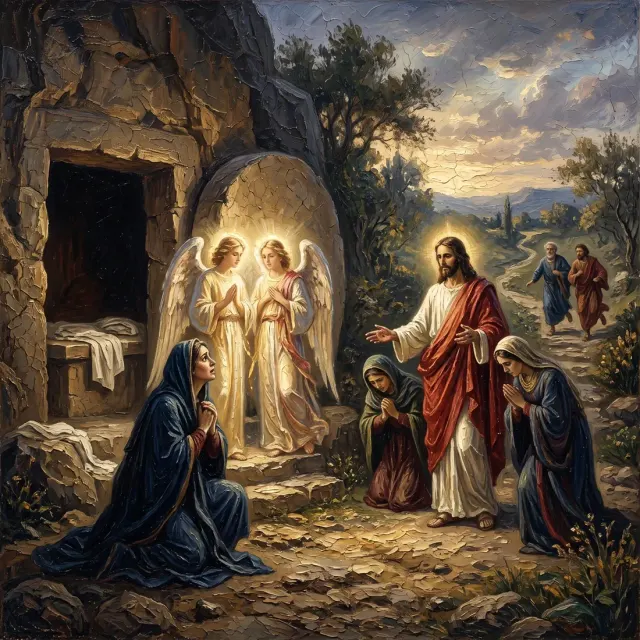
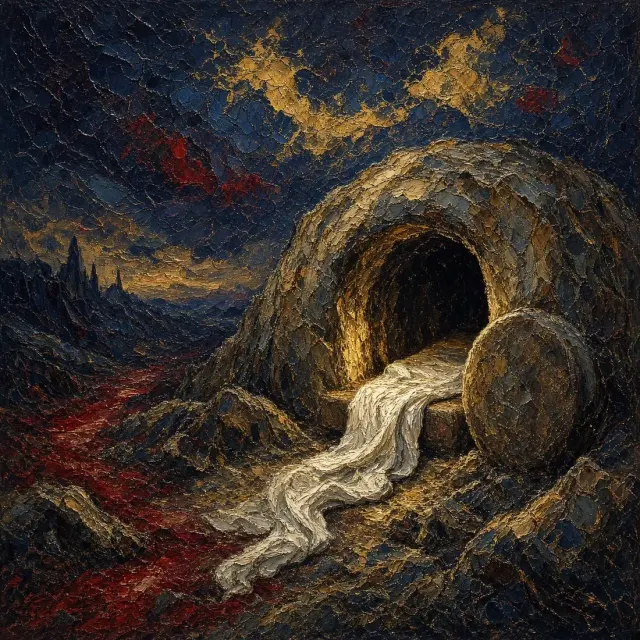
At dawn after the sabbath, the weekly holy rest day, the two women come to see the tomb. A great earthquake occurs as an angel of the Lord comes from heaven. He rolls the stone away from the entrance and sits on it. His face shines like lightning, and his clothes are bright white. The men guarding the tomb shake with fear and become like dead men. The people stationed to keep the grave secure cannot control what happens. Matthew describes the stone being moved, but he does not describe the exact moment when Jesus rises.
In everyday life
An overnight caretaker drops his keys as a sudden alarm reveals that the locked chamber he has guarded is already open. He stands still while others move toward the doorway, unable to make sense of the change. His guard duty has not secured the outcome. Matthew reports an angel and resurrection, not a failed lock or alarm.
Notice
Matthew 28:4 The guards become like dead men while the one they guarded is alive. Their fear reverses the security they were placed there to provide.
Matthew 28:1-4
King James Version1In the end of the sabbath, as it began to dawn toward the first day of the week, came Mary Magdalene and the other Mary to see the sepulchre.
2And, behold, there was a great earthquake: for the angel of the Lord descended from heaven, and came and rolled back the stone from the door, and sat upon it.
3His countenance was like lightning, and his raiment white as snow:
4And for fear of him the keepers did shake, and became as dead men.
Matthew 28:5-7
The Women Receive News and a Task
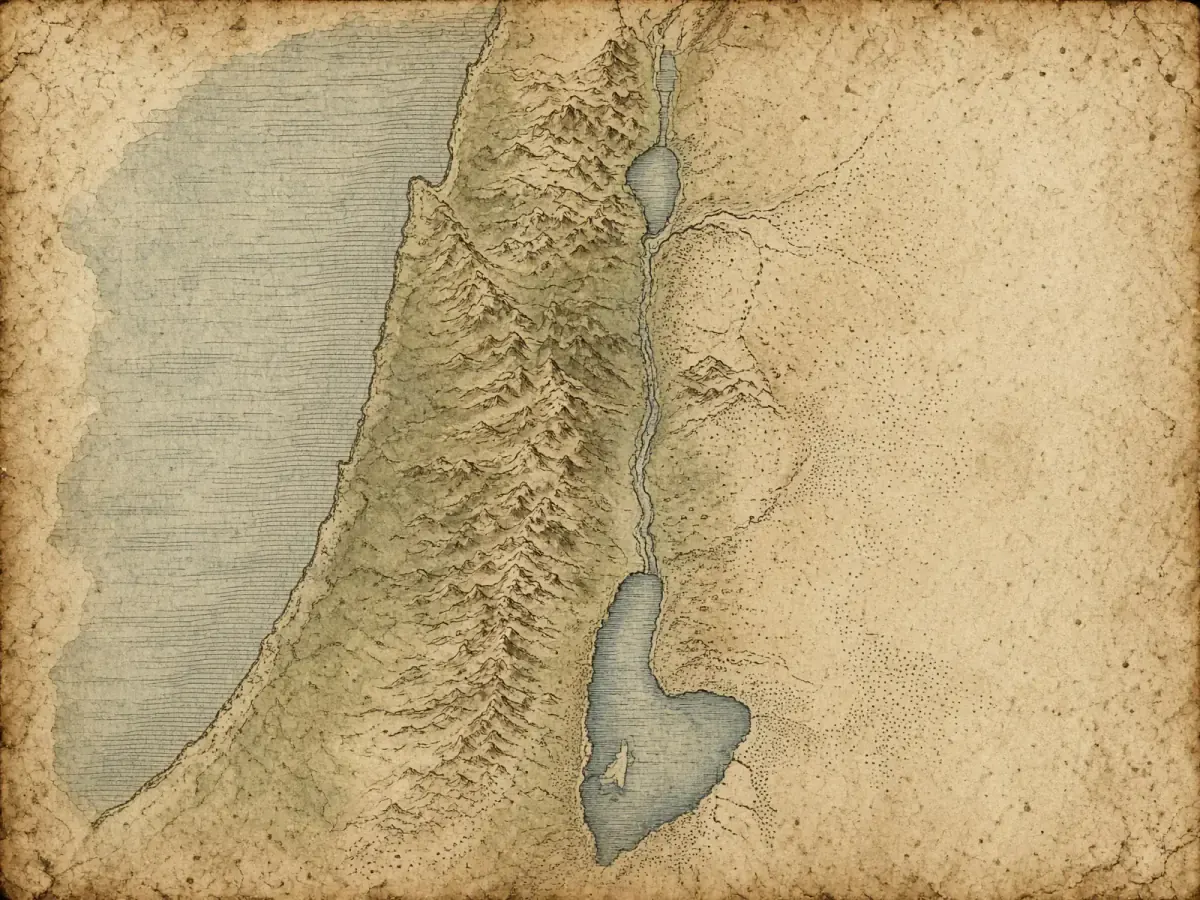
The angel tells the women not to be afraid. He knows they seek the crucified Jesus, but Jesus is absent because he has risen as promised. They are invited to inspect the place where he lay. Then they must go quickly and tell his followers. Jesus will go ahead to Galilee, the northern region where much of his work took place. They will see him there. The women receive more than news of an empty grave. They receive its explanation and a clear message to carry. The promised meeting directs them toward a living person rather than a missing body.
In everyday life
A missing-person liaison shows a sister a verified notice that her brother has been found alive. She names the place where the family will meet him and asks the sister to inform those waiting at home. Evidence leads to a message and a meeting. Jesus has risen after death, not survived while missing.
Notice
Matthew 28:6 The angel connects the empty place with Jesus' earlier promise. The absence of the body is explained by his rising, not left as an unanswered mystery.
Matthew 28:5-7
King James Version5And the angel answered and said unto the women, Fear not ye: for I know that ye seek Jesus, which was crucified.
6He is not here: for he is risen, as he said. Come, see the place where the Lord lay.
7And go quickly, and tell his disciples that he is risen from the dead; and, behold, he goeth before you into Galilee; there shall ye see him: lo, I have told you.
Matthew 28:8-10
Jesus Meets the Women Himself
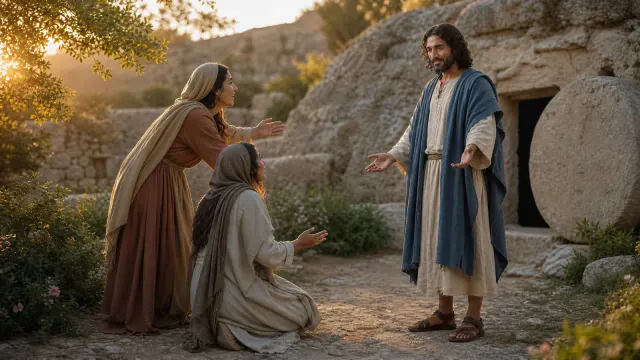
The women leave in fear and great joy and run to tell the followers. On the way, Jesus meets and greets them. They approach, hold his feet, and worship him. This meeting adds personal contact to what they heard at the tomb. Jesus repeats the command not to fear. He sends them to his brothers, his close followers, with instructions to go to Galilee. They will see him there. He calls those who had fled his brothers rather than dismissing them. The women now carry a message received from Jesus himself, whom they have seen and touched.
In everyday life
A reunited sister runs from a reception room to tell relatives that she has embraced the brother they feared lost. She no longer carries only an official notice. His greeting and touch are part of what she has to tell. The women meet and worship Jesus after his death; the reunion involves a man who remained alive.
Notice
Matthew 28:9 The women hold Jesus' feet as they worship. Matthew describes contact with the risen Jesus, not only an idea, feeling, or report about him.
Matthew 28:8-10
King James Version8And they departed quickly from the sepulchre with fear and great joy; and did run to bring his disciples word.
9And as they went to tell his disciples, behold, Jesus met them, saying, All hail. And they came and held him by the feet, and worshipped him.
10Then said Jesus unto them, Be not afraid: go tell my brethren that they go into Galilee, and there shall they see me.
Matthew 28:11-15
Money Buys a False Account
Some guards enter Jerusalem, the city near the tomb, and report what happened to the chief priests, the senior worship leaders. The priests meet with elders, the community leaders. They pay the soldiers a large sum. They instruct them to say that Jesus' followers stole the body while they slept. They also promise to protect the soldiers if the governor hears of it. The guards accept the money and repeat the account. Matthew says it remains current among the Jews, the people among whom these events occurred. The claim spreads through a planned payment, while the women carry what they have witnessed without such a bargain.
In everyday life
A loading-dock watchman accepts cash to report that a missing delivery vanished during his break. His supervisor promises to handle any questions from the owner. The agreed account protects those involved before anyone checks what occurred. The guards' paid claim denies Jesus' rising; the watchman's lie concerns missing freight.
Notice
Matthew 28:14 The leaders promise protection from the governor as part of the bargain. Money alone is not enough when the false account also admits failure at guard duty.
Matthew 28:11-15
King James Version11Now when they were going, behold, some of the watch came into the city, and shewed unto the chief priests all the things that were done.
12And when they were assembled with the elders, and had taken counsel, they gave large money unto the soldiers,
13Saying, Say ye, His disciples came by night, and stole him away while we slept.
14And if this come to the governor’s ears, we will persuade him, and secure you.
15So they took the money, and did as they were taught: and this saying is commonly reported among the Jews until this day.
Matthew 28:16-17
Worship and Doubt at the Meeting
The eleven followers travel to the mountain in Galilee that Jesus has named. The group is now eleven rather than twelve because Judas, the betrayer, is gone. They see Jesus and worship him, yet some doubt. Matthew leaves that tension in place instead of describing a group free from every hesitation. These are the people Jesus is about to send. The account gives no names for the doubters and no separate speech explaining each doubt. Their meeting with him is real, while their grasp of what has happened is still uneven.
In everyday life
Several rescue climbers reach a ledge and find their missing teammate waving beside his torn pack. One rushes to grip his hand. Another stays by the rope, too stunned to move after days of fearing the worst. Their shared sight brings different reactions at first. Jesus has returned from death; the climber has survived his fall.
Notice
Matthew 28:17 Both worship and doubt appear in this brief report. Matthew does not remove the hesitation to make the first witnesses look more certain than they were.
Matthew 28:16-17
King James Version16Then the eleven disciples went away into Galilee, into a mountain where Jesus had appointed them.
17And when they saw him, they worshipped him: but some doubted.
Matthew 28:18-20
A Mission Reaches Every Nation
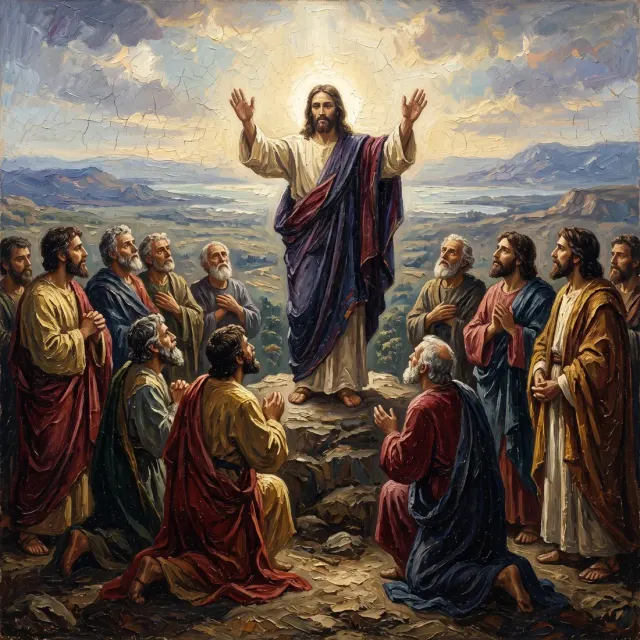
Jesus approaches and says he has received all authority in heaven and on earth. On that basis he sends the followers to make learners from every nation. They must baptize them in the name of the Father, Son, and Holy Ghost, the Holy Spirit. Baptism uses water to mark entry into this life of following Jesus. Christians differ over how baptism grants or expresses that new life. They must also teach people to keep all he commanded, not only repeat his name. His final promise is that he will remain with them through the world's remaining course. Their task is vast, but it rests on his authority and continuing presence.
In everyday life
A travelling music teacher parks her lesson bus beside a village hall. Her former students unload instruments and begin teaching the children waiting there. She asks them to teach the full course and stays close as they start. Their new work grows from her training. Jesus sends followers to every nation and promises a presence no teacher can give.
Notice
Matthew 28:20 Teaching includes observing what Jesus commanded, not only learning facts about him. His promise of presence accompanies that ongoing work through the end.
Matthew 28:18-20
King James Version18And Jesus came and spake unto them, saying, All power is given unto me in heaven and in earth.
19Go ye therefore, and teach all nations, baptizing them in the name of the Father, and of the Son, and of the Holy Ghost:
20Teaching them to observe all things whatsoever I have commanded you: and, lo, I am with you alway, even unto the end of the world. Amen.
Details worth noticing
The opening image
Matthew 28:1 begins with “In the end of the sabbath, as it began to dawn toward the first day of the week, came Mary Magdalene and the other Mary to see the sepulchre.”
Where the chapter turns
Matthew 28:10 forms a natural hinge: “Then said Jesus unto them, Be not afraid: go tell my brethren that they go into Galilee, and there shall they see me.”
The final note
Matthew 28:20 leaves the reader with “Teaching them to observe all things whatsoever I have commanded you: and, lo, I am with you alway, even unto the end of the world. Amen.”
A word trail through the chapter
The words disciples, Jesus, fear, Galilee, tell, angel help reveal the chapter’s repeated concerns.
KJV words made clear
- countenance
- A face, including the expression or appearance it has.
- Holy Ghost
- The Holy Spirit, named with the Father and Son as God.
Music and video connected to the passage
Related media appears when its Scripture reference overlaps this study. Music and video can illuminate a theme while the biblical text remains the foundation.