
The big picture
Morning brings Jesus, the arrested teacher, before Pontius Pilate, the Roman governor. The religious leaders press for death, and the crowd demands a cross. Judas, the follower who betrayed Jesus, cannot bear what he has done. Jesus suffers mockery and execution while friends watch from far away. Darkness, an earthquake, and other signs surround his death. A follower gives him a tomb, and his opponents arrange a guard. The chapter records both public rejection and acts of care for the dead.
In this chapter
- Betrayal Money Buys a Burial Field Matthew 27:1-10
The leaders bind Jesus and hand him to Pilate.
- Pilate Questions a Silent Prisoner Matthew 27:11-14
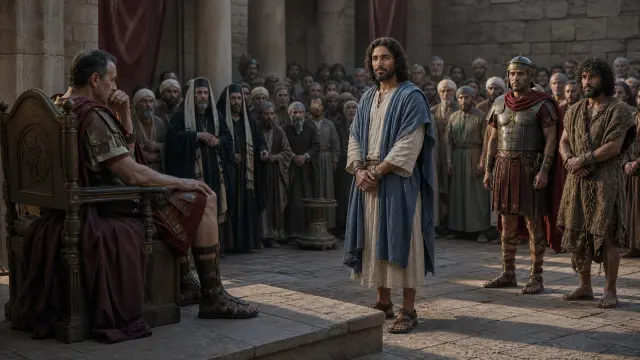
Pilate asks Jesus whether he is king of the Jews, the people whose leaders brought him.
- The Crowd Demands Crucifixion Matthew 27:15-26
Pilate offers the feast-time release of a prisoner: Jesus or Barabbas, a well-known captive.
- Soldiers Mock and Crucify Jesus Matthew 27:27-37
The soldiers dress Jesus in a scarlet robe and press a thorn crown onto his head.
- Mockers Demand That Jesus Save Himself Matthew 27:38-44
Two thieves hang on crosses beside Jesus.
- Darkness Surrounds the Death of Jesus Matthew 27:45-50
Darkness covers the land from about noon until three in the afternoon.
- Signs Shake the Land and Witnesses Matthew 27:51-56
The temple curtain tears from top to bottom.
- A Follower Gives Jesus a Tomb Matthew 27:57-61
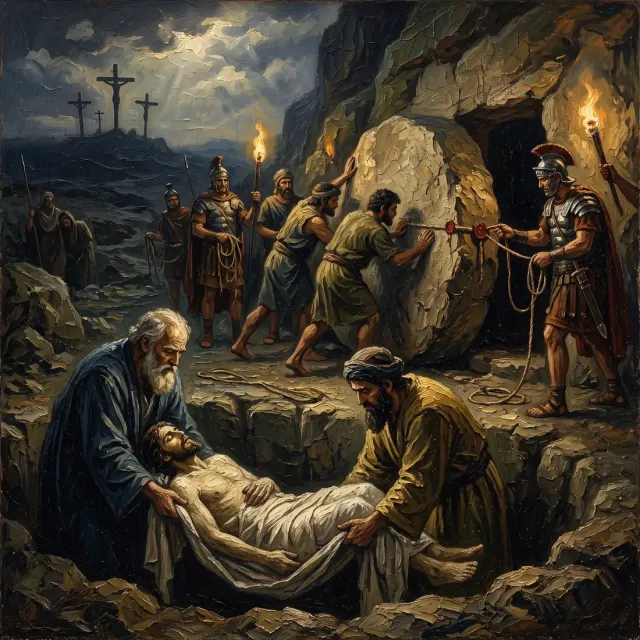
As evening comes, Joseph, a wealthy follower from the town of Arimathæa, asks Pilate for Jesus' body.
- Opponents Seal and Guard the Tomb Matthew 27:62-66
The next day, the chief priests and Pharisees, a strict religious group, approach Pilate.
Central truth
Jesus is killed despite signs of his innocence, while his death brings fearful signs and faithful witnesses remain near his tomb.

Scripture beside the summary
Matthew · King James Version · 66Matthew 27:1-10
Betrayal Money Buys a Burial Field
The leaders bind Jesus and hand him to Pilate. Seeing the death sentence, Judas feels remorse and returns the thirty silver pieces. He says he has betrayed an innocent man. The priests refuse to take responsibility for his guilt. Judas throws the money into the temple, God's worship centre, leaves, and dies by suicide. The priests will not place blood money in the treasury. Instead, they buy a potter's field as a burial place for strangers. Matthew connects this payment and purchase with words attributed to Jeremy, an earlier prophet. Their care over the money's use does not undo their part in buying a betrayal.
In everyday life
A suicide-bereavement counsellor places a chair beside a grieving relative and listens as she speaks about unanswered pleas for help. He does not reduce the death to one cause or offer a neat account of another person's guilt. He stays with the loss. Matthew names Judas' betrayal and remorse within Jesus' condemnation, not a full account of suicide's causes.
Notice
Matthew 27:6 The priests recognise the payment as blood money. Their refusal to put it in the treasury admits the stain without reversing the act that produced it.
Matthew 27:1-10
King James Version1When the morning was come, all the chief priests and elders of the people took counsel against Jesus to put him to death:
2And when they had bound him, they led him away, and delivered him to Pontius Pilate the governor.
3Then Judas, which had betrayed him, when he saw that he was condemned, repented himself, and brought again the thirty pieces of silver to the chief priests and elders,
4Saying, I have sinned in that I have betrayed the innocent blood. And they said, What is that to us? see thou to that.
5And he cast down the pieces of silver in the temple, and departed, and went and hanged himself.
6And the chief priests took the silver pieces, and said, It is not lawful for to put them into the treasury, because it is the price of blood.
7And they took counsel, and bought with them the potter’s field, to bury strangers in.
8Wherefore that field was called, The field of blood, unto this day.
9Then was fulfilled that which was spoken by Jeremy the prophet, saying, And they took the thirty pieces of silver, the price of him that was valued, whom they of the children of Israel did value;
10And gave them for the potter’s field, as the Lord appointed me.
Matthew 27:11-14
Pilate Questions a Silent Prisoner
Pilate asks Jesus whether he is king of the Jews, the people whose leaders brought him. Jesus answers by affirming Pilate's words. When the chief priests and elders accuse him, however, he offers no reply. Pilate asks whether he hears the many charges against him. Still Jesus does not answer them. The governor is deeply surprised. Jesus has not joined a contest to outtalk his accusers or plead his way out. His brief answer about kingship stands beside silence before the charges. Pilate must still decide what to do with the prisoner in front of him.
In everyday life
A tribunal clerk watches an accused volunteer answer one direct question and remain silent through a stream of hostile claims. She leaves space in the record rather than filling it with a defence he has not given. The chair is unsettled by the silence. Jesus faces execution and a claim of kingship, not a volunteer tribunal.
Notice
Matthew 27:14 Pilate's surprise concerns Jesus' refusal to answer the charges. Silence here does not mean the governor has heard a clear case proving guilt.
Matthew 27:11-14
King James Version11And Jesus stood before the governor: and the governor asked him, saying, Art thou the King of the Jews? And Jesus said unto him, Thou sayest.
12And when he was accused of the chief priests and elders, he answered nothing.
13Then said Pilate unto him, Hearest thou not how many things they witness against thee?
14And he answered him to never a word; insomuch that the governor marvelled greatly.
Matthew 27:15-26
The Crowd Demands Crucifixion
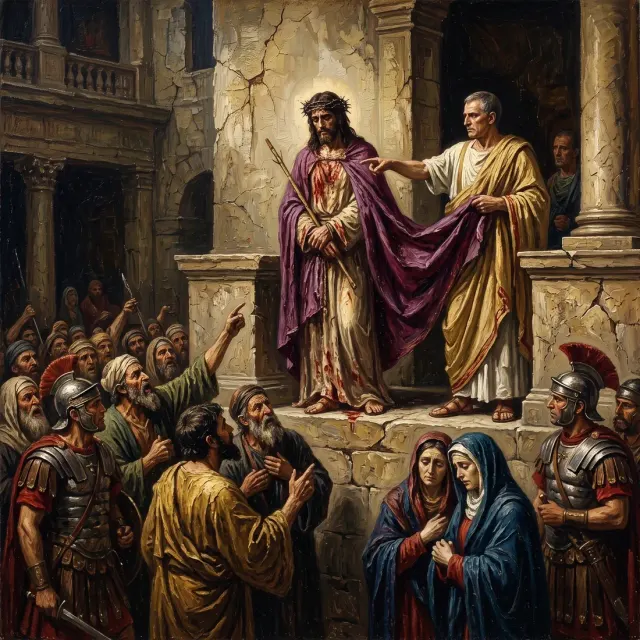
Pilate offers the feast-time release of a prisoner: Jesus or Barabbas, a well-known captive. He knows envy drove the leaders, and his wife warns him after a troubling dream. The leaders persuade the crowd to choose Barabbas and demand Jesus' crucifixion. Pilate asks what wrong Jesus has done, but the shouts grow. He washes his hands and claims freedom from blame. The crowd accepts blame for itself and its children. These speakers do not place guilt on every Jewish person or later generation. Pilate still releases Barabbas, has Jesus whipped, and hands him over to die. His handwashing does not stop his order.
In everyday life
A misconduct caseworker reads a signed order beside a public claim that its signer had no part in the harm. The official says the crowd left him no choice, but his name remains on the decision. The caseworker records both words and deed. Pilate authorises a death; the review only traces responsibility after an abuse.
Notice
Matthew 27:24 Pilate washes his hands while retaining the power to release or hand over prisoners. His public claim of innocence stands against the decision he makes.
Matthew 27:15-26
King James Version15Now at that feast the governor was wont to release unto the people a prisoner, whom they would.
16And they had then a notable prisoner, called Barabbas.
17Therefore when they were gathered together, Pilate said unto them, Whom will ye that I release unto you? Barabbas, or Jesus which is called Christ?
18For he knew that for envy they had delivered him.
19When he was set down on the judgment seat, his wife sent unto him, saying, Have thou nothing to do with that just man: for I have suffered many things this day in a dream because of him.
20But the chief priests and elders persuaded the multitude that they should ask Barabbas, and destroy Jesus.
21The governor answered and said unto them, Whether of the twain will ye that I release unto you? They said, Barabbas.
22Pilate saith unto them, What shall I do then with Jesus which is called Christ? They all say unto him, Let him be crucified.
23And the governor said, Why, what evil hath he done? But they cried out the more, saying, Let him be crucified.
24When Pilate saw that he could prevail nothing, but that rather a tumult was made, he took water, and washed his hands before the multitude, saying, I am innocent of the blood of this just person: see ye to it.
25Then answered all the people, and said, His blood be on us, and on our children.
26Then released he Barabbas unto them: and when he had scourged Jesus, he delivered him to be crucified.
Matthew 27:27-37
Soldiers Mock and Crucify Jesus
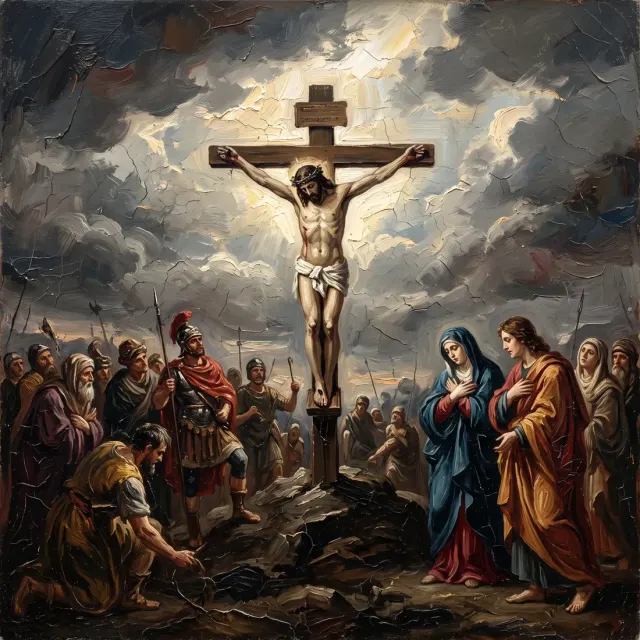
The soldiers dress Jesus in a scarlet robe and press a thorn crown onto his head. They give him a reed, bow in mock homage, spit on him, and strike him. Then they lead him away to crucify him. Simon, a man from Cyrene, a city in North Africa, is forced to carry the cross. At Golgotha, the place called a skull, Jesus refuses a bitter drink. They nail him to the cross, divide his clothes by chance, and keep watch. The written charge over his head calls him king of the Jews. Mock royal signs surround a real, brutal execution.
In everyday life
A torture-survivor advocate sorts testimony about how captors used mock titles and clothing to strip victims of dignity. She keeps the details needed for the claim without displaying them for curious visitors. The account belongs to the harmed person, not the audience. Jesus' crucifixion includes death and the charge of kingship, not only public humiliation.
Notice
Matthew 27:37 The charge placed over Jesus repeats the royal title used in the soldiers' mockery. Kingship is treated as both an insult and a reason for execution.
Matthew 27:27-37
King James Version27Then the soldiers of the governor took Jesus into the common hall, and gathered unto him the whole band of soldiers.
28And they stripped him, and put on him a scarlet robe.
29And when they had platted a crown of thorns, they put it upon his head, and a reed in his right hand: and they bowed the knee before him, and mocked him, saying, Hail, King of the Jews!
30And they spit upon him, and took the reed, and smote him on the head.
31And after that they had mocked him, they took the robe off from him, and put his own raiment on him, and led him away to crucify him.
32And as they came out, they found a man of Cyrene, Simon by name: him they compelled to bear his cross.
33And when they were come unto a place called Golgotha, that is to say, a place of a skull,
34They gave him vinegar to drink mingled with gall: and when he had tasted thereof, he would not drink.
35And they crucified him, and parted his garments, casting lots: that it might be fulfilled which was spoken by the prophet, They parted my garments among them, and upon my vesture did they cast lots.
36And sitting down they watched him there;
37And set up over his head his accusation written, THIS IS JESUS THE KING OF THE JEWS.
Matthew 27:38-44
Mockers Demand That Jesus Save Himself
Two thieves hang on crosses beside Jesus. People passing by insult him and repeat a charge about destroying and rebuilding the temple. They demand that he come down if he is God's Son. The chief priests, law teachers, and elders join in. They say he saved others but cannot save himself. They promise belief if he leaves the cross and ask why God does not rescue someone who trusts him. Even the thieves insult him. Their test makes self-rescue the proof of his claims. They cannot accept that remaining on the cross has a purpose other than failure.
In everyday life
A trauma-support volunteer closes a stack of hostile letters sent to a survivor. Each letter demands a public display of strength before its writer will believe her. The volunteer helps her record the threats without accepting their test as fair. Jesus is dying while mocked; the survivor is receiving care after harm.
Notice
Matthew 27:42 The leaders admit that Jesus saved others while using that fact to taunt him. Their demand reduces belief to an act of self-rescue on their terms.
Matthew 27:38-44
King James Version38Then were there two thieves crucified with him, one on the right hand, and another on the left.
39And they that passed by reviled him, wagging their heads,
40And saying, Thou that destroyest the temple, and buildest it in three days, save thyself. If thou be the Son of God, come down from the cross.
41Likewise also the chief priests mocking him, with the scribes and elders, said,
42He saved others; himself he cannot save. If he be the King of Israel, let him now come down from the cross, and we will believe him.
43He trusted in God; let him deliver him now, if he will have him: for he said, I am the Son of God.
44The thieves also, which were crucified with him, cast the same in his teeth.
Matthew 27:45-50
Darkness Surrounds the Death of Jesus
Darkness covers the land from about noon until three in the afternoon. Jesus cries to God about being forsaken. Matthew gives his cry and its meaning so the depth of his anguish is plain. Some bystanders think he is calling for Elias, an earlier prophet. One offers a sponge soaked with sour wine on a reed. Others wait to see whether Elias will rescue him. Jesus cries loudly again and dies. The account does not cover his distress with calm-sounding words. His death comes amid darkness, pain, misunderstanding, and the failure of any visible rescue.
In everyday life
A vigil companion holds a cup near a dying friend's lips and hears him ask why he feels so alone. She does not argue him out of his grief or pretend a calm room removes it. She remains beside him. Jesus' cry addresses God amid crucifixion and darkness over the land, not a peaceful bedside death.
Notice
Matthew 27:46 Matthew translates the cry rather than leaving it unexplained. The reader hears Jesus' anguish even though some standing nearby misunderstand whom he addresses.
Matthew 27:45-50
King James Version45Now from the sixth hour there was darkness over all the land unto the ninth hour.
46And about the ninth hour Jesus cried with a loud voice, saying, Eli, Eli, lama sabachthani? that is to say, My God, my God, why hast thou forsaken me?
47Some of them that stood there, when they heard that, said, This man calleth for Elias.
48And straightway one of them ran, and took a spunge, and filled it with vinegar, and put it on a reed, and gave him to drink.
49The rest said, Let be, let us see whether Elias will come to save him.
50Jesus, when he had cried again with a loud voice, yielded up the ghost.
Matthew 27:51-56
Signs Shake the Land and Witnesses
The temple curtain tears from top to bottom. The earth shakes, rocks split, and tombs open. Matthew says many dead holy people rise and appear in Jerusalem after Jesus rises. He gives no detailed account of their later lives. The officer and soldiers guarding Jesus become terrified by the earthquake and what they see. They confess that he truly was God's Son. Women who had served him in Galilee, a northern region, watch from far away. They include Mary Magdalene; Mary, mother of James and Joses; and the mother of the sons of Zebedee. Their continued presence contrasts with the flight of his other followers.
In everyday life
A disaster-log keeper reads statements from witnesses whose confidence collapses after an event they cannot explain. She marks where their earlier assumptions give way to fear and new claims. She preserves their words without adding details they did not see. Matthew reports signs involving the temple and the dead, not merely shaken witness confidence.
Notice
Matthew 27:54 The confession comes from the men guarding the execution, not only from Jesus' friends. The signs make even these witnesses speak of him as God's Son.
Matthew 27:51-56
King James Version51And, behold, the veil of the temple was rent in twain from the top to the bottom; and the earth did quake, and the rocks rent;
52And the graves were opened; and many bodies of the saints which slept arose,
53And came out of the graves after his resurrection, and went into the holy city, and appeared unto many.
54Now when the centurion, and they that were with him, watching Jesus, saw the earthquake, and those things that were done, they feared greatly, saying, Truly this was the Son of God.
55And many women were there beholding afar off, which followed Jesus from Galilee, ministering unto him:
56Among which was Mary Magdalene, and Mary the mother of James and Joses, and the mother of Zebedee’s children.
Matthew 27:57-61
A Follower Gives Jesus a Tomb
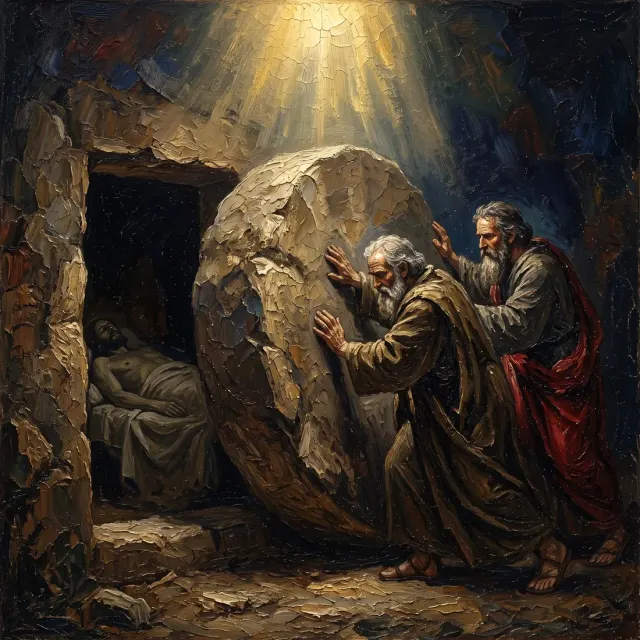
As evening comes, Joseph, a wealthy follower from the town of Arimathæa, asks Pilate for Jesus' body. Pilate grants the request. Joseph wraps the body in clean linen and places it in his own unused tomb cut into rock. He rolls a large stone across the entrance and leaves. Mary Magdalene and the other Mary remain seated opposite the tomb. Their watching connects the place of death with the place of burial. Jesus is not left as an unnamed body after execution. A follower gives him careful burial, and the women know where he has been laid.
In everyday life
A funeral volunteer receives permission to collect the body of a man whose relatives are far away. He finds clean clothes, arranges a grave, and tells two friends where they can sit nearby. Care continues when the dead man can offer nothing in return. Joseph gives his own unused rock tomb to Jesus, not a public burial arrangement.
Notice
Matthew 27:61 The two women sit facing the tomb after Joseph leaves. Their presence matters because the later visit will be to a place they have already seen.
Matthew 27:57-61
King James Version57When the even was come, there came a rich man of Arimathæa, named Joseph, who also himself was Jesus’ disciple:
58He went to Pilate, and begged the body of Jesus. Then Pilate commanded the body to be delivered.
59And when Joseph had taken the body, he wrapped it in a clean linen cloth,
60And laid it in his own new tomb, which he had hewn out in the rock: and he rolled a great stone to the door of the sepulchre, and departed.
61And there was Mary Magdalene, and the other Mary, sitting over against the sepulchre.
Matthew 27:62-66
Opponents Seal and Guard the Tomb
The next day, the chief priests and Pharisees, a strict religious group, approach Pilate. They recall Jesus' claim that he would rise after three days. Calling him a deceiver, they ask for security at the tomb. They fear his followers will steal the body and claim he has risen. Pilate tells them to use a guard and secure it as well as they can. They seal the stone and post watchmen. The burial now has official precautions around it. The leaders remember Jesus' promise, but they respond by trying to prevent what they think will be a fraud.
In everyday life
A warehouse custodian seals a disputed crate and posts a guard after a claim that its contents will vanish. He records the seal number and the watch schedule so no later account can ignore the precautions. His effort reveals how seriously he takes the claim. Jesus' opponents guard a grave against an alleged theft, not stored goods.
Notice
Matthew 27:64 The request names the explanation the leaders expect to give: a stolen body. Their plan shows that Jesus' promise of rising has not been forgotten.
Matthew 27:62-66
King James Version62Now the next day, that followed the day of the preparation, the chief priests and Pharisees came together unto Pilate,
63Saying, Sir, we remember that that deceiver said, while he was yet alive, After three days I will rise again.
64Command therefore that the sepulchre be made sure until the third day, lest his disciples come by night, and steal him away, and say unto the people, He is risen from the dead: so the last error shall be worse than the first.
65Pilate said unto them, Ye have a watch: go your way, make it as sure as ye can.
66So they went, and made the sepulchre sure, sealing the stone, and setting a watch.
Details worth noticing
The opening image
Matthew 27:1 begins with “When the morning was come, all the chief priests and elders of the people took counsel against Jesus to put him to death:”
Where the chapter turns
Matthew 27:38 forms a natural hinge: “Then were there two thieves crucified with him, one on the right hand, and another on the left.”
The final note
Matthew 27:66 leaves the reader with “So they went, and made the sepulchre sure, sealing the stone, and setting a watch.”
A word trail through the chapter
The words JESUS, Pilate, took, governor, chief, priests help reveal the chapter’s repeated concerns.
KJV words made clear
- scourged
- Beaten severely with a whip as a punishment.
- centurion
- A Roman army officer responsible for a group of soldiers.
- yielded up the ghost
- An older way to say that a person died.
Music and video connected to the passage
Related media appears when its Scripture reference overlaps this study. Music and video can illuminate a theme while the biblical text remains the foundation.
 Sealed until the Third DayMatthew 27:57-66Listen to related music →
 The Veil Was TornMatthew 27:27-56Listen to related music →
 A Stone at the DoorMatthew 27:57-66; Mark 15:42-47; Luke 23:50-56; John 19:38-42Listen to related music →
 It Is FinishedMatthew 27:32-56; Mark 15:21-41; Luke 23:26-49; John 19:16-37Listen to related music →