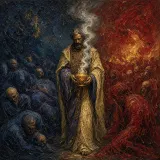
The big picture
Rebellion grows within Israel, God's people, as its leaders face another challenge. Korah, a Levite who already serves the sacred tent, joins Dathan and Abiram, members of another tribe, against Moses, the leader, and Aaron, the priest. Many respected men support them. Their claim that everyone is holy becomes a demand for roles God has not given them. Judgement follows, and Aaron must act to save the people accusing him.
In this chapter
- Korah Demands the Priestly Role Numbers 16:1-11
Korah and his allies gather 250 recognised leaders against Moses and Aaron.
- Dathan and Abiram Refuse to Come Numbers 16:12-15
Moses summons Dathan and Abiram, but they refuse to appear.
- The Assembly Faces a Warning Numbers 16:16-24
Moses tells Korah and his company to stand before God with incense, together with Aaron.
- The Earth Opens and Fire Falls Numbers 16:25-35
Moses warns the people to leave the rebels' tents and touch nothing belonging to them.
- Fire Pans Become a Warning Numbers 16:36-40
Eleazar, Aaron's priestly son, receives God's order through Moses to recover the bronze fire pans from the burning and scatter their coals.
- Fresh Accusations Bring Another Crisis Numbers 16:41-45
The next day the whole assembly complains against Moses and Aaron, accusing them of killing God's people.
- Aaron Stands Between Death and Life Numbers 16:46-50
Moses tells Aaron to take fire from the altar, add incense and hurry among the people to make atonement.
Central truth
A challenge to God's appointed service brings deadly judgement, yet the accused priest becomes the means of stopping a plague.


Scripture beside the summary
Numbers · King James Version · 50Numbers 16:1-11
Korah Demands the Priestly Role
Korah and his allies gather 250 recognised leaders against Moses and Aaron. They argue that the entire assembly is holy and that the two leaders have raised themselves above it. Moses falls face down, then proposes a test: the men will bring incense in fire pans, and God will show whom he chooses. Moses reminds Korah that the Levites already have special service near God. Seeking the priesthood as well is not a complaint against Aaron alone, but rebellion against God's appointment.

In everyday life
A senior theatre technician tells the rigging crew that every worker matters, then demands control of work reserved for another certified team. The first claim is true, but it does not settle who has authority for the next task. Shared value does not erase distinct duties. Israel's priesthood is assigned by God, not certification.
Notice
Numbers 16:10 Korah already has a role near the tabernacle. Moses identifies the demand as seeking the priesthood in addition to service God has already entrusted to him.
Numbers 16:1-11
King James Version1Now Korah, the son of Izhar, the son of Kohath, the son of Levi, and Dathan and Abiram, the sons of Eliab, and On, the son of Peleth, sons of Reuben, took men:
2And they rose up before Moses, with certain of the children of Israel, two hundred and fifty princes of the assembly, famous in the congregation, men of renown:
3And they gathered themselves together against Moses and against Aaron, and said unto them, Ye take too much upon you, seeing all the congregation are holy, every one of them, and the LORD is among them: wherefore then lift ye up yourselves above the congregation of the LORD?
4And when Moses heard it, he fell upon his face:
5And he spake unto Korah and unto all his company, saying, Even to morrow the LORD will shew who are his, and who is holy; and will cause him to come near unto him: even him whom he hath chosen will he cause to come near unto him.
6This do; Take you censers, Korah, and all his company;
7And put fire therein, and put incense in them before the LORD to morrow: and it shall be that the man whom the LORD doth choose, he shall be holy: ye take too much upon you, ye sons of Levi.
8And Moses said unto Korah, Hear, I pray you, ye sons of Levi:
9Seemeth it but a small thing unto you, that the God of Israel hath separated you from the congregation of Israel, to bring you near to himself to do the service of the tabernacle of the LORD, and to stand before the congregation to minister unto them?
10And he hath brought thee near to him, and all thy brethren the sons of Levi with thee: and seek ye the priesthood also?
11For which cause both thou and all thy company are gathered together against the LORD: and what is Aaron, that ye murmur against him?
Numbers 16:12-15
Dathan and Abiram Refuse to Come
Moses summons Dathan and Abiram, but they refuse to appear. They call Egypt a rich land and accuse him of bringing them into the desert to die. They also blame him for failing to give them fields and vineyards, and accuse him of treating people as fools. Moses becomes angry and asks God not to accept their offering. He says he has taken no donkey from them and harmed none of them. The dispute includes a false charge of selfish leadership.

In everyday life
The volunteer housing organiser reads a letter from two residents who refuse a meeting and accuse him of profiting from their displacement. He opens his expense records, knowing he has not taken their money. Their anger rewrites his service as exploitation. Moses appeals to God over a rebellion against his appointed leadership.
Notice
Numbers 16:13 The rebels describe Egypt with language of rich provision. Their accusation reverses the meaning of leaving it and portrays Moses' leadership as the cause of their loss.
Numbers 16:12-15
King James Version12And Moses sent to call Dathan and Abiram, the sons of Eliab: which said, We will not come up:
13Is it a small thing that thou hast brought us up out of a land that floweth with milk and honey, to kill us in the wilderness, except thou make thyself altogether a prince over us?
14Moreover thou hast not brought us into a land that floweth with milk and honey, or given us inheritance of fields and vineyards: wilt thou put out the eyes of these men? we will not come up.
15And Moses was very wroth, and said unto the LORD, Respect not thou their offering: I have not taken one ass from them, neither have I hurt one of them.
Numbers 16:16-24
The Assembly Faces a Warning
Moses tells Korah and his company to stand before God with incense, together with Aaron. Each man brings a fire pan to the meeting tent. Korah gathers the assembly against the leaders, and God's glory appears. God tells Moses and Aaron to separate themselves so he can destroy the assembly. They fall down and plead that one man's sin not bring anger on everyone. God then tells the people to move away from the tents of Korah, Dathan and Abiram.

In everyday life
An emergency coordinator sees residents gathering around a dangerous dispute at a fuel depot. She urges the crowd to move away while senior staff plead for everyone outside the dispute to be protected. Standing near the conflict exposes others to its consequences. Numbers describes God's judgement, not the spread of a physical accident.
Notice
Numbers 16:22 Both accused leaders plead for the wider assembly while it stands against them. Their response seeks to spare the people rather than use the threat for revenge.
Numbers 16:16-24
King James Version16And Moses said unto Korah, Be thou and all thy company before the LORD, thou, and they, and Aaron, to morrow:
17And take every man his censer, and put incense in them, and bring ye before the LORD every man his censer, two hundred and fifty censers; thou also, and Aaron, each of you his censer.
18And they took every man his censer, and put fire in them, and laid incense thereon, and stood in the door of the tabernacle of the congregation with Moses and Aaron.
19And Korah gathered all the congregation against them unto the door of the tabernacle of the congregation: and the glory of the LORD appeared unto all the congregation.
20And the LORD spake unto Moses and unto Aaron, saying,
21Separate yourselves from among this congregation, that I may consume them in a moment.
22And they fell upon their faces, and said, O God, the God of the spirits of all flesh, shall one man sin, and wilt thou be wroth with all the congregation?
23And the LORD spake unto Moses, saying,
24Speak unto the congregation, saying, Get you up from about the tabernacle of Korah, Dathan, and Abiram.
Numbers 16:25-35
The Earth Opens and Fire Falls
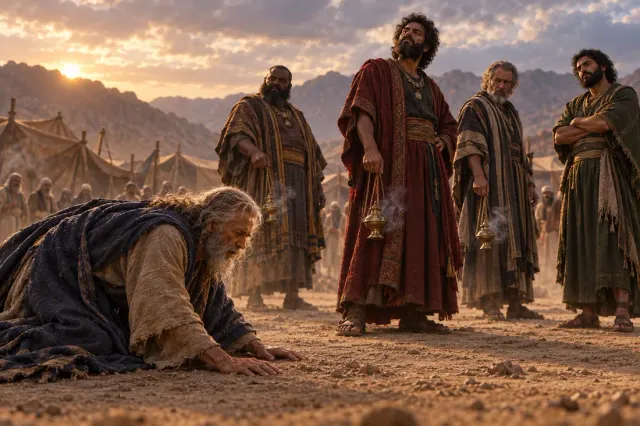
Moses warns the people to leave the rebels' tents and touch nothing belonging to them. Dathan and Abiram stand with their wives and children. Moses says an unusual death will show that God sent him. The ground opens, swallowing the households and possessions alive, then closes over them. The surrounding people flee in fear. Fire from God also consumes the 250 men offering incense. The account includes the deaths of families and children, making the judgement far wider than the leading men's deaths alone.

In everyday life
A village social worker reads the names of affected families after a catastrophe and stops at the children listed beside their parents. The loss reaches households, not only the adults whose decisions shaped events. She cannot make the sorrow smaller by counting leaders alone. Numbers identifies the deaths as God's judgement on rebellion.
Notice
Numbers 16:27 Wives, sons and small children are present at the tents. The account does not hide that the judgement falls on households as well as the men leading the challenge.
Numbers 16:25-35
King James Version25And Moses rose up and went unto Dathan and Abiram; and the elders of Israel followed him.
26And he spake unto the congregation, saying, Depart, I pray you, from the tents of these wicked men, and touch nothing of theirs, lest ye be consumed in all their sins.
27So they gat up from the tabernacle of Korah, Dathan, and Abiram, on every side: and Dathan and Abiram came out, and stood in the door of their tents, and their wives, and their sons, and their little children.
28And Moses said, Hereby ye shall know that the LORD hath sent me to do all these works; for I have not done them of mine own mind.
29If these men die the common death of all men, or if they be visited after the visitation of all men; then the LORD hath not sent me.
30But if the LORD make a new thing, and the earth open her mouth, and swallow them up, with all that appertain unto them, and they go down quick into the pit; then ye shall understand that these men have provoked the LORD.
31And it came to pass, as he had made an end of speaking all these words, that the ground clave asunder that was under them:
32And the earth opened her mouth, and swallowed them up, and their houses, and all the men that appertained unto Korah, and all their goods.
33They, and all that appertained to them, went down alive into the pit, and the earth closed upon them: and they perished from among the congregation.
34And all Israel that were round about them fled at the cry of them: for they said, Lest the earth swallow us up also.
35And there came out a fire from the LORD, and consumed the two hundred and fifty men that offered incense.
Numbers 16:36-40
Fire Pans Become a Warning
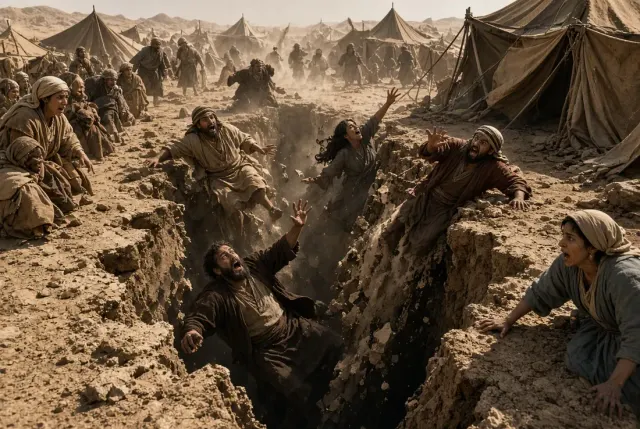
Eleazar, Aaron's priestly son, receives God's order through Moses to recover the bronze fire pans from the burning and scatter their coals. The pans have become holy because they were presented before God, despite the guilt of those who used them. They are hammered into plates covering the altar. The metal remains as a visible warning that only Aaron's descendants may offer incense there. An object from the failed challenge now guards the very boundary the rebels tried to cross.
In everyday life
A railway inspector mounts a damaged coupling beside the workshop safety board after a fatal failure. Workers pass it whenever they collect tools, and its presence recalls a boundary that must be respected. The object keeps a costly warning visible. The fire pans also remain holy because they were offered before God.
Notice
Numbers 16:38 The fire pans are holy even though their users sinned. Their reuse follows their presentation before God, rather than approval of the men who brought them.
Numbers 16:36-40
King James Version36And the LORD spake unto Moses, saying,
37Speak unto Eleazar the son of Aaron the priest, that he take up the censers out of the burning, and scatter thou the fire yonder; for they are hallowed.
38The censers of these sinners against their own souls, let them make them broad plates for a covering of the altar: for they offered them before the LORD, therefore they are hallowed: and they shall be a sign unto the children of Israel.
39And Eleazar the priest took the brasen censers, wherewith they that were burnt had offered; and they were made broad plates for a covering of the altar:
40To be a memorial unto the children of Israel, that no stranger, which is not of the seed of Aaron, come near to offer incense before the LORD; that he be not as Korah, and as his company: as the LORD said to him by the hand of Moses.
Numbers 16:41-45
Fresh Accusations Bring Another Crisis
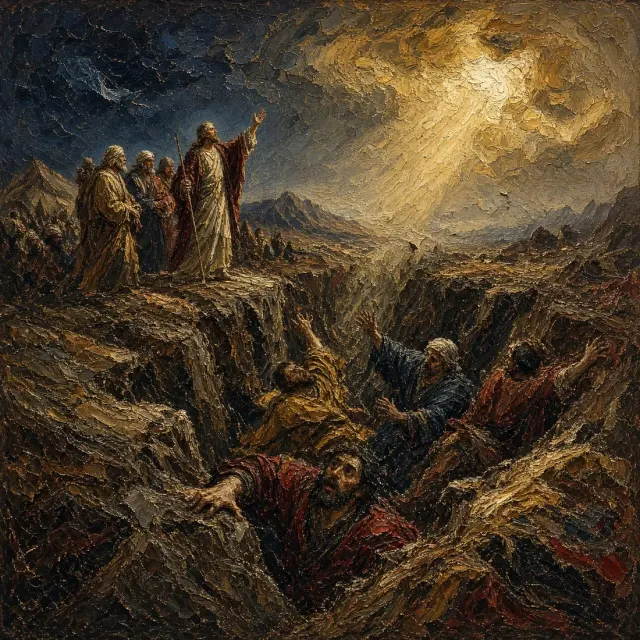
The next day the whole assembly complains against Moses and Aaron, accusing them of killing God's people. The recent judgement has not ended the challenge. As the crowd gathers, the cloud covers the tabernacle and God's glory appears again. Moses and Aaron go before the tent. God again tells them to move away so he can consume the assembly, and they fall face down. The people have treated divine judgement as the leaders' wrongdoing, placing the camp in fresh danger.
In everyday life
The mining chaplain listens in a pithead room as grieving neighbours blame the inspectors who warned them before a collapse. Pain gives the accusation force, but does not make it accurate. The same families gather again, unable to accept what happened. Israel's renewed accusation brings another direct encounter with God's anger.
Notice
Numbers 16:41 The accusation comes the very next day. Even the previous deaths have not persuaded the assembly to accept that the judgement was God's act rather than Moses' attack.
Numbers 16:41-45
King James Version41But on the morrow all the congregation of the children of Israel murmured against Moses and against Aaron, saying, Ye have killed the people of the LORD.
42And it came to pass, when the congregation was gathered against Moses and against Aaron, that they looked toward the tabernacle of the congregation: and, behold, the cloud covered it, and the glory of the LORD appeared.
43And Moses and Aaron came before the tabernacle of the congregation.
44And the LORD spake unto Moses, saying,
45Get you up from among this congregation, that I may consume them as in a moment. And they fell upon their faces.
Numbers 16:46-50
Aaron Stands Between Death and Life
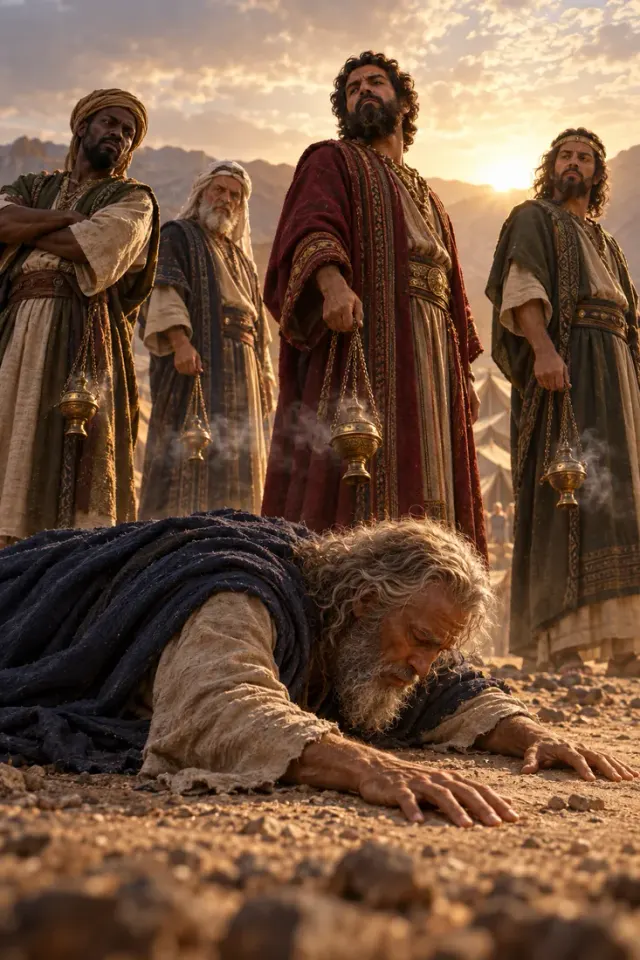
Moses tells Aaron to take fire from the altar, add incense and hurry among the people to make atonement. A plague has already begun. Aaron runs into the assembly and offers the incense on their behalf. He stands between the dead and the living, and the plague stops. Another 14,700 people have died, apart from those killed in Korah's rebellion. Aaron then returns to Moses at the tent. The priest whose role was challenged acts urgently for the people who blamed him.
In everyday life
A paramedic runs toward a crowd that was shouting at him moments earlier, carrying the equipment needed to keep people alive. He attends to those in danger without first demanding that they retract their accusations. The work comes before his defence. Aaron stops a plague through priestly atonement, not emergency treatment.
Notice
Numbers 16:48 The living and the dead stand on opposite sides of Aaron. The priesthood challenged as self-serving is shown acting for the survival of the people who rejected it.
Numbers 16:46-50
King James Version46And Moses said unto Aaron, Take a censer, and put fire therein from off the altar, and put on incense, and go quickly unto the congregation, and make an atonement for them: for there is wrath gone out from the LORD; the plague is begun.
47And Aaron took as Moses commanded, and ran into the midst of the congregation; and, behold, the plague was begun among the people: and he put on incense, and made an atonement for the people.
48And he stood between the dead and the living; and the plague was stayed.
49Now they that died in the plague were fourteen thousand and seven hundred, beside them that died about the matter of Korah.
50And Aaron returned unto Moses unto the door of the tabernacle of the congregation: and the plague was stayed.
Details worth noticing
The opening image
Numbers 16:1 begins with “Now Korah, the son of Izhar, the son of Kohath, the son of Levi, and Dathan and Abiram, the sons of Eliab, and On, the son of Peleth, sons of Reuben, took…”
Where the chapter turns
Numbers 16:22 forms a natural hinge: “And they fell upon their faces, and said, O God, the God of the spirits of all flesh, shall one man sin, and wilt thou be wroth with all the congregation?”
The final note
Numbers 16:50 leaves the reader with “And Aaron returned unto Moses unto the door of the tabernacle of the congregation: and the plague was stayed.”
A word trail through the chapter
The words LORD, congregation, Moses, Aaron, Korah, Israel help reveal the chapter’s repeated concerns.
KJV words made clear
- behold
- look, or pay close attention
- unto
- to
- thee
- you
- thou
- you
- thy
- your
Music and video connected to the passage
Related media appears when its Scripture reference overlaps this study. Music and video can illuminate a theme while the biblical text remains the foundation.