The big picture
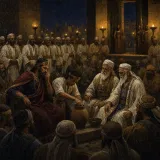
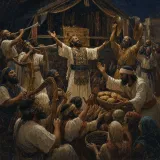
A condolence mission opens 1 Chronicles 19, and suspicion turns it into an international war. The account is careful about the first cause: David says he intends kindness toward Hanun, while Hanun’s advisers allege espionage and overthrow. Their charge is recorded as suspicion, not revealed as David’s hidden motive. The humiliation of the envoys then creates the hostility the advisers thought they were detecting. Ammon spends heavily on foreign military support, Joab and Abishai coordinate against two fronts, and Syrian reinforcements widen the conflict again until David takes command. The ending is political as much as military. Hadarezer’s servants make peace, the Syrians refuse further help to Ammon, and Hanun is left more isolated than before. The chapter’s irony is severe: fear of an enemy helps manufacture the very crisis it feared.
In this chapter
- The Advisers Create the Enemy They Fear 1 Chronicles 19:1-5
The chapter marks the difference between intention and accusation with unusual clarity.
- An Expensive Answer to a Self-Made Crisis 1 Chronicles 19:6-9
The Ammonites understand that their treatment of the envoys has made them “odious to David,” and their answer is enormously expensive preparation.
- Two Fronts and an Agreement to Help 1 Chronicles 19:10-15
Joab’s response to the two-front danger is neither solitary heroics nor vague confidence.
- The Hired War Widens Again 1 Chronicles 19:16-19
The first Syrian retreat only pushes the conflict into a larger round.

Scripture beside the summary
1 Chronicles · King James Version · 191 Chronicles 19:1-5
The Advisers Create the Enemy They Fear
The chapter marks the difference between intention and accusation with unusual clarity. David sends men to comfort Hanun because Nahash had shown him kindness. Hanun’s princes reinterpret the mission as reconnaissance for invasion, but 1 Chronicles never converts their suspicion into inside information about David’s real plan. What follows therefore grows out of the way they treat the envoys, not out of a plot the envoys were secretly carrying. The humiliation is physical and public: shaved faces and cut garments leave the men “greatly ashamed.” David’s first recorded response is not to scold them for failing the mission or rush them back into view. He gives them Jericho and time, telling them to remain until their beards grow. A diplomatic visit meant to preserve a relationship becomes the event that destroys it, and the advisers’ interpretation helps create the enemy they claimed was already present.
Deep dive
The account carefully separates the purpose David states from the purpose the advisers allege. David states his intention to show kindness in return for Nahash's kindness. The advisers claim that the visitors have come to spy and overthrow the land. Their accusation is recorded as their interpretation, not disclosed as David's hidden plan. The ensuing hostility follows their treatment of the envoys rather than revealing the alleged plot as the true purpose of the visit.
The envoys' shaved faces and damaged garments make the insult bodily and public. David's first response recorded here is directed toward their shame: they are to remain at Jericho until their beards have grown. The king treats their recovery as a matter requiring time and shelter, not an inconvenience to be ignored while larger affairs proceed. A mission intended to preserve a relationship has been turned into the occasion for destroying it.
Words to trace: David, Hanun, Ammon, children, father, servants
Verse-by-verse path
- 1 Chronicles 19:1
Nahash is the Ammonite king who besieged Jabesh-gilead and offered peace only on condition of putting out every man’s right eye (1 Samuel 11:2). His death opens the chapter because a new king means treaties must be renewed, and courts watched those transitions closely.
- 1 Chronicles 19:2
“Kindness” is chesed, the loyalty owed within a bond or treaty. What Nahash did for David is never recorded; an enemy of Saul had reason to shelter Saul’s fugitive. Another son of Nahash, Shobi, will later bring David supplies at Mahanaim when he flees Absalom (2 Samuel 17:27).
- 1 Chronicles 19:3
The princes’ question turns on the word “honour”, literally to make heavy, to give weight. They ask whether the gesture is weighty or hollow. Their three verbs, search, overthrow and spy out, move from reconnaissance to conquest in a single breath.
- 1 Chronicles 19:4
In 2 Samuel 10:4 the beard is shaved on one side only, half of it, which made the mockery sharper still. Among Israel and its neighbours a full beard marked a free adult man, and cutting the garments “in the midst” left the envoys exposed from the waist down, the treatment given to captives.
- 1 Chronicles 19:5
Jericho was the first settlement a traveller reached after crossing the Jordan from Ammon, so the envoys could wait there without entering Jerusalem. The city lay under Joshua’s curse and would not be rebuilt as a walled town until Hiel’s day (1 Kings 16:34), which suits a quiet waiting place.
1 Chronicles 19:1-5
King James Version1Now it came to pass after this, that Nahash the king of the children of Ammon died, and his son reigned in his stead.
2And David said, I will shew kindness unto Hanun the son of Nahash, because his father shewed kindness to me. And David sent messengers to comfort him concerning his father. So the servants of David came into the land of the children of Ammon to Hanun, to comfort him.
3But the princes of the children of Ammon said to Hanun, Thinkest thou that David doth honour thy father, that he hath sent comforters unto thee? are not his servants come unto thee for to search, and to overthrow, and to spy out the land?
4Wherefore Hanun took David’s servants, and shaved them, and cut off their garments in the midst hard by their buttocks, and sent them away.
5Then there went certain, and told David how the men were served. And he sent to meet them: for the men were greatly ashamed. And the king said, Tarry at Jericho until your beards be grown, and then return.
1 Chronicles 19:6-9
An Expensive Answer to a Self-Made Crisis
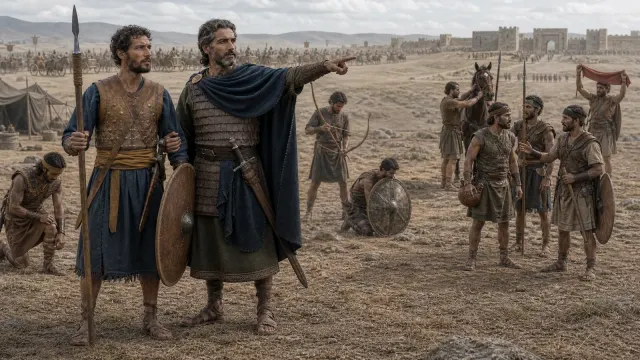
The Ammonites understand that their treatment of the envoys has made them “odious to David,” and their answer is enormously expensive preparation. Silver goes out to hire chariots, horsemen, and allied forces from several regions. The sequence supplies the irony without requiring commentary from an invented speaker: fear of a hostile intention has produced conduct that now makes hostility a practical expectation. The military geography then matters. Ammon’s forces stand near the city gate while the hired kings occupy the field, creating separated fronts rather than a single line. Those details set up Joab’s next problem. The battlefield is not decoration around a foreordained outcome. It explains why the Israelite army must divide and why mutual support between commanders becomes essential. A failed act of diplomacy has now expanded into a crisis involving multiple peoples and positions.
Deep dive
The hiring of Syrian forces shows that Hanun's court now anticipates the consequences of its treatment of the envoys. Considerable silver goes toward preparing for the hostility that the advisers claimed to detect in the original act of sympathy. The sequence supplies its own irony: suspicion has helped produce the danger it announced.
The positions of the Ammonite and hired forces explain the problem Joab faces. The city entrance and the open field create separate fronts rather than one line that can be met in a single direction. The military details are not mere decoration around an inevitable victory. They establish the practical danger that the next exchange between Joab and Abishai addresses. The quarrel has expanded beyond two rulers and now places multiple forces on the ground.
Words to trace: Ammon, children, battle, chariots, David, maachah
Verse-by-verse path
- 1 Chronicles 19:6
“Odious” is literally “made themselves stink”, the same verb Jacob uses in Genesis 34:30. Only Chronicles gives the fee: a thousand talents, some thirty tons of silver. Mesopotamia here is Aram-naharaim, “Aram of the two rivers”, and Maachah lay near Mount Hermon.
- 1 Chronicles 19:7
Samuel counts the hired force as men (2 Samuel 10:6, thirty-three thousand in all); Chronicles gives thirty-two thousand chariots, most likely meaning chariotry with its crews. Medeba is a town on the Moabite plateau east of the Dead Sea, named already in Numbers 21:30 and on the Moabite Stone of Mesha.
- 1 Chronicles 19:8
“The mighty men” are the gibborim, the seasoned warriors listed by name in chapter 11. David himself stays in Jerusalem for this first round, and Joab takes the professional core of the army rather than the full tribal levy.
- 1 Chronicles 19:9
The city is Rabbah, the Ammonite capital, modern Amman. Ammon holds the gate while the hired kings keep their own camp in the open, “by themselves”, a detail that explains why Joab finds enemies on two sides of him.
1 Chronicles 19:6-9
King James Version6And when the children of Ammon saw that they had made themselves odious to David, Hanun and the children of Ammon sent a thousand talents of silver to hire them chariots and horsemen out of Mesopotamia, and out of Syria-maachah, and out of Zobah.
7So they hired thirty and two thousand chariots, and the king of Maachah and his people; who came and pitched before Medeba. And the children of Ammon gathered themselves together from their cities, and came to battle.
8And when David heard of it, he sent Joab, and all the host of the mighty men.
9And the children of Ammon came out, and put the battle in array before the gate of the city: and the kings that were come were by themselves in the field.
1 Chronicles 19:10-15
Two Fronts and an Agreement to Help
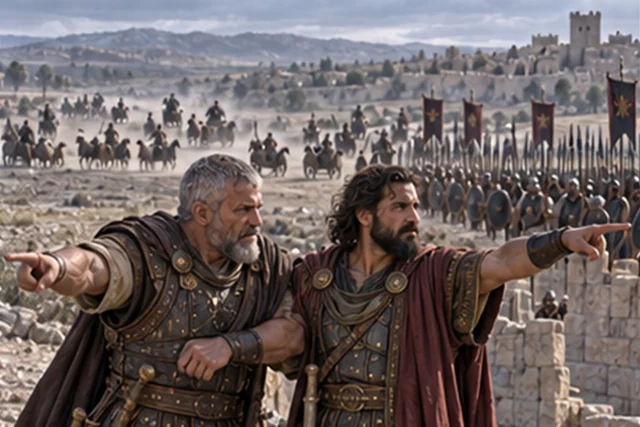
Joab’s response to the two-front danger is neither solitary heroics nor vague confidence. He divides the force, takes selected men against the Syrians, gives the remainder to Abishai against Ammon, and builds the plan around one promise: whichever brother faces the stronger enemy will receive help from the other. “Be of good courage” comes after the coordination has been arranged, not instead of it. So does the acknowledgment, “let the LORD do that which is good in his sight.” First Chronicles puts planning, courage, mutual aid, and submission to God in the same short speech. When the Syrians flee, the Ammonites follow them into retreat, revealing how dependent the two fronts were on each other. Joab returns to Jerusalem, but the chapter deliberately leaves the wider conflict unfinished. One withdrawal has not yet settled the coalition or the war.

Deep dive
Joab recognizes the danger in front and behind and selects men for the Syrian front while assigning the rest to Abishai against Ammon. His instructions are reciprocal. If either side proves too strong, the other brother is to come to its help. The plan depends on coordinated action rather than on a separate display of courage by each commander.
The appeal to courage for the people and their cities is followed by submission to what seems good to the Lord. That acknowledgment does not replace planning; it follows a very specific plan. When the Syrians flee, the Ammonites also retreat into the city. Their reaction shows how closely the two fronts depend on one another. Joab's return to Jerusalem ends this encounter, but the account has not yet described the final capture of the Ammonite capital.
Words to trace: Syrians, Ammon, children, fled, Joab, people
Verse-by-verse path
- 1 Chronicles 19:10
“Before and behind” means Joab has marched into a pincer. He takes “the choice of the choice”, the best of the already select men, and sends them against the larger and more professional force, the hired Syrians, leaving the city garrison for the smaller division.
- 1 Chronicles 19:11
Abishai receives the second front, as he received the Edomite campaign in 18:12. The two sons of Zeruiah work as a pair throughout David’s reign, loyal to him in battle and at times at odds with him over bloodshed (2 Samuel 3:39).
- 1 Chronicles 19:12
A plain mutual-aid agreement, spelled out in two conditional clauses that mirror each other exactly. Whichever brother faces the heavier fighting draws on the other, so neither division is abandoned to its own front.
- 1 Chronicles 19:13
“Behave ourselves valiantly” translates a single verb, to be strong. Joab speaks of “the cities of our God”, treating the towns of Israel as belonging to the LORD. His last clause leaves the result in God’s hands without pretending to know it in advance.
- 1 Chronicles 19:14
The Syrians break at the first contact, before any fighting is described. Mercenaries hired for silver had less reason than a home army to hold ground once a charge came at them.
- 1 Chronicles 19:15
The Ammonites retreat because their allies are gone, and the city gates close behind them. Joab does not lay siege; he goes home. The capture of Rabbah is left for the next campaign season in 20:1.
1 Chronicles 19:10-15
King James Version10Now when Joab saw that the battle was set against him before and behind, he chose out of all the choice of Israel, and put them in array against the Syrians.
11And the rest of the people he delivered unto the hand of Abishai his brother, and they set themselves in array against the children of Ammon.
12And he said, If the Syrians be too strong for me, then thou shalt help me: but if the children of Ammon be too strong for thee, then I will help thee.
13Be of good courage, and let us behave ourselves valiantly for our people, and for the cities of our God: and let the LORD do that which is good in his sight.
14So Joab and the people that were with him drew nigh before the Syrians unto the battle; and they fled before him.
15And when the children of Ammon saw that the Syrians were fled, they likewise fled before Abishai his brother, and entered into the city. Then Joab came to Jerusalem.
1 Chronicles 19:16-19
The Hired War Widens Again
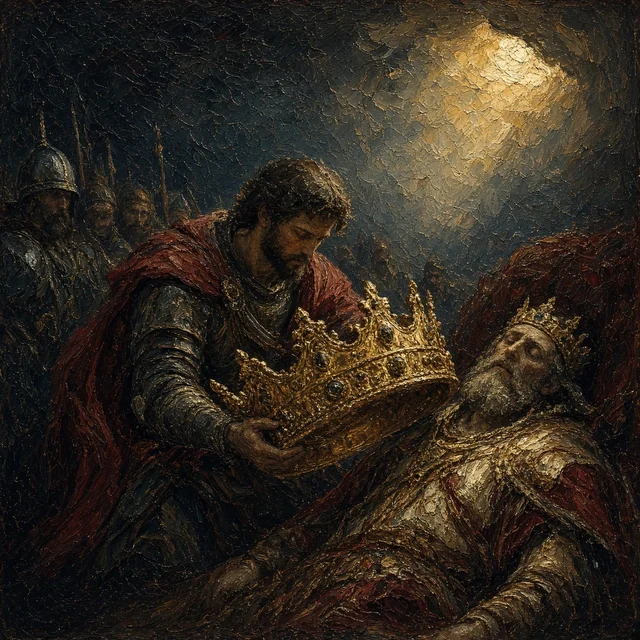
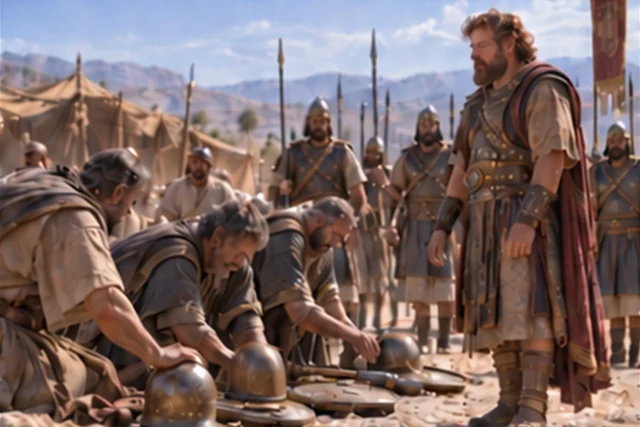
The first Syrian retreat only pushes the conflict into a larger round. Reinforcements are drawn from beyond the river under Shophach, and David now crosses the Jordan with Israel to meet them. The scale has traveled a remarkable distance from the original embassy of condolence. The renewed Syrian force is defeated, its commander dies, and the surviving political relationship changes. Hadarezer’s servants make peace with David and become subject to him, while the Syrians refuse to assist Ammon any further. That final refusal matters as much as the battle figures because it reveals what the war has done to the alliance system. Hanun’s court purchased outside help in response to the crisis it had created, and by the end that help is no longer available. First Chronicles does not invent remorse to finish the sequence. Isolation itself is the ending.
Deep dive
The first retreat does not settle the conflict. Syrian reinforcement draws another stage of fighting into the account, and David now leads Israel across Jordan. The scale has widened far beyond the embassy that opened the chapter. The death of the Syrian commander and the defeat of the force break the coalition's renewed effort.
The closing political result matters as much as the battlefield figures. Those associated with Hadarezer make peace with David and serve him, and the Syrians will no longer help the Ammonites. The last consequence of Hanun's insult is therefore isolation from the allies purchased to secure his position. Chronicles does not need an invented speech of regret to make the sequence intelligible. The changed relationships at the end state what the expanding conflict has accomplished.
Words to trace: Syrians, David, Israel, array, battle, captain
Verse-by-verse path
- 1 Chronicles 19:16
“The river” is the Euphrates, so Hadarezer is calling up Aramean forces from the far side of his empire. Shophach is Shobach in 2 Samuel 10:16, and Samuel names the battlefield, Helam, which Chronicles omits.
- 1 Chronicles 19:17
This time David takes the field himself and brings “all Israel”, the whole muster rather than the standing troops. Crossing the Jordan with the entire army was a commitment of the king’s own person, which the first round had avoided.
- 1 Chronicles 19:18
The numbers again part from Samuel, which has seven hundred chariot men and forty thousand horsemen (2 Samuel 10:18). Killing the commander ended the coalition, since armies of this kind held together around the man who led them.
- 1 Chronicles 19:19
Hadarezer’s vassals switch overlords, making peace with David and becoming his servants. The last clause leaves Ammon alone, which is the ground on which Joab will besiege Rabbah without interference in the chapter that follows.
1 Chronicles 19:16-19
King James Version16And when the Syrians saw that they were put to the worse before Israel, they sent messengers, and drew forth the Syrians that were beyond the river: and Shophach the captain of the host of Hadarezer went before them.
17And it was told David; and he gathered all Israel, and passed over Jordan, and came upon them, and set the battle in array against them. So when David had put the battle in array against the Syrians, they fought with him.
18But the Syrians fled before Israel; and David slew of the Syrians seven thousand men which fought in chariots, and forty thousand footmen, and killed Shophach the captain of the host.
19And when the servants of Hadarezer saw that they were put to the worse before Israel, they made peace with David, and became his servants: neither would the Syrians help the children of Ammon any more.
Questions to keep in mind while reading
- Track who acts, who speaks, who is affected, and what changes.
- Notice repeated promises, failures, rescues, and consequences.
- Do not assume the account approves every action that is reported.
Text first
Where readers differ
The chapter summary begins with what the passage says and how its parts fit together. It does not assume one denomination has already settled every question. Where a conclusion depends on a tradition, literary theory, or historical reconstruction, that dependence is named openly.
The KJV text is presented first. Interpretive conclusions are labeled, and differences are introduced only when they help a reader understand why serious communities do not always reach the same answer.
Comparative interpretive notes for this chapter are in preparation. Until reviewed notes are ready, this page separates the KJV text from summary and application without claiming that serious readers agree on every question.
Questions beneath the surface
- What account of God, human freedom, responsibility, and the good life emerges from 1 Chronicles 19?
- Which tension does the chapter refuse to resolve quickly?
- What changes when the chapter is read as part of the whole canon rather than as an isolated moral lesson?
- Where might a sincere reader confuse a familiar tradition with something the text states directly?
Questions for serious personal contemplation
These open-ended questions make room for tension, honest response, prayer, and conclusions that remain accountable to the chapter.
Observe without rushing
What part of 1 Chronicles 19 makes you stop, feel unsettled, or feel surprised, and why?
Which detail in the passage would be easiest to overlook? How does that detail change your understanding?
Where do you see tension between what happens and this focus: 1 Chronicles 19 develops its own movement around Ammon, children, David, Syrians, battle?
What important question does the passage leave open instead of resolving quickly?
Examine your inner life honestly
Which person, response, fear, or desire in the passage feels most like your own life right now?
What assumption about God, other people, or yourself does this text challenge?
Which part would you rather soften, avoid, or explain away too quickly? What might that reaction reveal?
If this Scripture could ask you one direct question, what do you think it would ask?
Respond with wisdom and courage
What do you need to remember, confess, grieve, thank God for, or trust after reading this passage?
How might another faithful person read this situation differently without ignoring the text?
What obedient response would be costly, uncomfortable, or slow, yet still faithful to Scripture?
What question will you carry into prayer this week, and which verses will you keep in front of you?
Music and video connected to the passage
Related media appears when its Scripture reference overlaps this study. Music and video can illuminate a theme while the biblical text remains the foundation.