The big picture
1 Chronicles 24 turns priestly ancestry into a working schedule. Aaron’s line has narrowed through Eleazar and Ithamar, and the unequal number of surviving chief households is acknowledged rather than forced into symmetry. Yet the assignments are not handed out as private favors. Lots are drawn, a scribe records the results, and the king, priests, princes, and family heads stand as witnesses. Twenty-four names then become twenty-four turns of service, an order rather than a ranking of holiness. The eighth course of Abijah will later appear in Luke’s account of Zacharias, showing how durable this institutional arrangement became. The chapter then extends the same logic to other Levite households. Family leadership remains real, but even principal fathers stand within a common procedure. Genealogy determines who belongs to the service; ordered allocation determines when and where they serve.
Central truth
David prepares Israel's continuing worship and government through named, ordered responsibilities, joining priests, Levites, musicians, gatekeepers, treasurers, and public officers in service that extends beyond his own reign.

The study notes have a page of their own
The movement by movement analysis, the words to trace, the verse by verse notes and where readers differ are written for someone studying alone. They are on the Deep Personal Reflections page for this chapter. This page is the lesson.
A chapter-specific teaching brief
These anchors come from this chapter itself. They help a teacher use the Level 1 overview, the Level 2 study, and the Scripture text as one lesson.
Open with the chapter’s first image
1 Chronicles 24:1: “Now these are the divisions of the sons of Aaron. The sons of Aaron; Nadab, and Abihu, Eleazar, and Ithamar.”
Slow down at the turning point
1 Chronicles 24:7: “Now the first lot came forth to Jehoiarib, the second to Jedaiah,”
Keep this word trail visible
sons, Eleazar, Ithamar, fathers, house, twentieth
What to explain, in order
Teach the passage in this order. Each step names the verses it rests on, so every point can be shown in the text before it is applied.
1 Chronicles 23:1-32
The Levites for a settled people
Begin with 23:1: David, "old and full of days", makes Solomon king. Then read the count of Levites and their four kinds of work in 23:3-5: the work of the house, officers and judges, gatekeepers, and musicians. Read 23:25-32 slowly. Explain that the move from a tent to a temple changes the Levites' work from carrying to caring for the house, preparing the bread and leading praise morning and evening. Teach this first because it explains why the following chapters exist: worship is being organised for a people at rest.
1 Chronicles 24:1-31
Priests by lot
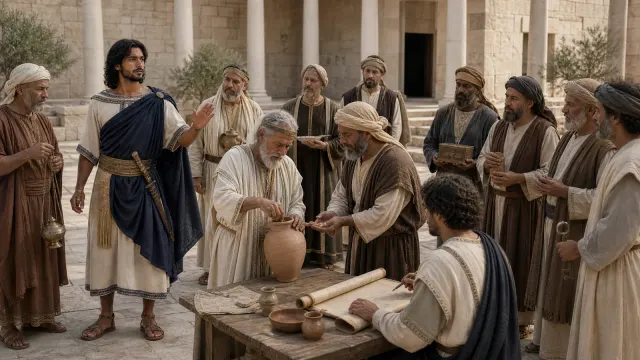
Read 24:1-2 and explain why only Eleazar and Ithamar have descendants: Nadab and Abihu died (Leviticus 10:1-2). Then read 24:3-6. Twenty-four priestly houses are arranged by lot, with Shemaiah the scribe writing them down in front of the king and the leaders. Point out that the eighth lot fell to Abijah (24:10), the course of Zacharias in Luke 1:5. Explain that the courses rotated through the year. Teach this step to show fairness and public record in how service was shared.
1 Chronicles 25:1-31
Musicians who prophesy
Read 25:1, where David and the captains of the host set apart the sons of Asaph, Heman and Jeduthun "who should prophesy with harps, with psalteries, and with cymbals". Explain prophesy here, from 25:3, as inspired thanks and praise to the LORD. Read 25:5, which mentions Heman's fourteen sons and three daughters, all under their father for song. Then read 25:7-8: two hundred eighty-eight trained musicians, with lots cast "as well the small as the great, the teacher as the scholar". Teach music as a ministry with training and order.
1 Chronicles 26:1-32
Gates, treasures and outside business
Read 26:12-13: the gatekeepers' divisions, assigned by lot for every gate. Point out Zechariah, "a wise counsellor" (26:14), and that Obed-edom's family appears, blessed with many sons (26:4-5). Then read the treasurers, 26:20-28, and explain dedicated things as gifts set apart for God, including war spoils. Read 26:29-32, Levites who served as officers and judges "for every matter pertaining to God, and affairs of the king". Teach this step to show that faithful administration is part of serving God.
1 Chronicles 27:1-34
Army, tribes and royal stewards
Read 27:1 to explain the twelve monthly army divisions, then glance at the tribal leaders in 27:16-22. Read 27:23-24 and explain why the census is mentioned again: it was not finished and not recorded, "because there fell wrath for it against Israel". Then read the stewards of 27:25-31 and the counsellors of 27:32-34, including Ahithophel and Hushai. Explain that farming, herding and advice all belong to the kingdom's order. Teach this last to show government and worship arranged side by side under God.
Where learners get stuck
The misreadings this passage tends to produce, and how to answer each from the text.
"These chapters are lists for clergy; they have nothing to say to ordinary believers."
The lists include bakers, musicians, gatekeepers, treasurers, judges, farm managers and herdsmen (23:29, 25:7, 26:13, 26:20, 26:29, 27:25-31). The Book of 1 Chronicles is showing that many kinds of work serve God and his people. Help learners find their own kind of work among these names, and see that faithfulness in ordinary tasks is part of worship.
"Casting lots means God's will is a matter of luck."
Proverbs 16:33 says "the whole disposing thereof is of the LORD". In 1 Chronicles 24-26 lots are used to assign turns of service fairly, "as well the small as the great" (25:8, 26:13), so that rank and influence could not choose the best duties. The point is fairness under God, not chance. Do not turn this into a method for making personal decisions today.
"Prophesying with harps means the musicians were foretelling the future."
25:3 explains it: Jeduthun "prophesied with a harp, to give thanks and to praise the LORD". The word here describes inspired praise and declaration of God's works, sung and played in worship. 25:5 calls Heman "the king's seer in the words of God", which shows that music and God's word were closely joined. Teach the text's own definition and avoid speculation.
"Since the census was sinful, all organisation and record-keeping in God's work is suspect."
1 Chronicles 23-27 is full of careful organisation and records, set up by David and approved as service to God. 27:23-24 recalls that the earlier census was not completed and not recorded because of wrath, but it does not condemn order itself. The difference lies in purpose and trust. Help learners value good administration while keeping it accountable to God.
Learning objectives
- Distinguish priestly duties from other Levitical service.
- Explain the changed Levitical responsibilities in 23:25-32.
- Identify how lots assign different service groups.
- Describe thanksgiving within the musicians' prophetic service.
- Connect dedicated treasures with continuing maintenance.
- Map temple service beside military and civil administration.
Teacher preparation
- Read chapters 23-27; make a five-column chart for Levites, priests, musicians, gates and treasures, and public administration.
- Explain courses as service divisions, porters as gatekeepers, cunning as skilled, and scholar as learner; this is not a register of academic courses.
- Compare the thirty-year threshold in 23:3 with twenty years in 23:24-27; show the changed duties and David's later arrangement without silently harmonizing the totals.
- Mark 24:5-6, 31; 25:8; and 26:13 for public allocation by lot; do not promise that random modern decisions reveal God's will.
- Read 27:23-24 beside chapter 21; retain the warning about the unfinished census within these extensive administrative lists.
Evidence and interpretation checks
Explicit
Read 23:28-32, 25:3, 26:20-28, and 27:1: assistance, thanksgiving, treasury care, and monthly public service are specified responsibilities.
Scripture-supported
Compare 24:10 with Luke 1:5, 8-9: the later account identifies Zacharias with Abia's priestly course and service by lot.
Strong inference
Infer from 24:31, 25:8, and 26:13 that shared allocation limits preference for seniority or prominence; do not claim every responsibility is interchangeable.
Possible or traditional reading
Treat prophesying in 25:1-3 as including worshipful proclamation and thanksgiving; reducing it to prediction alone misses the activity explicitly named in verse 3.
Limit
Observe that 23:1-27:34 neither commands churches to inherit these offices by family line nor provides a universal modern staffing chart or divination procedure.
Discussion with answer guidance
1. Why do the Levites' duties change when the people have rest?
What a good answer contains
David explains: "The LORD God of Israel hath given rest unto his people", so the Levites "shall no more carry the tabernacle, nor any vessels of it" (23:25-26). Their new work is to "wait on the sons of Aaron" in the courts and chambers, with the shewbread, the flour and the baking (23:28-29), and "to stand every morning to thank and praise the LORD, and likewise at even" (23:30). A good answer sees the job changing with the times. A weak answer thinks the Levites lost their purpose.
Show teacher guidance
Use 23:25-32: carrying the tabernacle gives way to settled support, preparation, and regular praise; changed tasks do not mean useless workers.
2. What distinguishes Aaron's line from the other Levites?
What a good answer contains
"Aaron was separated, that he should sanctify the most holy things, he and his sons for ever, to burn incense before the LORD, to minister unto him, and to bless in his name for ever" (23:13). The other Levites assist them (23:28), and 24:1-3 divides only Aaron's descendants into the priestly courses. A good answer keeps priests and Levites distinct. A weak answer calls every Levite a priest, or ranks one group as more loved by God.
Show teacher guidance
Compare 23:13, 28 with 24:1-3; retain the priestly distinction rather than calling every Levite a priest.
3. What do the lot passages say about prominent and less prominent workers?
What a good answer contains
The lots are cast "as well the small as the great, the teacher as the scholar" (25:8), and for the gatekeepers "as well the small as the great" (26:13). The priestly heads cast lots "even the principal fathers over against their younger brethren" (24:31). A good answer sees fairness in how turns of service were assigned: rank did not buy the best duty. A weak answer claims everyone had the same skill or the same job.
Show teacher guidance
Read 24:31, 25:8, and 26:13; identify shared allocation without claiming equal skill or identical jobs.
4. What does Jeduthun do when he prophesies with a harp?
What a good answer contains
Jeduthun "prophesied with a harp, to give thanks and to praise the LORD" (25:3). Heman is called "the king's seer in the words of God" (25:5). A good answer stays with the chapter's own description: inspired praise and thanksgiving, sung and played in God's house. A weak answer imagines the musicians predicting future events, or dismisses the word prophesy as meaning nothing.
Show teacher guidance
Answer from 25:3: he gives thanks and praises the Lord; retain the chapter's language without inventing unheard predictions.
5. Why preserve the names of those who manage dedicated treasure?
What a good answer contains
Shelomith and his brothers were "over all the treasures of the dedicated things" given by David, the chief fathers and the captains (26:26), from "the spoils won in battles" to "maintain the house of the LORD" (26:27). Gifts from Samuel, Saul, Abner and Joab were "under the hand of Shelomith" (26:28). A good answer sees that dedicated gifts need trustworthy keepers. A weak answer thinks that once a gift is given to God, no one needs to manage it.
Show teacher guidance
Use 26:26-28: gifts require custody and support maintenance; dedication does not make administration unnecessary.
6. Why do soldiers, farm managers, and the failed census appear here?
What a good answer contains
Because a kingdom under God needs ordered public service as well as worship. 27:1 sets out monthly army divisions of twenty-four thousand. 27:25-31 names stewards over treasures, fields, vineyards, olive trees, herds, camels and flocks. In between, 27:23-24 recalls the census: Joab "began to number, but he finished not, because there fell wrath for it". A good answer sees royal service set beside sacred service, and the failed census remembered. A weak answer skips the chapter as irrelevant.
Show teacher guidance
Read 27:1, 23-31; distinguish royal service from sanctuary service and note that organization remains under moral scrutiny.
Responsible application
Heart and habits
Ask learners to explain the worth of an unseen maintenance task through 23:28-32, without treating visibility as a measure of faithfulness.
Relationships and community
Design a fictional rota that includes experienced teachers and learners; compare 25:8 while retaining training and appropriate supervision.
Accountable stewardship
Outline how a donated resource should be received, recorded, safeguarded, and used; connect the proposal with 26:26-28 rather than treating generosity as the final step.
Session plans
Two timings of the same lesson. The shorter keeps the reading, the central discussion and one response; the longer gives the confusions and the application their own time.
45 minutes
Rest changes the work
Read 23:1-5 and 23:25-32. Take question one.
Priests and Levites
Read 23:13 and 24:1-6. Take question two and mention Luke 1:5.
Lots and music
Read 25:1-8. Take questions three and four, and confusions two and three.
Treasures
Read 26:20-28. Take question five.
The king's business
Read 27:1 and 27:23-31. Take question six and confusion four.
Handout and prayer
Read the key verse together, give out the handout and pray for those who serve in hidden roles.
90 minutes
A five-column chart
Draw five columns: Levites, priests, musicians, gates and treasures, public officers. Explain that the class will fill it.
The Levites
Read 23:1-6 and 23:24-32. Take question one and confusion one.
The priests
Read 23:13 and 24:1-19 with Leviticus 10:1-2 and Luke 1:5. Take question two.
The musicians
Read 25:1-8. Take questions three and four, and confusions two and three.
Gates and treasures
Read 26:12-14 and 26:20-32. Take question five.
The kingdom's order
Read 27:1 and 27:23-34. Take question six and confusion four.
Application
Let learners add their own church's roles to the chart, then pray by name for people in each column.
Handout and prayer
Read the key verse together, point to the take-home line and pray.
Adapting the lesson
Children
Set up stations around the room: a bakery for the shewbread, a music corner, a door to guard, a treasure chest to count, a farm with toy animals. Let children rotate through them by drawing names from a bag, as the lots were cast. Teach that God's house needed many helpers, and that the little ones took turns as well as the big ones.
Youth
Ask which role in their church they never notice. Read 25:8 and 26:13 and talk about the teacher and the scholar, the small and the great, sharing turns fairly. Spend time on the musicians in 25:1-7 and on training as part of worship. Let them find a job in chapters 23-27 that matches a gift they have.
Adults
Discuss how the Book of 1 Chronicles presents organisation as worship, and how these chapters would have encouraged returned exiles rebuilding temple service. Talk about stewardship of dedicated gifts in 26:26-28 and about accountability in church administration. Compare 27:23-24 with chapter 21. Value the many roles without ranking them.
One to one
Read 23:28-32 and 25:7-8 together. Ask the person what work they do, inside or outside church, and how it could be done as service to God. If they feel their role is small or unseen, show them the names of gatekeepers and bakers that God's book kept. Pray for them by name.
Song and video learning lab
A song or video may interpret, compress, or dramatize the text. Its value becomes clearer when its choices are compared with Scripture.
- Before the media: the exact passage and its central movement.
- During the media: the words, people, events, and emotions the artist emphasizes.
- After the media: what it clarifies, what it leaves out, and what belongs back in the biblical text.
Handout
One page for learners to take home. The print button prints this section alone.
1 Chronicles 23:1–27:34
The passage in brief
In 1 Chronicles 23 to 27 David, now old, makes Solomon king and organises the service of God's house and of the kingdom. The Levites no longer need to carry the tabernacle, so they help the priests, prepare bread and lead praise morning and evening. Priests, musicians and gatekeepers take turns by lot, the small as well as the great. Treasurers guard the gifts given to God, and officers manage the army, the farms and the flocks.
A verse to keep
And to stand every morning to thank and praise the LORD, and likewise at even;
1 Chronicles 23:30 · King James Version
Questions to take home
How did the Levites' work change when Israel had rest, according to 23:25-32?
What does 25:8 say about how the musicians were assigned their turns?
Which job in these chapters is most like something you do?
This week
Thank and praise the LORD every morning and evening this week, as the Levites did.
Music and video connected to the passage
Related media appears when its Scripture reference overlaps this study. Music and video can illuminate a theme while the biblical text remains the foundation.