The big picture
Ahab wants Ramoth-gilead back and receives nearly unanimous prophetic support for the campaign, but the chapter keeps separating agreement from truth. Jehoshaphat asks for another inquiry, and Micaiah is summoned despite Ahab’s complaint that he never speaks good concerning him. Micaiah first echoes the favorable answer, then describes Israel scattered without a shepherd and a heavenly council in which a lying spirit draws Ahab toward the battle. The warning is public, but Ahab imprisons the prophet and goes anyway. He disguises himself while Jehoshaphat remains in royal robes. Syrian captains are fooled by the clothing, yet an archer who does not know whom he is striking sends an arrow through a joint in Ahab’s armor. Ahab dies by evening, his blood is licked at Samaria, and the chapter closes with Jehoshaphat’s reign and Ahaziah’s succession. Israel’s throne continues, and so does Baal worship.
Central truth
Micaiah's unwelcome word proves true when Ahab dies despite prophetic flattery and battlefield disguise, while the closing reign notices continue to measure kings by their faithfulness to the Lord.

The study notes have a page of their own
The movement by movement analysis, the words to trace, the verse by verse notes and where readers differ are written for someone studying alone. They are on the Deep Personal Reflections page for this chapter. This page is the lesson.
A chapter-specific teaching brief
These anchors come from this chapter itself. They help a teacher use the Level 1 overview, the Level 2 study, and the Scripture text as one lesson.
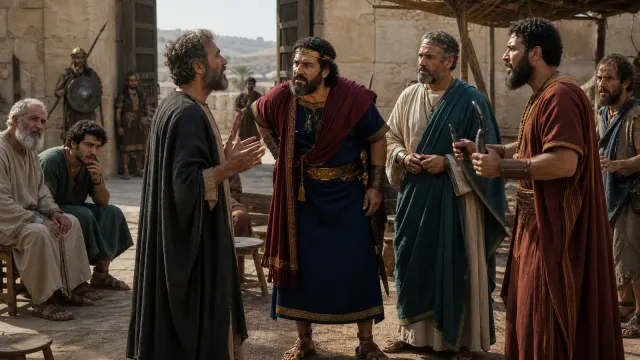
Open with the chapter’s first image
1 Kings 22:1: “And they continued three years without war between Syria and Israel.”
Slow down at the turning point
1 Kings 22:27: “And say, Thus saith the king, Put this fellow in the prison, and feed him with bread of affliction and with water of affliction, until I come in peace.”
Keep this word trail visible
king, Israel, LORD, Jehoshaphat, Micaiah, gilead
What to explain, in order
Teach the passage in this order. Each step names the verses it rests on, so every point can be shown in the text before it is applied.
1 Kings 22:1-12
Four hundred voices
Begin with the setting: three years of peace, then Ahab wants Ramoth-gilead back and asks Jehoshaphat of Judah to join him. Read Jehoshaphat's request in 22:5, "Enquire, I pray thee, at the word of the LORD to day." Then the four hundred prophets, all saying go up. Read Jehoshaphat's uneasy question in 22:7 and Ahab's answer in 22:8: "I hate him; for he doth not prophesy good concerning me". Describe Zedekiah's iron horns as a vivid piece of theatre. Teach this first so the class feels the weight of the crowd before Micaiah arrives.
1 Kings 22:13-18
One man and the truth
Read the messenger's advice and Micaiah's reply in 22:14 slowly. Then the meeting with the king: the first answer that echoes the others, Ahab's demand for truth, and the true vision of sheep without a shepherd. Explain the shepherd as a common picture for a king (Numbers 27:17), so the vision means Ahab will die and the army scatter. Read Ahab's complaint in 22:18. Teach this step as the heart of the passage: one faithful voice under heavy pressure to agree.
1 Kings 22:19-28
The heavenly court
Read Micaiah's vision of 22:19-23 in full and without embellishment. Explain that he is showing Ahab what lies behind the four hundred voices. The passage is difficult: the LORD sends a lying spirit as judgment on a king who has refused the truth again and again. Readers in different traditions explain this differently, and you need not settle it. Point to 2 Thessalonians 2:10-12 as a similar theme. Then Zedekiah's slap, Micaiah's reply, the prison order and Micaiah's test in 22:28. Teach this step carefully and let learners voice their questions.
1 Kings 22:29-38
A disguise and a random arrow
Read the march to Ramoth-gilead. Explain Ahab's disguise and his plan to let Jehoshaphat stand out. Then the Syrian order to target only the king of Israel, the chase after Jehoshaphat, and the arrow shot "at a venture". Explain harness as armour and the joints as the gaps between its plates. Read the king's death at evening briefly, and 22:38, where dogs lick his blood at the pool of Samaria, "according unto the word of the LORD". Teach this step to show that no disguise can hide anyone from God's word.
1 Kings 22:39-53
Two kings and the close of the book
Finish with the closing notices, which are easy to skip. Ahab's ivory house and cities are mentioned in one verse. Then Jehoshaphat: right in God's eyes, with high places left; peace with Israel; failed ships. Then Ahaziah, son of Ahab and Jezebel, walking in the ways of father, mother and Jeroboam, and serving Baal. Explain that the Book of 1 Kings ends here and 2 Kings continues the same history. Teach this last so the class sees that the book's real subject is faithfulness to the LORD, measured king by king.
Where learners get stuck
The misreadings this passage tends to produce, and how to answer each from the text.
"If most religious leaders agree, they must be right."
Four hundred prophets speak "with one mouth" (22:13), and they are wrong. Micaiah stands alone and speaks what the LORD says (22:14). The test in Deuteronomy 18:22 is whether the word comes true, and 22:28 applies it. Teach learners to weigh what is said against God's word rather than counting voices, while avoiding the opposite mistake of assuming the lone voice is always right.
"God lies, so we cannot trust what he says."
The passage shows God judging Ahab, who had rejected the truth repeatedly, by giving him over to the falsehood he preferred. Even then God has Micaiah tell Ahab plainly what is happening (22:23), so the king is warned. Numbers 23:19 and Titus 1:2 say God does not lie. Traditions explain the scene in different ways; let the text stand, acknowledge the difficulty and keep the warning at the centre.
"Ahab died by chance, not by God's word."
The arrow was shot "at a venture" (22:34), with no particular target. But the death came exactly as Micaiah said, and 22:38 adds "according unto the word of the LORD which he spake". The Book of 1 Kings shows God's word fulfilled through what looked like an accident. Proverbs 16:33 says the lot is cast into the lap, but the disposing is of the LORD.
"The dogs licked Ahab's blood in Naboth's vineyard."
Verse 38 places it at "the pool of Samaria", where the chariot was washed. Elijah's word in 21:19 had spoken of the place where Naboth's blood was licked, and 21:29 delayed part of the judgment to Ahab's son, which 2 Kings 9:25-26 records at Naboth's plot. Keep the locations as the text gives them and do not move Samaria to Jezreel to make the two verses match.
Learning objectives
- Identify the pressure placed on Micaiah's message.
- Explain the contrast between royal and heavenly thrones.
- Describe the lying-spirit vision without softening its difficulty.
- Connect Ahab's disguise with the battle's outcome.
- Compare Micaiah's prediction with the king's death.
- Distinguish the closing assessments of Jehoshaphat and Ahaziah.
Teacher preparation
- Locate Ramothgilead, Samaria, and Jezreel; retain each named location rather than forcing them together.
- Explain 'void place' as an open area, 'at a venture' as without a specified target, and 'harness' as armour.
- Mark the messenger's demand for agreement in 22:13 and Micaiah's commitment in 22:14.
- Read the whole heavenly-court vision in 22:19–23; prepare to acknowledge judgment through deception without inventing the spirit's identity.
- Reserve time for 22:41–53; Ahab's battlefield death must not swallow the book's closing evaluations.
Evidence and interpretation checks
Explicit
Read 22:13–14: the messenger requests conformity, while Micaiah commits to speak what the Lord says rather than what pleases the king.
Scripture-supported
Compare 22:17, 28 with 22:35–36; the king dies and the army disperses, corresponding to the warning about sheep without a shepherd.
Strong inference
Infer that Ahab takes the danger seriously enough to seek protection from 22:30; the disguise suggests unease without proving his private explanation.
Possible or traditional reading
Treat Micaiah's initial favourable answer in 22:15 as likely irony, especially given 22:16; the account records the exchange but not his vocal tone.
Limit
Do not identify the spirit as Satan or Naboth, invent Micaiah's eventual release, or move the pool of Samaria in 22:38 to Jezreel.
Discussion with answer guidance
1. What does the messenger want Micaiah to match: truth or agreement?
What a good answer contains
The messenger asks for agreement: "the words of the prophets declare good unto the king with one mouth: let thy word, I pray thee, be like the word of one of them, and speak that which is good" (22:13). Micaiah answers with his only rule: "As the LORD liveth, what the LORD saith unto me, that will I speak" (22:14). A good answer sees the pressure to conform and Micaiah's refusal to be measured by the majority. A weak answer treats the messenger as giving friendly advice, or assumes four hundred voices must be right.
Show teacher guidance
Use 22:13–14. The instruction asks for the same favourable message as the others; Micaiah makes the Lord's word his standard instead.
2. Why does Ahab challenge the answer that initially sounds favourable?
What a good answer contains
Micaiah first repeats the court prophets' words, "Go, and prosper" (22:15). Ahab at once demands "that thou tell me nothing but that which is true in the name of the LORD" (22:16), as though he hears that Micaiah is echoing them. When the true vision comes, "all Israel scattered upon the hills, as sheep that have not a shepherd" (22:17), Ahab complains that Micaiah never prophesies good. A good answer sees the irony: Ahab knows the truth when he hears it and still rejects it. A weak answer misses the shift between 22:15 and 22:17.
Show teacher guidance
Read 22:15–18. He demands truth and then objects to the unwelcome vision; allow irony as interpretation without pretending a stage direction is supplied.
3. What does the heavenly-court vision disclose before Ahab enters battle?
What a good answer contains
Micaiah sees "the LORD sitting on his throne, and all the host of heaven standing by him" (22:19). The LORD asks who will persuade Ahab to fall at Ramoth-gilead, and a spirit offers to be "a lying spirit in the mouth of all his prophets" (22:22). Micaiah then tells Ahab openly: "the LORD hath put a lying spirit in the mouth of all these thy prophets, and the LORD hath spoken evil concerning thee" (22:23). A good answer notices that the deception is exposed before the battle, so Ahab is warned. A weak answer treats the court prophets as merely mistaken.
Show teacher guidance
Use 22:19–23: the Lord authorizes a lying spirit as judgment, and Micaiah exposes it publicly. Do not reduce the scene to ordinary bad advice.
4. What contrast appears between Ahab's disguise and Jehoshaphat's robes?
What a good answer contains
Ahab says "I will disguise myself, and enter into the battle; but put thou on thy robes" (22:30). The Syrian king orders his captains to fight only the king of Israel (22:31). They chase Jehoshaphat in his robes, until "Jehoshaphat cried out" and they realise their mistake (22:32-33). A good answer sees Ahab trying to escape God's word by hiding his identity and putting his ally at risk instead. A weak answer thinks the disguise was clever and nearly worked.
Show teacher guidance
Trace 22:29–33: the openly royal figure attracts pursuit while Ahab hides his identity. Correct the claim that disguise guarantees him safety.
5. How do the arrow, death, and dispersal answer Micaiah's warning?
What a good answer contains
Then "a certain man drew a bow at a venture, and smote the king of Israel between the joints of the harness" (22:34). An arrow shot without a target finds the one gap in the king's armour. He is held up in his chariot and dies at evening (22:35), and the cry goes out "Every man to his city" (22:36), the scattered sheep of 22:17. Micaiah had said "If thou return at all in peace, the LORD hath not spoken by me" (22:28). A good answer links each detail to the warning. A weak answer calls it bad luck.
Show teacher guidance
Read 22:34–38 with 22:17, 28. An unnamed archer wounds Ahab, the king dies, and the army disperses; retain the explicit Samaria location.
6. Why keep reading after Ahab's burial and successor notice?
What a good answer contains
Because the Book of 1 Kings is measuring kings, not only telling battles. Jehoshaphat "walked in all the ways of Asa his father", "nevertheless the high places were not taken away" (22:43); his ships for Ophir are broken (22:48). Ahaziah son of Ahab "did evil in the sight of the LORD" and "served Baal, and worshipped him" (22:52-53). A good answer sees the book ending with the same two questions it has asked all along, and with Baal still worshipped in Samaria. A weak answer stops at Ahab's burial and misses the closing verdicts.
Show teacher guidance
Use 22:41–53: Jehoshaphat receives qualified commendation and has failed ships; Ahaziah continues Baal worship. The book closes with moral evaluation, not a battle statistic.
Responsible application
Heart and habits
Ask learners to distinguish requesting honest advice from demanding reassuring advice, using Ahab's exchange rather than naming a real leader.
Relationships and community
Have groups propose protections for truthful dissent in an invented committee without assuming that every solitary dissenter is automatically correct.
Hear warnings before outcomes
Discuss why an institution should test an unwelcome warning while action remains possible rather than celebrate accuracy after preventable harm.
Session plans
Two timings of the same lesson. The shorter keeps the reading, the central discussion and one response; the longer gives the confusions and the application their own time.
45 minutes
Ramoth-gilead
Read 22:1-6 and Jehoshaphat's request in 22:5.
The crowd and the lone voice
Read 22:7-14 and take question one and confusion one.
Sheep without a shepherd
Read 22:15-18 and take question two.
The heavenly court
Read 22:19-28 and take question three and confusion two, slowly.
The arrow
Read 22:29-38 and take questions four and five, then confusions three and four.
The closing verdicts
Read 22:43 and 22:52-53, take question six, and read the key verse together.
90 minutes
Pressure to agree
Ask when it is hardest to say something no one wants to hear. Then read 22:13-14.
Four hundred prophets
Read 22:1-12 and point out Jehoshaphat's two requests in 22:5 and 22:7.
Micaiah
Read 22:13-18 and take questions one and two and confusion one, with Deuteronomy 18:21-22.
The vision
Read 22:19-28 and take question three. Spend time on confusion two with Numbers 23:19 and 2 Thessalonians 2:10-12.
Disguise and arrow
Read 22:29-38 and take questions four and five, with confusions three and four.
The last verdicts
Read 22:39-53 and take question six. Review the measure the book has used since 2:3-4.
Application
Ask each person to name one place where they are pressed to say only what others want to hear.
Handout and prayer
Read the key verse together and pray for courage to speak truth.
Adapting the lesson
Children
Line up many children on one side saying go up and win, and one child on the other side saying what God says. Ask which one the king should listen to. Tell children that the king tried to hide by dressing like an ordinary soldier, but God's word still came true. Say simply that the king was hit by an arrow and died. Leave out the dogs and the blood. Finish with Micaiah's brave words in 22:14.
Youth
Youth know peer pressure well. Read 22:13-14 and ask them where they feel pushed to agree. Then talk about Micaiah's courage and its cost: a slap and prison. Handle the lying spirit honestly; say that it is a hard passage and that God still warned Ahab. Use Ahab's disguise to talk about the impossibility of hiding from God.
Adults
Adults can wrestle with the heavenly court scene and the theme of judicial hardening, without resolving debates between traditions. Discuss what made Jehoshaphat uneasy among four hundred agreeing prophets. Compare 22:28 with Deuteronomy 18:21-22. Note the careful fulfilment in 22:38 and its relation to 21:19. Avoid applying the passage to modern political leaders or campaigns.
One to one
Read 22:14 together and ask where the person needs courage to say only what God says. Then read 22:8 and ask, gently, whether there is a voice in their life they avoid because it tells them hard things. Pray together for an honest heart and for the courage of Micaiah.
Song and video learning lab
A song or video may interpret, compress, or dramatize the text. Its value becomes clearer when its choices are compared with Scripture.
- Before the media: the exact passage and its central movement.
- During the media: the words, people, events, and emotions the artist emphasizes.
- After the media: what it clarifies, what it leaves out, and what belongs back in the biblical text.
Handout
One page for learners to take home. The print button prints this section alone.
1 Kings 22:1–53
The passage in brief
King Ahab asks King Jehoshaphat of Judah to help him take back Ramoth-gilead. Four hundred prophets tell Ahab he will win, but Jehoshaphat asks for a prophet of the LORD. Micaiah, whom Ahab hates, says he will speak only what the LORD tells him, and he warns that Ahab will die. Ahab puts him in prison and goes to battle in disguise, but an arrow shot at random kills him, as God had said. The book closes with Jehoshaphat in Judah and Ahab's son serving Baal in Israel.
A verse to keep
And Micaiah said, As the LORD liveth, what the LORD saith unto me, that will I speak.
1 Kings 22:14 · King James Version
Questions to take home
What did the messenger want Micaiah to do in 22:13, and how did Micaiah answer?
How did Ahab try to escape Micaiah's warning in 22:30?
How did Ahab's death fulfil the word of the LORD in 22:34-38?
This week
This week, when you are pressed to say what others want, ask first what God's word says and speak that.
Music and video connected to the passage
Related media appears when its Scripture reference overlaps this study. Music and video can illuminate a theme while the biblical text remains the foundation.