The big picture
Ahab wants Ramoth-gilead back and receives nearly unanimous prophetic support for the campaign, but the chapter keeps separating agreement from truth. Jehoshaphat asks for another inquiry, and Micaiah is summoned despite Ahab’s complaint that he never speaks good concerning him. Micaiah first echoes the favorable answer, then describes Israel scattered without a shepherd and a heavenly council in which a lying spirit draws Ahab toward the battle. The warning is public, but Ahab imprisons the prophet and goes anyway. He disguises himself while Jehoshaphat remains in royal robes. Syrian captains are fooled by the clothing, yet an archer who does not know whom he is striking sends an arrow through a joint in Ahab’s armor. Ahab dies by evening, his blood is licked at Samaria, and the chapter closes with Jehoshaphat’s reign and Ahaziah’s succession. Israel’s throne continues, and so does Baal worship.
In this chapter
- Two Kings Assemble a Favorable Answer 1 Kings 22:1-12
Three years of peace with Syria end when Ahab turns attention to Ramoth-gilead, territory he regards as Israel’s but which remains in Syrian hands.
- Agreement Is Requested Before the Prophet Arrives 1 Kings 22:13-18
The messenger sent for Micaiah tells him exactly what kind of prophecy the room wants.
- The Throne Above the Royal Audience 1 Kings 22:19-23
The earthly scene has featured two kings sitting on thrones while prophets perform before them.
- The Prophet Is Imprisoned, Not Answered 1 Kings 22:24-28
Zedekiah’s answer to Micaiah is not a competing vision but a blow to the face and a challenge: by what route did the Spirit of the LORD leave him to speak through Micaiah?
- The Disguise Defeats Recognition, Not the Announced End 1 Kings 22:29-36
Ahab goes to battle after hearing Micaiah’s warning and chooses disguise, while Jehoshaphat remains visibly dressed as a king.
- Blood at Samaria, and a Judgment Extending Beyond It 1 Kings 22:37-40
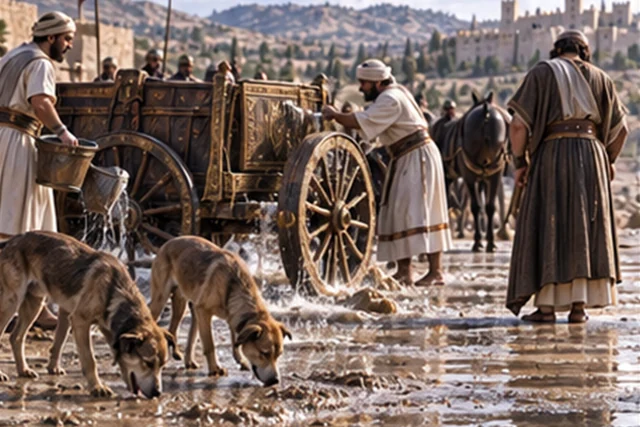
Ahab’s body is brought back to Samaria and buried, but the chapter lingers on what remains in his chariot.
- Jehoshaphat’s Reign Is More Than the Battle Beside Ahab 1 Kings 22:41-50
After the intensity of Ahab’s death, the chapter steps back and gives Jehoshaphat’s reign its own assessment rather than reducing him to the ally who stood beside Ahab at Ramoth-gilead.
- A New King Continues the Old Allegiances 1 Kings 22:51-53
Ahaziah’s short accession notice gathers the northern kingdom’s accumulated religious inheritance into three lines.

Scripture beside the summary
1 Kings · King James Version · 531 Kings 22:1-12
Two Kings Assemble a Favorable Answer
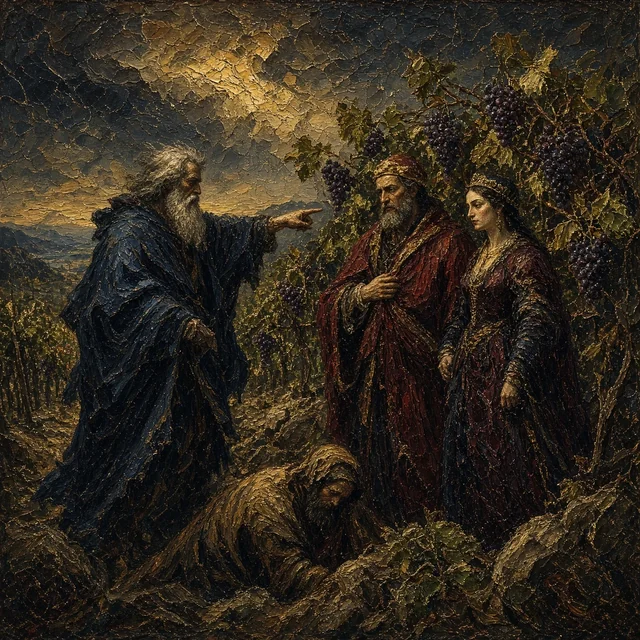
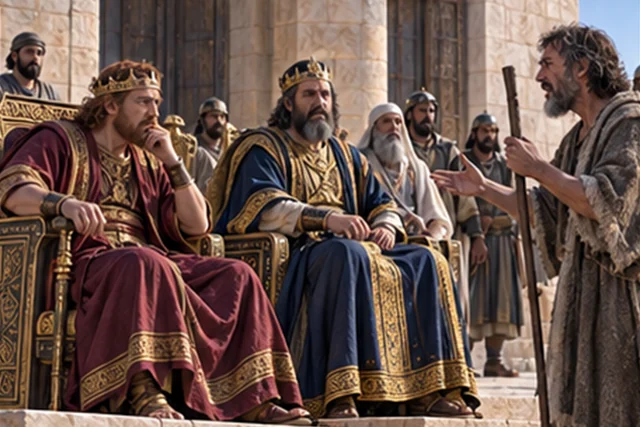
Three years of peace with Syria end when Ahab turns attention to Ramoth-gilead, territory he regards as Israel’s but which remains in Syrian hands. Jehoshaphat readily joins the alliance, pledging people and horses, and only afterward asks that the word of the LORD be consulted. The public answer could hardly look more impressive. About four hundred prophets speak in favor of the campaign, the two kings sit in robes on their thrones at Samaria’s gate, and Zedekiah dramatizes victory with iron horns. Yet Jehoshaphat still asks whether another prophet of the LORD is available. Ahab admits that Micaiah can be consulted but says he hates him because Micaiah does not prophesy good concerning him. That admission exposes the problem before Micaiah enters. The king does not object that Micaiah has no access to the LORD. He objects that the answers are unwelcome. The royal inquiry already has a preferred result.
Deep dive
The three years without war follow the earlier conflict and treaty with Syria. Ahab now identifies Ramoth-gilead as Israelite territory remaining in Syrian hands. Jehoshaphat commits his people and horses before asking for an inquiry at the word of the LORD. The consultation therefore occurs after the alliance has already been voiced, not before either king has declared a position.
The public scene supplies impressive agreement: two robed kings on their thrones, about four hundred prophets, and iron horns with which Zedekiah dramatizes the promised victory. The later word from Micaiah will have to stand against both numbers and ceremony. These four hundred are not explicitly identified as the prophets of the groves summoned in chapter 18, and the shared approximate number is insufficient to establish that connection.
Ahab’s reason for disliking Micaiah is revealingly specific. He does not accuse him here of never receiving a word from the LORD; he acknowledges that an inquiry can be made through him. The objection is that the resulting words are unfavorable to Ahab. The requested consultation already has a preferred answer.
Words to trace: king, Israel, Jehoshaphat, LORD, gilead, Ramoth
Verse-by-verse path
- 1 Kings 22:1
These three quiet years very likely hold the battle of Qarqar in 853 BC, where the annals of the Assyrian king Shalmaneser III list “Ahab the Israelite” with two thousand chariots fighting beside Damascus against Assyria. The Book of 1 Kings never mentions it.
- 1 Kings 22:2
“Came down” is literal: Jerusalem stands higher than Samaria. Second Chronicles 18:1 adds that Jehoshaphat had already joined affinity with Ahab by marriage, his son Jehoram having married Ahab’s daughter Athaliah (2 Kings 8:18).
- 1 Kings 22:3
Ramoth-gilead, “heights of Gilead”, was a city of refuge east of the Jordan (Deuteronomy 4:43) and one of Solomon’s district seats (4:13). Ahab puts the question to his servants first, and it is a rebuke: we sit still while it is taken from us.
- 1 Kings 22:4
“I am as thou art, my people as thy people, my horses as thy horses” is the language of total alliance. Jehoshaphat will say the same words again to Ahab’s son Jehoram before the campaign against Moab (2 Kings 3:7).
- 1 Kings 22:5
“To day” may carry the sense “first of all”, but either way the request comes after the pledge of verse 4. The king of Judah commits his army and only then asks for the word of the LORD.
- 1 Kings 22:6
Four hundred recalls the four hundred prophets of the groves who ate at Jezebel’s table (18:19). Their answer uses “the Lord”, Adonai, not the covenant name, and never says which king or whose city: it could be heard either way.
- 1 Kings 22:7
“A prophet of the LORD besides” implies that Jehoshaphat did not count the four hundred as prophets of the LORD. He uses the covenant name that their answer had avoided.
- 1 Kings 22:8
Micaiah means “Who is like the LORD?” Ahab’s complaint is honest to the point of comedy: he hates the one man who can enquire of the LORD because the answers are bad. “Let not the king say so” is a mild rebuke between allies.
- 1 Kings 22:9
The “officer” is a saris, a court official, a word that can also mean a eunuch. “Hasten hither” shows the summons was urgent, and the messenger’s advice to Micaiah on the way (verse 13) will show it was also coached.
- 1 Kings 22:10
The “void place” is a threshing floor at the entrance of the gate, a flat open space often used for public assemblies. The two robed kings on thrones make the scene a formal court, and the robes will matter again in verse 30.
- 1 Kings 22:11
Zedekiah’s own name means “the LORD is righteousness”, so he claims the LORD’s authority. Horns pushing enemies echo Moses’ blessing on Joseph (Deuteronomy 33:17), where the same verb describes horns that “push the people together”.
- 1 Kings 22:12
Now the chorus uses the covenant name, “the LORD”, where verse 6 had “the Lord”. After Jehoshaphat asked for a prophet of the LORD, the four hundred adjust their wording. “Go up... and prosper” is the phrase Micaiah will echo back.
1 Kings 22:1-12
King James Version1And they continued three years without war between Syria and Israel.
2And it came to pass in the third year, that Jehoshaphat the king of Judah came down to the king of Israel.
3And the king of Israel said unto his servants, Know ye that Ramoth in Gilead is ours, and we be still, and take it not out of the hand of the king of Syria?
4And he said unto Jehoshaphat, Wilt thou go with me to battle to Ramoth-gilead? And Jehoshaphat said to the king of Israel, I am as thou art, my people as thy people, my horses as thy horses.
5And Jehoshaphat said unto the king of Israel, Enquire, I pray thee, at the word of the LORD to day.
6Then the king of Israel gathered the prophets together, about four hundred men, and said unto them, Shall I go against Ramoth-gilead to battle, or shall I forbear? And they said, Go up; for the Lord shall deliver it into the hand of the king.
7And Jehoshaphat said, Is there not here a prophet of the LORD besides, that we might enquire of him?
8And the king of Israel said unto Jehoshaphat, There is yet one man, Micaiah the son of Imlah, by whom we may enquire of the LORD: but I hate him; for he doth not prophesy good concerning me, but evil. And Jehoshaphat said, Let not the king say so.
9Then the king of Israel called an officer, and said, Hasten hither Micaiah the son of Imlah.
10And the king of Israel and Jehoshaphat the king of Judah sat each on his throne, having put on their robes, in a void place in the entrance of the gate of Samaria; and all the prophets prophesied before them.
11And Zedekiah the son of Chenaanah made him horns of iron: and he said, Thus saith the LORD, With these shalt thou push the Syrians, until thou have consumed them.
12And all the prophets prophesied so, saying, Go up to Ramoth-gilead, and prosper: for the LORD shall deliver it into the king’s hand.
1 Kings 22:13-18
Agreement Is Requested Before the Prophet Arrives
The messenger sent for Micaiah tells him exactly what kind of prophecy the room wants. The other prophets speak “with one mouth,” so Micaiah is urged to match them and speak good to the king. He answers with an oath that he will speak what the LORD says. Yet his first reply before Ahab echoes the favorable chorus: go and prosper. The text gives no stage direction explaining his tone, but Ahab’s immediate demand for truth shows that the king does not accept the words as straightforward agreement. Micaiah then gives the vision that matters: Israel scattered on the hills like sheep without a shepherd, with each person permitted to return home. The image points to the loss of the ruler rather than the destruction of the entire army. Ahab’s response is revealingly personal. He turns to Jehoshaphat as if the unpleasant content proves his complaint about Micaiah. The warning itself remains unanswered.
Deep dive
The pressure on Micaiah comes before the royal audience. The messenger explains that the other prophets speak with one mouth and asks him to make his word like theirs. Their agreement is offered as the reason for further agreement. Micaiah answers with a different rule for his speech: what the LORD says to him is what he will say.
His first response before Ahab nevertheless echoes the promised success. The text gives no stage direction describing his tone, but Ahab’s immediate demand for truth shows that he does not receive this as straightforward approval. Micaiah then reports Israel scattered on the hills like sheep without a shepherd. The following permission for each man to return home locates the coming loss in the absent ruler rather than predicting the death of every soldier.
Ahab turns to Jehoshaphat as though the warning proves his earlier complaint about Micaiah. The king makes the unfavorable content evidence against the speaker. What the vision says about the battle remains unanswered by that objection.
Words to trace: king, LORD, good, Micaiah, Israel, tell
Verse-by-verse path
- 1 Kings 22:13
The messenger uses the word “good” twice, and it is the chapter’s contested word: Ahab complains Micaiah never prophesies good (verse 8) and will say so again (verse 18). The plea is for a verdict chosen in advance.
- 1 Kings 22:14
“As the LORD liveth” is the oath Elijah swore before Ahab in 17:1. Micaiah’s promise to speak only what the LORD says is close to Balaam’s answer to the king of Moab (Numbers 22:38), another prophet hired to say something agreeable.
- 1 Kings 22:15
Ahab’s question has changed from “Shall I go” in verse 6 to “shall we go”, drawing Jehoshaphat in. Micaiah returns the court’s own words, and the whole room knows they are the four hundred’s words, not his.
- 1 Kings 22:16
To “adjure” is to put someone under oath. “How many times” suggests earlier encounters in which Micaiah had given Ahab the same treatment, which fits the king’s complaint in verse 8.
- 1 Kings 22:17
The picture of sheep without a shepherd comes from Numbers 27:17, where Moses asks the LORD for a leader so the congregation will not be left that way. Ancient kings were commonly called shepherds, and “in peace” is the phrase Ahab will use of his own return in verse 27.
- 1 Kings 22:18
Ahab speaks of Micaiah in the third person with Micaiah standing there. The vision never named the king, yet Ahab at once recognises himself as the missing shepherd, which is its own admission.
1 Kings 22:13-18
King James Version13And the messenger that was gone to call Micaiah spake unto him, saying, Behold now, the words of the prophets declare good unto the king with one mouth: let thy word, I pray thee, be like the word of one of them, and speak that which is good.
14And Micaiah said, As the LORD liveth, what the LORD saith unto me, that will I speak.
15So he came to the king. And the king said unto him, Micaiah, shall we go against Ramoth-gilead to battle, or shall we forbear? And he answered him, Go, and prosper: for the LORD shall deliver it into the hand of the king.
16And the king said unto him, How many times shall I adjure thee that thou tell me nothing but that which is true in the name of the LORD?
17And he said, I saw all Israel scattered upon the hills, as sheep that have not a shepherd: and the LORD said, These have no master: let them return every man to his house in peace.
18And the king of Israel said unto Jehoshaphat, Did I not tell thee that he would prophesy no good concerning me, but evil?
1 Kings 22:19-23
The Throne Above the Royal Audience
The earthly scene has featured two kings sitting on thrones while prophets perform before them. Micaiah now opens a larger court: the LORD sitting on his throne, with the host of heaven standing on either side. The question in that council is not whether Ahab should receive the victory he wants, but how he will be persuaded to go up to Ramoth-gilead and fall there. A spirit proposes becoming “a lying spirit” in the mouths of Ahab’s prophets and is commissioned to do so. The passage therefore makes a harder claim than merely saying that court prophets independently told a convenient falsehood. Their favorable message operates within an announced judgment. The spirit is not identified as Satan, and the chapter does not supply a complete theory of divine judgment and deceptive speech. What it does make clear is that Ahab hears the disclosure before battle. The mechanism drawing him toward Ramoth-gilead is exposed publicly while he still has the warning in front of him.
Deep dive
The two kings have been sitting on their thrones while prophets speak before them. Micaiah now describes the LORD on his throne with the host of heaven standing beside him. The royal audience is placed within a larger court, and the matter under consideration is not whether Ahab will receive permission to achieve his wishes. It is how he will be persuaded to go to Ramoth-gilead and fall there.
The vision assigns an active role to deception. A spirit proposes becoming a lying spirit in the mouths of Ahab’s prophets, and the LORD commissions it. Micaiah then says that the LORD has put that lying spirit in their mouths. Reducing the scene to prophets independently telling convenient lies would remove a difficult claim the passage actually makes. The spirit is not named as Satan, and the vision supplies no account of its origin or a complete explanation of how divine judgment and false prophetic speech relate.
The disclosure itself is also part of the encounter. Ahab hears the warning that the favorable chorus is deceptive before he goes to battle. The deception is not hidden from him until after his death. Micaiah’s unwelcome word publicly identifies both the danger and the means by which the king is being drawn toward it.
Words to trace: LORD, persuade, spirit, lying, manner, mouth
Verse-by-verse path
- 1 Kings 22:19
The heavenly council appears only rarely in the Old Testament, most fully in Isaiah 6 and Job 1–2. The host “standing” is the posture of servants in attendance, while the LORD sits, as the two kings at the gate sit while their prophets perform.
- 1 Kings 22:20
“Persuade” renders pathah, a verb that can mean entice or deceive; Jeremiah uses it in 20:7 when he complains the LORD has deceived him. The council deliberates in the open, “one said on this manner, and another”, like advisers around a throne.
- 1 Kings 22:21
The Hebrew has the article, “the spirit”, which some read as the spirit of prophecy itself and others as one particular member of the council. It steps forward and stands before the LORD, as a courtier volunteers for a commission.
- 1 Kings 22:22
“Wherewith?” is a single Hebrew word, bammah, the LORD asking by what means. The answer and the commission follow quickly, and the spirit is promised success before it goes: “persuade him, and prevail also”.
- 1 Kings 22:23
“These thy prophets” gives them to Ahab, not to the LORD. The sentence also closes the chapter’s quarrel over good and evil: the LORD has indeed “spoken evil concerning thee”, just as Ahab complained.
1 Kings 22:19-23
King James Version19And he said, Hear thou therefore the word of the LORD: I saw the LORD sitting on his throne, and all the host of heaven standing by him on his right hand and on his left.
20And the LORD said, Who shall persuade Ahab, that he may go up and fall at Ramoth-gilead? And one said on this manner, and another said on that manner.
21And there came forth a spirit, and stood before the LORD, and said, I will persuade him.
22And the LORD said unto him, Wherewith? And he said, I will go forth, and I will be a lying spirit in the mouth of all his prophets. And he said, Thou shalt persuade him, and prevail also: go forth, and do so.
23Now therefore, behold, the LORD hath put a lying spirit in the mouth of all these thy prophets, and the LORD hath spoken evil concerning thee.
1 Kings 22:24-28
The Prophet Is Imprisoned, Not Answered
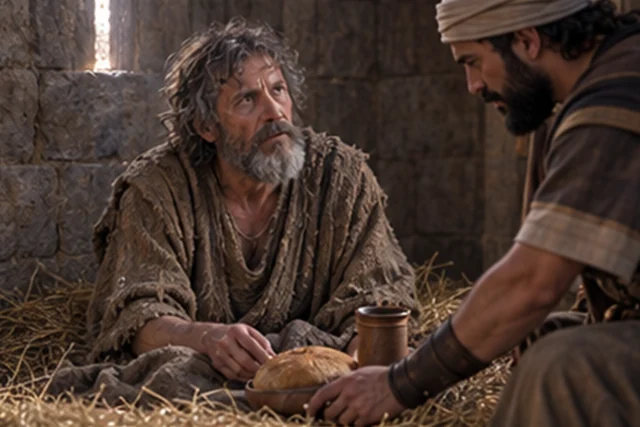
Zedekiah’s answer to Micaiah is not a competing vision but a blow to the face and a challenge: by what route did the Spirit of the LORD leave him to speak through Micaiah? Micaiah answers by pointing forward to a day when Zedekiah will hide in an inner chamber, but the chapter never narrates that later moment, so its exact circumstances remain unstated. Ahab then uses the power he unquestionably has. He sends Micaiah back to prison, orders him fed with bread and water of affliction, and makes his own peaceful return the endpoint of the confinement. Micaiah takes that exact condition and turns it into the public test of his word. If Ahab returns in peace, then the LORD has not spoken through him. King and prophet therefore stake opposite claims on the same future event. Ahab can decide where Micaiah sleeps and what he eats. He cannot decide which word Ramoth-gilead will verify.
Deep dive
Zedekiah answers the rival prophetic claim with a blow and a challenge about the Spirit of the LORD. Micaiah responds by pointing to a future day when Zedekiah will hide in an inner chamber. The chapter does not narrate that later hiding, so its exact circumstances remain outside the account. The immediate result is the removal of the dissenting prophet rather than a resolution of the claims by further inquiry.
Ahab makes his expected return the limit of Micaiah’s imprisonment. Micaiah makes the same return the test of his message: a peaceful return would mean the LORD had not spoken by him. The king and prophet thus name one event with opposite implications. Ahab can control Micaiah’s location and rations, but those orders do not decide what happens at Ramoth-gilead. The final appeal to all the people turns the exchange into publicly witnessed testimony before the prisoner is taken away.
Words to trace: Micaiah, affliction, king, LORD, peace, Amon
Verse-by-verse path
- 1 Kings 22:24
A blow on the cheek was a public humiliation rather than a disabling attack (Job 16:10; Lamentations 3:30). Zedekiah’s question assumes the Spirit of the LORD had been with him, and he wants to know how it could have left.
- 1 Kings 22:25
“An inner chamber” is again the “room within a room” where Ben-hadad hid in 20:30. Micaiah gives Zedekiah the same end as the defeated Syrian king: fleeing indoors from what he said would not happen.
- 1 Kings 22:26
“Carry him back” suggests Micaiah was already in custody before the summons. “The king’s son” may be a title for a royal official rather than an actual son; seals bearing the title “son of the king” have been found for men with administrative roles.
- 1 Kings 22:27
“Bread of affliction and water of affliction” means short rations, enough to keep a prisoner alive. “This fellow” is contemptuous, and “until I come in peace” uses shalom, the very word Micaiah’s vision gave to the soldiers going home without their master.
- 1 Kings 22:28
“Hearken, O people, every one of you” are also the opening words of the Book of Micah (Micah 1:2), from a later prophet with almost the same name. Some scholars think a copyist added the line here, and it is missing from some Greek manuscripts.
1 Kings 22:24-28
King James Version24But Zedekiah the son of Chenaanah went near, and smote Micaiah on the cheek, and said, Which way went the Spirit of the LORD from me to speak unto thee?
25And Micaiah said, Behold, thou shalt see in that day, when thou shalt go into an inner chamber to hide thyself.
26And the king of Israel said, Take Micaiah, and carry him back unto Amon the governor of the city, and to Joash the king’s son;
27And say, Thus saith the king, Put this fellow in the prison, and feed him with bread of affliction and with water of affliction, until I come in peace.
28And Micaiah said, If thou return at all in peace, the LORD hath not spoken by me. And he said, Hearken, O people, every one of you.
1 Kings 22:29-36
The Disguise Defeats Recognition, Not the Announced End
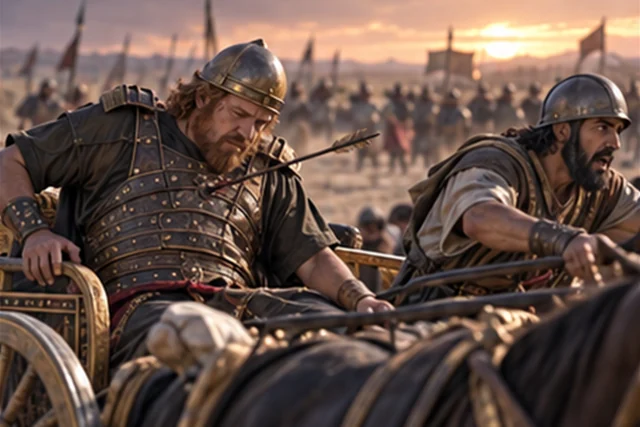
Ahab goes to battle after hearing Micaiah’s warning and chooses disguise, while Jehoshaphat remains visibly dressed as a king. The practical effect appears immediately. Syrian chariot captains have orders to fight only the king of Israel, so they see Jehoshaphat’s robes and pursue the wrong man. Once they realize their mistake, they turn away. Ahab’s disguise has successfully defeated human recognition, but that is not what determines the announced outcome. A bowman shoots “at a venture,” without knowing the identity that matters, and the arrow enters between the joints of Ahab’s armor. The king asks to be taken out of the fighting, yet the battle intensifies and he remains propped in his chariot, bleeding until evening. At sunset the army is told to go home, each man to his city and country. Micaiah’s vision of scattered sheep without a shepherd is fulfilled without the army needing to be annihilated. The ruler dies, and the people disperse.

Deep dive
Jehoshaphat has asked for the LORD’s word, heard Micaiah’s warning, and still goes to battle with Ahab. The text does not supply his reasoning. Ahab’s disguise is likewise stated without a full explanation of his private calculations. Its practical effect becomes clear when Syrian chariot captains, ordered to attack the king of Israel, mistake the robed Jehoshaphat for their target. Once they recognize the error, they withdraw from him.
Ahab is not struck because those captains successfully discover the disguise. A bowman shoots without knowing the decisive identity of his target, and the arrow enters at a joint in the armor. The KJV’s phrase "at a venture" makes the contrast between the archer’s limited knowledge and the previously announced outcome especially sharp. The king requests withdrawal but is held up in the chariot as the battle continues, bleeding until evening.
The proclamation at sunset sends the men back to their cities and countries. It answers Micaiah’s image of sheep allowed to go home after losing their shepherd. The account does not need to describe the destruction of the entire army to show the fulfillment of that vision. The ruler is gone, and the fighting people disperse.
Words to trace: king, Israel, Jehoshaphat, battle, captains, chariot
Verse-by-verse path
- 1 Kings 22:29
Both kings go up, and no reason is given for Jehoshaphat, who asked for the true prophet and heard him. “Went up” is the verb of the four hundred’s command and of the council’s question in verse 20.
- 1 Kings 22:30
Disguise before a prophetic word has already failed once in this book, when Jeroboam’s wife went disguised to Ahijah (14:2), and the prophet of 20:38 used a disguise against Ahab himself. The robes that verse 10 described now make Jehoshaphat the only king visible on the field.
- 1 Kings 22:31
Thirty-two captains matches the thirty-two kings of 20:1, whom Ben-hadad replaced with captains on his advisers’ counsel (20:24). The Syrian king whom Ahab spared and called brother now gives one order: kill Ahab.
- 1 Kings 22:32
Jehoshaphat’s cry is not explained here. Second Chronicles 18:31 adds that “the LORD helped him”. A cry, perhaps a Judean battle cry or an appeal, is apparently what reveals him as the wrong king.
- 1 Kings 22:33
The captains obey their orders exactly. Once they see he is not the king of Israel, they have no interest in him, and the only king on the field wearing robes rides away unhurt.
- 1 Kings 22:34
“At a venture” is literally “in his innocence”, shooting without a target in mind. “Harness” again means armour, the word of Ahab’s own proverb in 20:11. The arrow finds the gap where the scale armour joined, and the man who girded it on does not take it off in triumph.
- 1 Kings 22:35
Propped upright facing the Syrians, the king stays in view so the army does not break. The blood pooling in the floor of the chariot is set down deliberately, because verse 38 will need it.
- 1 Kings 22:36
The proclamation is a ringing cry, and its words fulfil the second half of Micaiah’s vision (verse 17): every man to his house. The army is dismissed, not destroyed.
1 Kings 22:29-36
King James Version29So the king of Israel and Jehoshaphat the king of Judah went up to Ramoth-gilead.
30And the king of Israel said unto Jehoshaphat, I will disguise myself, and enter into the battle; but put thou on thy robes. And the king of Israel disguised himself, and went into the battle.
31But the king of Syria commanded his thirty and two captains that had rule over his chariots, saying, Fight neither with small nor great, save only with the king of Israel.
32And it came to pass, when the captains of the chariots saw Jehoshaphat, that they said, Surely it is the king of Israel. And they turned aside to fight against him: and Jehoshaphat cried out.
33And it came to pass, when the captains of the chariots perceived that it was not the king of Israel, that they turned back from pursuing him.
34And a certain man drew a bow at a venture, and smote the king of Israel between the joints of the harness: wherefore he said unto the driver of his chariot, Turn thine hand, and carry me out of the host; for I am wounded.
35And the battle increased that day: and the king was stayed up in his chariot against the Syrians, and died at even: and the blood ran out of the wound into the midst of the chariot.
36And there went a proclamation throughout the host about the going down of the sun, saying, Every man to his city, and every man to his own country.
1 Kings 22:37-40
Blood at Samaria, and a Judgment Extending Beyond It
Ahab’s body is brought back to Samaria and buried, but the chapter lingers on what remains in his chariot. When it is washed at the pool, dogs lick the king’s blood, and the Book of 1 Kings explicitly connects the event with the word of the LORD. That statement sits beside a real geographical tension. Naboth’s killing belongs to Jezreel, while Ahab’s blood is licked in Samaria. The account affirms fulfillment without explaining every relationship between the location language of the earlier judgment and what happens here. Later events in Ahab’s house will return to Naboth’s ground, so Samaria and Jezreel should not simply be collapsed into one place. The annal notice then records Ahab’s ivory house and the cities he built. Those achievements remain part of his reign, but they are not allowed to interpret his death. The prophetic word does that. Ahaziah succeeds him, and the wider sentence against the dynasty remains unfinished.
Deep dive
The washing of the chariot brings the royal death down to blood left in an ordinary public place. Ahab receives burial, but the dogs’ access to his blood is explicitly identified as fulfillment of the LORD’s word. His ivory house and the cities he built follow in the annal notice. Those achievements are recorded, yet they do not supply the interpretation of his death; the prophetic word does.
There is a real geographical difficulty in relating every detail to 21:19. Naboth’s killing belongs to Jezreel, while Ahab’s blood is licked at Samaria. One reading connects the location-specific judgment with the subsequent sentence on Ahab’s house, completed when his son’s body is cast into Naboth’s field in 2 Kings 9:25–26. Another recognizes the blood-licking here as the stated fulfillment while leaving the difference between the place clauses unresolved. The Book of 1 Kings affirms fulfillment but does not explain each step of that relationship. Samaria and Jezreel must not be quietly treated as the same place. Ahab’s son succeeds him, leaving the wider sentence against the house still ahead.
Words to trace: Samaria, Ahab, king, washed, acts, Ahaziah
Verse-by-verse path
- 1 Kings 22:37
The Hebrew can read “the king died and came to Samaria”. He does return to Samaria, as he told the jailer he would, but not in peace, which is the condition Micaiah set in verse 28.
- 1 Kings 22:38
The King James “they washed his armour” follows an interpretation; the Hebrew most naturally reads “and the harlots bathed”, the pool being where prostitutes washed. Either way, the king’s blood runs into water used by the least honoured people in the city.
- 1 Kings 22:39
Excavations at Samaria recovered hundreds of carved ivory fragments in Phoenician style, many probably inlays from palace furniture. Amos 3:15 later names “the houses of ivory” among what will perish.
- 1 Kings 22:40
“Slept with his fathers” is used even though Ahab died in battle; it marks burial among his ancestors, not a peaceful death. His son Ahaziah bears a name meaning “the LORD has grasped”, a Yahweh name given in the house of Baal’s patron.
1 Kings 22:37-40
King James Version37So the king died, and was brought to Samaria; and they buried the king in Samaria.
38And one washed the chariot in the pool of Samaria; and the dogs licked up his blood; and they washed his armour; according unto the word of the LORD which he spake.
39Now the rest of the acts of Ahab, and all that he did, and the ivory house which he made, and all the cities that he built, are they not written in the book of the chronicles of the kings of Israel?
40So Ahab slept with his fathers; and Ahaziah his son reigned in his stead.
1 Kings 22:41-50
Jehoshaphat’s Reign Is More Than the Battle Beside Ahab
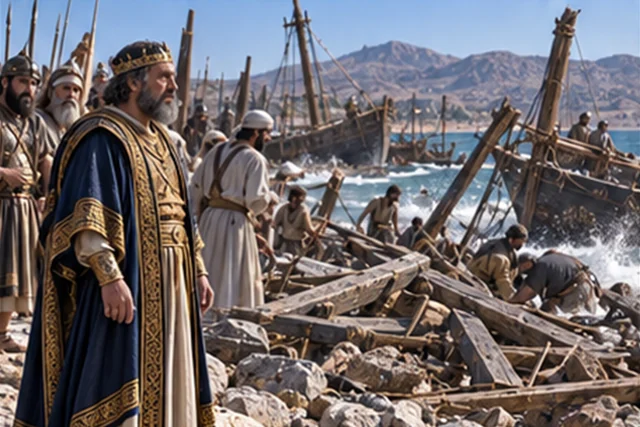
After the intensity of Ahab’s death, the chapter steps back and gives Jehoshaphat’s reign its own assessment rather than reducing him to the ally who stood beside Ahab at Ramoth-gilead. He follows Asa’s course and does what is right in the eyes of the LORD, while the high places remain and continue to be used. As with Asa, favorable judgment and unfinished reform are placed in the same sentence without contradiction. Peace with Israel is also remembered, marking a significant change from the recurring wars of earlier reigns. Jehoshaphat removes what remained of the sodomites from the land and undertakes a maritime project from Ezion-geber, hoping to reach Ophir for gold. The ships break before the voyage succeeds, and this chapter does not say why. Ahaziah later offers to join the venture, but Jehoshaphat refuses without a recorded explanation. His burial in David’s city and Jehoram’s succession close a reign broader than its most famous battlefield alliance.
Deep dive
The reign notice returns to Jehoshaphat’s accession and evaluates his course as a whole. He follows Asa in doing what is right, yet the high places remain in use. As in Asa’s own notice, the favorable judgment does not require the removal of every qualification. Peace with Israel also receives explicit mention, distinguishing this period from the earlier recurring wars between the two kingdoms.
The ships introduce a smaller echo of Solomon’s earlier reach. Jehoshaphat attempts a voyage to Ophir for gold from Eziongeber, but the ships break before they make the journey. The account states the failure without identifying its cause here. Ahaziah’s proposed participation is then refused; no full explanation of that refusal is given. The notice concerning Edom’s deputy rather than an independent king supplies regional context beside the maritime project, without detailing a treaty or naval arrangement. Jehoshaphat’s burial and Jehoram’s succession complete his reign before attention turns to Ahab’s successor.
Words to trace: Jehoshaphat, king, father, ships, Ahab, began
Verse-by-verse path
- 1 Kings 22:41
The account returns to Judah for the first time since Asa’s death in 15:24. Jehoshaphat’s accession is dated by Ahab’s reign, the synchronised reckoning that stitches the two kingdoms’ records together.
- 1 Kings 22:42
Thirty-five at accession and twenty-five years on the throne make sixty at his death. Judah’s kings have their mothers named because the queen mother held a recognised position at court; Azubah’s name means “forsaken”.
- 1 Kings 22:43
Hebrew Bibles split this verse in two, so from “nevertheless” onward their numbering runs one ahead of the English to the end of the chapter. The high places are the same exception made for Asa in 15:14.
- 1 Kings 22:44
Peace with Israel ended half a century of border war that ran through the reigns of Rehoboam, Abijam and Asa. The price came later: the marriage that sealed it brought Athaliah to Jerusalem, where she would try to destroy the royal line (2 Kings 11:1).
- 1 Kings 22:45
“His might that he shewed, and how he warred” points to more than is told here. Second Chronicles gives Jehoshaphat four chapters (17–20), including his judges in every city and a victory over Moab and Ammon won by singers.
- 1 Kings 22:46
The King James “sodomites” renders qadesh, a male functionary tied to shrine practice, not a man from Sodom. Rehoboam’s reign had them (14:24), Asa began removing them (15:12), and his son finishes the work.
- 1 Kings 22:47
Edom was under Judah’s control, governed by a deputy rather than its own king. That is why Jehoshaphat can build ships at Ezion-geber on Edomite ground. Under his son Edom revolts and makes a king of its own (2 Kings 8:20).
- 1 Kings 22:48
“Ships of Tharshish” names a class of large sea-going vessel, not necessarily a destination. Solomon’s fleet had sailed from the same port at the head of the Gulf of Aqaba to Ophir (9:26–28), so Jehoshaphat is trying to revive his great-great-grandfather’s trade.
- 1 Kings 22:49
Second Chronicles 20:35–37 records Jehoshaphat joining Ahaziah in building the fleet, and a prophet named Eliezer saying the ships broke for that reason. The refusal here makes most sense as coming after the wreck, a partnership he would not try twice.
- 1 Kings 22:50
His son is Jehoram, and Ahab’s second son, reigning in Samaria, is also Jehoram. For some years two kings with the same name, brothers-in-law by marriage, rule the two kingdoms at once.
1 Kings 22:41-50
King James Version41And Jehoshaphat the son of Asa began to reign over Judah in the fourth year of Ahab king of Israel.
42Jehoshaphat was thirty and five years old when he began to reign; and he reigned twenty and five years in Jerusalem. And his mother’s name was Azubah the daughter of Shilhi.
43And he walked in all the ways of Asa his father; he turned not aside from it, doing that which was right in the eyes of the LORD: nevertheless the high places were not taken away; for the people offered and burnt incense yet in the high places.
44And Jehoshaphat made peace with the king of Israel.
45Now the rest of the acts of Jehoshaphat, and his might that he shewed, and how he warred, are they not written in the book of the chronicles of the kings of Judah?
46And the remnant of the sodomites, which remained in the days of his father Asa, he took out of the land.
47There was then no king in Edom: a deputy was king.
48Jehoshaphat made ships of Tharshish to go to Ophir for gold: but they went not; for the ships were broken at Ezion-geber.
49Then said Ahaziah the son of Ahab unto Jehoshaphat, Let my servants go with thy servants in the ships. But Jehoshaphat would not.
50And Jehoshaphat slept with his fathers, and was buried with his fathers in the city of David his father: and Jehoram his son reigned in his stead.
1 Kings 22:51-53
A New King Continues the Old Allegiances
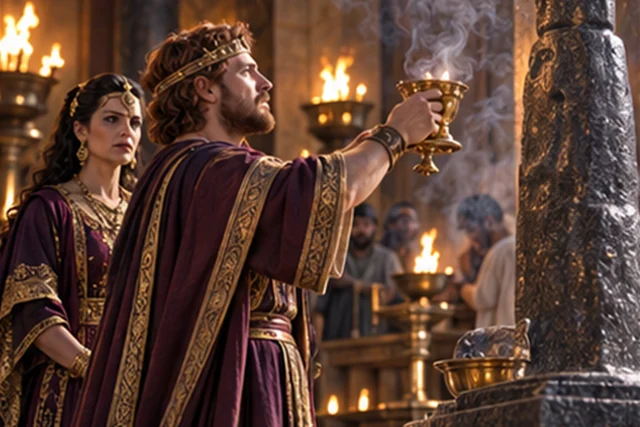
Ahaziah’s short accession notice gathers the northern kingdom’s accumulated religious inheritance into three lines. He walks in the way of his father, in the way of his mother, and in the way of Jeroboam, the earlier king who made Israel to sin. Those references keep two developments together that might otherwise be separated too neatly. The older northern breach associated with Jeroboam has not disappeared, and the later royal sponsorship of Baal under Ahab and Jezebel has not been absorbed into it. Ahaziah inherits both patterns and continues Baal worship in Samaria. That is where the Book of 1 Kings chooses to stop. Ahab is dead, but his dynasty has not yet received the full judgment announced against it. Elijah’s work is not finished, and Elisha has not yet taken his place. The final movement is therefore not resolution but succession: another king receives the throne while the kingdom’s established unfaithfulness continues with him.
Deep dive
Ahaziah’s assessment gathers several lines of influence into one short notice. He follows his father, his mother, and Jeroboam. The wording does not allow the newer royal sponsorship of Baal to hide the older northern pattern, or the older pattern to absorb everything distinctive about Ahab and Jezebel. Their legacies coexist in the worship continued by their son.
The Book of 1 Kings closes without resolving the judgment against Ahab’s house or ending Elijah’s ministry. The two-year reign has only been introduced, and the last recorded action is the service and worship of Baal. Ahab’s death fulfilled a prophetic warning, but it did not itself reform the kingdom. The opening of the book concerned who would succeed David; its ending again names a successor, now with the warning that inherited rule can carry inherited wrongdoing forward as readily as it carries a family name.
Words to trace: Israel, father, LORD, Ahab, Ahaziah, anger
Verse-by-verse path
- 1 Kings 22:51
The Hebrew had one book of Kings; the division into two came with the Greek translation, which is why a reign begins in the last verses of 1 Kings and ends in 2 Kings 1. His “two years” may mean little more than one, counted inclusively.
- 1 Kings 22:52
A king’s mother rarely appears in the verdict on his reign. Jezebel’s way is set beside Ahab’s and Jeroboam’s, three separate streams of sin now running through one young king.
- 1 Kings 22:53
The first book of Kings ends on Baal worship and the phrase “all that his father had done”. The second book opens with this same Ahaziah sending to ask a Philistine Baal whether he will recover.
1 Kings 22:51-53
King James Version51Ahaziah the son of Ahab began to reign over Israel in Samaria the seventeenth year of Jehoshaphat king of Judah, and reigned two years over Israel.
52And he did evil in the sight of the LORD, and walked in the way of his father, and in the way of his mother, and in the way of Jeroboam the son of Nebat, who made Israel to sin:
53For he served Baal, and worshipped him, and provoked to anger the LORD God of Israel, according to all that his father had done.
Questions to keep in mind while reading
- Track who acts, who speaks, who is affected, and what changes.
- Notice repeated promises, failures, rescues, and consequences.
- Do not assume the account approves every action that is reported.
Text first
Where readers differ
The chapter summary begins with what the passage says and how its parts fit together. It does not assume one denomination has already settled every question. Where a conclusion depends on a tradition, literary theory, or historical reconstruction, that dependence is named openly.
The KJV text is presented first. Interpretive conclusions are labeled, and differences are introduced only when they help a reader understand why serious communities do not always reach the same answer.
Comparative interpretive notes for this chapter are in preparation. Until reviewed notes are ready, this page separates the KJV text from summary and application without claiming that serious readers agree on every question.
Questions beneath the surface
- What account of God, human freedom, responsibility, and the good life emerges from 1 Kings 22?
- Which tension does the chapter refuse to resolve quickly?
- What changes when the chapter is read as part of the whole canon rather than as an isolated moral lesson?
- Where might a sincere reader confuse a familiar tradition with something the text states directly?
Questions for serious personal contemplation
These open-ended questions make room for tension, honest response, prayer, and conclusions that remain accountable to the chapter.
Observe without rushing
What part of 1 Kings 22 makes you stop, feel unsettled, or feel surprised, and why?
Which detail in the passage would be easiest to overlook? How does that detail change your understanding?
Where do you see tension between what happens and this focus: Micaiah standing alone before the kings and Ahab entering battle in disguise before his death?
What important question does the passage leave open instead of resolving quickly?
Examine your inner life honestly
Which person, response, fear, or desire in the passage feels most like your own life right now?
What assumption about God, other people, or yourself does this text challenge?
Which part would you rather soften, avoid, or explain away too quickly? What might that reaction reveal?
If this Scripture could ask you one direct question, what do you think it would ask?
Respond with wisdom and courage
What do you need to remember, confess, grieve, thank God for, or trust after reading this passage?
How might another faithful person read this situation differently without ignoring the text?
What obedient response would be costly, uncomfortable, or slow, yet still faithful to Scripture?
What question will you carry into prayer this week, and which verses will you keep in front of you?
Music and video connected to the passage
Related media appears when its Scripture reference overlaps this study. Music and video can illuminate a theme while the biblical text remains the foundation.