The big picture
Samuel's death removes a major figure of guidance, and the Book of 1 Samuel immediately turns to a crisis in which David himself must be stopped. Nabal has wealth, a prosperous shearing season, and a harsh answer for men who protected his shepherds. David answers insult with four hundred swords and an oath to destroy every male in the household. Abigail sees the disaster from both sides. She gathers provisions, rides out without waiting for Nabal's consent, and gives David an argument larger than wounded honour: the man expected to rule Israel should not reach that future carrying blood shed without cause or vengeance taken with his own hand. David listens. He blesses the LORD for sending her, blesses her judgment, and admits she has kept him from evil. Nabal later dies after the LORD strikes him, allowing David to see his grievance answered without committing the massacre he had planned. The chapter ends with Abigail becoming David's wife, while Ahinoam is also named and Michal has been given away, leaving the royal household already complicated by new bonds and broken ones.
Central truth
Abigail's timely provisions and appeal to David's future responsibility restrain his intended bloodshed, and David thanks the Lord for sending the woman whose counsel stops him.
The study notes have a page of their own
The movement by movement analysis, the words to trace, the verse by verse notes and where readers differ are written for someone studying alone. They are on the Deep Personal Reflections page for this chapter. This page is the lesson.
A chapter-specific teaching brief
These anchors come from this chapter itself. They help a teacher use the Level 1 overview, the Level 2 study, and the Scripture text as one lesson.
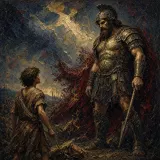
Open with the chapter’s first image
1 Samuel 25:1: “And Samuel died; and all the Israelites were gathered together, and lamented him, and buried him in his house at Ramah. And David arose, and went down to…”
Slow down at the turning point
1 Samuel 25:21: “Now David had said, Surely in vain have I kept all that this fellow hath in the wilderness, so that nothing was missed of all that pertained unto him: and…”
Keep this word trail visible
LORD, David, Nabal, Abigail, young, handmaid
What to explain, in order
Teach the passage in this order. Each step names the verses it rests on, so every point can be shown in the text before it is applied.
1 Samuel 25:1-8
Samuel's death and a shearing feast
Begin with the short note of Samuel's death and Israel's mourning (25:1). The prophet who anointed David is gone, and the chapter that follows tests whether David will act like Saul. Then introduce Nabal and Abigail with the text's own contrast: she is "of good understanding", he is "churlish and evil in his doings" (25:3). Explain "churlish" as harsh and surly. Sheep-shearing was a festival of plenty. David's request in 25:6-8 is courteous and grounded in protection given. Teach this first so the class sees the request as reasonable.
1 Samuel 25:9-13
Who is David?
Read Nabal's reply aloud. He pretends not to know David, calls him a runaway servant, and refuses with a string of "my": my bread, my water, my flesh. Explain "railed on them" as abused them with words. Then David's response, one short command and four hundred swords: "Gird ye on every man his sword." Point out the contrast with chapter 24, where he would not touch Saul. Teach this step so learners feel how fast an insult can push even a good man toward violence.
1 Samuel 25:14-22
A servant's report and Abigail's haste
A young man goes to Abigail, not Nabal, because "he is such a son of Belial, that a man cannot speak to him" (25:17). He confirms David's protection. Abigail acts at once, loads provisions, and sets out without telling Nabal. The scene cuts to David, muttering his vow of vengeance. Explain "requited me evil for good" as repaid kindness with harm. Teach this step to show wisdom moving quickly and quietly, and to make clear what David intends before Abigail meets him.
1 Samuel 25:23-31
Abigail's plea
Read Abigail's speech slowly; it is one of the longest speeches in the book. She bows, takes the blame upon herself, and names Nabal's folly, explaining that "Nabal" means fool. She credits the LORD with having "withholden thee from coming to shed blood". She presents her gift, speaks of David's "sure house" and of the LORD's battles, and uses two images in 25:29: the soul "bound in the bundle of life" with God, and enemies slung out "as out of the middle of a sling". Explain both. Many readers hear an echo of Goliath; the text does not name him.
1 Samuel 25:32-35
Blessed be thy advice
David's response is as important as her speech. He blesses the LORD for sending her, blesses her advice, and blesses her. He admits that without her he would have killed every male in Nabal's household. He accepts the gift and says, "I have hearkened to thy voice, and have accepted thy person." Teach this step as a model of receiving correction: David names the wrong he intended, thanks God and the person who stopped him, and changes course at once. That is harder than anything Abigail did.
1 Samuel 25:36-44
Nabal's end and Abigail's marriage
Abigail waits until morning, then tells Nabal. His heart "died within him", and ten days later "the LORD smote Nabal, that he died" (25:38). Do not give a modern diagnosis. David blesses the LORD for avenging him and keeping him from evil. Then David sends for Abigail, who becomes his wife, and the text notes Ahinoam and that Saul gave Michal to another man. Report the marriages as the text does, without making them an instruction or a romance. Teach this last because it shows the LORD judging Nabal without David's sword.
Where learners get stuck
The misreadings this passage tends to produce, and how to answer each from the text.
"David had every right to be angry, so his plan was justified."
David's grievance was real: his men had protected Nabal's flocks (25:15-16) and Nabal insulted him. But his plan was to kill every male in the household (25:22), including servants who had nothing to do with it. David himself later calls it coming "to shed blood" and "avenging myself with mine own hand" (25:33), and blesses God for stopping him. Teach learners that a real wrong does not justify any response, and that anger needs a voice like Abigail's.
"Abigail was disloyal to her husband by going behind his back."
Abigail acted to save her whole household, including Nabal, from slaughter (25:17, 34). The servant came to her because Nabal could not be spoken to. She takes the blame on herself, does not plot against Nabal, and tells him the truth when he is sober (25:37). The text calls her "a woman of good understanding" (25:3). Teach that wisdom can mean acting to prevent harm when someone in authority will not, and be careful with learners in difficult marriages; this is not a rule for every situation.
"God struck Nabal dead, so God kills people who are rude to his servants."
The text says "the LORD smote Nabal, that he died" (25:38), and David sees it as the LORD returning "the wickedness of Nabal upon his own head" (25:39). Nabal was "evil in his doings" (25:3), not merely rude once. The point of the chapter is that the LORD judged Nabal so that David did not have to take vengeance. Do not teach that God will strike down everyone who insults us; teach that we leave vengeance to him, as Romans 12:19 says.
"Abigail's speech was just flattery to save her own skin."
She speaks of the LORD again and again in her plea, of David's calling, and of the grief David would carry if he shed blood without cause (25:26-31). David himself credits God with sending her and calls her words "advice" (25:32-33). Her humility is real courtesy in her setting, not manipulation. Teach that wise speech can be respectful and humble and still bring hard truth, and that her concern reaches beyond herself to David's future.
Learning objectives
- Contrast Nabal's response with the servant's report about David's men.
- Identify how far David's planned retaliation exceeds the insult.
- Trace Abigail's preparation, approach, and central appeal.
- Explain why Abigail asks David to consider his future conscience.
- Identify whom David blesses after accepting her counsel.
- Distinguish the reported marriages from a command to imitate them.
Teacher preparation
- Read 24:12 and 25:21–22 together; prepare the startling contrast between David's earlier restraint and present revenge.
- Explain 'churlish' as harsh or surly, and 'railed' as abusive speech, in 25:3, 14.
- Explain that sheep-shearing supplies the occasion for the feast and request; do not invent a contract guaranteeing payment.
- Prepare the 'bundle of life' and sling imagery in 25:29 as Abigail's language of protection and judgment.
- Handle threatened killing, Nabal's death, and the marriages without gore, medical diagnosis, or romantic formulas.
Evidence and interpretation checks
Explicit
Read 25:32–35: David blesses the Lord, Abigail's advice, and Abigail herself, and explicitly acknowledges that she has prevented bloodshed and personal revenge.
Scripture-supported
Compare 25:15–16 with 25:21: the servant independently confirms the protection David says his men provided.
Strong inference
Infer from 25:30–31 that Abigail connects David's future leadership with a conscience unburdened by this intended killing; she asks him to look beyond today's insult.
Possible or traditional reading
Treat the sling image in 25:29 as possibly recalling David's familiar victory in chapter 17; the wording does not explicitly name Goliath.
Limit
State that 25:37–38 does not supply a modern diagnosis for Nabal, and 25:39–44 reports marriages without making polygamy an instruction or ideal.
Discussion with answer guidance
1. What does the servant know that Nabal's reply leaves out?
What a good answer contains
That David's men protected Nabal's shepherds. Nabal sneers, "Who is David? and who is the son of Jesse? there be many servants now a days that break away every man from his master" (25:10). But the young man tells Abigail, "the men were very good unto us, and we were not hurt, neither missed we any thing" and "They were a wall unto us both by night and day" (25:15-16). A good answer sees the servant as an independent witness confirming David's claim in 25:7. A weak answer accepts Nabal's version, or misses that his insult also denies a real debt of kindness.
Show teacher guidance
Compare 25:10–11 with 25:14–16: David's men protected the shepherds and took nothing. Nabal's account of worthless runaways is not the passage's final assessment.
2. How many people does David intend to punish for Nabal's insult?
What a good answer contains
Every male in Nabal's household, not only Nabal. David says, "Surely in vain have I kept all that this fellow hath in the wilderness", and "he hath requited me evil for good" (25:21), and swears to leave none of his males alive by morning (25:22). The servant had warned, "evil is determined against our master, and against all his household" (25:17). A good answer sees how far beyond the insult David's anger runs, and that innocent people would die. A weak answer makes David justified because Nabal was rude, or describes the threat in graphic terms.
Show teacher guidance
Read 25:21–22: the threat extends to the household's males, not simply Nabal. Keep the disproportion visible without graphic elaboration.
3. What does Abigail do before delivering her speech?
What a good answer contains
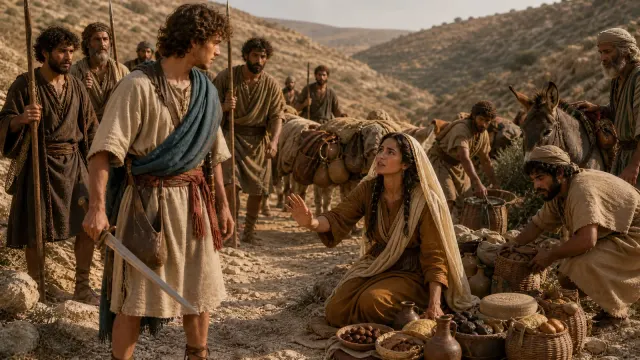
She acts quickly and generously. "Abigail made haste, and took two hundred loaves, and two bottles of wine, and five sheep ready dressed, and five measures of parched corn, and an hundred clusters of raisins, and two hundred cakes of figs, and laid them on asses" (25:18). She sends servants ahead, rides out herself, and when she sees David "she hasted, and lighted off the ass, and fell before David on her face" (25:23). A good answer sees wisdom that arrives with food and humility before it arrives with words. A weak answer jumps straight to her speech.
Show teacher guidance
Identify provisions, haste, messengers, and personal approach in 25:18–23; wisdom here arrives with bread, not merely an excellent argument.
4. Why does Abigail speak about David's future rule and grief of heart?
What a good answer contains
Because she wants him to look past today's insult to the future God has promised. She says "the LORD will certainly make my lord a sure house" (25:28), and that when he is "ruler over Israel" this "shall be no grief unto thee, nor offence of heart unto my lord, either that thou hast shed blood causeless, or that my lord hath avenged himself" (25:30-31). A good answer sees her appeal to his calling and his conscience. A weak answer dismisses it as flattery or misses that she is protecting David from himself as much as her household from David.
Show teacher guidance
Use 25:28–31: she warns against carrying unnecessary bloodshed and self-avenging into the future. Do not reduce the appeal to flattery.
5. How does David respond when someone interrupts his determination?
What a good answer contains
He blesses God, her advice and her. "Blessed be the LORD God of Israel, which sent thee this day to meet me: And blessed be thy advice, and blessed be thou, which hast kept me this day from coming to shed blood, and from avenging myself with mine own hand" (25:32-33). He accepts her gifts and sends her home in peace (25:35). A good answer sees David receiving correction as God's deliverance, from a woman, while armed and angry. A weak answer treats it as David being talked down, or as a loss of honour.
Show teacher guidance
Read 25:32–35: he names God's intervention, credits her counsel, accepts the provisions, and stops. Correction becomes deliverance, not an insult to his authority.
6. Why does Abigail wait before telling Nabal what happened?
What a good answer contains
Because he is drunk. Nabal is holding "a feast in his house, like the feast of a king" and "was very drunken: wherefore she told him nothing, less or more, until the morning light" (25:36). Then "when the wine was gone out of Nabal", she tells him, and "his heart died within him, and he became as a stone" (25:37). A good answer sees wise timing. It should not become a rule that someone in an unsafe marriage must confront a dangerous spouse alone; Abigail's setting is particular. A weak answer misses the timing entirely.
Show teacher guidance
Read 25:36–37: Nabal is drunk. Distinguish Abigail's timing from a rule requiring unsafe spouses to confront alone.
Responsible application
Heart and habits
Give a fictional character an insult and an excessive response; ask what Abigail's future-facing question would expose before action becomes irreversible.
Relationships and community
Examine how a group can receive timely correction without humiliating the person who raises it; use David's explicit gratitude as the starting point.
Wise intervention
Identify practical support, credible information, and proportionate speech in Abigail's response; do not turn her dangerous encounter into compulsory crisis mediation for learners.
Session plans
Two timings of the same lesson. The shorter keeps the reading, the central discussion and one response; the longer gives the confusions and the application their own time.
45 minutes
Samuel dies
Read 25:1-3. Explain "churlish" and introduce Abigail and Nabal.
Who is David?
Read 25:4-13. Ask question one.
The plan for revenge
Read 25:14-22 without reading 25:22 aloud. Take questions two and three and confusion one.
Abigail's plea
Read 25:23-31. Ask question four and use confusion four.
Blessed be thy advice
Read 25:32-38. Take questions five and six and confusions two and three.
Handout
Read the key verse together and give out the handout. Pray for wise words and willing ears.
90 minutes
Insults
Ask how people usually respond when they are insulted after doing good. Note answers, then read 25:1-3.
A fair request and a rude reply
Read 25:4-13. Take question one and compare David's request with Nabal's answer.
The servant and Abigail
Read 25:14-22. Take questions two and three and confusion one.
Abigail's speech
Read 25:23-31. Take question four and confusion four. Explain the bundle of life and the sling.
David hears
Read 25:32-35. Take question five and discuss what it costs to receive correction.
Nabal's end
Read 25:36-44. Take question six and confusions two and three. Report the marriages plainly.
Application
Use the lesson plan's application on restraint. In pairs, describe a fictional conflict and how someone like Abigail could step in.
Handout and prayer
Read the key verse together, point to the take-home line, and pray.
Adapting the lesson
Children
Tell how David was angry and wanted to hurt Nabal's family, and how Abigail loaded donkeys with bread, raisins and figs and rode out to stop him. Bring some raisins or figs to share. Let a child play Abigail kneeling and asking David not to do something he would be sorry for. Leave out Nabal's death or say simply that he died. Teach that it is good to listen when someone tells us to calm down.
Youth
Ask how fast an insult online can turn into a fight. Read 25:10-13 and then 25:21-22 described in plain words. Spend time on Abigail's plea and on David's response in 25:32-33: blessing the person who stopped him. Ask who could be an Abigail for them, and whom they could be one for. Avoid romanticising the marriage at the end.
Adults
Discuss anger and vengeance, the wisdom of Abigail's speech and timing, and David's humility in receiving correction. Treat the household situation with care: some adults live with harsh or drinking spouses. Make clear that Abigail's actions are not a rule that someone must confront an unsafe person alone, and point to help where needed. Note the polygamy in 25:43 as reported, not commended.
One to one
Read 25:21-35 together and ask whether they are angry at someone right now. Let Abigail's question about grief and offence of heart in 25:31 be asked of them gently: what would they regret? If they live with someone like Nabal, listen carefully, take their safety seriously, and help them find support rather than pressing them to act like Abigail.
Song and video learning lab
A song or video may interpret, compress, or dramatize the text. Its value becomes clearer when its choices are compared with Scripture.
- Before the media: the exact passage and its central movement.
- During the media: the words, people, events, and emotions the artist emphasizes.
- After the media: what it clarifies, what it leaves out, and what belongs back in the biblical text.
Handout
One page for learners to take home. The print button prints this section alone.
1 Samuel 25:1–44
The passage in brief
After Samuel dies, David asks a rich man named Nabal for food, because David's men had protected Nabal's shepherds. Nabal insults David and refuses. David arms four hundred men to kill every male in Nabal's household. Nabal's wise wife Abigail quickly loads donkeys with food, rides out to meet David, and begs him not to shed blood and avenge himself. David blesses God for sending her and turns back. When Nabal hears what happened, he is struck down and dies ten days later, and David marries Abigail.
A verse to keep
And David said to Abigail, Blessed be the LORD God of Israel, which sent thee this day to meet me: And blessed be thy advice, and blessed be thou, which hast kept me this day from coming to shed blood, and from avenging myself with mine own hand.
1 Samuel 25:32-33 · King James Version
Questions to take home
What did Nabal's servant say about David's men (25:15-16)?
What did Abigail ask David not to do, and why (25:26-31)?
How did David respond to Abigail (25:32-35)?
This week
The next time someone warns you not to do something in anger, stop, listen, and thank them.
Music and video connected to the passage
Related media appears when its Scripture reference overlaps this study. Music and video can illuminate a theme while the biblical text remains the foundation.